
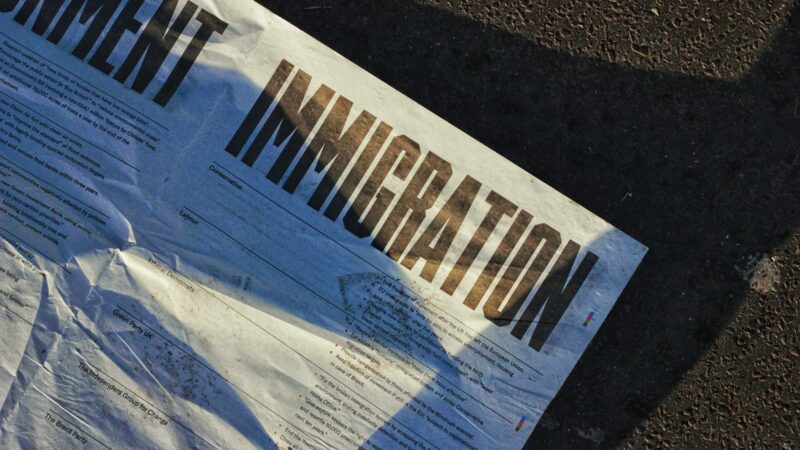
Open Borders Rely on Political Irrationality
All too often, open-border policy stems from the fact that politics is determined by a class of people with deep-seated illusions about the facts surrounding immigration. Sweden is an ideal example of this pattern. Of all the countries in Europe, Sweden is especially notorious for having welcomed large numbers of refugees it could not properly integrate. In 2015, notes columnist James Traub, the country absorbed 163,000 of them. It has not gone well. Skyrocketing crime rates, mass unemployment among immigrants, and heavy strain on the welfare state have made Swedes weary of incoming foreigners. As a result, writes Traub, even Sweden’s Social Democrats have embraced ‘harsh language’ which used to be monopolised by ‘far-right nativists.’
This year’s November issue of the academic journal Kyklos includes the article Misrepresentation and migration, which explores the causes of that initial Swedish openness to migrants. Authors Anders Kärnä and Patrik Öhberg note that the extreme permissiveness with which migrants were let into the country ran radically counter to the will of the Swedish electorate. Voters’ dissatisfaction brought a right-wing government to power in 2022 and fueled the rise of the hard-right Sweden Democrats. Backlash was so strong that in 2015 the country’s prime minister was forced to make a U-turn and advocate for tougher restrictions after pushing for open borders earlier that year.
So why did the political class initially defy popular opinion to welcome hundreds of thousands of foreigners? Kärnä and Öhberg argue that Swedish politicians held far different views on the subject than their constituents. Polling coducted over the years shows that in every major party other than the Sweden Democrats, politicians were significantly less likely than their constituents to favour accepting fewer refugees until 2018. The authors conclude that pushback from the voting public, including through the emergence of the Sweden Democrats as a political competitor, eventually drove elected officials in other parties to revise their positions. Nevertheless, politicians from two of the three left-wing parties continued to be somewhat more pro-refugee than their constituents in 2018, the last year for which numbers are provided.
Contrary to what one might assume, the disagreement between politicians and voters did not occur because the politicians were better informed than the common people. On the contrary, they were deeply mistaken about the effects of their policies. The authors cite survey data from 2015 and 2017, showing that most Swedish politicians thought the economic impact of accepting refugees was ‘positive in the long run.’ However, they demonstrate that this belief is contradicted by all available peer-reviewed journal articles and by all the expert analyses of the issue which have appeared in official reports by the Swedish government. The existing studies indicated, and still indicate, that refugees are harmful rather than beneficial to Swedish economic performance. In other words, the idea that refugees were good for the economy was a piety which the political class held against all evidence.
Sweden’s experience is not unique. The immigration debate in the United States has also been marked by false ideas which politicians continue to hold despite overwhelming evidence against them. As Steven Camarota of the Center for Immigration Studies has observed, the notion that immigration can remedy ‘the aging of American society’ continues to be unquestioningly advanced by advocates of open borders even though it is blatantly inconsistent with the facts. The increasing average age of immigrants, their decreasing fertility rates, and the sheer size of the influx which would be required to offset American demographic woes make such a project impracticable.
Kärnä and Öhberg’s paper considers the irrationality of unfettered immigration only from an economic standpoint, but it is harmful in other ways as well. In addition to economic consequences, accepting countless immigrants whose values are incompatible with those of the host society creates sociopolitical problems with no obvious solution.
One such issue is organised crime. The Financial Times reports that, relative to population size, Sweden suffers from the third-highest rate of gun deaths of any EU country. A major cause of this epidemic is ‘[w]ell-established criminal gangs’ which are ‘largely run by second-generation immigrants.’ Sweden’s prime minister has identified ‘irresponsible immigration policy and failed integration’ as the root of the epidemic. Meanwhile, as France 24 details, the Swedish government is currently considering options which would let it deport ‘asylum-seekers and immigrants for substance abuse, association with criminal groups or statements threatening Swedish values.’
The political repercussions of large-scale immigration are also severe, and the presence of people who do not share Western values presents a serious threat. For instance, Sweden’s left-wing parties have dithered in their condemnation of Hamas’s terrorist attack against Israel. ‘If you assume,’ explains journalist Richard Orange, ‘that the 200,000, or perhaps even as many as 250,000, Arabic speakers [in Sweden] are broadly pro-Palestinian, that’s an important voter base.’
Dominik Tarczyński, a Member of the European Parliament from Poland, eloquently addressed the sociopolitical implications of immigration in a September speech. He pointed out that despite receiving no large-scale immigration, Poland was prospering economically, and said the Polish people did not want more migrants. ‘You know why? Because there are zero terrorist attacks in Poland,’ he explained, citing EU statistics.
Europol’s data on terrorism do indeed bear out Tarczyński’s claim. The agency’s Terrorism Situation and Trend Report for 2023 provides a map of the EU showing how many terrorist attacks and ‘arrests on suspicion of terrorism’ each country experienced in 2022. Poland was among the handful of states where none of either occurred. France was arguably the country most affected, with six attacks and 109 arrests, though Italy suffered twelve attacks and carried out 45 arrests. Notably, jihadist terrorism prompted far more arrests than any other kind of terrorism from 2020 to 2022, although leftist and anarchist terrorism accounted for a few more attacks – 44 versus 30. Sweden experienced an attack during this period. Poland did not.
The migrants’ cultural background is the key issue, more so than immigration itself. On another occasion, Tarczyński told leftist televison host Cathy Newman: ‘We took over two million Ukrainians, who are working, who are peaceful in Poland. We will not receive even one Muslim.’ This, he emphasized, was the will of the Polish electorate. If Tarczyński is representative – and he is – then Poland’s immigration policy is based on a realistic understanding of the effects of mass migration as well as on respect for the will of the people. As Kärnä and Öhberg show, both of these considerations failed to inform Swedish immigration policy for most of the 2000s and 2010s, and it is dubious whether they have enough of an impact even today.
Tarczyński’s motto is ‘Be like Poland.’ Swedish politicians should take that advice to heart. To judge by experience, however, it will fall to Sweden’s voters to make them do so.
In Brussels, the Eurocrats are increasingly out of control
Earlier last month, it was announced that the European Commission wants to double the budget of the EU for North African countries to no less than 42 billion euros. It thereby also wants to extend the Erasmus programme for student exchanges to that region. One does not need to be a migration expert to understand that this will only exacerbate the current major migration challenges, and that public opinion may not be fully on board with this, to put it mildly. Things are really going from bad to worse with the European Commission, which is led by Ursula von der Leyen. Despite great unease with green policies and migration policies, and some minor adjustments, her EU Commission is trying to continue with business as usual.
In October, von der Leyen survived two votes in the European Parliament to topple her. Notable was how the French centre-right Les Républicains, which are part of the centrist European People’s Party (EPP), supported the motion of Marine Le Pen’s National Rally’s EP group to oust von der Leyen. Also, there is grumbling among the centre-left. German SPD MEP René Repasi even warned von der Leyen that she has six months to deliver on the promises she made to his centre-left group, or it could put forward its own censure motion.
Then, it would be wrong to expect the European Parliament to really show their teeth. One diplomat confided to Politico nobody needs to worry about an overly powerful European Parliament, stating: “I don’t believe in this new Parliament, sorry. (…) They can threaten, but when a leader picks up the phone, they always fall in line.” One example of that is how the socialist group recently went along with von der Leyen’s omnibus bill, a modest exercise in EU regulatory simplification, after Spanish PM Pedro Sanchez intervened.
A Hungarian scandal?
Developments within the European Commission may affect its stability more than whatever happens in the European Parliament. First, there has been Pfizergate, whereby the European Court of Justice ruled that the European Commission violated transparency rules by failing to grant access to text messages between Ursula von der Leyen and the CEO of pharma giant Pfizer.
Secondly, there are now also allegations that the Hungarian government would have deployed intelligence officers to Brussels to gather information on EU institutions and to recruit an EU official. According to a number of media, Hungarian intelligence officers disguised as diplomats would have attempted to infiltrate EU institutions during the period when the current Hungarian European Commissioner, Olivér Várhelyi, served as Hungary’s ambassador to the EU.
Várhelyi has reportedly told President Ursula von der Leyen he was “not aware” of the alleged spying activities. Her spokesperson told media afterwards that “the president is pleased to have sat down with the Commissioner on this issue and the working group will continue its work on the subject.” In other words: von der Leyen is absolutely not keen to escalate this, and also other European governments will prefer not to engage into a direct diplomatic clash, if everything would be proven.
As I have been writing before, if it is serious about fighting cronyism, the EU should cut its EU transfers for all Member States, given how easy it is to otherwise accuse the EU of “double standards”. Stories about cronyism and executive control of the judiciary have been popping up all across other Central and Eastern European countries, like Poland, the Czech Republic, Romania and Bulgaria. Obviously, similar problems have been evident in the old EU member states as well, not to mention Italy. In 2021, Professor Vince Musacchio, a renowned anti-corruption expert from the Rutgers Institute on Anti-Corruption Studies, has warned that between 2015 and 2020, the EU has allocated around €70bn to Italy in structural & investment funds. Half of these funds ended up in the hands of organised crime.”
Then to see EU Commissioner Olivér Várhelyi stepping down would perhaps not be the saddest of outcomes. He is responsible for health policy but has been telling MEPs that “new tobacco and nicotine products pose health risks comparable to traditional ones.” This is simply unscientific to the core and should disqualify him from this position. Channelling his inner nannycrat, Várhelyi has also been pushing for a taxation system on products high in sugar, fat, and salt to help finance public health during a meeting with the European Parliament’s health committee, thereby arguing some of those receipts should go to the EU budget. So much for the idea of “Orban’s man” standing up against Brussels.
American pressure
While internal European Commission trouble or pressure from the European Parliament may not change much, there is still the matter of US President Donald Trump.
So far, he has already forced the EU to abandon its plans for a digital tax, while the US has also obtained concessions regarding the EU’s planned climate tariff, CBAM, prompting countries such as South Africa to demand equal treatment. The new tariff is likely to deal a severe blow to African economies. South Africa’s Presidential Climate Commission estimates that CBAM would reduce African exports to the EU by 30-35% by 2030, representing a value of €1.7 to €2.1 billion.
Despite the trade agreement reached between the EU and the US this summer, Trump has threatened new tariffs on the EU in response to the €2.95 billion fine imposed on Google. He warned: “We cannot let this happen to brilliant and unprecedented American Ingenuity and, if it does, I will be forced to start a Section 301 proceeding to nullify the unfair penalties being charged to these Taxpaying American Companies.”
The Trump administration also continues to challenge the EU’s new digital rules – the Digital Services Act and the Digital Markets Act – which it calls ‘Orwellian’. In doing so, it accuses the EU of censorship. Apparently, the US is even considering sanctions in the form of visa restrictions against EU officials in connection with the DSA.
Equally strong is the Trump administration’s opposition to the EU’s green regulations adopted during Von der Leyen’s first term, the era of the ‘green deal’. It has for example been objecting to the upcoming EU anti-deforestation directive, which was in fact already challenged by the Biden administration. These new EU rules ban the import of goods if producers fail to prove that no forests were felled in their production. In September, the European Commission proposed to delay the implementation of the directive a second time, until 2027 instead of 2026, blaming an IT system issue. Not long after, it once again changed the timing of the delay, adding confusion for everyone.
According to one member state source, the Commission’s concessions may be due to US pressure, and unrelated to the closure of the EU-Indonesia trade deal, as others have alleged. Trading partners like Indonesia and Malaysia are large exporters of palm oil and thereby heavily affected by the new bureaucratic burdens that EUDR would impose. Malaysia considers it unfair that its imports are classified as “standard risk”, as opposed to the US classification of “low risk”, given that deforestation there has improved significantly, with NGOs recognising a reduction of 13 per cent last year. Just as South Africa complaints about US privileges in the context of CBAM, also here, the new two-tier system for trading partners is under fire. In this way, Trump does not only affect EU regulation, but also the EU’s trade relationship with the rest of the world.
Not only did the Trump administration manage to get a de facto opt-out from the EU’s bureaucratic new deforestation rules, it is pushing for more. With Qatar, the U.S. has been urged the European Union to scale back the EU’s corporate sustainability directive CSDDD – the EU tends to love Communist-sounding acronyms. Thereby, both have threatened that the rules risked disrupting liquefied natural gas trade with Europe.
Suicidal energy policies
Despite the ongoing developments, the EU Commission’s 2026 work programme for 2026 appears to offer “business as usual”, without major changes to EU policy, apart from a “simplification” exercise that leaves major EU measure that burden competitiveness, like its ETS climate taxation, most “green deal” regulations, the AI Act or GDPR untouched. The centre-right EPP is likely to get some concessions on the new 2040 climate target the EU Commission has been pushing forward, but the question in the first place is whether there should be yet another climate target at all.
Simplification is good, but it is not enough. The EU’s climate taxation scheme ETS should be abolished, so to drastically cut the price of energy for European industry. At the moment, this tax is almost twice as high as the total US natural gas price, which in itself is only about one fifth of the natural gas price in Europe. Major chemical company INEOS is now advocating scrapping carbon taxation, but it remains a political taboo, despite the fact that the US, which does not have such a tax system, has managed to reduce CO2 emissions per capita relatively more than the EU since 2005.
The situation is urgent. Europe’s chemical industry, which is the bedrock of all other industry, has been scrapping lots of investment and jobs this year.
On the contrary, the European Commission is however pushing hard to simply continue with its plans to expand the EU’s ETS climate tax. This “ETS2” scheme is estimated to cost families up to 650 euros extra per year in terms of extra costs for fuel and heating. The institution seems completely tone-deaf to reality.
Photo Credit.