While boomers indulge themselves in the same 2016 talking points on GB News for the 68th time this week, it seems like young conservatives are tired of it. The right wing of Generation Z have been raised on “Ben Shapiro DESTROYS Liberal Student” compilations. Meanwhile, while the conservative young people have moved on, the “triggered leftist” has moved on from university and into our civil service or primary schools, increasing their influence in society. And as much as we’d like to move on from cringe culture war issues, it seems like they’re not going anywhere. If we don’t confront them effectively then the left will continue to infect our institutions.
The left call the right “racist, sexist, homophobic, bigoted!” Each adjective enough to make the average wet Tory squeal apologetically and disregard the history of the party that has been told through a left wing narrative. Instead of giving the conservative argument for why an actual Conservative politician has done something, they say “yes, I know that was bad but what about this…” and then proceed to state a left wing policy pushed by a so called “right winger”.
And what do the right call the left to match their accusations of bigotry?
“Snowflakes”
It doesn’t quite have the same effect, does it?
The problem with the right is that they’re missing their own vocabulary. We don’t have the same words that appeal to the general public’s emotion as the left do. They say that we hate the poor and minorities. They say we want poor kids to starve. They say that we’re selfish. Of course, we know that’s not true. We want to see our country and community thrive.
However, unlike the left, we haven’t had mainstream institutions providing us with arguments to make. The right of Gen Z can’t have their social media pages flooded with aesthetic infographics simplifying radical Marxist rhetoric into simple slogans like the left do because there aren’t many conservative equivalents. Go onto #BorisJohnson and you’ll just see posts on how corrupt the Tories are and how Boris is a blubbering fool. Browse #KeirStarmer and you’ll see posts on Labour victories and how they’re crushing the Tories.
The Conservative Party doesn’t help with the government wasting their majority by not pushing any actual conservative policies and instead needlessly pander towards the left while they butcher the name of actual conservatives like Thatcher and Churchill to justify it. Even within the general party, a concerning number of Young Conservatives are pro-BLM and believe that a biological man in a dress is a woman. These people either have no backbone or are careerists who won’t join the Liberal Democrats because they’re irrelevant. Either way, kick them out.
Then you have the Young Conservatives who like a few Thatcher quotes and believe in general conservative principles like “free enterprise” and “equal opportunity” (which, let’s be honest, are more liberal principles). However, you can’t blame them too harshly considering that it’s much harder to discover right wing philosophy and history in comparison to that of the left. Ask an A Level Politics teacher for book recommendations and they’ll probably recommend Karl Marx’s The Communist Manifesto or Owen Jones’ Chavs. Similarly, go into Waterstones and the politics section catering ranges from septum piercing Sociology students to Keynesian #FBPE Britpoppers. Maybe you’ll find Douglas Murray’s Madness of the crowd between all the prison abolitionist and Europhile literature if you’re lucky.
However, since this generation of Young Conservatives have to go out their way to find the charm of Peter Hitchens or Roger Scruton, is it any wonder they resort to cheap arguments that the reason the left is so bad is that they’re too “progressive”?
The problem with Black Lives Matter isn’t that the activists are too sensitive. It’s that they’re promoting divisive, radical racial politics and harming people and property as a means of doing so. We shouldn’t have to say “but if the right did that then we would never hear the end of it”, we need to control the narrative. After months of destroying cities, causing damage and ruining lives, it’s ridiculous that January 6th is the focus of political extremism in the US.
After the death of George Floyd, the mainstream narrative needed a problem and a solution. They decided the problem was racism and police brutality and that the solution was police abolition and divisive critical race theory. They used it as an opportunity to sneak in other themes such as Marxism and collectivism while silencing anyone who disagreed with their dogma as “racist”. The average person who didn’t care too much about politics will just carelessly accept this narrative in order to fit in when their friends and co-workers discuss it at work.
The right could’ve offered their own solutions to the problems. A law and order argument could be called for more community policing and police accountability. Instead the right had to go on the defence, leading to the phrase “All Lives Matter” which was just received by the public of being covering up racism. We need to be proactive instead of reactive.
Similarly with transgender ideology, the right shouldn’t be focused on pronoun badges. If I was the average apolitical person and I saw that the biggest issue the right is concerned about is pronoun badges, then I’d call them “snowflakes”. They should be focused on the fact that there are perverted men trying to get their way into women’s spaces (oftentimes spaces where they are most vulnerable like domestic violence shelters) and silence any woman who speaks out about it. They should be focused on the fact that there are actors in our institutions who are trying to have conversations with children about sexuality and confuse them into later seeking out unnecessary surgery which mutilates their bodies.
If the right wants to succeed then they need to equip themselves with the right words and slogans. This is why Ron DeSantis is successful in Florida: by switching the narrative he has turned the “Don’t Say Gay Bill” into the “Anti Groomer Bill”. British Conservatives need to learn from this. It’s understandable to be fed up with the over usage of the current culture war vocabulary. However, you need to find an alternative to replace it because these issues aren’t going away.
Photo Credit
-
Current Criticism on Austen: An Overview of the Norton Critical Pride and Prejudice, 4th Ed.’s Back Material
“Short and easy will be the task of the mere biographer. A life of usefulness, literature, and religion, was not by any means a life of event…to the little disappointments incidental to human life was never added, even for a moment, an abatement of good-will from any who knew her.”
No, this quote does not refer to the late Queen Elizabeth II—though several aspects of it, from the humble understatement to the positive rapport among her acquaintances, could just as well describe the late monarch (ignoring the lacking a “life of event” part) as they do its actual subject, Jane Austen.
Written by her brother Henry and included as a preface to the posthumous volume containing Northanger Abbey and Persuasion, the brief biography is one of the many resources found in the 2016 Norton Critical Edition (the fourth) of Pride and Prejudice, edited by Donald Gray of Indiana University and Mary A. Favret of Johns Hopkins. Besides confirming that one cannot understand Austen without understanding her, as he puts it, “thoroughly religious and devout” faith (another parallel between Austen and Her Royal Highness, and many others), the biography gives several details that lend insight into not only P&P but Austen’s other novels, as well.
This is, of course, the purpose of Norton Critical Editions, which I have used since my first essay as a California kid at Oxford (due on a Monday after meeting my tutor on Friday). The Norton Alice’s Adventures in Wonderland, bought, read, and cited in a two-day scramble, saved my grade that weekend, and it still graces my bookshelf for whenever I or mine might need it.
While pieces contemporary with the books’ printings, like the above biography, letters from the author to family and friends, and subsequent reviews at the time (for P&P from Scott, C. Bronte, Emerson, Twain, and others) provide a great context, as a student I found most useful the critical excerpts included in each edition, which attempt to give an up-to-date view on the literary conversation surrounding a certain work. For undergraduates who may not know where to look for sources on a certain author, I usually suggest Norton Criticals (and, by God, the several-page-long Selected Bibliography in the back—my brother and sister in Christ, THEY DO YOUR WORK FOR YOU), if only as a primer for larger critical discussion.
But the editions aren’t, and shouldn’t be, limited to the student; indeed, fans of Austen (or whom have you) might wear down their editions faster and more thoroughly than the student who buys it for a two-week paper. Although written with the academic in mind, works like Norton Critical Editions might very well contribute to the canon being preserved outside of the university, providing, as they do, the tools for a historical and critical understanding of one’s favorite work.
Literally one of the greatest novels ever written, and second in my mind only to The Brothers Karamazov, qua novel, Pride and Prejudice needs no encomium from me. Based on and in parts expanding my Goodreads review, what follows is a summary of and, at times, response to the recent critical sources in the 4th Norton Edition. I hope it will prove useful to Austen lovers as much as students.
D.A. Miller, “No One is Alone,” from Jane Austen; Or the Secret of Style (2003).
Discusses the break between Austen’s style and her characters, with the former being omniscient and the latter being little-knowing. Recounts how Austen’s style developed from reading 18th-century writers like Sam Johnson and how she novelized several aspects of their articles. Discusses the paradox of Elizabeth’s marrying Darcy (Miller cynically sees it as an unfortunate contradiction) by supposedly eschewing the very wit (or “impertinence”) that made her unique.
Jeff Nunokawa, “Speechless in Austen,” from Differences 16 (2005).
Discusses the timelessness in Austen (both narration and characters), whose writing seems to have no idea of the enormous cultural changes that were to come in the 1800s. Nunokawa identifies this confident changelessness as being part of why we read P&P, which, despite readers’ approaching it with nostalgia, has very little actual nostalgia within its pages. Discusses, like Elfenbein below, Austen’s use of space-as-social dynamic. Also contextualizes and discusses silence within P&P, and how Darcy must learn to open up because it is through sociability and inclusion, not mere rank, that one succeeds in P&P. Reasons that in Austen one can only know themselves through social interaction, and so Darcy’s attempting to only speak when he has something perfect or great to say ironically reduces him. Finally, examines the certainty of tone often used by both Austen’s narrator and her characters.
At times syntax/language felt a bit overwrought, but it may be because it’s an excerpt and, its being the first article I read after finishing the novel, I was still reading with Austen’s rhythm.
Andrew Elfenbein, “Austen’s Minimalism,” from The Cambridge Companion to Pride and Prejudice (2013).
Examines how and why Austen leaves out descriptive details; identifies her as not being a realist (as has been argued) because of this selectivity. Contextualizes Austen with Johnson’s 18th-century advice to make writing timeless by avoiding too many details; shows how Austen nuances this by using detail to enhance beauty of characters/scenes, like the then popular picturesque school (which suffuses the book – see Knox-Shaw below). Identifies rooms and the outdoors not as physical places but as identifiers of distance and a context for the social interactions that make up the book. One of the best articles in the edition, both for historical context and argument flow.
Peter Knox-Shaw, “Pride and Prejudice, A Politics of the Picturesque,” from Jane Austen and the Enlightenment (2004).
Identifies the Picturesque as finding a medium between the Burkean-Romantic poles of pacifying Beauty and provoking Sublime. Follows the picturesque as a running metaphor through the book for Elizabeth and Darcy’s love, and thus, for Elizabeth’s breaking of gender stereotypes/politics. Argues that, like the picturesque, Elizabeth’s development depicts a nuancing of (if not campaign against) conventional beauty, while showing that beauty and attractiveness are not synonymous in the book (see Michie below). In conjunction with the other articles on the picturesque, Knox-Shaw’s was one of the more enlightening articles in the material.
Felicia Bonaparte, “Conjecturing Possibilities: Reading and Misreading Texts in Jane Austen’s Pride and Prejudice,” from Studies in the Novel 37.2 (2005).
Places P&P within the contemporary philosophical debate between the rationalists and the empiricists. Establishes how P&P identifies Jane Austen as an empiricist in the line of David Hume due to its consistent focus on skepticism regarding secondhand accounts, texts, and assumptions. Stresses how often characters’ epistemology is discovered to be faulty, and how the book encourages a general skepticism regarding first impressions. Argues that the Bennet sisters each, in their own way, undermines one’s ability to interpret reality with certainty, and that Elizabeth’s developing a “practical empiricism” is “the bildung of the novel.” Goes further to argue that Austen was even an early Nietzschean post-modernist in how she incorporates her characters’ mutual and self-reflective interpretations into their construction of, rather than deduction of, reality. Probably my favorite of the edition’s essays, for its historical context and depth of substance, as well as readability.
Vivien Jones, “Feminisms,” from A Companion to Jane Austen (2012).
Argues that, despite her focus on primarily women characters and their circumstances, Austen should not be classed as an early feminist because of her reaffirmation of marriage, which Jones interprets as an endorsement of the patriarchal structure she sees throughout the book. Identifies Austen, rather, as a postfeminist author, who (she thinks mistakenly) argues in her characters and scenarios that the inequalities facing early-19th-century women had largely been dealt with and that many problems experienced by women could be surmounted not by societal revolution and polemic but by individual reflection and reformation. Identifies Elizabeth as being in the vein of Mary Wollstonecraft, but Austen as aligning more with the conservative female writer Hannah More. Accuses Austen of contextualizing the benefits achieved by Wollstonecraft within a conservative/Tory context of twenty years later that reaffirms the social structure. Reads P&P as conservative reinterpretation of previous feminist ideals through the onus for individual, rather than broader social, reform. In my opinion, Jones’s view that Elizabeth’s marriage is a renegging on her previous independence (rather than a full expression of it) misses the point of the book, which his her growth out of her own pride and prejudice (an impetus and growth Austen notably gives to Darcy, too).
Janet Todd, “Jane Austen’s Hero,” from The Cambridge Companion to Pride and Prejudice (2013).
Argues that Darcy’s place in society allows him to begin the book as a boor, whereas Elizabeth’s requires her to adapt through the book. Sees Elizabeth as having no individuality in either Darcy or Collins’s eyes. Follows Alistair Duckworth’s 1971 Marxist reading of the book’s property entail (arguably refuted below by Macpherson), applying it to gender and property. Like Jones above, interprets Elizabeth’s growth out of her pride and prejudice as a negative, a product of her social standing and gender, and thus misses the point of the book.
Elsie B. Michie, “Social Distinction in Jane Austen,” from The Vulgar Question of Money: Heiresses, Materialism, and the Novel of Manners from Jane Austen to Henry James (2011).
Interprets P&P as Austen’s attempt to find the proper relation to wealth. Reads book as a response to Hume and Smith’s writings on the problematic effects of wealth on English society. Elizabeth as the opposite of Miss Bingley and Lady Catherine, both of whom present the negative effects of status via inherited wealth (shallow, arrogant, etc). Examines the growth of manners to replace the traditional virtues of the landed aristocracy (both shown in said characters). Points out how Elizabeth’s manners, as well as her disregard for inherited virtue or status, make her attractive despite her lack of apparent beauty (see Knox-Shaw above). Looks at what Darcy’s growing attraction to her says about him. A good essay for understanding and contextualizing the different dynamics in the Elizabeth-Lady Catherine interactions, as well as the changing social mores of the time.
Sandra Macpherson, “Rent to Own: or, What’s Entailed in Pride and Prejudice,” from Representations 82 (2003).
Lays out the laws of property entail—and, Macpherson points out, ironic humor surrounding the issue—that undergird the plotof P&P. Debunks Duckworth’s Marxist view that the book’s society is structured along class and gender lines (see Todd, above). Showing how entail cannot be blamed on any one person or group, explains the implicit joke in both Mrs. Bennet’s expecting something to be done about the entail and Collins’s continual apology for it (both of which Austen’s readers would have seen as ridiculous). Reads Austen as not being against entail, per se, because it is an image of social obligation, not one of exclusion. Examines Austen’s contrasting renting vs owning as makers of different personalities and virtues (vis, Bingley and Darcy). One of the more enlightening, historically based, and easy/fun to read of the back material; possibly my favorite, contending with Bonaparte.
Andrew Maunder, “Making Heritage and History: The 1894 Illustrated Pride and Prejudice,” from Nineteenth-Century Studies 20 (2006).
Examines the role illustrations play in forming (and revising) later perceptions of an artist and their work. Explores how, “Illustrations play a central role in how readers construe novels,” and “modify, challenge, and even dictate readers’ understandings,” of the novels. Argues in a footnote that later illustrations of P&P like , rather than the text itself, are to be attributed with the reading that Darcy becomes more emotionally responsive by the novel’s end; conversely sees the text as validating Darcy’s cold “legal and ethical formalism,” and pushing Mr. Bingley to emulate it. Explores the effect the 1894 edition had on how the novel was interpreted, despite it’s being merely a “gift book” among many similars flooding the market. Presents and critiques key illustrations by artist Hugh Thompson and describes others, unpictured; interprets Thompson’s stated desire to show Austen’s “sense of fun,” as going too far, into reinterpretation. Although Thompson and editor George Allen caused a revival of interest in Austen, implies the popularity had more to do with the reinterpretive lens than with Austen’s work, itself (see my own critique of the recent Persuasion adaptation, linked above).
Tiffany Potter, “Pride and Prejudice and Zombies,” from Women, Popular Culture, and the Eighteenth Century (2012).
Reads Seth Grahame-Smith’s book/reinterpretation, P&P&Zs, as more than a pulp piggyback off of Austen. Presents book as a concretization of the implicit, unspeakable aspects of P&P, with the zombies being “a literalization of the threat of a social death in spinsterhood…in opposition to the socially constructed life-and-death quality of the marriage plot.” Interprets several moments from Grahame-Smith’s book as helping readers better understand Austen, such as Lydia’s becoming an “unmentionable” zombie as an image of the unspeakability of her adultery in Austen, or the steady death to zombiehood of Charlotte as a picture of her intellectual death in marrying Collins. An interesting piece that treats P&P&Z seriously, though Potter ultimately interprets certain aspects of Austen (e.g. Jane and Elizabeth’s marriages) negatively, like others above.
-
Nature vs Nurture: The Failing of Black Caribbean Pupils in Education
According to the race report published last year, 63% of Black caribbean households are single parent households, as opposed to the black african community who is at 43%, the UK’s rate is 14.7%. The culture for the black community in the UK is quite similar to the US which also has problems with black on black crime, low literacy rates and father absence. The larger question that has raged between left and right for centuries is nature or nurture? How much control does an ethnic minority have over their fate?
What we are discussing is not an issue exclusive to the black community. “Redneck culture” , a term used by Thomas Sowell to describe a subculture prevalent in ghettos, encourages a way of life and mentality that is not conducive to the success of any community. A quote from his book White Liberals and Black Rednecks used to describe the southern white population follows: “ proneness to violence, neglect of education, sexual promiscuity… reckless searches for excitement, lively music and dance etc” This is only a short sample from a long list of cultural behaviours that without knowing the topic of focus, would be thought exclusive to the black community.
What the leftist intelligentsia often leave out of conversations about race are the effects of culture and values within a community. Not every ill can be attributed to the supposed “effects of capitalism”. The left’s obsession with proving that racism causes inequality has meant that many problems that could be solved independent of the state, are used as incentives to garner the black vote.
With the data available by comparing the different ethnic communities in the UK we should be able to see the effect that values have on a community, which largely shows that the Black African community does much better in education and has lower rates of expulsion for pupils alongside better mental health. This is especially outstanding as the things mentioned above are named as social behavioral problems, arising from single parenthood. As the lack of a paternal and/or maternal influence are proven to negatively affect emotional control for example higher levels of aggression. Could this be why Caribbean pupils are twice as likely to get temporarily excluded at 10.2% compared to 4.2%. They also have the highest rates of detention under the mental health act.
The black community in Britain faces a large issue of knife crime where between 2017 and 2020 black people aged 15-17 made up 47% of homicide victims. Sadiq Khan even predicts a rise in violent crime in London due to the cost of living crisis.
Aside from behavioral problems, Caribbean pupils are also far more likely than African students to do worse in education. Which should be the top priority for growth in any community as it leads to higher paid jobs. Although black pupils as a whole are more likely to go to university than white pupils. Black Caribbean students are the most likely to go into high tariff universities. Could this possibly be because there is a lack of educational importance in the Caribbean community, which means that African pupils progress further? 10.9% of black caribbean compared to 17.3% of African pupils gain 3 A’s at A Level.
Now immigrants do tend to do better in education, but not all immigrants do equally well. 42% of the Chinese population gained 3 A’s and 33.2% of Indians followed by 26% of white students. Which indicates that their fate is not fixed but contrary, and that immigrant children often outperform white students.
What the black community has is not primarily an issue of race but of culture, which requires steady homes and values to fix, that which conservatism provides.
-
British Conservatism is Ignorant of History and has Forgotten its Past (Magazine Excerpt)
This dictatorship of the present has been enabled by around thirty years of material abundance and relative peace following the conclusion to the Cold War. As John Keegan, the military historian put it, Britain and American can afford our universalist idealism and our fantasies of a benevolent world united and ameliorated through commerce, given our good geographical fortune of being separated from continents by bodies of water. We can forget that the tides of history have pulled whole cultures under in violence and war, instead indulging in an imagined progressive history, moving ever upwards towards ever greater enlightenment and prosperity.
Our leaders, if they deserve the name, have forgotten the lessons of history, because they do not know history. They do not know the fate of nations and peoples. They are ignorant of the importance of the landscape of the world and the moral landscape of the heart, and how the interplay between the two shapes the destinies of civilisation. It is not to engage in nostalgia for a vanished age that never existed to reckon with the fact that those who governed us in the past were well aware of life’s tragic nature, of the reality of necessity and the ultimate goal of the avoidance of anarchy, its own form of tyranny. Our leaders in the 19th and up to the mid-20th centuries had been baptised in the fires of historical experience and therefore knew that the maintenance of right order, in accordance with the good, true, and beautiful, was the precondition for any liberty. Utopian, romantic ideas of universal rights, spreading democracy and natural freedom were dangerous in their unbounded idealism, leading nations and government astray in the quest for moral perfection.
History never ended, in the sense Francis Fukuyama meant it. Hegel, and his disciple Alexander Kojeve, were both wrong in discerning a direction to human History that would see the creation of the perfect liberal democratic regime and state of being in our world. History is the story of the deeds men and women do and accomplishments achieved together as clans, tribes, cities, empires, and nations. It is a story that will only end at the end of all things. Awareness of the living past reminds us that our lives are part of the weave of time, stretching back across the years, our own lives and the actions we take adding the threads that continue into the future.
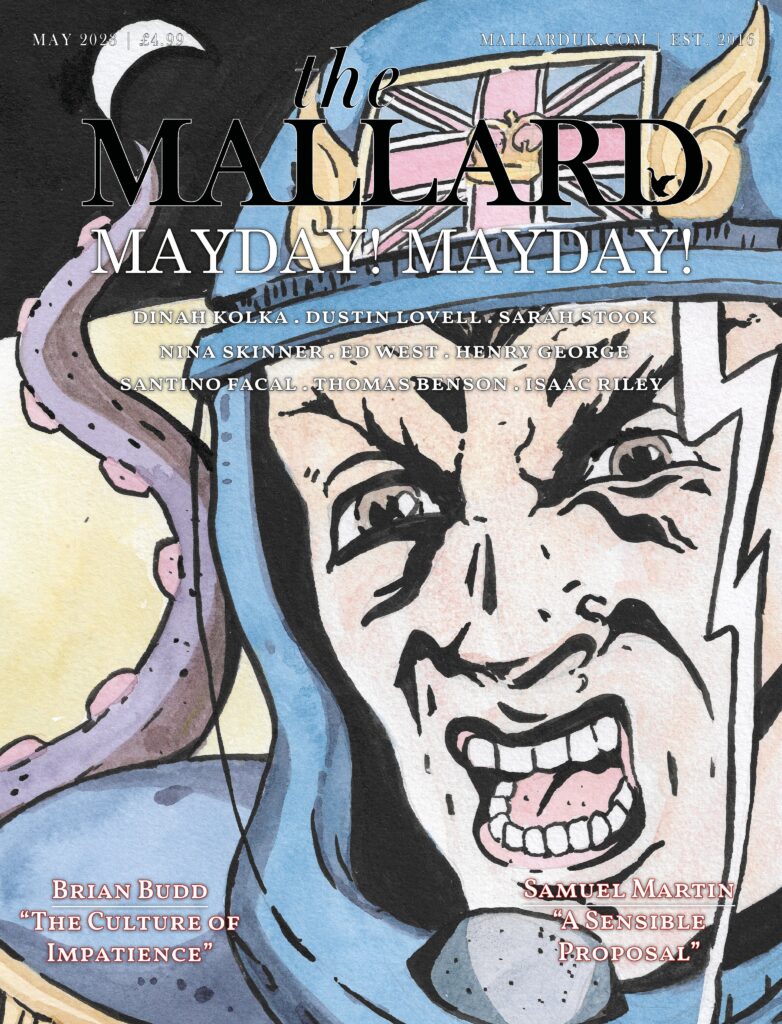
This is an excerpt from “Mayday! Mayday!”. To continue reading, visit The Mallard’s Shopify.