
Little England: Bekonscot, Le Corbusier and the Housing Crisis
The Morris men stand, hankies aloft, in the same pose they’ve held for decades. The little girl tugs at her father’s sleeve.
“Who are they, daddy?”
Her father pauses for a moment, scratches his chin and ventures a guess.
“They’re Irish dancers.” He says, “I think.”
The girl looks confused.
“I mean, I don’t know why they’re wearing lederhosen.”
Puzzled, he contemplates the scene further. I walk on.
BEKONSCOT
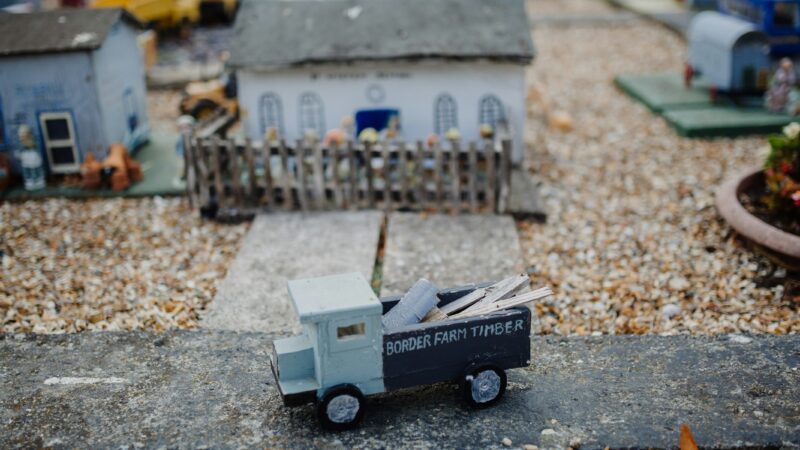
In 1927 Roland Callingham’s wife, tiring of her husband’s toy railway, insisted that he take his trains outside. Callingham, a well-to-do city accountant, purchased four acres of land on the outskirts of the Buckinghamshire town of Beaconsfield and, with the assistance of his gardener, W.A. Berry, began work on a model village, complete with a high street, church and railway, each constructed at the scale of one inch to one foot. Callingham dubbed his creation ‘Bekonscot’.
Originally intended as a private diversion, Bekonscot opened to the public in 1929, and soon became a popular tourist attraction, incorporating, in time, seven model villages. Initially, Bekonscot kept pace with the changing architectural styles of the times. However, a reactionary purge in the 1990s saw most modern buildings removed and the villages returned to a thirties aesthetic. Thus, what was originally conceived as a chance to see the everyday world in miniature, is increasingly a museum of a bygone Britain. Notably, the villages’ high streets are devoid of the vape shops and Turkish barbers that lend colour to the contemporary streetscape. Today, concessions to modernity are confined to a handsome Art Deco tube station, a few authentically drab office buildings and some token Arts and Crafts houses.
‘THE BEAUTIFUL’
The week before I visited Bekonscot, the government, determined to accelerate the rate of housebuilding across Britain, announced plans to build 300,000 new homes annually. Earlier in the summer, Angela Rayner announced plans to drop a requirement that new houses be ‘beautiful’, dismissing the old rules as ‘ridiculous’. ‘Beautiful’ explained Rayner ‘means nothing, really.’
For our deputy prime minister; her mind addled, like most of her generation, by postmodernism; ‘beautiful’ is a concept too subtle to be reduced to simple language, and as such, is essentially meaningless. For the modern liberal, ‘beauty’ can be filed alongside ‘female’ and ‘nation’ as terms too slippery to contain meaning.
This does not mean that the Angela Rayners of the world fail to recognise beauty (or, for that matter, ugliness) when they see it. It is rather that they have taught themselves to disregard the evidence of their eyes and dismiss all aesthetic judgments as purely subjective. But how smart must one be to understand that the average street in Salisbury, say, or Stratford-upon-Avon, is more beautiful than its equivalent in Salford or South Croydon? This is a truth that I am sure even Angela Rayner would acknowledge, if pushed.
FORM FOLLOWS FUNCTION
Why, among those less sophisticated than the average Labour cabinet minister, is ‘modern’ often a synonym for ‘ugly’? There is no reason why contemporary buildings should not be beautiful. Modern architects can do ‘spectacular’ well – witness London’s ‘objects’ – the statement buildings that litter the City and Docklands. But such edifices, no matter how impressive, do not belong to any regional or national tradition. The Gherkin would not look out of place in Los Angeles, say, or Lagos. Further, every ‘object’ is an experiment, and if it fails to pay off, a city must live in its shadow.
By contrast, tradition makes for attractive architecture. Ugliness is seldom worth repeating and does not endure. In aesthetics, as in politics, however, the liberal distrusts tradition, preferring theory. In our enlightened age, it is not enough for a building or artwork to be beautiful, rather it has to satisfy certain theoretical criteria. One only needs eyes to judge how a building looks. It requires an education to understand what a building means.
Only an architectural theorist of Le Corbusier’s brilliance could have built a city as inhuman as Chandigarh. By contrast, the numberless attractive villages that dot the British countryside were built, in the main, by unlettered craftsmen, men who would have found modern architectural theory incomprehensible. The vernacular architectural styles immortalised in Bekonscot evolved across centuries and were to inform the styles of suburban housing into the immediate post-war era.
The latter half of the twentieth century saw the defeat of tradition and the victory of theory, in politics, in art, and in architecture. Just as, for the political utopian, one solution (the common ownership of the means of production, for example, or the disappearance of the state and the triumph of the market) is sufficient to meet the needs of all human societies, so, for Le Corbusier, the principle of ‘form following function’ was a universal maxim. The great brutalist dreamed of a world remade in concrete and glass. Le Corbusier spoke of architecture when he maintained that ‘[In] Oslo, Moscow, Berlin, Paris, Algiers, Port Said, Rio or Buenos Aires, the solution is the same…’ but the sentiment is echoed throughout radical literature.
The Le Corbusiers of the post-war era have left Britain an uglier place. I am confident that, by the time Labour leaves office, many of Britain’s towns will be uglier still.
Britain needs new houses, of course. Would I feel the same sense of trepidation if acres of countryside were to disappear beneath dozens of (full-scale) Bekonscots? No. But, alas, the philistines hold power and are intent on despoiling our countryside with more of the soulless Legolands that litter the outskirts of our towns.
In Bekonscot, of course, it is forever 1933. Were things really better then? Life today is undoubtedly easier, but in many respects, Britain is a less pleasant place in which to live, with the cultural and economic revolutions of the post-war era having eroded social solidarity and trust. This decline finds a strange parallel in the quality of our built environment, as the reins of power passed to those less concerned with ensuring that England looked like England.
Tellingly, overseas visitors to Bekonscot seem to be having a great time. Perhaps Bekonscot looks more like the England they hoped to see than whatever they have found outside.
THE LAST DANCE
This is the future we have chosen, or at least, the future that was chosen for us. We could choose another. Conservatives should reject the mistaken idea that the cultural, social (and yes architectural) changes we are living through are inexorable and unalterable.
Which brings me back to the incident with the Morris dancers.
By the late nineteenth century, Morris was all but dead. A small band of Victorian enthusiasts recognised the tradition’s value and fought to ensure it did not die. Folk dance has never been fashionable, much less ‘useful’ (I should imagine that it would be difficult to convince Angela Rayner of its value) but England would be that little bit poorer if it were to disappear.
Likewise, the antique crafts required to build cottages and cathedrals were passed down across generations and are largely lost now. We are poorer for their being lost. But they could be revived. It only requires will.
Bekonscot’s brochure describes a ‘little piece of history that is forever England.’ There is no reason why the full-size England outside of Bekonscot’s walls should not remain forever England also. Traditions are only truly lost if we stop fighting for them
The Campaign for Scottish Independence is back to Square One
‘Within the next five years, in one form or another, break-up is likely to come about’. These are not the reflections of an unhappily married man, but a pronouncement on the fate of Great Britain, as prophesied by none other than Tom Nairn, widely considered the intellectual flagbearer for Scottish nationalism up until his death last year. Most notable for his book The Break-up of Britain, which foretells the dissolution of the United Kingdom as a consequence of imperial decline, Nairn, delivering one of his final interviews, felt confident enough to declare that the hour was finally at hand, despite being ‘usually cautious about predicting timelines’.
Nairn wasn’t alone in his prediction. According to a Survation poll, when asked ‘How likely or unlikely do you think it is that there will be another referendum on Scottish independence in the next five years?’, 65% of Scots were of the opinion that it was either ‘Very likely’ ‘or ‘Quite likely’. Only 25% answered ‘Quite unlikely’ or ‘Very unlikely’. The 65% may indeed be correct; but if any such referendum is to take place within the given timeframe, Scottish nationalists will have to pray for a miracle to happen within the next week or so, seeing as the survey in question was conducted all the way back in October 2019. Nairn’s five-year prediction was made in 2020, which affords it slightly more leeway. Yet the odds that the Scottish National Party, which only months ago suffered a crushing defeat at the ballot box, is able to persuade the British government to grant them a second vote by next year are slim to none. The truth is that the nationalist cause hasn’t looked more hopeless since the result of the original Scottish Independence referendum in 2014.
Even that episode, in which the UK faced its first truly existential threat since England and Scotland were united in 1707, ended on a modestly optimistic note for separatists. While the result of the vote was 55-45 in favour of Scotland remaining in the UK, the fact that Alex Salmond, the leader of the Scottish National Party, had been able to secure a referendum from the British government in the first place – and that the ‘Yes’ side, as the pro-Independence side became known, had come so close to winning – was taken by many as a sure sign that the Union was on its last legs. Worse still for the ‘No’ side, the fact that Independence was more popular among younger voters seemed to suggest that the end of the UK was not only inevitable but imminent. Led by liberal activists whose passionate appeals invoked the rhetoric of earlier Independence movements in former British colonies, the nationalists’ quest for freedom from the English yoke became an end goal for progressives; it was merely a matter of time before the pendulum swung left, thereby slicing in half the nation-state that birthed the modern world.
Any doubts anyone may have harboured about the impending demise of the UK were surely dispelled by the political turbulence that followed the referendum – the general election a year later, the other referendum the year after that, if not the snap election that took place the year after that – which to onlookers home and abroad resembled the death throes of a spent entity. In particular, amidst the chaos that occurred in the wake of the UK’s vote to leave the European Union in 2016, the only thing anyone seemed to be able to predict with any certainty was that Scotland – which had voted 62-38 to remain in the EU – would jump ship at the soonest opportunity. (Around a third of Scottish voters even believed that there would be another referendum before the UK completed the Brexit proceedings.)
Indeed, for many unionists, the ostensible advantages of remaining within the European Union proved a deciding factor in their ‘No’ vote: a stronger economy, representation at the European Parliament, and facilitated travel to the continent. As part of the UK, Scotland was by extension part of the EU, and a newly independent Scotland would surely struggle to gain re-entry to a bloc which mandates a 3% deficit ratio for all member states, given that the nation’s deficit hovered around 10%. But the UK’s vote to leave the EU put a knot in that theoretical chain of consequences. Remaining in the UK became a guarantee that Scotland would be cut off from the EU, while Independence under the stewardship of the passionately pro-Europe Scottish National Party at least allowed for the possibility, however scant, of being ‘welcomed back into the EU with open arms as an independent country’, in the words of one MP.
Against this backdrop, even the most optimistic unionist would not have expected the status quo to hold. And yet, 10 years on from the 2014 referendum, Independence polls produce, on average, the same 55-45 split. So what happened?
As it turned out, while Britain’s decision to leave the EU predictably shored up support for the SNP, it also complicated the logistics of Independence. The smallest matryoshka in the set, Scotland would find itself not only isolated but vulnerable, separated by a hard border with its only contiguous neighbour. The country would have to decide between a customs union with England, Wales and Northern Ireland (which collectively constitute the greater part of Scotland’s trade) or with the much larger, but more distant, EU.
And while a number of sometime unionists found themselves suddenly on the ‘Yes’ side of the debate – including a contingent of high-profile figures, from the actors Ewan McGregor and John Hannah to the writers Andrew O’Hagan and John Burnside – a number of those who had voted ‘No’ in 2014 suddenly found themselves siding with the so-called ‘Little Englander’s. These Eurosceptic defectors were broadly comprised of what the commentator David Goodhart would go on to classify as ‘somewheres’: patriotic Scots, typically older and poorer, and defined by a profound attachment to the place they call home, as opposed to the cosmopolitan aloofness of ‘anywheres’. An understudied but significant section of society, Scottish ‘somewheres’ have been instrumental in preventing separatism gaining a majority in the almost weekly polls, considering how many elderly, unionist voters have passed away in the last ten years, and how many Gen-Z, overwhelmingly pro-Indpendence voters have aged into the electorate.
Then there was COVID. As with every other political matter, the arrival of the coronavirus pandemic in 2019 dramatically changed the nature of the Independence debate. Since pandemic response was a devolved matter, the four home nations took a competitive approach to dealing with the virus. While Prime Minister Boris Johnson was initially reluctant to impose lockdowns, Sturgeon lost no time in employing comparatively draconian measures, such as mask mandates and severe quarantine regulations. As a result, Scotland was able to boast a considerably lower death rate than England. Between January 2020 and June 2021, excess deaths in Scotland were only around 3% higher than average, compared with England, where they were 6 % higher. This measurable discrepancy had the effect of suggesting to many minds that not only was Scotland capable of handling its own affairs, but that government under the SNP was safer and more effective than direct rule from Westminster. For the first time, Independence polls consistently suggested that the ‘Yes’ side would win a hypothetical referendum..
But the momentum didn’t last. As the months passed, and particularly as Johnson was coerced into a stricter COVID policy, adopting many of the SNP’s own strategies, the gap in hospitalisation and death rates between each of the home nations narrowed to a pinpoint. Moreover, the UK had developed its own vaccine, and thanks to opting out of the EU’s vaccine rollout was able to conduct its vaccination campaign far more rapidly than any other European country.
From there it was all downhill for the SNP. In the summer of 2021, it transpired that the party had been misallocating donations and routinely lying about membership figures. Nicola Sturgeon, who had replaced Salmond as First Minister after the 2014 referendum, resigned in February 2023, citing gridlock around the Independence question. A month later Peter Murrell, Sturgeon’s husband and chief executive of the SNP, was arrested as part of a police investigation into the party’s finances, prompting the SNP’s auditors to resign as well.
Sturgeon was replaced as party leader by Humza Yousaf. But while the former First Minister had been able to command respect even from her adversaries, Yousaf, who lacked Sturgeon’s charisma and the prestige that comes with an established reputation, proved a far more divisive leader at a time when the party was crying out for unity. The fact that Yousaf only narrowly won the leadership contest, after his openly Presbyterian opponent had been slandered by members of her own coalition for espousing ‘extreme religious views’, did little to endear him to the Christian wing of his party. Perhaps most controversially, his decision to carry forward the Gender Reform Bill – which made it possible to change one’s legal gender on a whim by removing the requirement of a medical diagnosis – provoked derision from a public which still falls, for the most part, on the socially conservative side of the fence. Nor were progressives much impressed by his decision to end the SNP’s power-sharing agreement with the Scottish Greens.
Yousaf resigned after thirteen months in office and was replaced by John Swinney, one of the more moderate senior members of the party, but the damage to the SNP’s credibility had already been done. With less than two months to go until the UK-wide general election, Swinney had his work cut out for him when it came to convincing Scots to continue to put their trust in the scandal-ridden SNP. Independence polling returned to pre-COVID levels. However, for nationalists, such polls were less germane to the pursuit of a second referendum than the election polls, given that keeping a pro-Independence party at the helm in Holyrood was a necessary prerequisite to secession. As long as the SNP commanded a majority of seats, there was a democratic case to be made for holding another referendum. This had been Sturgeon’s argument during the 2021 Scottish parliament election campaign, which was, in her eyes, a ‘de facto referendum’. If the SNP were to end up with a majority of seats, she claimed, the party would have the permission of the Scottish people to begin Independence proceedings. (As it happened, they went on to win sixty-four seats – one short of a majority.)
The SNP had fewer seats in the House of Commons, but the nature of Britain’s first-past-the-post electoral system meant they still enjoyed considerable overrepresentation. Still, if possessing forty-eight seats at parliament was not enough to secure a referendum from the British government, then plummeting to a meagre nine seats in the 2024 general election killed the prospect stone dead. As the Labour party made sweeping gains in Scotland and the UK more widely, the SNP suffered the worst defeat in its 90-year history. In a speech following the election, a dour-faced Swinney acknowledged the need ‘to accept that we failed to convince people of the urgency of independence in this election campaign.’ The party ‘need[ed] to be healed and it need[ed] to heal its relationship with the people of Scotland’.
It is difficult to take note of something that isn’t there, which is perhaps why, as Ian MacWhirter noted in a piece for Unherd, ‘It doesn’t seem to have fully dawned on the UK political establishment that the break-up of Britain, which seemed a real possibility only a few years ago, has evaporated’. The topic of Independence now rarely features in the news, and some of the biggest names associated with Scottish nationalism – not only Nairn and Burnside, but also Alasdair Gray, Sean Connery and Winifred Ewing – have passed away in the decade since the referendum. Meanwhile, younger Scots are turning away from nationalism in general, an unforeseen phenomenon which MacWhirter puts down to the fallout from Brexit, the Covid-19 pandemic and the war in Ukraine, a sequence of geopolitical shocks that has many Scots wondering whether the campaign to sacrifice the nation’s economy and security on the altar of identity might well be recklessly indulgent. ‘The Union is probably safer now than at any time since the Jacobites waved their claymores 300 years ago.’
If the SNP hope to bring the dream of Independence back to life, it will not be enough to rely on generational shift and the goodwill of the British government. An uphill struggle awaits the Independence movement. It will entail extensive repairs to the party’s image, providing clarity on issues such as currency, retention of the monarchy and the route to EU membership, and – perhaps hardest of all – presenting a clear case as to why Scotland would be better off as an independent nation. Until then, the Union looks set to enjoy a new lease of life.
Photo Credit.