When the government launched its ‘Retain and Explain’ policy in January 2021, those of us who value our heritage and see through the attacks on it greeted it with cautious optimism. Sadly, the unveiling of a new plaque in Shrewsbury about Clive of India has proved that caution well placed.
For the policy helped close one battleground over removal, only to open up another much bigger one over history itself. History has always been open to interpretation and reinterpretation, but never, until now, has one single version been declared the ‘correct’ one. We have entered a dangerous new era for the study of history, where debate is increasingly controlled, its terms of reference defined by one group with one particular agenda.
Plaques were touted as a compromise, but handing editorial control of history to those who want to rewrite it is not so much a compromise as an act of unconditional surrender. Turning a monument into an anti-monument is a much more powerful victory than simply removing it. The Chairman of the Edinburgh’s ‘Slavery and Colonialism’ review is upfront about not wanting to remove statues, preferring instead to project his own version of history onto them. And it very much is his version of history. The review has descended into chaos and threats of legal action from academics who have been excluded and dismissed as a ‘racist gang’. These include Professor Sir Tom Devine, Professor Jonathan Hearn and Professor Angela McCarthy. The cry of ‘racist’ – long used to shut down criticism and debate – has now permeated academia as those with the ‘right’ views sense the opportunity to control public discourse (and then to reap the financial rewards through appointments, book and media deals).
So far, we have seen plaques unveiled for three prominent historical figures – Henry Dundas in Edinburgh, Cecil Rhodes in Oxford, and now Clive – each one proving an exercise in unadulterated propaganda. I don’t intend to conduct a point-by-point rebuttal here, as defending reputations is not my primary objective. But it’s clear that the vital distinction between fact and opinion has been blurred. It is not a ‘fact’ that Clive “inflicted famine, poverty and other atrocities” on India, any more than it’s a fact that Rhodes’ activities “led to great loss of life” or that Dundas was responsible for the enslavement of half a million Africans.
It’s all too easy to paint a lazy caricature of Clive as a colonial bogeyman. Much harder to understand him in context as a man who overcame his own mental health issues to achieve astounding feats against a decadent and corrupt regime abroad and a hostile establishment at home resentful of his class and success. Instead, today’s agenda-driven historians have sided with that very same spiteful establishment. Not exactly progressive.
The plaque has proved a blunt tool for a delicate job. Aside from the problem of who writes them, there is the insurmountable one of space. Biographies of these figures run to hundreds of pages each and there is simply no way to boil these down to a hundred words with any semblance of nuance or credibility. The obnoxious ‘QR code’ may side-step the space issue, but still concedes the need to provide an official interpretation where no such need exists. With their limited resources, councils need to reprioritise running local services instead of assuming responsibility for history lessons.
And this is not even to broach the aesthetic argument against these blights on our public realm that deface our statues as surely as any graffiti. If the Edinburgh review gets its way, Scotland’s historic capital will become a forest of plaques, with a lecture and guilt-trip on every corner.
Plaques have had their chance to prove they can deliver balanced history and have conspicuously failed. These three fiascos should be more than enough to spell the end of the plaque as a serious tool of historical debate and of the ‘Explain’ part of Retain and Explain. Just as the government and Historic England has adopted a default position of objecting to any application to remove a statue, now is the time for them to do likewise and consign the plaque to history.
-
How to Deal with an Ideological Villain
A pet peeve of mine is when an antagonist in a book, show, or movie is driven by an ideology that, when he or she is inevitably defeated, nonetheless remains without being dismantled or rendered inept in some way. While, today, it is more often the protagonist driven by his or her writer’s self-inserted worldview, antagonists have, for over a century, often had ideological motivations–saving the climate, achieving some form of racial or sexual (but never ideological) equity, promoting radical resource conservation, whatever. Of course, we keep our hands clean by having the villain nominally lose, but that still leaves the ideology to be dealt with.
If left unanswered, the antagonist’s scheme, though foiled in its dastardly implementation, can too easily become a case of a merely overzealous attempt to produce what some believe to be a nonetheless good, noble goal with whatever hue of progressivism initially drove him or her. The good and the bad becomes, thus, not a matter of principle or goal but of method–the villain or villainess was such because he or she was too radical for those around him or her, etc. Hence, you get people considering whether the Marvel Universe’s Thanos was right in trying to reduce planetary populations by half, whether it wouldn’t be just for Godzilla: King of the Monsters’s Dr. Emma Russel to accelerate some a titanic climate emergency to fully dispense with humanity, or whether X-Men’s Magneto’s openly violent revolution for minority-mutant acceptance wouldn’t be justified–if not just a little satisfying.
Of course, the author who led the way with dealing with explicitly ideological villains was Dostoevsky, who reached his zenith of popularity, not to mention innovation, by dismantling Turgenev’s and Chernyshevsky’s ideological heroes. He did this often through mockery but predominantly through exposing to light of their ideologies through his antagonists who share them. Let us attend: the two–exposure and mockery–can and arguably should go hand-in-hand.
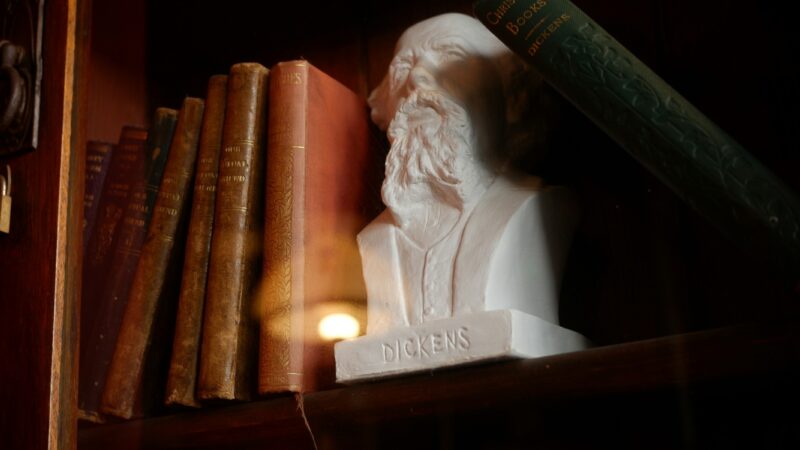
Dostoevsky made it his M.O. to resolve his characters’ conflicts by showing why their motivations are as bad as (or worse than) the attempted implementation. However, there was another writer, up to whom Dostoevsky looked, who was already doing this in England before Dostoevsky hit the Russian literary scene. I am, of course, talking about Charles Dickens.
No reader of Dickens can miss his criticism of the perspectives and politics of his day, be it open scorn, mocking satire, or earnest plea. While not all of his villains recant their ideas, one of his most complete cases of repentance is also one of his most popular tales, especially come Yuletide. This is none other than A Christmas Carol.
Now, readers will not need me to review the plot of Ebenezer Scrooge, whose name has become synonymous with Christmas in the English-speaking world. However, I nonetheless want to briefly examine points in Scrooge’s arc to see how it is not only his avarice but also the then popular ideology that justified it that is defeated in the end. Dickens pretty handily sets up the contemporary pop philosophy that gilds Scrooge’s greed. Rejecting personal charity for the impersonal, tax-funded state institutions of ‘“prisons…Union workhouses…the Treadmill and the Poor Law,”’ he identifies himself in the first scene as a Social Darwinist and Malthusian Utilitarian. ‘“Christian cheer of mind or body to the multitude,”’ as one of the scene’s collectors of charity puts it? Bah–humbug! ‘“I help to support the establishments I have mentioned,”” he says, ‘“they cost enough; and those that are badly off must go there…If they would rather die…they had better do it, and decrease the surplus population.”’ In Scrooge, Dickens concretises the worst versions of the ideologies gaining popularity as an increasingly rationalistic society dispensed with Christian superstitions of God’s image in each individual, and with them the Christian ethics behind giving of one’s own to the poor.
Of course, Dickens includes us in the dramatic irony that Scrooge’s integrity is neither admirable nor monstrous (yet), but pitiable and foolish. The former is articulated when, drawn through key moments of his past by the Ghost of Christmases thereof–his lonely Christmases as a child, his little sister who would leave behind his supposedly foolish nephew, his erstwhile love for the Christmas season at Old Fezziwig’s regardless of its cost in ‘mortal money’–Scrooge is reminded of how spectacularly he fumbled the bag with his fiancée Belle by grasping a different bag too tightly. The enlightened self-righteousness of Scrooge’s post-Christian ethic is neither as internally consistent nor as impressive as its holder might try to maintain: juxtaposing Scrooge’s excited apology for Fezziwig’s party in spite of himself with an unwillingness to look on the greed that would lead to his present loneliness, Dickens makes clear that Scrooge’s ideological righteousness covers a deeply buried sense of failure, regret, and betrayal of the best aspects of his past self. The scene shakes Scrooge’s supposedly staid principles, and his explicit and implicit admissions that gold is not the be-all, end-all valuer of life serve to begin his reformation.
Having shown why Scrooge is to be pitied for his Malthusian views (which he may not even fully hold), Dickens progresses to show Scrooge that he has also been unnecessarily foolish to hold them. Satisfying the first scene’s foreshadowing, this foolishness is shown when the Ghost of Christmas Present gives us more of his nephew, Fred.
Hard on the heels of shaming Scrooge with the mistreated Bob Cratchit’s nonetheless toasting him, the second Ghost presents Fred’s dinner party, sans uncle. Whereas Cratchit politely rebuffed his wife’s insults to Scrooge, Fred does the same to his wife’s with jollity. ‘“His wealth is of no use to him. He doesn’t do any good with it.”’ When his wife says, ‘“I have no patience with him,”’ Fred returns:
‘“Oh, I have!…I am sorry for him: I couldn’t be angry with him if I tried. Who suffers by his ill whims? Himself, always…[The] consequence of his taking a dislike to us, and not making merry with us, is, as I think, that…he loses pleasanter companions than he can find in his own thoughts, either in his moldy old office or his dusty chambers. I mean to give him the same chance every year, whether he likes it or not, for I pity him.”’
The girls mock the idea of Scrooge’s ever taking Fred up on that chance. However, unbeknownst to them, their mock unknowingly digs the knife of change further into the invisible uncle–not by disclaiming the immorality of his avarice (which might harden him), but by showing how foolish he is to maintain his proud isolation in it.
And the fact is that Scrooge would much rather be with them. In spite of himself, he tries his invisible darnedest to play along with the group’s games, which leads him, unsuspectingly, into being the butt of the night’s climactic joke. Having already shown Scrooge the ineffectuality of his gold and spite, Dickens meets both not with other characters’ argument but with mockery. Little wonder that the later Dostoevsky, who would mock his characters while showing the disastrous real-world consequences of their ideas, counted Dickens as one of his primary influences.
And yet, Dickens does not risk leaving things there, for one man’s pitiable past and foolish present might not undermine an entire ideology, even to the man himself. Before he leaves, the second Ghost reveals to Scrooge the true nature of his ideas–in the forms of the emaciated siblings, Ignorance and Want, hidden beneath his heretofore abundant cloak. ‘“Scrooge started back, appalled. Having them shown to him in this way, he tried to say they were fine children, but the words choked themselves, rather than be parties to a lie of such enormous magnitude.”’ Pushed to choose between the utilitarian phrases of his ideology and his own human sympathy, Scrooge ultimately cannot utter the former.
Readers don’t need me to review Scrooge’s interview with the third Ghost. Suffice it to say, his initial viewpoint, if followed through, will land him little posthumous respect among the living, even those who nominally venerate the old skinflint. Furthermore, to add insult to injury, with none to care for his affairs, Scrooge’s possessions will land in the hands of petty thieves–who, as a last insult to his way of life, parody him in their penny pinching over his personal effects. In death, he is treated according to the utilitarian ideology he espoused in life.
Now, several moments in A Christmas Carol are, without a doubt, moralistic and even a bit preachy in dealing with Scrooge’s ideology (example, the two waifs, above), and can, thus, arguably be skipped in retellings or depictions without the story’s–or Scrooge’s humbling’s–losing much weight. As I have previously written on the story, the falling away of such excesses, bound as they are to ideas and issues contemporary to its writing, is the beginning of a work’s usefulness as art. That so much of A Christmas Carol remains despite its initial polemic speaks to Dickens’s ability to make a point without its feeling like he is doing so.
And yet, his depiction of Social Darwinism remains relevant–not the least because Scrooge’s hardnosed display foreshadows those in our own day who promote state redistribution schemes while foregoing personal charity, yet somehow still thinking themselves moral and on the side of the poor. Furthermore, current progressive ideologies often take on the same self-satisfied tone, even glee, as Scrooge at the supposedly justified handicap or destruction (always their fault) of the designated outgroup–white men, “the rich,” landlords, heteronormative family units, groups indigenous to European lands, etc. Their hijacking every medium they can for the sake not of creating good art but of spreading “The Message” has left a dearth of art and stories that seek not only to include the majority of audiences but also to simply be good for their own sake. The question among conservative creators (which, as I argue in the above linked article, not to mention my novel, includes many more than those who consider or label themselves conservative) of how to create the best art can and should point us to authors like Dickens and Dostoevsky.
While politics was not the point for such authors, they did not shy away from dealing with insidious ideas of their day. The difference between them and authors who see art as inherently political was and should be that, in treating art as a function of greater things than politics–not to mention weighing it against human experience and tradition–they exposed inhuman ideas fully in the lives of their characters. Such a thing necessarily leads, as can be seen in A Christmas Carol, towards at least some characters’ repenting of their ideology towards a more wholistically human ethic that balances personal rights and interests with duties and responsibilities for others–one I would argue is best found in the Christian view of man and its subsequent moral tradition, articulated implicitly in Dickens and explicitly in Dostoevsky.
Like many pre-20th-century books, A Christmas Carol is refreshing, if nothing else because its lesson is for its protagonist (who is also its antagonist), not its readers, who are included in the joke. However, even thus reducing it to a “lesson” is to render it as inhumanly provincial as is the pre-repentance Scrooge. We should look to older literature not just to nostalgically escape the present (though that’s often a necessary salve), nor to learn how to “retvrn” to a time before all the other advancements our culture has made (on the backs of the previous centuries’ literature and ethics, one should add). We should do so because older books have survived the changing of times.
Said survival is not, as Marxist progressives claim, because their popularity has been artificially and oppressively maintained in various social traditions and structures (though one man’s supposedly oppressive structure might be many other men’s most efficient means of justly and safely ordering society). Rather, it is because their authors concretised elements of human life that are and will remain immutably true. That, of course, can have implicit ideological or political (etc.) ramifications, but such accidental effects are not their core substance. Watching a rendition of A Christmas Carol to get into the Christmas spirit might have the effects of motivating us to give to the less fortunate or to look, Cratchit-like, with forgiveness on even the most oppressive of our fellow men (or on ourselves, as Scrooge, himself, learns to do). However, to see this kind of thing as inherently political or ideological is, itself, to maintain an ideology about the relationship between art, actual people, and each other that would reduce all three. Thankfully, should we want to dismantle such a thing, we know where to look.
-
The Internet as Mob Rule
The ancient Greeks believed political constitutions repeated in a pattern called kyklos (“cycle). The idea first occurs in Plato’s Republic, gets elaborated by Aristotle in his Politics, then reaches its apogee in Polybius’ Histories.
Unlike modern theorists of cyclical rise and fall of civilisations, such as Oswald Spengler, the kyklos doesn’t have a zenith or golden age. It’s rather a waxing and waning of stable society types, followed by unstable society types. What characterises a stable society is that the ruling class and citizens both strive towards the common good, conceived as the objective purpose of human beings, which results in their happiness and flourishing. Society becomes unstable when its members stop having the common good in mind, and instead strive after their selfish private interests to the detriment of other citizens.
Kyklos then presupposes several things. First, it isn’t culture specific. Its objectivist outlook means it applies equally to all political human groups, always and everywhere. Second, the engine that drives history is human virtue and vice, and not economics, class struggle, or war. These are secondary factors resulting from the characters of human beings. Healthy economies, contented class structures, well-won peace and just wars all result from virtuous people. Third, the stable government types are various. Kyklos defends neither monarchy, nor aristocracy nor a republic exclusively. It isn’t a Whiggish or utopian theory of history, that says if and only if a certain group are in power all will be well. Rather it claims that whatever group are in power, they must be virtuous to rule well. Vice immediately leads to disorder.
Simplifying in the extreme, the kyklos model runs as follows. Rule can be by one person, several, or many. When these rule for the common good, they are just, and are called monarchy, aristocracy and republican respectively. When they rule for their private interest to the detriment of society, they are tyranny, oligarchy and democratic respectively.
It’s important to note that by “democracy” I don’t mean here a system of popular representation or voting. The virtuous form of this is called a polity or republic in classical thinking. In the latter, bonds of authority and specialised expertise remain. In the former, absolutely everything is sacrificed for the sake of equality of the masses (see below).
A good monarch rules with benevolence. His successors are unjust and become tyrants. The nobility removes them, creating an aristocratic state. These in turn degenerate into oligarchs as they grow decadent and self-interested and begin to oppress the poor. The people rise up and remove them, creating a republic where all citizens have a say. But the mass of citizens loses the bonds of political friendship, grows selfish, and the republic becomes a democracy. Democracy eventually deteriorates to a point where all bonds between people are gone, and we have a mob rule. The mob annihilates itself through infighting. One virtuous man seizes power, and we return to monarchy. The cycle begins anew.
With these preliminaries out of the way, I come to my point. I believe the present age we are forced to live through is highly ochlocratic. Of course, it’s not a pure mob rule since we have non-mob elites and a rule of law. I also think our age is oligarchic (dominated by elites swollen with pleasure). But it’s more ochlocratic, I contend, than it was a few centuries ago, and enough that mob behaviour characterises it.
The defining trait of unstable regimes, as I’ve just said, is vice. However, vice doesn’t just happen spontaneously as though people awake one morning deciding to be selfish, spoilt, and cruel. Evil people, as Aristotle notes, often believe they are good. Their fault is that they’ve mistaken something which is bad for what is good. For example, the man who hates the poor falsely believes money is the same as goodness. The man who mocks monks and sages for their abstinence believes all and only pleasure is good. Even when we know what is good for us, ingrained habit or upbringing might make the illusion of goodness overpowering. A lifetime of cake-gorging can condition one to the point it overrides the knowledge that sugar is bad for health.
I think the Spanish thinker Jose Ortega y Gasset in The Revolt of the Masses (1930) unwittingly echoes Plato when he points to the faults of the democratic “mass-man” of the twentieth century. All human societies need specialised minorities to function. The more demanding and specialised a field, the more those who do it will be a minority of the population. Further, all societies, to function, need sources of authority which aren’t decided by a majority vote. Modern democracy has created the illusion that the unspecialised mass is sovereign and has no reliance on anybody. It has achieved this mirage through artificial liberation: creating unnatural freedoms through constant government intervention and technocratic engineering.
This in turn has supported vices out of unthinking habit. The mass-man accepts his lack of qualifications and is proud of this absence. He isn’t one deluded about his knowledge. Quite the opposite. The mass-man is someone who openly declares he knows nothing but demands to be listened to anyway because he’s a member of the sacred demos. In short, according to Ortega y Gasset, the ideology of the mass-man is: “I’m ordinary and ignorant, and so I have more of a say than those who are specialised and learned.”
The internet is a democratic medium par excellence. This isn’t to say that its members are all egalitarian and individualist, rather, its very construction assumes egalitarian and individualist ideas, and these force themselves onto its users whether they be willing or not.
Here we can extend the criticisms that Neil Postman makes at television in Amusing Ourselves to Death (1985) to the web. On the internet, all information is available to everyone. Anyone can create it, and anyone can opine on it. The medium doesn’t distinguish for quality, so the greatest products of human civilisation sit alongside the basest, on the same shelf. There are no filters online for expertise or experience, indeed, any attempts to create such filters are decried as “gatekeeping”. As a result, the internet has no difficulty settings (to use a metaphor). Getting through the easier levels isn’t mandatory to reach the harder ones. You can skip ahead, so to speak, and mingle with the pros as their peer.
Someone might object here that I’m exaggerating, since online communities monitor themselves all the time. I can indeed post my amateur opinions onto an internet space for astrophysicists, but these will mock and exclude me once I become a nuisance. However, this isn’t an answer. The internet is built on the assumption of mass wisdom, and the only way to enforce hierarchies of value on it is by banding a mob together. The space around remains anarchic. Yes, there are communities of wise people online, but these exist in an ocean of communities of fools. The medium presents them all as equally valuable. Which communities grow powerful still depends on the wishes of the mass.
When the internet produces a rare fruit of quality, this is because by sheer accident, the wishes of the mass have corresponded to reality. It isn’t an in-built feature.
The result is that the internet functions like a classic mob regimen or ochlocracy. The medium has no sensitivity to quality, but rather responds to will, provided enough people are behind it. Those who wield influence online do so because the mob will has selected them. They are our modern versions of Plato’s Athenian demagogues, or rabble-rousers of the French Revolution. A mass of ignorant and desperate people swirls around equally ignorant and desperate demagogues who promise them whatever they want. Demagogues rise and fall as the mob is first enamoured then bored of them. As the internet has grown to encompass our whole lives, this ochlocracy has spilt out into the real world.
In this space, truth entirely drops out. It’s a common fault of the ignorant to confuse desire with truth since desires are often hotly felt and what is very vivid seems real. Our egalitarian internet machine therefore is wont to magnify desires rather than realities. And because it magnifies desires, these ever more get confused with reality, until mob wishes would replace the common good of society. I believe a good example of this is how the online demagogue-mob relationship works. When internet personalities, especially political and social influencers, fall from grace, it’s usually because their followers realise they can no longer get what they want out of them (seldom do demagogue and mob cordially separate because each has become wiser). The power lies with the followers and not with their purported leader.
Which brings me back to kyklos. A classic Greek political cycle resets when a virtuous individual takes the reigns from the mob and establishes a monarchy. He recreates justice through his personal goodness. This was more likely, I think, in ancient societies where religion, community and family were stronger, and so the pool of virtuous people never entirely depleted. If our ochlocratic internet is indeed a stage in a kyklos (or a component of an ochlocratic stage), and it ends, I think it will end with one demagogic idiocy imposing itself on the others by force.
A population conditioned by the internet to think mass-appeal as equivalent to truth will readily accept a technocratic whip provided it claims to issue from the general will. Which idiocy gains supremacy is a matter of which can capture the greater part of the mass in the least time, to form a generation in its own image. This is why I don’t think the current trend of the internet becoming more regulated and censored is good. The regulators and censors come from the same debased crop as those they regulate and censor.
Enjoying The Mallard? Consider subscribing to our monthly magazine.
-
Consorts (Part 1)
We’ve had many monarchs in English and British history. Nearly all of them have been married, some more than once.
Here’s part one of my series on consorts:
Matilda of Flanders
- Life: c. 1031-2nd November
- Reigned: 25th December 1066-2nd November 1083
- Spouse: William I (m. 1051/1052)
- Children: Nine, including William I and Henry I
- Parents: Baldwin V, Count of Flanders and Adela of France
- Origin: France
Early Life: Matilda of Flanders was born in roughly 1031 to Baldwin V, Count of Flanders and Adela of France. Baldwin was a descendent of Alfred the Great. It’s believed that Adela could be the woman who was married to William I’s uncle, though historians are unsure if it is her. She was also the daughter of Robert II of France. This meant that Matilda had an impeccable lineage.
We do not know much about Matilda’s early life beyond that she spent it in Lille, northern France. Her mother, the extremely devout Adela, taught her daughter.
Marriage and Children: Flanders was a key region of Europe and allied with many of the important players. This made Matilda an extremely eligible match. William of Normandy was a bastard whose legitimacy tainted his prosperity. Legend has it that Matilda told his envoy that she was too high born for a bastard. William reportedly, depending on which version you believe, either dragged her off of her horse or went to her house and hit her. Matilda was reportedly so moved by that passion that she decided she’d marry only him.
Pope Leo Ix refused to give permission as the pair were too closely related as fifth cousins. This did not dissuade them, and they married in around 1051/1052.
William and Matilda had a strong, loving relationship. Unlike many of his contemporary leaders, William never took a mistress. They worked well together and Matilda was instrumental in getting William on the throne of England. He was devastated by her death, which led to an increase in his authoritarian tendencies.
They had at least nine children, including future kings William II and Henry I. Their daughters either took the veil or had advantageous marriages.
Pre-Reign and Queenship: Matilda became the Duchess of Normandy upon marriage. She had all but one of her children there, with Henry being born in England. Matilda contributed to her husband’s attempts to gain the English throne. She purchased and paid for a lavish ship, designing it herself. William was said to be deeply touched by the move.
Matilda remained regent in Normandy as William settled in England following the Battle of Hastings. She proved a capable leader, with Normandy seeing no uprisings or rebellions under her care. It also became a flourishing centre for arts.
She arrived in England in 1068, where she was crowned in a lavish ceremony. William made sure to crown as Queen and not merely a consort, as had been the case up until that point. Her name was mentioned in official documents and the Church fully recognised her.
Matilda had many landholdings and was a very wealthy woman in her own right. She closely supervised the education of her children, all of whom were educated to the highest extent.
The marriage did hit a rough patch. Their son Robert had been furious at his father for taking his (Robert’s) deceased fiancée’s lands. Robert was further angered when William failed to punish his younger sons after a prank on him. After Robert nearly accidentally killed William in battle, he was exiled. A few years later, William discovered that Matilda had been sending Robert money. He was livid but Matilda managed to plead motherly affection and win him back. Matilda brokered a reconciliation between father and son in 1080.
Matilda died in late 1083. William was devastated. He never remarried- though he wouldn’t have needed to- and did not take any mistresses. It’s said that the loss of her good influence made him more tyrannical. She is buried in Normandy at a church not far from where her husband rests.
Personality: Matilda was a deeply intelligent individual in terms of both street smarts and academia. She ensured the education of her children and was by all accounts a very loving mother. Her relationship with her husband was a good one and she was his best counsel. Matilda’s courage and shrewdness made her a strong ally and callable leader. She was deeply pious, even for the time, and left a lot of money to the church and charity.
Legacy: Matilda is remembered as the first official Queen of England. Her pious nature led her to build many religious centres. Some used to believe she was involved in creating the Bayeux Tapestry, though historians discredit that. She’s the descendent of nearly all English and British monarchs.
Matilda of Scotland
- Life: 1080-1st May 1118
- Reigned: 11th November 1100-1st May 1118
- Spouse: Henry I (m.1110)
- Children: Empress Matilda and William Adelin
- Parents: Malcolm III of Scotland and Margaret of Wessex
- Origin: Scotland
Early Life: Matilda was born with the name Edith sometime in 1080. Edith’s parents were Malcolm III of Scotland and Margaret of Wessex. Malcolm ruled Scotland for thirty-five years, whilst the deeply intellectual Margaret would later be given a sainthood. At her christening, Edith pulled the headdress of her godmother, Matilda of Flanders. This was said to be an omen that Edith would one day be Queen.
Edith’s education was advanced for a woman at the time. She was a desirable match, but the strong-willed Edith refused many matches. Her parents had her betrothed to Alan Rufus, Lord of Richmond, a man forty years her senior, when she was thirteen. The death of her parents and older brother saw Rufus run off to marry another. Her uncle took the throne and her brothers were sent to England for protection. It is likely that Edith stayed in England too.
Marriage and Children: When William II of England died in 1100, his brother Henry took the throne as William was childless. He wished to marry and to cement his stature, he wished to marry Edith. Edith was reportedly beautiful and they’d known each other for years. The only problem was that Edith had been raised in a convent and there was conjecture as to whether she’d been a nun or not. It had been her aunt Christina’s wish, but Edith refused. She told a commission that she’d only been veiled to protect from being raped by soldiers. Edith further said she’d stamped on her habit after being given it. It was eventually decided that Edith was free to marry.
Henry married Edith in November 1100. She changed her name to Matilda. Matilda-how I feel refer to her from now on- and Henry had two children who lived past infancy. They were Matilda and William (original naming).
The pair seemed to have a happy marriage, despite Henry’s many, many illegitimate children. This was the norm for the time and it seems that Matilda chose to ignore it.
Queenship: Matilda was a learned Queen who served as a regent when her husband was away-which was often. She was a huge patron of the arts and made her home of Westminster a hub of music and literature. Matilda was also deeply religious, maybe even more so than her mother, and charitable. She commissioned hospitals, churches, schools and other public works. Matilda would wash the feet of the poor and kiss the hands of the ill.
As was custom for the time, Matilda helped find strong marriages for her children. She had her daughter Matilda married off to Henry V, Holy Roman Emperor in 1114. William was engaged to Matilda of Anjou in 1113 and would be married when they were old enough.
Matilda died in May 1118, her husband by her side. Henry mourned the loss, but had to remarry after the death of his son.
Personality: Matilda had a strong personality, as evidenced by her fight to be able to marry instead of being kept as a nun. She was extremely intelligent and devout. It seemed that she was trusted enough to be regent when her husband was often away and she had an active role.
Legacy: Matilda is most remembered for being a devout Christian who funded public works and charity. Many suggested that she be canonized but this never happened. Matilda was used as an excuse by King Stephen to deny her daughter the chance at being Queen, as he argued that she’d been a nun and thus not eligible for marriage.
Adeliza of Louvain
- Life: c.1103-1151
- Reigned: 24th January 1121-December 1135
- Spouse(s): Henry I (m. 1121), William d’Aubigny (m.1138)
- Children: Seven with William d’Aubigny
- Parents: Godfrey, Count of Louvain and Ida of Ching
- Origin: Belgium
Early Life: Adeliza of Louvain was born in around 1103 to Godfrey, Count of Louvain and Ida of Ching. Very little is known about her early life beyond the fact she was reportedly extremely beautiful. Her nickname was ‘The Fair Maiden of Brabant.’ Through her father, she was a descendent of Charlemagne. She may have been well-educated as she knew French, this was not the language of her home.
Marriage: In 1120, Henry I lost his only legitimate son William. He needed an heir and wished to marry Adeliza due to her beauty and heritage. The two wed in January 1121.
Their marriage produced no children, though Adeliza would have children with her second husband. Henry and Adeliza likely had a good marriage as they were always together. She was not, however, at his deathbed in France.
Queenship: Adeliza was not political like her predecessor, but was a huge patron of the arts. She pushed for French literature, making it popular among the nobles of Europe. Henry gave her generous dower lands which allowed her to live in wealth.
Post-Queenship: Henry died in 1135, leaving Adeliza as a widow. She lived in her dower lands as the Anarchy started to unfold. In her widowhood, Adeliza was a proponent of religious charity and commissioned many buildings for the Church. She also remembered Henry and took care of his memorial.
Adeliza was living in an abbey when she was proposed to by William d’Aubigny. His family were minor nobility so the marriage was not too much of a challenge. The pair had seven children together and were ancestors of two of Henry VIII’s wives. Her husband William was a staunch supporter of Stephen, but Adeliza quietly supported Matilda, with whom she had a good relationship. It was only after Stephen threatened the family that Adeliza was forced to lure Matilda into a trap. She did ensure that Matilda could safely leave.
In 1150, Adeliza entered a monastery. This is unusual as she was still married with children. Records indicate she died a year later.
Personality: We know little of Adeliza beyond the fact she was uninterested in politics but enjoyed art. She seemed to be a good stepmother.
Legacy: Adeliza is oft-forgotten due to her lack of politics and not being the mother of a monarch. She is an ancestor of Anne Boleyn and Catherine Howard, however, so she did manage to have a say in the royal lineage many years down the line.
Geoffrey of Anjou
- Life: 24th August 1113-7th September 1151
- Reigned: (Disputed) 1141-1148
- Spouse: Empress of Matilda (m.1128)
- Children: Three legitimate, including Henry II
- Parents: Fulk, King of Jerusalem and Ermengarde, Countess of Maine
- Origin: France
Early Life: Geoffrey of Anjou was born on the 24th August 1113. His father Fulk would become King of Jerusalem upon his second marriage to Melisende of Jerusalem’. Geoffrey had three younger siblings and two younger-half siblings. His sister Matilda was the widow of his brother-in-law William. As a young man, Geoffrey was handsome and loved sports and hunting.
Marriage: Aware of the fact that he likely wasn’t going to have any more legitimate sons, Henry I of England needed his daughter Matilda to marry and have heirs. Anjou had been an ally since William had married Geoffrey’s sister Matilda. In 1128, Geoffrey and Matilda married.
Their marriage was not a happy one. Matilda was a decade older than Geoffrey and felt that marrying a Count was beneath her, as her previous husband had been an emperor. They were both strong-willed and independent people who liked to get their own way. Geoffrey would have bastards.
They had three sons together: Henry, Geoffrey and William. The latter two would die fairly young.
Pre-Reign and Consort: As Count of Anjou, Geoffrey was in charge of the state. He put down several rebellions. In 1135, his father-in-law finally died. Some states submitted to Matilda and accepted her reign, but the English nobles chose her cousin Stephen (eldest living nephew of Henry I). This was for two reasons- the fact that Matilda was a woman and the fact that they didn’t particularly like her husband.
During his contested consortship, Geoffrey fought in Normandy whilst Matilda headed to England. He did make headway but was bogged down, leaving him no time to assist his wife in England. Geoffrey was endlessly putting down rebellions and eventually gave Normandy to his eldest son Henry.
Geoffrey died suddenly at the age of 38. He is buried in Les Mans.
Personality: Geoffrey was outwardly affable and charming, with a love for merriment and sports. He could be very cold and his strong personality made him clash with his wife. Geoffrey was nonetheless very loyal to Matilda, though one would argue that gaining the crown would be more of a benefit to him.
Legacy: Along with Lord Guildford Dudley, Geoffrey is one of two disputed consorts. He is often not included in historical rankings or is least not classed as a consort. His son Henry would live on as king, meaning that Geoffrey is an ancestor of many monarchs.
Matilda of Boulogne:
- Life: c.1105-3rd May 1152
- Reigned: 22nd December 1135-3rd May 1152
- Spouse: Stephen (m.1125)
- Children: Five, including Eustace
- Parents: Eustace III, Count of Boulogne and Mary of Scotland
- Origin: France
Early Life: Matilda of Boulogne was born around 1105 to Eustace III, Count of Boulogne and Mary of Scotland. She was their only child, which was unusual for the period. Her mother Mary was the sister of Matilda of Scotland, consort to Henry I and mother of the Empress Matilda.
Extraordinarily little is known about Matilda’s early life beyond the fact she was betrothed to Stephen aged two and was educated in convents.
Marriage and Children: Matilda and Stephen married in 1125. The two enjoyed an extremely happy marriage, with Stephen taking no mistresses nor bearing any illegitimate children. They had a mutual love and respect for one another.
The pair had five children, three of whom would later rule Boulogne. Eustace was the eldest son and heir to Stephen until the Treaty of Wallingford saw him displaced.
Pre-Reign and Queenship: The first ten years of marriage were relatively peaceful, with the couple often visiting England. All that changed in 1135 upon the death of Henry I. Whilst Matilda waited to claim the throne, Stephen immediately jumped into action and headed to England.
The Anarchy would see Matilda and Stephen often parted. When it came to war, Matilda proved to be a surprisingly excellent leader and tactician. She often came to her husband’s aid with troops. Matilda forged an alliance with her uncle, David I of Scotland, before allying with France through the marriage of Stephen to the king’s sister Constance.
Upon hearing of her husband’s capture, Matilda begged her cousin for his release but was refused. Her army then forced the Empress out of London. It was after she captured Matilda’s extremely loyal half-brother that a prisoner exchange finally happened.
The war dragged on until 1147, when the Empress Matilda returned from Normandy. There was a stalemate at this point and no side had declared victory. Stephen acted as king. Meanwhile, Matilda enjoyed widespread popularity. She was admired for her steadfast dedication to her husband, her bravery, courage and intelligence. Contemporary chroniclers said that she had a man’s heart in a woman’s body. Stephen always listened to her counsel.
Matilda died fairly suddenly in spring 1152 whilst staying in Essex. Stephen was not there at the time. One can assume he was devastated. They are buried together at Faversham Abbey, Kent.
Personality: Matilda was one of medieval Europe’s most brilliant women. Not only was she an extremely loyal spouse, but she was also a talented leader and soldier. She was on the frontlines during the war and was key in several victories. Her love for her husband was evident, as was his love for her. Contemporary citizens loved Matilda and held her up as an ideal woman.
Legacy: Despite the fact her children never ruled England, three would rule Boulogne. Her daughter Marie and granddaughter Ida would be Countesses of Boulogne in their own right, not forced to share power with their husbands. As Henry II was her cousin’s son, Matilda is an ancestor of many of our monarchs.