“We, the undersigned student organizations, hold the Israeli regime entirely responsible for all unfolding violence.
Today’s events did not occur in a vacuum. For the last two decades, millions of Palestinians in Gaza have been forced to live in an open-air prison. Israeli officials promise to “open the gates of hell,” and the massacres in Gaza have already commenced. Palestinians in Gaza have no shelters for refuge and nowhere to escape. In the coming days, Palestinians will be forced to bear the full brunt of Israel’s violence.
The apartheid regime is the only one to blame. Israeli violence has structured every aspect of Palestinian existence for 75 years. From systematized land seizures to routine airstrikes, arbitrary detentions to military checkpoints, and enforced family separations to targeted killings, Palestinians have been forced to live in a state of death, both slow and sudden.
Today, the Palestinian ordeal enters into uncharted territory. The coming days will require a firm stand against colonial retaliation. We call on the Harvard community to take action to stop the ongoing annihilation of Palestinians.”
Authored by the Harvard Undergraduate Palestinian Solidarity Committee and co-signed by over thirty other student groups at the elite university, this statement has started to cause problems for its signatories.
Resignations have occurred. Groups have backtracked. Names have been sealed. Why? Because for once in their life, these kids are going to be on the receiving end of the anger that they often direct at others.
Responses to the horror in Israel have been varied. Whilst a good majority of people are horrified by the atrocities that have been committed, not everybody has been so sympathetic. Some have outright celebrated what has happened. Others have been more measured in their response, instead doing the ‘both sides’ tango that they are excellent at dancing.
Such an example is at play here. The students and societies at Harvard who wrote this letter may not have actually straight up endorsed the atrocities that have occurred, but they did lay the blame squarely at Israel’s feet.
The backlash has been sudden and all-encompassing. Academics, fellow students, businesses, politicians and all other types have roundly criticised the groups and students who signed this letter. Those who have been named have distanced themselves from the letter.
The list of groups and names have been removed from the statement in order to apparently protect them from repercussions. Unfortunately for them, the list remains readily accessible.
If these people were so sure of this viewpoint that they signed a statement such as this, it begs the question: why have they decided to step back?
It’s simple really. They’re terrified of facing the consequences that they demand of others.
Take for example a woman named Ryna Workman, President of the NYU Law Student Bar Association. Ms. Workman, who had been a summer associate of the prestigious Winston and Strawn law firm, had a job offer rescinded by them. She had written a statement online refusing to condemn the actions of Hamas, all while once again blaming Israel.
With such actions costing a student from a top college a job, it’s no wonder that those who signed the Harvard statement are melting away like the Wicked Witch of the West. These students attend the oldest and arguably most elite college in the US, and are primed for their pick of summer internships and jobs in some of the top organisations possible. If their names are attached to controversy, then their necks are on the line.
Considering Harvard students wish to permeate a culture in which one can easily be shunned for their actions, it’s fair that some might be unsympathetic to their plight. In 2020, students petitioned for any official in the Trump administration to be banned from engaging with the college in any official capacity. Its scores on self-censorship and free speech are abysmal. Students actively keep their opinions to themselves. Harvard is no bastion of freedom.
These students don’t care if other people suffer for their thoughts, but God forbid they can’t work for some human rights lawyer during the summer holidays.
For years, there have been people who have believed that the rules don’t apply to them. They have kept themselves on the right side of the opinion divide. Their voices have been the loudest. They’re the good guys. They’ve never had to worry about their views being scorned. They’ve always been safe. Now, however, they’ve crossed the line that they set down, and they’re reaping the consequences.
Considering how many presidents, members of Congress and Supreme Court Justices have attended Harvard, it’s more than likely that these students will be the ones running the country one day. Even if they’re not in the top branches of government, they’ll be the lawyers standing up in court.
Harvard is a place that opens doors. They don’t want those doors slammed in their face. It’s just a pity for them they’re the ones usually on the other side of that door.
-
10 Pages Minimum: A 2022 Book Report
At the end of 2021, I challenged myself to read at least 10 pages of a book a day. I was initially shocked at how difficult I found it to just sit down quietly and read a book. However, within the first month, I found it easier and easier to sit quietly, and enjoy reading. Having been unable to read practically anything for pleasure in the past few years, I am glad that I was able to accomplish this. By the end of 2022, I was able to read 14 books, and I decided that it would be prudent to compile a list of them, and to give a brief review of each one. All of these reviews were written within a few days of finishing the book, so as to give my most accurate opinions of them. This article, therefore, has been a year in the making! I hope that I am able to persuade you to take up this challenge in 2023.
Upon reflection, it has become clear to me that my reviews at the start of the year are not as good as the ones nearer the end of the year. Please excuse me for this, I have had no experience in writing book reviews up until now; but I feel as though this exercise has given me good practice in the area.
Book 1: American Psycho by Bret Easton Ellis
Read from: 01/01/2022 to 14/01/2022
Rating: 5/5
Review:
When I saw this for sale in Waterstones, I chuckled to myself because I have seen the film so many times, and am very aware of all of the references and memes it has generated. I immediately bought it and I am extremely glad that I decided to make it my first read of 2022.
The book is an extremely well-written and unique dive into the horror nightmare land of Yuppie culture in the 1980s through the eyes of an unreliable narrator, Patrick Bateman.
For anyone who has seen and enjoyed the film, you will love this book. This novel fleshes out the character of Patrick Bateman and the accompanying cast and really helps to add the context and depth which would be impossible (or at least extremely difficult) to show on film.
The book is intentionally written in a repetitive and confusing style to try and put us in the head of Bateman, who lives a life surrounded by repetitive and confusing people constantly lost in meaningless conversations over what kinds of socks match with a certain tie, or who is calling up the newest celebrity-owned restaurant to make a reservation. As a reader, you may find this jarring at some points. But I beg you to be mindful of the point Ellis is trying to make. By about a third of the way through you will begin to appreciate the pages and pages of text covering the newest album from Huey Lewis and the News, and Patrick’s running commentary on what he, his girlfriend, his friends, and his victims are wearing.
Please be aware that if you have a vivid imagination, this book can be extremely difficult to read at some points due to the levels of violence and gore it portrays in excruciating detail. (I actually found myself feeling sick at some points, but this just lends more credit to the incredibly descriptive abilities of Bret Easton Ellis).
I thoroughly recommend this book, and I hope that you read it and enjoy it as much as I did.
Book 2: The Art of Rhetoric by Aristotle
Read from: 15/01/2022 to 13/02/2022
Rating: 4/5
Review:
I had never been very interested in philosophy, I had always found it unnecessary for myself to learn it. However, after a few debates and arguments with some of my friends who did enjoy learning philosophy, I decided that I would finally get around to reading some.
As I am interested in politics and public speaking, one of my friends recommended to me the Art of Rhetoric. I bought this book some time ago last year and had never read it, so I thought it would be best to start off my philosophical education with this book… that was a mistake.
I soon came to realise that, if you have never read any of Aristotle’s work, he can appear to be a confusing writer. He seems to love tangents and diversions and references to his own and other people’s work. Whilst it was certainly interesting to read about all of these tangents, it did make it quite difficult and confusing at some points to really understand his point or what he was talking about. One minute he would be talking about the different reasons people debate, and then he would suddenly be discussing the benefits of slave ownership.
Another issue I had while reading the book is that it introduces some new terms and words that I had never heard of before such as ‘Enthymemes’ etc. I had to spend considerable time actually learning what all of these specific terms meant before I could even understand what a large amount of the book was talking about, otherwise, I would have completely missed the context of entire chapters. That is not the fault of the book but a fault of mine (as mentioned earlier this was the first philosophical book I have ever read, and that was my mistake).
The book is actually split into three books (all relatively short). Without spoiling anything, The first two books give a lot of context to the third book which is where the actual ‘art of rhetoric’ is discussed at length. This made the first two books feel very slow compared to the third. It is also worth noting that the first two books are where most of the tangents can be found, whereas the third book seems laser-focused on the topic at hand.
Overall, I found the book very enjoyable. It pushed me to actually learn new concepts and terms I had never heard of before, and gave me new ways of looking at debate and argument as a practice. I would definitely recommend this book to people interested in improving their debate and public speaking skills, however, I would also warn you that, if you have never studied philosophy before, don’t be surprised if you have to re-read a few pages and do some research on some of the concepts Aristotle talks about.
Book 3: Trans-Siberian Rail Guide by Robert Strauss
Read from: 13/02/2022 to 19/02/2022
Rating: 4/5
Review:
I found this book completely by accident at the ‘Barter Books’ second-hand book shop in Alnwick. I saw the cover, saw the low price, took a guess at what it might be about, and decided that I had to have it! At first, I assumed that this would be a simple guide for tourists of the Trans Siberian railway, but as soon as I started reading it, I discovered that it was so much more than that. It is a charming collection of history, anecdotes, and stories about the Trans Siberian Railway; and an assortment of (now obsolete) information about the various ways one could successfully navigate the journey across the Soviet Union to China and Japan (or vice versa) via train in the late 1980s.
This is by no means a history book, however, it is a very dated guidebook that was written for an 80’s audience, and it contains an absolute heap of useless and obsolete information about how to behave properly around Soviet border agents, the addresses of various consulates and embassies for countries which no longer exist, and tips on where best to buy camera film and cheap Hi-Fi’s when lost in Beijing. I found that this added to the charm of the book, and made it more interesting to read about the lived experiences of those bold adventurers making their way across Communist Russia, Mongolia, and China.
What makes this book even more endearing is that, when it was written, the author put out an advert for readers of the Times newspaper to submit their own stories of their travels along the Trans Siberian to him. He features these stories throughout where relevant, which really adds to the human touch of the book.
The book is broken down into 5 parts. Some of these parts are more focussed on the history of the railway and various anecdotes and stories of travelers’ experiences over the last 100 years on it. Other parts of the book are more instructional and list embassies, hotels, hostels, useful numbers for Visa applications, etc. The author, Robert Strauss, does an excellent job of weaving these two very separate kinds of information together to make for a very delightful read.
I would highly recommend this book to anyone interested in the history of the Trans Siberian Railway, anyone who wants a brief flashback to the late 1980s, and anyone who is sad enough to spend their time reading pages and pages of completely useless and obsolete information about how to purchase train tickets from the Hungarian Socialist Republic (people like me).
Book 4: Lolita by Vladimir Nabokov
Read from: 20/02/2022 to 08/04/2022
Rating: 4/5
Review:
This book was bought for me as a gift by my girlfriend after I had expressed some curiosity in it (it is her favourite book and I was interested to see why).
This book (sometimes referred to as ‘The Great Divider’) is a tricky one to get through at times, it brazenly challenges you to keep reading it, despite its cruel themes and evil characters. I found some parts of the book particularly difficult to stomach due to the horrible issues which it covers, but I did soldier on through it to the end. This is why it has taken me almost double the time to get through this book as it has to get through other books of a similar length.
The book tells the story of Humbert Humbert, a handsome young European academic who comes to America after the death of his first wife. The story is told in the past tense from his perspective as he desperately tries to convince the reader, using all of his intellectual charm and cultured European graces, that his attraction to young girls is completely fine, and that the rape of his landlady turned wife’s daughter, Lolita, is justified.
It is fair to say that the book is a heavy read, and forces you to stay on your toes in order to not sympathise with him. Humbert Humbert is the king of unreliable narration, and phrases the most disgusting events in ways that can become very palatable to the reader if not considered properly in context.
This is indeed the crux of the book’s appeal, it is astonishingly beautifully written, even if it leaves you feeling sick or sad afterward. The writing style of the author, Vladimir Nabokov, in this book is absolutely impeccable and suits the theme and character of Humbert Humber almost too perfectly. It made the characters feel so alive and real.
My main complaint about the book, and what is stopping it from receiving five stars in my opinion, is that some sections (specifically the road trips) seem unnecessarily drawn out and overcomplicated, whilst other parts (specifically the ending) seem too rushed and simple – it feels as though you waited through a huge build-up over hundreds of pages for an ending that is covered in less than 30! I understand that this is because the book is framed as a retelling of a story from one person’s blinkered perspective, but I would have enjoyed it a bit more if the book spent more time fleshing out other parts of the story, and perhaps cutting back on excessive detail in others. However, this issue did not kill to book for me and I did still find it very readable almost all of the time.
In conclusion, an absolutely fantastic read that I would definitely recommend to anyone bold enough to take on Nabokov’s challenge.
Book 5: Mine Were of Trouble by Peter Kemp
Read from: 08/04/2022 to 13/05/2022
Rating: 5/5
Review:
This book was completely unknown to me until I started being recommended it by various anonymous accounts on Twitter. My curiosity peaked after I had heard the general theme of it; and I must say, I am extremely glad that I took the decision to buy and read it.
This is arguably one of the most interesting, thrilling, and charming books I have ever read, and most certainly is a contender for my favourite of the year. The author, Peter Kemp, has a superb skill for structure, detail, and storytelling that makes it extremely difficult to put this book down. It gives you just enough detail to help you understand the situations he was in without being too heavy-handed and boring. At some moments, ‘Mine Were of Trouble’ reads almost like an adventure book; not because the events are so unbelievable, but because of the great lengths the author went to describe the acts of heroism and horror he saw in real life.
The book tells the true story of the experiences of Peter Kemp (the author), a 21-year-old English law student who was so moved by the stories coming to Britain of the horrors experienced by Catholic priests at the hands of the Republicans, that he decided to join the Carlists (a monarchist faction within the Nationalist army during the Spanish civil war). The book does not read like a diary, and instead is more of a lengthy account of his entire time before and during his service in the Spanish Nationalist military.
The true tales told by Kemp range from the humourous and charming to the horrendous and despicably ugly. At times during the book I was chuckling, and at other times I was almost crying. The book is not attempting to engender these emotions within you, it is simply telling you the story of Kemp’s fascinating journey through the civil war. It serves to remind us all that not all of war is horror; and not all of war is camaraderie, fun, and games.
This book has generated within me a great desire for travel and escapades. I would sincerely recommend this book to anyone interested in the history and politics of inter-war Europe and the Spanish civil war. I would also recommend this book to anyone interested in the concepts of masculinity, heroism, and the call to adventure. Whilst not saying it directly, Kemp touches on all of these topics in great detail. His time and actions in Spain reflect his values of faith, honour, courage, and compassion. This book has served as a great insight for me into all of these topics, and I am sure that it would do the same for you.
Book 6: Convenience Store Woman by Murata Sakaya
Read from: 13/05/2022 to 16/05/2022
Rating: 5/5
Review:
As I was strolling around the Waterstones near Monument Metro Station in Newcastle, my girlfriend and I came across a small ‘Japanese Literature’ section. I have never read any Japanese literature of any kind ever, so I was intrigued by it. I was curious to see what was on offer and, as I was looking at the table, I was passed a copy of this book ‘Convenience Store Woman’ by my girlfriend who said to me that she had really enjoyed reading it in the past. I took her advice and, as it was only £8.99, I decided to buy it. This was a very good decision, and I am very glad that I bought this book.
The book itself is very short at just 160 pages with barely more than 200 words a page on average, so you can get through this extremely quickly. I consider myself to be quite a slow reader and I managed to complete it in just 3 days! I found the book to be very difficult to put down, the pacing was just right and kept you hooked into the story all of the time. I didn’t feel as though the story dragged at any point, and the general theme was one which I found quite relatable.
The story itself centres around Miss Keiko Furukura, a 36 year old Japanese woman who has been working the same part time job at the same convenience store for the last 18 years. Whilst never stating it explicitly, it is obvious that Keiko has autism and struggles to understand the actions of the people in the world around her, except for when she is working in the store. Keiko’s whole life revolves around her job at the store and it seems as though, to her, it is the one thing that gives her a purpose. She sees no reason to keep herself healthy, except for the benefit of the running of the store; she sees no reason to take a shower and shave, except for the benefit of the running of the store etc. This all changes when a new employee, a man name Shiraha, enters the picture.
Both of these characters are outcasts who take a different approach to dealing with the similar situation that they find themselves in. Shiraha is a failure who cannot find a wife. He is angry at the world for forcing him to work and just wants to hide away and do nothing. Keiko, on the other hand, has no anger to the world and just cares about the running of the store. The author does an excellent job at contrasting their opinions and methods for dealing with their problems, and it proves to be an excellent commentary on the expectations that Japanese society places on men and women.
If you are looking for a light and quirky book, this is certainly one for you. I thoroughly enjoyed reading it, and I was sad to have finished it so quickly. It has been a refreshing brake from the other books I have read so far, and I will certainly make an attempt to read more Japanese literature in the future as a result of it.
Book 7: The Great Gatsby by F. Scott Fitzgerald
Read from: 16/05/2022 to 24/05/2022
Rating: 4/5
Review:
This particular book was of great importance to me because of how I came to have it. It was given to me as a gift by my English teacher back in 2016 just before I took my GCSEs. I had never read the book and we did not study it at school, I knew absolutely nothing of the plot and I used to ask her questions about it. Instead of giving the answer away, she bought me it as a present so I could come to the answer myself. Well, after almost six years of starting it, stopping it, and starting again, I finally got myself into gear and finished it. This was a great relief to me, as it means that I wont have to read the first chapter over and over again any more.
The book is relatively short but the pacing of the story can make it quite difficult to read at times. I found the start and end of the book to be very slow and drawn out whilst particular sections were very rushed. I’m sure that Fitzgerald was doing this for dramatic purposes, however I felt as though I should have been given more information at certain important moments. Fitzgerald is clearly a master of the English language and his usage of it in the book is interesting and unique. I found that some of the speech patterns in the book are very dated (this is the original unabridged version after all) which certainly gave it a 1920s feel. Whilst I had no problem with this, you do sometimes find yourself re-reading the same lines to make sure you understood what was being conveyed in this older style of writing. If you are not used to certain aspects of 1920s speech patters and history, try and buy a copy like mine which came with context explainers at the back. This helped me in my own understanding of what was going on in certain scenes.
The story is a somewhat reliable narration by Nick Carraway, a Midwesterner come to seek his fortune in New York City in the early 1920s. There he meets his neighbour Jay Gatsby, a mysterious and extremely wealthy man who, by complete chance, happens to be madly in love with Nick’s cousin Daisy, who lives just across the water from him. Daisy is married to the equally wealthy adulterer, Tom Buchanon. The story follows Nick as he is pulled further and further into a disgusting web of deceit, lies, and deception that surrounds Gatsby, Daisy, and Tom.
I found that the 2013 film adaptation of the book is fairly true to the source material, but it does skip over a large chunk of the relationship between Nick and Jordan Baker. The book does a better job of fleshing out the relationship between the two and it also does a much better job of making the characters less fantastical and more realistic. The film portrays Nick as a clueless do-gooder who just happened to be caught up in rich peoples cruelty whereas the book assures you that he knows what he’s getting himself in to.
In conclusion, a classic book which I would highly recommend. Not too long and certainly recommended if you have seen the film and wanted a bit more from the characters.
Book 8: Rules of Civility by Amor Towles
Read from: 24/05/2022 to 22/06/2022
Rating: 4/5
Review:
This is arguably the first book of the year that I have read that I went into with absolutely no idea of what to expect. I had never heard of Amor Towles or his works, and this book was more of an impulse purchase after a friend of mine saw it on sale for a ridiculously low price and recommended it to me. I am glad that he made such a frantic bid to get me to but it. I have also just noticed that this is the third book of the year that I have read to be based in New York City (with American Psycho and The Great Gatsby being the other two). I suppose, through the lens of these fictions, I have taken a journey of the history of New York from the 1920’s to the 1980’s.
This book follows the life of Katherine Kontent, a typist at a law firm, as she makes her way through the year of 1938 in New York City. The concept of time passing is a big factor in this novel, the book is structured heavily around the changing of the seasons and the progression of time. It is no surprise that the main story starts on New Years eve 1937 and ends on New Years eve 1938. She, along with her room-mate Eve, meet Tinker Gray, a very curious individual who they both take great interest in. Over the course of the year, this typist is pulled from the bottom of New York society to the top. She becomes close and personal friends with the wealthy and not-so-famous member of society who keep the machine of the city moving along. She seems to find herself both disgusted and fascinated by it, and keeps venturing into it for more.
This book had the ability to trigger a very strong emotional response from me. It reminds us (bluntly in some places and subtly in others) that time is indeed passing and slipping through our fingers, and that we are the total sum of all of our decisions and all the decisions of everyone around us. Fittingly, I found the ending of the book both beautiful and agonising; all of the separate story lines of the small array of characters that Katherine meats neatly come to their conclusions. It left me felt feeling so sad, and I am not entirely sure why this is. Perhaps it is because it reminds that, no matter how eccentric or interesting we try to be, we too are side characters in someone else’s story; and one day, our relationship with those people will end as well one way or another.
The book’s structure is well put together, and it is clear to me that Amor Towles has an incredible grasp on the English language. His writing style is very unique and enjoyable; however, the method he uses to represent conversations (long flows of text rather than broken up sentences with quotation marks) can be quite jarring at times and it sometimes became very difficult to tell who was talking to who. I would also argue that the pacing of the book was a bit strange. The story seemed to race at the start, then slow down toward the middle, and then jump to a breakneck pace at the end again.
In conclusion, this was definitely an enjoyable book and is one which I shall be recommending to others.
Book 9: The Communist Manifesto by Karl Marx and Friedrich Engels
Read from: 23/06/2022 to 23/06/2022
Rating: 3/5
Review:
Due to the nature of this book and my political biases, I think it unfair to attempt to give this book a true ‘rating’, so I have opted to give it a 3 out of 5 – truly, the most neutral of ratings you can award a book (or anything for that matter).
I read this book many years ago when I was only a child, and so I saw that it was high time to read it again. Whilst I do not agree with Marx and Engels, I found the book to be very interesting and insightful into the initial aims of Communism.
I think today in the world of debate, we get very caught up in politicking, good and bad looks, and the humdrum of boring arguments. Sometimes we forget what certain people actually sincerely believe. It was quite refreshing to read straight from the source. I appreciate the fact that there have been many different iterations and interpretations of communism over the last hundred or so years, but it was nice to actually be able to get a grip of what the original idea of it actually was. As we live in the age of gutter politics, Marx is someone who has been warped and twisted beyond disbelief by people on both sides. Rereading this book reminded me that the chap, at the end of the day, was a philosopher trying to make sense of the modern industrial world and make predictions on the upcoming class struggles between proletariat and bourgeoisie.
Has this book changed my opinions on economic and social relations? No. I am just glad to have been given a fresh perspective on what communism is, and what Marx and Engels were trying to put forward. I am curious as to what they would think of the modern world if we could reach through history and bring them to now. I wonder if they would rejoice or shudder at the state of the modern communist movements. I wonder what they would say about the history of the last 100 years. I wonder how they would view the states of China, Cuba, and the like.
In terms of the books structure, it is incredibly short. You can read this in an afternoon if you really wanted to. I found the first half and the last tenth to be the most interesting, whereas the middle of the book was very slow.
In conclusion, it’s a short read and I would recommend it to anyone interested in learning about the communist movement. I would be interested in reading more of Marx’s material after this as I personally found it very interesting.
Book 10: Silence by Shusaka Endo
Read from: 24/06/2022 to 16/07/2022
Rating: 5/5
Review:
I picked up this book at the same time that I got ‘Convenience Store Woman’ from the Japanese section at Newcastle Waterstones. It is funny as I had not intended to get any books at all and wound up buying two. I have also now purchased this book again as a present for a few friends as it is relatively cheap and extremely worth a read. I loved this book and I am glad that I made the impulse purchase after admiring its cover in the Waterstones.
This book follows the journey of Father Rodrigues as he journeys to Japan in the 1640s with his friend Father Garupe to act as a missionary and to discover the fate of his former teacher, Father Ferreira who has been rumoured to have apostatized and to now be assisting the Japanese government in hunting down and persecuting Christians. The journey of Rodrigues is a sad and miserable one. He starts with, what he believes to be, complete faith in God and the Catholic church. This faith is tested repeatedly by the misery and suffering of himself and the Christians of Japan that he sees around him. He is constantly doing battle with the silence of God when he sees injustice and cruelty done upon himself and his fellow Christians.
The novel’s author, Shusaka Endo, was a Japanese Catholic, and I believe the book itself was an attempt by himself to understand his relationship with God and his Christian faith through the abstraction of historical story telling. I believe, therefore, that this book is a good way of understanding my own faith better and coming to terms with the reality of the world around me and my relationship with God. If you are a Christian as well, I would thoroughly recommend this book.
The book, at just 267 pages, is relatively short and I found it very readable. The author uses letters, diaries, and reports from different sources as a framing device for good chunks of the story which helps to break it up and adds a layer of depth to the various characters that are met along the way. The general arc of the story is good and has a sound progression. Do not go into this book looking for a happy ending, you will not find one. The story does not finish with some grand triumph for any character, it merely reflects on the situations that they find themselves in.
Overall, I would certainly recommend this book. It is a brilliant example of 20th century Japanese fiction and, more specifically, provides an excellent retrospective on the persecution of Japanese Christians in the early Edo period by a practicing Japanese Christian. It is a great shame that the film adaptation by Martin Scorsese (himself a great admirer of this book) was such a commercial flop.
I would like to take a moment, if I may, to reflect on the books I have read so far. It is now the 17th of July 2022 and so much has happened since I started this challenge. Russia invaded Ukraine, I turned twenty-two, Boris Johnson has resigned, I bought my first house, and now we are all suffering through an absurdly hot heatwave and sky-high energy and commodity prices. It has indeed been a strange year for me, Britain, and most of the world. My one constant, however, has been the reading I have been doing. As I mentioned at the start of this piece, I barely read at all in the last decade, and it has been thoroughly enjoyable to burn my way through so many of the books that have been sitting gathering dust in my room.
I did not think, when I set myself this challenge, that I would have already finished 10 books by the end of the year… let alone the middle of July. I am very proud of this achievement, and I am looking forward to carry on reading throughout the year and into the next (and so on and so forth). I have learned so much from these books, not just what they contain, but also the foundations of what makes good fictions and non-fictions so enticing. I also think that my reading comprehension and patience has increased dramatically, and my ability to review the books has improved too.
If you are still reading this behemoth of an article at this point, I hope that you have been finding it of some use or interest. I sincerely hope that it motivates you to pick up some of the books laying around at your house that you’ve been telling yourself you would actually read too.
Book 11: Patriotism by Yukio Mishima
Read from: 17/07/2022 to 17/07/2022
Rating: 5/5
Review:
This book was recommended to me by a friend. I did not intend to read it so quickly but it is an incredibly short book and is an extremely compelling read. It is also the second Japanese book I have read in a row. I am glad that I bought it and I hope that I can convince you to buy it too.
The book is set over a period of three days and follows the story of a Lieutenant in the Japanese Imperial Army, Shinji Takeyama, and his beautiful young wife, Reiko. Being instructed to command troops destined to fight the forces of rebellious officers (many of whom are his close friends), Shinji is faced with the impossible choice of loyalty to his friends, or loyalty to the Imperial Army and the Emperor of Japan. Shinji, instead, chooses to commit seppuku (ritualistic suicide) with his wife as his witness.
The book describes, in graphic detail, the couple’s last few hours together on the night that they will take their own lives. It explicitly takes the reader through the couple making love multiple times before then agonizingly describing every moment of Shinji and Reiko’s suicide. Reading this part of the book was genuinely difficult at some points due to the gruesome nature of Yukio’s writing style.
Achieving a ‘glorious death’ was something that the author was very focussed on in his own personal life, so it is easy to understand why he would write about ritualistic suicide so positively. After further investigation, I discovered that the rebellion in the book was a real event that took place known as the ‘Ni Ni Roku’ Incident. This incident, along with many other events in Japanese politics, would shape Yukio’s worldview and drive him further into his beliefs surrounding right wing politics and the future of the Japanese nation and people.
In terms of structure, the book is incredibly short and can be read easily in less than an hour. I would thoroughly recommend the book to anyone interested in Yukio Mishima, this is an excellent way to ingratiate yourself with his beautiful and graphic writing style, and a good way to get a glimpse at his views and beliefs.
Book 12: The Sailor Who Fell From Grace with the Sea by Yukio Mishima
Read from: 17/07/2022 to 13/08/2022
Rating: 4/5
Review:
This is the fourth Japanese-authored book I have read this year, the third in a row of Japanese books, and the second from the esteemed author Yukio Mishima. I heard about this book from various accounts on Twitter and have seen it recommended numerous times but I had absolutely no idea what it was about. I am still not entirely sure if I have fully understood the book, but I will do my best to review it here.
The book is set in Japan a few decades after the second world war, and follows the story of the child Noboru and his wealthy widowed mother Fusako. Noboru is part of a gang of self-proclaimed genius boys led by ‘the chief’ who have become radically angered and dissatisfied with the modern world and modern rules and morality. Noboru is obsessed with the sea and ships and, when he is taken by his mother to the docks to actually see some vessels, they meet the ship’s second mate, Ryuji.
Fusako and Ryuji are smitten with each other and they have sex soon after meeting, whilst Noboru watches on from a peephole he has discovered in between his wall and his mother’s. Initially, Noboru is very pleased with Ryuji. He likes the fact that he is connected to the sea and he sees him as perfect. However, after a series of faux-pas on the part of Ryuji, and Noboru’s excessively high standards and non-standard morality, he soon finds himself disgusted by Ryuji.
This book is strange. I very much enjoyed it, but sometimes it was difficult to get into. Yukio Mishima was exploring his own philosophies and ideas on modern morality through the character of an extremely intelligent child, however, sometimes this came across as very unbelievable and annoying. The only truly sympathetic character is Ryuji.
Mishima, of course, uses his masterful command of language and metaphor to create beautiful images in the reader’s mind, especially when discussing sex and violence. This is a theme seen throughout all of Mishima’s work.
In terms of structure, I found that the pacing of this book was actually very good. The book is split into two halves, ‘summer’ and ‘winter’, each having its own distinct tone. The book is quite short at just over 100 pages and was paced in such a way that it never felt too quiet or too busy throughout.
Overall, a good book that I enjoyed. I would recommend it to you if you were especially interested in understanding Mishima’s personal philosophies and worldview.
Book 13: The Obesity Code by Dr Jason Fung
Read from: 14/08/2022 to 25/08/2022
Rating: 4/5
Review:
As someone who has struggled with weight their entire life, this book was a real eye opener. This book was bought for me years ago by my dad, but I never once opened it. I did not know who Dr Jason Fung was, and I had no intention to read what I assumed was just another self help book. Fast forward to a few months ago when a friend of mine suggested buying this book (as it had really helped them with their weight). I realised that I already had it buried away on my book shelf, and I made it my aim to at least try and get through it. As soon as I saw the cover, I realised that this Jason Fung was the same Jason Fung whose YouTube videos I had been watching for the past few months. Given the high quality of his channel, I went in with high expectations, and I was not disappointed!
Firstly, this is not a self help book. Dr Fung uses this book to meticulously and thoroughly dismantle commonly held misconceptions about diet, exercise, and weight loss. His calm and methodical approach to explaining problems with the diet and pharmaceutical industry (especially in North America and Europe) is eye opening and fantastically interesting. I found myself unable to put this book down (hence why I was able to read it so quickly).
I wouldn’t be doing the book justice by trying to fully explain Fung’s take on weight loss, but the general lesson he teaches is that insulin and cortisol are the two hormones that contribute the most to weight gain and obesity; that the post-70s western diet and lifestyle has made us prone to insulin resistance and excess cortisol; and that the standard ‘eat less, move more’ advice so often given out by doctors and government health agencies is unhelpful for people truly trying to lose weight. Dr Fung’s solution to these problems is intermittent fasting, which he claims is beneficial for reducing insulin resistance and being the most effective tool for obese people to lose weight.
The vast majority of the book is spent focussing on his main hypothesis that insulin causes weight gain. He only goes into fasting in the final section. This is why I do not consider this to be a ‘self help’ book. He spends far more time helping the reader understand what the problem is then actually giving specific solutions for this to be thought of as ‘self help’. Whether that is a good or a bad thing is up to you, but personally, I liked it. The book didn’t feel preachy or like quackery.
My only complaint, and the reason I don’t think I can award 5 stars, is that Dr Fung spends a huge amount of time going over the same points again and again. I appreciate that he is attempting to drill an idea into the reader, but it can get quite monotonous after a while.
Since watching his YouTube videos last month and reading his book, I have lost roughly 12kg in weight (about 2 stone/28lbs). This is evidence enough for me that his methods work, and I am fervently carrying on with them. If you struggle with your weight or are just interested in a fresh take on why the world has an obesity problem, I would most certainly recommend this book and his YouTube channel.
Book 14: No Colours or Crest by Peter Kemp
Read from: 28/08/2022 to 31/12/2022
Rating: 5/5
Review:
This book took a much longer time to finish than normal due to personal issues and should not be taken as a slight on the piece of work. This book is the second of Peter Kemp’s three books detailing his activities before and during the second world war (see review number 5 for a cover of his first book ‘Mine Were of Trouble’).
We follow him on his journey after the Spanish civil war, joining the British army as a liaison officer and being sent into Albania to act as a representative of Britain and to gather information on partisan activities in the area. Being parachuted into the country, he is forced to deal with the complex political issues that drown the region in mistrust and curtail any effort to form a united front against the Italian and German occupying forces.
This first section of the book was very interesting to me, Enver Hoxha (the post war Communist dictator of Albania) is a character which I have known about for a very long time, but never seriously investigated and researched. In this book, Peter tells of his regular dealings with Hoxha, along with his other Communist, Monarchist, Republican, and Reactionary counterparts in their desperate bid to repel the invaders and attempt to seize legitimacy in forming a new government for Albania after the war has ended. Peter’s writings about these figures and his travels through Albania showcase the chaos and unpredictability of a small nation at war not only with an outside power, but also itself.
The second, much shorter, section at the end of the book tells of Peter’s brief time in Poland in 1945, and his capture and mistreatment by the Soviet Red Army, who viewed him as less of an ally than a potential enemy once the war was over.
The book is an excellent read for any history nerds interested in the niche fringes of the second world war, featuring a very unique insight and detailed description of war stories not often talked about in Western media. Kemp’s keen memory and light-hearted nature make for, not only a detailed read, but also an enjoyable one.
The pacing of the book can be a bit slow at times. I thought it was a shame that Kemp talked for so long about his time in Albania, but very little about his time in Poland. I appreciate that he was in Albania for much longer, but it would have been nice if he could have been a bit more detailed in his discussion on his time spent in Eastern Europe.
Peter has a distinctive writing style which became more and more obvious as I read through this piece, and I would struggle to define it. He writes memoirs like no other memoirs I have read.
Overall, an excellent read which I thoroughly enjoyed and would recommend. I will be reading and reviewing his third book ‘Alms for Oblivion’ later in 2023.
It is the 1st of January 2023 and I cannot believe how much my life has changed since my last writing on here on the 17th of July (just after review number 10) and over the year as a whole. I am now a settled homeowner on the other side of a breakup, I have spent time living in London to escape family drama, and I am 30kg lighter than when I started the year. The war in Ukraine still rages on, and inflation seems to have calmed down just a little bit. I have been totally blown away by the rate of change I have experienced this year, and I am reminded whilst writing this that one of the only constants I have had throughout 2022 was the challenge to myself to read more this year. I am extraordinarily proud of what I have accomplished, and I sincerely look forward to doing it again in 2023, I hope that next year I am able to read at least 20 books.
I hope that these reviews and remarks have given you some encouragement to take up reading this year, it really was one of the best decisions I made at the start of 2022, and I hope that you see fit to make it one of your own resolutions for 2023.
-
We Need a Che Guevara of Our Own
The title might be misleading at first, but there is a good reason for that. To understand the needs and opportunities for the contemporary Right, we first need to understand what got the Left into power at first.
Enter Che Guevara, or more exactly, enter Ernesto Guevara de la Serna.
For anyone in either the free-market or the classical conservative sphere, the travel log of his motorcycle trip around Latin America should be a required reading. Not because it is an historical account of the radicalization of one man, who from well-educated Argentinian bourgeois doctor went to terrorist, revolutionary and guerrilla leader, but because it shows the seeds of how a simple man with ideas (albeit in his case, the worst ones) can become an archetype, a religious icon for a set of beliefs.
Even for someone like Murray Rothbard himself, Che Guevara was someone worth of interest, to the point of writing a highly critical but yet prophetic obituary for him, and Rothbard, of course, was right, because Che Guevara has probably become the most well-known political figure in recent Latin American history, and outside of the developed West, that is, the US-led Anglosphere and Western Europe, his face and his name have become synonymous with armed struggle, with guerrilla warfare, with an utopian socialist ideal that knows no limits nor boundaries.
His death at the hands of the Bolivian Army, helped by the CIA, in a failed attempt to spark an agrarian Marxist revolution in the Andean Altiplano, only contributed more to his already legendary status among those who oppose the ideas of freedom and civilization.
In practice, his death made him a martyr of the Left, a religious symbol of a revolution that never came but is always presented as the gospel of egalitarianism. Say what you want about Che Guevara, say he was a killer and a terrorist, and you will be right. But that doesn’t take away the fact that Che was ready to die for his ideas, and in fact did so.
The Right, neither conservative nor libertarian, doesn’t have a single person who has gone to such extents. We don’t have martyrs, and our beliefs are not religious. We may think of the self-immolating acts committed by the likes of Alex Jones or Kanye West as martyrdom for our causes, like free speech, but they are nothing but counterproductive folk activism.
In fact, our beliefs, are quite the opposite to a religious fanatism, for they are rooted in the reasonable analysis of history, nature and society, and as such, the results of our ideas, even if adequate on a long term, are not easy to sell to high-time preference masses, who have become used to receive subsidies from governments and have internalized the propaganda created by the corporate-managerial class that works in tandem with policy-makers.
Our society is deadlocked between an individual struggle for freedom and an organized struggle for power, and our times are stranger than ever, for they represent what Francis Fukuyama still insists is the End of History, but look closer to the civilization end stage described by Oswald Spengler in his Decline of the West magnum opus.
The problem is that if we take either Fukuyama’s or Spengler’s words for granted, we’re still left without some key elements to understand the mechanics of our age: liberal democracy is indeed the dominant system all around the world, but it is not liberal (for it is not generous, as defined by Erik von Kuehnelt-Leddihn, and because it creates false, unstable prosperity out of heavy taxation, inorganic monetary emission and general government intervention of the economy), nor it is democratic (for it allows everyone to vote, no matter who or what “the People” is or is intended to be, and reserves power only for an unelected managerial class.)
If this account of facts is remindful of James Burnham’s ideas, it is because he, like Spengler, identified elements of our current collapse, and tried to predict its future by equating the imminent managerialism of the West with Soviet Stalinism and Italian fascism, and in many senses, Burnham was right, and Western managerialism has indeed become something akin to fascism, although without the nationalism, as Lew Rockwell has repeatedly warned us.
But where does that leave us and how is Che Guevara connected to all of this?
Simple: for Burnham, as well as for Spengler, as theorists of Western collapse, the system that would be in place in the endgame of civilization would depend on strongmen like Cecil Rhodes to work smoothly, for they, as the Great Men in History described by Thomas Carlyle, would be the only ones able to take the reins of power to direct society.
This mention of Cecil Rhodes is not random, because he could probably be considered the best example of how a Great Man idea must be compensated with a sound understanding of historical processes, and because Rhodes, like Che Guevara, was strongman, a tactician and a born leader. In Hans-Hermann Hoppe’s words, he was a natural elite.
From an English boy with poor health, the son of an Anglican priest, he became a mining magnate and then an important politician in South Africa. His talent for business allowed to thrive and prosper, and his short stay in Oxford University shaped his worldview into one of British dominance and influence.
In the same fashion as other strongmen before him, Rhodes was elevated into the highest prestige in his last years and after his death, with the British colonies he helped to acquire getting named after him (not unlike Bolivia being named after Simón Bolívar), with his South African estate becoming the campus for the University of Cape Town, and with his large fortune left to fund the Oxford scholarship named in his honor, which has helped educated thousands of politicians and enterprise heads from all around the Anglosphere, with the original intent of shaping them to think in the same way Rhodes himself thought about a British-dominated world.
But his legacy hasn’t prospered as much as the almost religious veneration Che Guevara has acquired, for the idea of Rhodes, the imperial businessman and politician, once respected as an ideal of the British Empire, has now become anathema even in the very institution he attended and donated his fortune to, for the gospel of egalitarianism cannot allow the veneration of natural elites, in their own times and contexts.
Che Guevara, on the other side, by living fast and dying young, by focusing and sacrificing himself to his ideas, created a myth around and about himself, a myth that men like Cecil Rhodes could have never even achieved.
And now, in our Populist age, where political and business leaders emerge out of the polarization of ideas and beliefs, where strongmen and magnates like Ron DeSantis and Elon Musk can lead thousands of supporters and yet still have troubles to hold or exercise power in their own spheres of influence, the question remains: what are we missing that the Left does have?
We may not realize it, but the Left is currently lacking this key element: they don’t have natural elites, they don’t have caudillos, they don’t have true leaders.
In their inflation of their egos, they have elevated the likes of Klaus Schwab and Samuel Bankman-Fried into their demigods, and when the societal collapse they have caused themselves may finally come, they won’t be able to prevent it or to mitigate it.
But here is where and when our duty becomes clear: if the Left is a fanatic religious movement focused on enforcing egalitarianism, and if the Left has had its martyrs like Che Guevara, then our fight, just as Rothbard said, must also be a religious crusade, one for the defense of freedom and civilization.
But to fight such a fight you don’t only need fighters, you need leaders, tacticians, strategists. Not everyone can be one, because our natural differences make us spontaneously inclined to different activities and positions in life, but extreme circumstances do create extreme leaders.
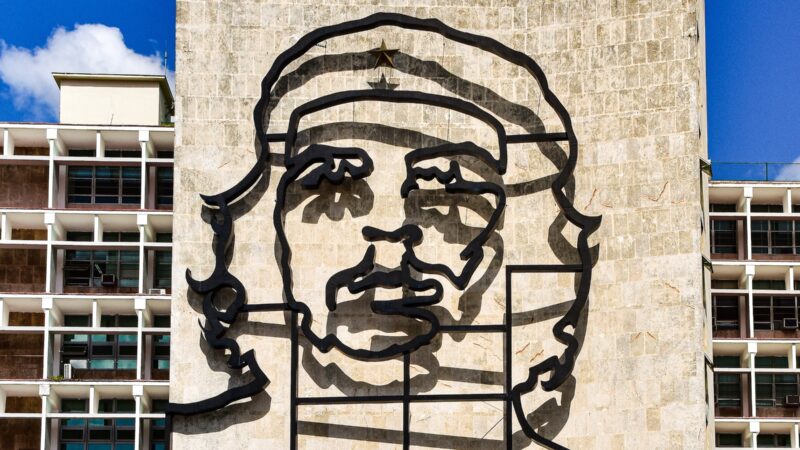
Ernesto Guevara did not become El Che from day to night, he was transformed by his trip around Latin American, radicalized by the poor living conditions of his fellow men, and engaged by the common identity of a single continent from the Rio Grande to Patagonia. It just happens he took to wrong path and he fought for the wrong ideas, and instead of prosperity to the masses, the only things he brought were death and misery, in Cuba, in Angola, and in Bolivia.
His face, now a symbol, still represents carnage and poverty wrapped around an utopian ideal, but ultimately proves the point of this essay: Che was, and still is, a symbol.
We, in the Right, cannot take him for our side, because it would be incoherent and counterproductive, but we must understand what made him as such. Che emerged under the most unlikely conditions and circumstances. Our Che will probably emerge from the most unlikely of the places as well.
Because if one thing is true, that our conflict with the left is indeed a religious fight against a fanatic progressive dogma, then we will also need leaders and martyrs, just like Che was for the Left in the past. We need a Che Guevara of our own.
-
Little Dark Age and Murdering the Author
Roland Barthes’ essay Death of the Author is required reading for many students who wish to study the humanities, such as English Literature. The general thesis of the essay is that narrative intent from the author cannot be discovered as it is impossible to know what the author’s thoughts were at the time of writing. Thus, Death of the Author can be understood to mean “art without the artist” – by the reader is the only true reading. The authority of the author, and therefore the author himself, perishes.
It is an interesting and incredibly influential essay that has played a large part in the development of critical theory over the course of the 20th century. Using this as a basis, it is my belief that we can take the theory further.
Rather than experience the art in a passive way, accepting what the author produces as is, and making our own interpretations from that point, I propose that we instead take an active participation in taking art from the artist and use it to our own ends. This is much easier to do thanks to the internet, and the emergence of meme culture.
It is from meme culture that murdering the author rises. 2016 can be seen as the black swan moment for this with the election of Donald Trump and the reignition of right-wing populism. In this moment, a new breed of meme was born, and it is one of these memes that I think best exemplifies how effective murdering the author can be.
In 2017 MGMT released their song “Little Dark Age”, a protest song lamenting the election of Trump. As the title suggests, the zeitgeist as the artist saw it was regressing back into a period of ignorance, ultimately taking the past 70 years of Progress with it. As recent as 2021 however, the meme remixes of this song have become increasingly popular. The song is used as a backdrop over footage designed to ignite reactionary pride – praise of Christianity and the heroic spirit are commonplace within this. My personal favourites are the ones that glorify the British Empire.
The popularity of the meme is an example of the remix culture unique to the internet, an issue with 21st century creations in general. 21st century art is stunted, and we can only find creative outlets in what has come before. This is a problem with all art and culture in the West, but has been commented on before so I will not belabour the point, except to say that our obsession with nostalgia seems to have left us bereft of creating our own cultural milieu and we are forced to stand blindly on the shoulders of giants.
We are indeed in a little dark age, and MGMT clearly felt that. It just isn’t the dark age they think it is. For a generation of people brought up in countries whose hour of greatness was over, and on whom all the world’s ills could be blamed, it is little surprise that a song like Little Dark Age could be used in the way it did. With lyrics like “Forgiving who you are for what you stand to gain/Just know that if you hide it doesn’t go away”, the song seems to be calling out to those who are trodden on by the current regime, such as political dissidents, delivering the Evolian message of riding the tiger. In the remix culture that epitomises internet trends, this is an example of destroying the meaning of a talented, well intended but misinformed artist and rewiring it for a different purpose.
No matter how MGMT feels about the current political and cultural climate, the fact remains that Little Dark Age is reactionary. It speaks of cultural degradation, inauthenticity – the sense of something being lost. MGMT have put their finger on the pulse, and their diagnosis seems apt – but the wrong patient has died.
Their anger is correct but misdirected, which is why we on the right see the song as something to be hijacked. We are not witnessing the death of the author here – instead, we are the author’s murderers. We are Lenin storming the Tsar’s palace in 1917. We take what is theirs and subvert it to our own ends.
The fact is that reactionary media, be it music, film, literature or television, is entirely hegemonic to the left’s favour. Reactionary discourse is repeatedly shut out of the Overton window, which is panned by boomeresque false idols on one side and comical Marxist villains on the other. In order to make a point, we must use the tools of the enemy. We must be the Vietcong stealing M16s from a US military base. We take from the author what is theirs, deconstruct their arms and create something entirely new using the skeleton of their works.
We are the murderers of the author and this is our strongest weapon.