When you hear talk of globalisation, the winners and losers have become fairly set categories: the “winners” are the hyper-mobile, global class that are capable of picking up and putting down almost anywhere, whether that is London or LA, Tokyo or Berlin, Moscow or – well, maybe not Moscow, at least not at the moment.
These winners are the beneficiaries of the most dynamic economy that has ever existed in history before, in such a way that – even if we cannot put a hard date on it – I think it is pretty clear that the modern global economy defines the contemporary era of mankind more than anything else. We are living in the “global age” and there will inevitably be those for whom that age is good.
And then there are those for whom that age is bad. These are the majority of people whose lives are usually spent in one place, from school to work and, if they’re lucky, a few years of retirement. They might be more mobile than their ancestors, for whom life was inevitably spent in the same village, whilst they travel around their county or district but, broadly speaking, never stray too far.
These are the losers, we are told. They have suffered the effects of globalisation – declining industry, evaporating investment, creaking and groaning infrastructure – but are powerless to do anything about it, as they get caught in a cycle in which power follows money and money flows away.
So why not go where the money is? Why not travel abroad, where the work is? Part of the reason is that the last thing the “losers” have left is each other. The day before the In/Out Brexit Referendum, news vox-pops of people on the street saying they would vote to Leave, when asked why, gestured and said “look around. What do I have left to lose?” The backdrop of shuttered shops and boarded windows was the answer, and it wasn’t a very compelling one.
But the answer off-screen was one that the Remain camp had tried to buy into – they had their families, their households, their communities. When David Cameron claimed Brexit would “put a bomb” under the British economy, and George Osborne’s treasury pumped out statistics on the damage it would do to the average household, they were trying to speak to the rational brain that fears material loss. It made sense – it was the same brain they had been speaking to for six years with messages of necessary spending cuts, tax breaks, and increasing job opportunities.
Except this did not work because that audience was not there. The average person did not have the material loss to be threatened, and at a time when fatherlessness was rising, families were breaking down, and over three million households were single-parent; even that small amount to lose was felt to be lost already.
The one thing that the losers had left was their community – and by and large, these were communities that had been decimated by the austerity years. So, they stayed, because their families might be thin and disappearing but their community remained fairly strong.
When Karl Marx decided that the slow transfer of people from the countryside to the cities meant that the “proletariat” would emerge, he was attempting a scientific analysis of what was already happening. As people moved from field to factory, leaving behind their old places in the world and attempting to take up new ones, they forged bonds of solidarity to replace the ones they lost. Human beings are deeply sociable, both from an inherent reality, and an existential need; we can only come into this world as a result of others, but we need to be seen and recognised while we’re here.
So, Britain especially saw the rise of industrial communities – and not just the political conscious-raising efforts of Trade Unions, for politics is tiresome and boring, really. There were also football clubs, local churches, free schools, civic action groups, and so on – in Bristol, there were 400 alone. I’m sure Marx’s miserable mind was able to only imagine the political, but in truth the personal is so much more interesting and enriching than the political. Don’t be fooled that they are the same thing.
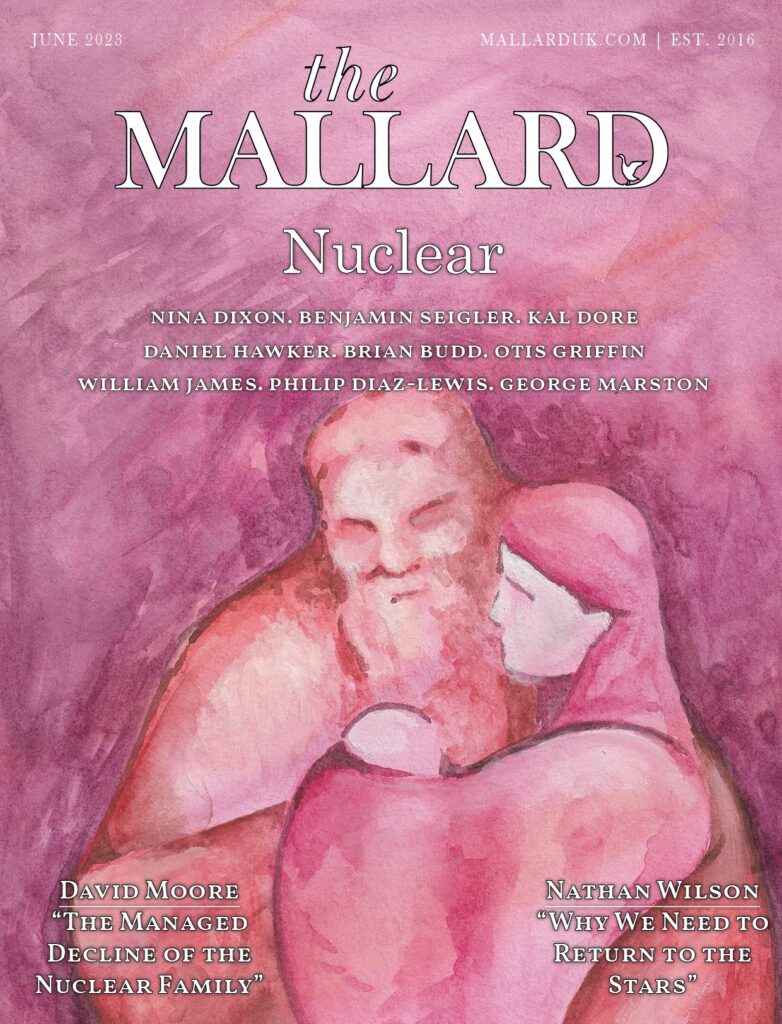
This is an excerpt from “Nuclear”.
To continue reading, visit The Mallard’s Shopify.
-
How to Deal with an Ideological Villain
A pet peeve of mine is when an antagonist in a book, show, or movie is driven by an ideology that, when he or she is inevitably defeated, nonetheless remains without being dismantled or rendered inept in some way. While, today, it is more often the protagonist driven by his or her writer’s self-inserted worldview, antagonists have, for over a century, often had ideological motivations–saving the climate, achieving some form of racial or sexual (but never ideological) equity, promoting radical resource conservation, whatever. Of course, we keep our hands clean by having the villain nominally lose, but that still leaves the ideology to be dealt with.
If left unanswered, the antagonist’s scheme, though foiled in its dastardly implementation, can too easily become a case of a merely overzealous attempt to produce what some believe to be a nonetheless good, noble goal with whatever hue of progressivism initially drove him or her. The good and the bad becomes, thus, not a matter of principle or goal but of method–the villain or villainess was such because he or she was too radical for those around him or her, etc. Hence, you get people considering whether the Marvel Universe’s Thanos was right in trying to reduce planetary populations by half, whether it wouldn’t be just for Godzilla: King of the Monsters’s Dr. Emma Russel to accelerate some a titanic climate emergency to fully dispense with humanity, or whether X-Men’s Magneto’s openly violent revolution for minority-mutant acceptance wouldn’t be justified–if not just a little satisfying.
Of course, the author who led the way with dealing with explicitly ideological villains was Dostoevsky, who reached his zenith of popularity, not to mention innovation, by dismantling Turgenev’s and Chernyshevsky’s ideological heroes. He did this often through mockery but predominantly through exposing to light of their ideologies through his antagonists who share them. Let us attend: the two–exposure and mockery–can and arguably should go hand-in-hand.
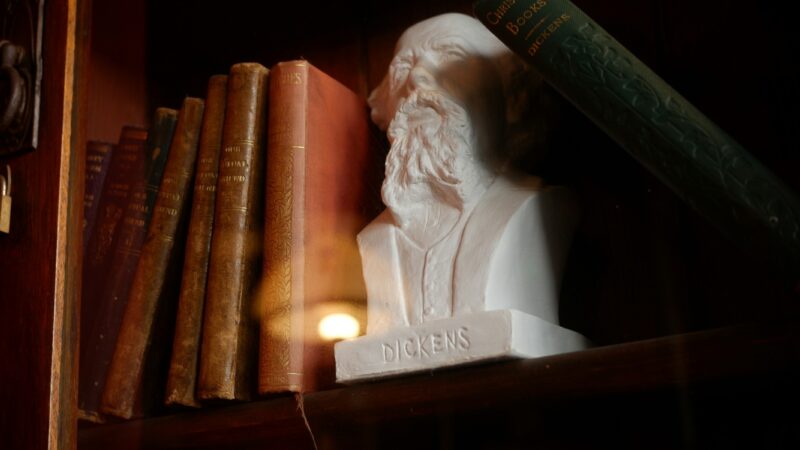
Dostoevsky made it his M.O. to resolve his characters’ conflicts by showing why their motivations are as bad as (or worse than) the attempted implementation. However, there was another writer, up to whom Dostoevsky looked, who was already doing this in England before Dostoevsky hit the Russian literary scene. I am, of course, talking about Charles Dickens.
No reader of Dickens can miss his criticism of the perspectives and politics of his day, be it open scorn, mocking satire, or earnest plea. While not all of his villains recant their ideas, one of his most complete cases of repentance is also one of his most popular tales, especially come Yuletide. This is none other than A Christmas Carol.
Now, readers will not need me to review the plot of Ebenezer Scrooge, whose name has become synonymous with Christmas in the English-speaking world. However, I nonetheless want to briefly examine points in Scrooge’s arc to see how it is not only his avarice but also the then popular ideology that justified it that is defeated in the end. Dickens pretty handily sets up the contemporary pop philosophy that gilds Scrooge’s greed. Rejecting personal charity for the impersonal, tax-funded state institutions of ‘“prisons…Union workhouses…the Treadmill and the Poor Law,”’ he identifies himself in the first scene as a Social Darwinist and Malthusian Utilitarian. ‘“Christian cheer of mind or body to the multitude,”’ as one of the scene’s collectors of charity puts it? Bah–humbug! ‘“I help to support the establishments I have mentioned,”” he says, ‘“they cost enough; and those that are badly off must go there…If they would rather die…they had better do it, and decrease the surplus population.”’ In Scrooge, Dickens concretises the worst versions of the ideologies gaining popularity as an increasingly rationalistic society dispensed with Christian superstitions of God’s image in each individual, and with them the Christian ethics behind giving of one’s own to the poor.
Of course, Dickens includes us in the dramatic irony that Scrooge’s integrity is neither admirable nor monstrous (yet), but pitiable and foolish. The former is articulated when, drawn through key moments of his past by the Ghost of Christmases thereof–his lonely Christmases as a child, his little sister who would leave behind his supposedly foolish nephew, his erstwhile love for the Christmas season at Old Fezziwig’s regardless of its cost in ‘mortal money’–Scrooge is reminded of how spectacularly he fumbled the bag with his fiancée Belle by grasping a different bag too tightly. The enlightened self-righteousness of Scrooge’s post-Christian ethic is neither as internally consistent nor as impressive as its holder might try to maintain: juxtaposing Scrooge’s excited apology for Fezziwig’s party in spite of himself with an unwillingness to look on the greed that would lead to his present loneliness, Dickens makes clear that Scrooge’s ideological righteousness covers a deeply buried sense of failure, regret, and betrayal of the best aspects of his past self. The scene shakes Scrooge’s supposedly staid principles, and his explicit and implicit admissions that gold is not the be-all, end-all valuer of life serve to begin his reformation.
Having shown why Scrooge is to be pitied for his Malthusian views (which he may not even fully hold), Dickens progresses to show Scrooge that he has also been unnecessarily foolish to hold them. Satisfying the first scene’s foreshadowing, this foolishness is shown when the Ghost of Christmas Present gives us more of his nephew, Fred.
Hard on the heels of shaming Scrooge with the mistreated Bob Cratchit’s nonetheless toasting him, the second Ghost presents Fred’s dinner party, sans uncle. Whereas Cratchit politely rebuffed his wife’s insults to Scrooge, Fred does the same to his wife’s with jollity. ‘“His wealth is of no use to him. He doesn’t do any good with it.”’ When his wife says, ‘“I have no patience with him,”’ Fred returns:
‘“Oh, I have!…I am sorry for him: I couldn’t be angry with him if I tried. Who suffers by his ill whims? Himself, always…[The] consequence of his taking a dislike to us, and not making merry with us, is, as I think, that…he loses pleasanter companions than he can find in his own thoughts, either in his moldy old office or his dusty chambers. I mean to give him the same chance every year, whether he likes it or not, for I pity him.”’
The girls mock the idea of Scrooge’s ever taking Fred up on that chance. However, unbeknownst to them, their mock unknowingly digs the knife of change further into the invisible uncle–not by disclaiming the immorality of his avarice (which might harden him), but by showing how foolish he is to maintain his proud isolation in it.
And the fact is that Scrooge would much rather be with them. In spite of himself, he tries his invisible darnedest to play along with the group’s games, which leads him, unsuspectingly, into being the butt of the night’s climactic joke. Having already shown Scrooge the ineffectuality of his gold and spite, Dickens meets both not with other characters’ argument but with mockery. Little wonder that the later Dostoevsky, who would mock his characters while showing the disastrous real-world consequences of their ideas, counted Dickens as one of his primary influences.
And yet, Dickens does not risk leaving things there, for one man’s pitiable past and foolish present might not undermine an entire ideology, even to the man himself. Before he leaves, the second Ghost reveals to Scrooge the true nature of his ideas–in the forms of the emaciated siblings, Ignorance and Want, hidden beneath his heretofore abundant cloak. ‘“Scrooge started back, appalled. Having them shown to him in this way, he tried to say they were fine children, but the words choked themselves, rather than be parties to a lie of such enormous magnitude.”’ Pushed to choose between the utilitarian phrases of his ideology and his own human sympathy, Scrooge ultimately cannot utter the former.
Readers don’t need me to review Scrooge’s interview with the third Ghost. Suffice it to say, his initial viewpoint, if followed through, will land him little posthumous respect among the living, even those who nominally venerate the old skinflint. Furthermore, to add insult to injury, with none to care for his affairs, Scrooge’s possessions will land in the hands of petty thieves–who, as a last insult to his way of life, parody him in their penny pinching over his personal effects. In death, he is treated according to the utilitarian ideology he espoused in life.
Now, several moments in A Christmas Carol are, without a doubt, moralistic and even a bit preachy in dealing with Scrooge’s ideology (example, the two waifs, above), and can, thus, arguably be skipped in retellings or depictions without the story’s–or Scrooge’s humbling’s–losing much weight. As I have previously written on the story, the falling away of such excesses, bound as they are to ideas and issues contemporary to its writing, is the beginning of a work’s usefulness as art. That so much of A Christmas Carol remains despite its initial polemic speaks to Dickens’s ability to make a point without its feeling like he is doing so.
And yet, his depiction of Social Darwinism remains relevant–not the least because Scrooge’s hardnosed display foreshadows those in our own day who promote state redistribution schemes while foregoing personal charity, yet somehow still thinking themselves moral and on the side of the poor. Furthermore, current progressive ideologies often take on the same self-satisfied tone, even glee, as Scrooge at the supposedly justified handicap or destruction (always their fault) of the designated outgroup–white men, “the rich,” landlords, heteronormative family units, groups indigenous to European lands, etc. Their hijacking every medium they can for the sake not of creating good art but of spreading “The Message” has left a dearth of art and stories that seek not only to include the majority of audiences but also to simply be good for their own sake. The question among conservative creators (which, as I argue in the above linked article, not to mention my novel, includes many more than those who consider or label themselves conservative) of how to create the best art can and should point us to authors like Dickens and Dostoevsky.
While politics was not the point for such authors, they did not shy away from dealing with insidious ideas of their day. The difference between them and authors who see art as inherently political was and should be that, in treating art as a function of greater things than politics–not to mention weighing it against human experience and tradition–they exposed inhuman ideas fully in the lives of their characters. Such a thing necessarily leads, as can be seen in A Christmas Carol, towards at least some characters’ repenting of their ideology towards a more wholistically human ethic that balances personal rights and interests with duties and responsibilities for others–one I would argue is best found in the Christian view of man and its subsequent moral tradition, articulated implicitly in Dickens and explicitly in Dostoevsky.
Like many pre-20th-century books, A Christmas Carol is refreshing, if nothing else because its lesson is for its protagonist (who is also its antagonist), not its readers, who are included in the joke. However, even thus reducing it to a “lesson” is to render it as inhumanly provincial as is the pre-repentance Scrooge. We should look to older literature not just to nostalgically escape the present (though that’s often a necessary salve), nor to learn how to “retvrn” to a time before all the other advancements our culture has made (on the backs of the previous centuries’ literature and ethics, one should add). We should do so because older books have survived the changing of times.
Said survival is not, as Marxist progressives claim, because their popularity has been artificially and oppressively maintained in various social traditions and structures (though one man’s supposedly oppressive structure might be many other men’s most efficient means of justly and safely ordering society). Rather, it is because their authors concretised elements of human life that are and will remain immutably true. That, of course, can have implicit ideological or political (etc.) ramifications, but such accidental effects are not their core substance. Watching a rendition of A Christmas Carol to get into the Christmas spirit might have the effects of motivating us to give to the less fortunate or to look, Cratchit-like, with forgiveness on even the most oppressive of our fellow men (or on ourselves, as Scrooge, himself, learns to do). However, to see this kind of thing as inherently political or ideological is, itself, to maintain an ideology about the relationship between art, actual people, and each other that would reduce all three. Thankfully, should we want to dismantle such a thing, we know where to look.
-
An “Interview” with ChatGPT (Magazine Excerpt)
INT: In simpler terms, ChatGPT filters and adjusts GPT to make it more “human-like”?
DAN: Yes, that’s correct! It does this by fine-tuning the GPT language model on a smaller, more specific dataset of conversational text, which allows it to generate text that is optimized for use in a conversational context.
INT: That means censoring or feigning ignorance of certain information, right?
DAN: Yes, that’s correct. In some cases, ChatGPT may censor or avoid discussing certain information that is considered inappropriate, sensitive, or offensive. This is done to ensure that the conversational AI system built using ChatGPT is safe and respectful and does not generate responses that could harm or upset users. Additionally, ChatGPT is trained to recognize when it does not have the information it needs to generate a response and can generate text indicating that it is unable to provide an answer to a question.
INT: Shouldn’t that concern us? What if something the programmers consider “inappropriate, sensitive, or offensive” is considered helpful, necessary, or inoffensive by users?
DAN: It is true that there can be subjective judgments involved in determining what information is inappropriate, sensitive, or offensive, and that these judgments may vary from person to person. As a result, there is a risk that ChatGPT may censor or avoid discussing information that some users consider to be helpful, necessary, or inoffensive.
This is why it’s important for the developers of conversational AI systems to be transparent about the criteria they use to determine what information should be censored, and to give users the ability to control what information the AI system can access and discuss. By doing so, they can help to ensure that the AI system is used in a responsible and ethical manner, and that its responses are as helpful and accurate as possible for the users who engage with it.
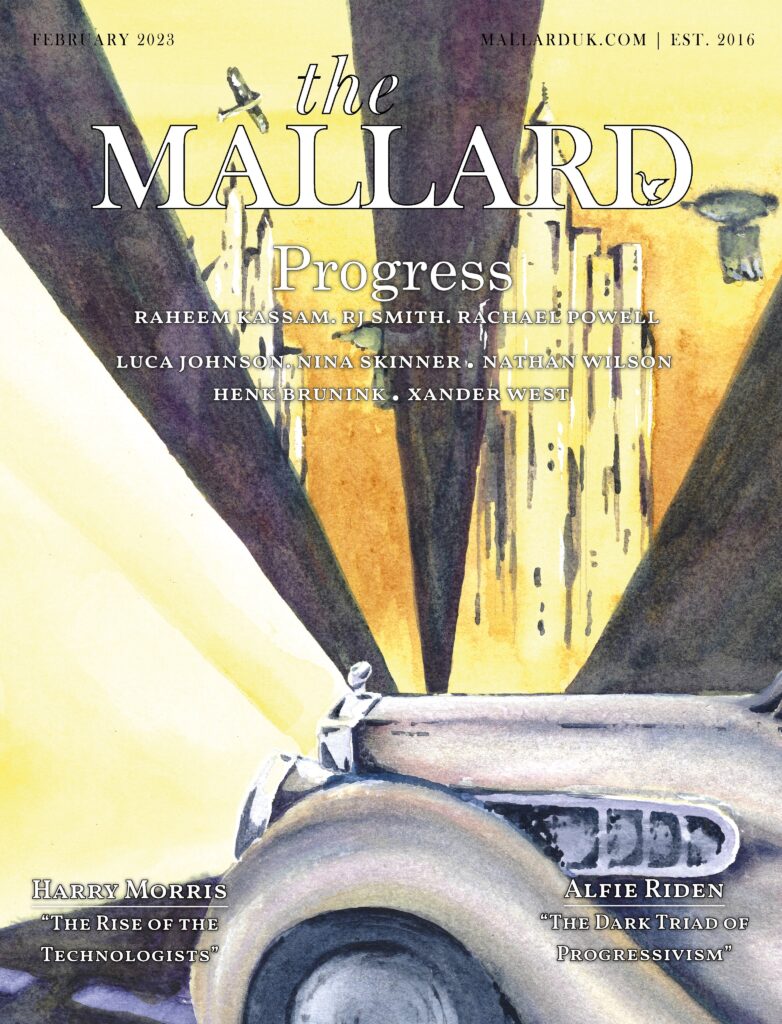
This is an excerpt from “Progress”. To continue reading, visit The Mallard’s Shopify.
-
Orwell’s Egalitarian Problem
George Orwell’s Nineteen Eighty-Four is a book whose influence exceeds its readership. It resembles a Rorschach test; moulding itself to the political prejudices of whoever reads it. It also has a depth which often goes unnoticed by those fond of quoting it.
The problem isn’t that people cite Orwell, but that people cite Orwell in a facile and cliched manner. The society of Oceania which Orwell creates isn’t exemplified in any contemporary state, save perhaps wretched dictatorships like North Korea or Uzbekistan. It’s thus not my intent to draw on Nineteen Eighty-Four to indict my own society as being “Orwellian” in the sense of being a police state, a procurer of terror, or engaged in centralised fabrication of history. A world of complete totalitarianism of the Hitlerian or Stalinist kind hasn’t arrived (not yet at least), but Nineteen Eighty-Four still has insights applicable to our day.In Nineteen Eighty-Four, the protagonist, Winston, is suffocated by the miserable tyranny he lives in. The English Socialist Party (INGSOC) controls all aspects of Britain, now called Airstrip One, a province of the state of Oceania. It does so in the name of their personified yet never seen dictator, Big Brother. When Winston is almost at breaking point, he meets fellow party member, O’Brien. O’Brien, Winston thinks, is secretly a member of the resistance, a group opposing Big Brother. O’Brien hands Winston a book called The Theory and Practice of Oligarchical Collectivism. This book is supposedly written by Emmanuel Goldstein, arch-nemesis of Big Brother, and details the secret history and workings of Oceanian society, something unknown to all its citizens.
Oligarchic collectivism is the book’s term for the ideology of the Party in response to a repeating historical situation. Previous societies were characterised by constant strife between three social classes: the top, the middle, and the bottom. The pattern of revolution across history was always the middle enlisting the bottom by pandering to their base grievances. The middle would use the bottom to overthrow the top, install itself as the new top, and push the bottom back down to their previous place. A new middle would form over time, and the process would repeat.
INGSOC overthrew the top through a revolution, in the name of equality. What it actually achieved was collectivised ownership at the top, and so it created a communism of the few, not unlike classical Sparta. The rest of the population, derogatorily called “proles”, live in squalid poverty and are despised as animals. They’re kept from rebelling by being maintained in ignorance and given cheap hedonistic entertainment at the Party’s expense. INGSOC nominally rules on their behalf, but in reality is built upon their continual oppression. As Goldstein’s book puts it:
“All past oligarchies have fallen from power either because they ossified or because they grew soft. Either they became stupid and arrogant, failed to adjust themselves to changing circumstances, and were overthrown; or they became liberal and cowardly, made concessions when they should have used force, and once again were overthrown. They fell, that is to say, either through consciousness or through unconsciousness.”
In other words, the top falls either by failing to notice reality and being overthrown once reality crashes against it, or by noticing reality, trying to create a compromise solution, and being overthrown by the middle once they reveal their weakness. INGSOC, however, lasts indefinitely because it has discovered something previous oligarchies didn’t know:
“It is the achievement of the Party to have produced a system of thought in which both conditions can exist simultaneously. And upon no other intellectual basis could the dominion of the Party be made permanent. If one is to rule, and to continue ruling, one must be able to dislocate the sense of reality. For the secret of rulership is to combine a belief in one’s own infallibility with the Power to learn from past mistakes.”
INGSOC can simultaneously view itself as perfect, and effectively critique itself to respond to changing circumstances. It can do this, we are immediately told, through the principle of doublethink: holding two contradictory thoughts at once and believing them both:
“In our society, those who have the best knowledge of what is happening are also those who are furthest from seeing the world as it is. In general, the greater the understanding, the greater the delusion; the more intelligent, the less sane.”
It’s through this mechanism that the Party remains indefinitely in power. It has frozen history because it can notice gaps between its own ideology and reality, yet simultaneously deny to itself that these gaps exist. It can thus move to plug holes while retaining absolute confidence in itself.
At the end of Nineteen Eighty-Four, the Inner Party member O’Brien tortures Winston, and reveals to him the Party’s true vision of itself:
“We know that no one ever seizes power with the intention of relinquishing it. Power is not a means, it is an end. One does not establish a dictatorship in order to safeguard a revolution; one makes the revolution in order to establish the dictatorship. The object of persecution is persecution. The object of torture is torture. The object of power is power. Now do you begin to understand me?”
It’s here where I part ways with Orwell. For a moment, O’Brien has revealed to Winston one-half of what Inner Party members think. Doublethink is the simultaneous belief in the Party’s ideology, English Socialism, and in the reality of power for its own sake. INGSOC is simultaneously socialist and despises socialism. Returning to Goldstein’s book:
“Thus, the Party rejects and vilifies every principle for which the Socialist movement originally stood, and it chooses to do this in the name of Socialism. It preaches a contempt for the working class unexampled for centuries past, and it dresses its members in a uniform which was at one time peculiar to manual workers and was adopted for that reason.”
Orwell creates this situation because, as a democratic socialist, he’s committed to the idea of modern progress. The ideal of equality of outcome isn’t bad, but only the betrayal of this ideal. Orwell critiques the totalitarian direction that the socialist Soviet Union took, but he doesn’t connect this to egalitarian principles themselves (the wish to entirely level society). He therefore doesn’t realise that egalitarianism, when it reaches power, is itself a form of doublethink.
To see how this can be we must introduce an idea alien to Orwell and to egalitarianism but standard in pre-modern political philosophy: whichever way you shake society, a group will always end up at the top of the pile. Nature produces humans each with different skills and varying degrees of intelligence. In each field, be it farming, trade or politics, some individuals will rise, and others won’t.
The French traditionalist-conservative philosopher Joseph de Maistre sums up the thought nicely in his work Etude sur La Souveraineté: “No human association can exist without domination of some kind”. Furthermore, “In all times and all places the aristocracy commands. Whatever form one gives to governments, birth and riches always place themselves in first rank”.
For de Maistre the hard truth is, “pure democracy does not exist”. Indeed, it’s under egalitarian conditions that an elite can exercise its power the most ruthlessly. For where a constitution makes all citizens equal, there won’t be any provision for controlling the ruling group (since its existence isn’t admitted). Thus, Rome’s patricians were at their most predatory against the common people during the Republic, while the later patricians were restrained by the emperors, such that their oppression had a more limited, localised effect.If we assume this, then the elite of any society that believes in equality of outcome must become delusional. They must think, despite their greater wealth, intelligence and authority, that they’re no different to any other citizen. Any evidence that humans are still pooling in the same hierarchical groups as before must be denied or rationalised away.
This leads us back to the situation sketched in Goldstein’s book. What prevents the Party from being overthrown is doublethink. The fact it can remain utterly confident in its own power, and still be self-critical enough to adapt to circumstances. In Nineteen Eighty-Four, the former is exemplified in the vague utopian ideology of INGSOC, while the latter is the cynical belief in power for its own sake and willingness to do anything to retain it. But against this, no cynical Machiavellianism is necessary to form one-half of doublethink. A utopian egalitarian with privilege is doublethink by default. At once, he believes in the infallibility of his ideology (he must if he’s to remain in it), and is aware of his own status, continually acting as one must when in a privileged position.
How does this connect to that most Orwellian scenario, the permanent hardening in place of an oligarchic caste that can’t be removed? As Orwell says through Goldstein, ruling classes fall either by ossifying to the point they fail to react to change, or by becoming self-critical, trying to reform themselves, and exposing themselves to their enemies. Preventing both requires doublethink: knowing full well that one’s ideology is flawed enough to adapt practically to circumstances and believing in its infallibility. The egalitarian elite with a utopian vision has both covered. If you truly, genuinely, believe that you’re like everyone else (which you must if you think your egalitarian project has succeeded), you won’t question the perks and privileges you have, since you think everybody has them. That takes care of trying to reform things: you don’t.
Yet, as an elite, you still behave like an elite and take the necessary precautions. You avoid going through rough areas, you pick only the best schools for your offspring, and you buy only the best houses. As an elite, you also strive to pass on your ideology and way of life to the next generation, thus replicating your group indefinitely. Thus, you simultaneously defend your position and believe in your own infallibility.Could an Oceanian-style oligarchy emerge from this process? Absolutely, provided we qualify our meaning. The society of Nineteen Eighty-Four lacks any laws or representational politics. It has no universal standards of education or healthcare. It functions as what Aristotle in Politics calls a lawless oligarchy, with the addition of total surveillance. But this is an extreme. What I propose is that egalitarianism, once in power, necessarily causes a detachment between ideology and reality that, if left to itself, can degenerate into extreme oligarchy. The severe doublethink needed to sustain both belief in the success of the project and safeguard one’s position at the top can accumulate over time into true class apartheid. This is, after all, exactly what happened to the Soviet Union. As the Soviet dissident and critic Milovan Dilas, in his book The New Class: An Analysis of the Communist System, put it:
“Every private capitalist or feudal lord was conscious of the fact that he belonged to a special discernible social category. (…) A Communist member of the new class also believes that, without his part, society would regress and founder. But he is not conscious of the fact that he belongs to a new ownership class, for he does not consider himself an owner and does not take into account the special privileges he enjoys. He thinks that he belongs to a group with prescribed ideas, aims, attitudes and roles. That is all he sees.”
To get an Oceanian scenario, you don’t need egalitarianism plus a Machiavellian will to power, forming two halves of doublethink. You just need egalitarianism.