A Premise:
Deep, and yet deeper down, below the marsh slime and the swamp rot, even underneath poppy roots and the granite rows, Old England’s Foundations lie. While thinned and turned soils are cold and damp, the fiery Mantle warms and pulses, twisting round and circling on itself; the Core sees into itself and ponders on its shadows; to reach out into the cold and dark, hope perchance to find new wheels to turn, or perhaps not. Content, in the underworld, dreaming of the pictures of its marble face, Old England’s Foundations are buried the deepest, overwritten by thin and beaten sheets of plaster and tissue paper.
Yet, this is a fantasy: circumstantial myths of Old England, and its Foundations. Those marshes were sealed, and the swamps became roads, and the shapes and the names of the trees do not matter anymore. Accumulated plays turned in on themselves and became a meaningless fresco; the hand-me-down uniform, hoarded in poverty, with no weavers to craft anew. That Core is no form but a feeling, fleeting and shallow, giving only the image of warmth. Gawp at the statues and the towers and the gold on the wall. They were never yours.
Intermission, The Alchemists’ Folly:
Higher, and yet higher so, far reaching beyond the sea and above the clouds, up and up Nature’s Ladder, climbs a Champion. For all its power and glory. He soon received the ravenous attention of The Crow, the most cunning of all the birds. It said: “I have seen many climb, and their plans dissolved away, but wear my feather, and sing my song, and Nature’s sure to play”. The Crow put a feather on The Champion’s shoulder, and The Champion cawed until he had near reached the clouds. He looked down to measure his climb, and one cheek was slashed by The Crow’s feather; he saw many other smaller birds with more beautiful sounds and colours than The Crow, hiding fearfully away in their nests.
Higher and higher, between the feathers and the stars, up The Ladder, climbed The Champion. The clouds from below were sunlit pillars in the sky yet seemed smoke and fog inside. At once, the guiding stars were blotted out, and The Champion was frozen in the dark. He begged it clear, and The Cloud said: “Truly, Nature loves to hide, and seems at first a chaos sight, but learn its ways, obey and pay, by water’s path will light”. The Champion’s waterskin was plucked by a gale, and The Cloud gave in credit due a magic hailstone, and it magnified the light of the stars. His fingers were cold and heavy, his water was lost, and the constellations seemed more twisted than ever before; but, with the dim path seen by magic divined, The Champion waged on.
An earthquake struck, and The Ladder path fell; weathered wood, by many footsteps heeled, shattered with the turning of a generation. His bearing steers all amiss under the dizzying constellations, for the old way is no more; and The Champion loses their footing, curses the folly, and plummets into brine under the bottommost rungs; championing, no more. The Fool who works with wood and nail, at the bottom of The Ladder, did not build houses that day, for another ladder was built by him; and The Fool then propped it, already to seize the opportunity, to climb the path again. But The Cloud and The Crow remain in their Nature, as they wait between the salt and the stars.
Their Conclusion:
Hailing practice and ritual, making nothing new, and the new, ugly; what comes from a fool’s history? Yesterday’s legislation becomes today’s tradition, and old and common habits are preserved by kitsch committee. To justify what happened, because it happened, accounting to stacked sediments of past scoresheets? If that is good, then good is evil; bored eyes make nothing beautiful around our empty hands, so we make eternities of nothing, and are compassed about by our enduring appetites. With Nature as your sentimental measure, you pay tribute to accidental shadows on the wall. Where is The True, The Good, The Beautiful? God have mercy on your windswept souls.
-
A Romantic Case for Anime
We’ve all felt it—the mixed excitement and dread at hearing a beloved book is set to be made into a movie. They might do it right, capturing not only key plot events but also (and more importantly) how it feels to be swept up in the work as a whole; 2020’s Emma with Anya Taylor-Joy comes to my mind, most of all for the way it captures how someone who understands and loves Austen’s ubiquitous irony might feel when reading her work. However, they also might do it poorly; despite both 1974 and 2013 attempts’ being worth watching, I’ve yet to see a rendition of The Great Gatsby that captures the book’s plot and narrative tone in the right proportion (in my opinion, the 1974 version emphasizes the former but misses some of the latter, while parts of the 2013 version exagerrate the latter just to the border of parody). My readers have, no doubt, already imagined examples of works they’ve always wished could be faithfully put onto the screen and others they’d rather not be risked to the vicissitudes of translating from one medium to another.
The last decade has thankfully seen a growth in long-form, box-office quality productions that makes it more possible than ever to imagine longer works being produced without curtailing their lengthy plotlines—example, the BBC’s 2016 rendition of War and Peace. However, this leaves another, perhaps more important, hurdle to hazard: while live-action media can now faithfully follow the plots of the originals, there still remains the difficulty of conveying the tone and feel of the works, especially when different media necessarily have different capacities and limitations of representation. Though I’ve enjoyed productions that have been made, I don’t know that I would expect live-action renditions to reproduce the aesthetic impression of, say, Paradise Lost, The Hunchback of Notre Dame, or Crime and Punishment, and I worry that attempts to do so might mar more than measure up. The problem lies in the difficulty of translating characters’ inner experience—which is usually conveyed by a stylizing narrator—via the essentially externalistic medium of the camera eye.
While a live action movie or series might remain faithful to the selective events in a plot, the lack of an interpretive narrator removes a key element of what defines epic poems and novels. Paradoxically, the narrowing of perspective through a stylizing narrator allows story to move from the limits of natural events into the limitlessness of human perception and interpretation. Voiceover narrators can provide thematic stylization in film, as well as essential plot coherence, but it is still primarily the camera that replaces the literary narrator as the means of conveyance. Furthermore, if too ubiquitous, voiceovers can separate the audience from the action, which is the focus of film. Film’s power inheres in its ability to place the audience in the midst of a plot, removing as many frames between the watcher and the story’s events as possible. However, this is also why books are so difficult to translate: motion pictures focus on events when the aesthetic experience of literature inheres in how characters and narrator experience said events.
The literary movement that focused most on the character’s experience (and, vicariously, ours) as the purpose of art was Romanticism. Romantic literature and poetry were less concerned about the subject matter than about their effect on the character’s emotions—in the sense that, from the generally Platonic metaphysics of the Romantics, the incidental reaches its fullest meaning by provoking an aesthetic experience far beyond it. From Hawthorne’s rose bush growing outside Salem’s prison, to Shelley’s secondhand rumination on the ruined feet of Ozymandias, to Keats’s apostrophe to the Grecian urn, the Romantics showed how part of the reality of an object involves its significance to the observer, and it was the role of the Romantic narrator and speaker to draw out that effect for the reader.
It is this essential influence of the narrator and characters’ inner lives on the great works’ aesthetic experience that makes me skeptical of even the best acting, camera work, and post-production effects to sufficiently replace them. It may be possible, and, again, I have very much enjoyed some renditions. Furthermore, not wanting to be the audience member who misses the Shakespeare performance for the open copy of the play on their lap, I tend to watch movie adaptations as distinct works rather than in strict relation to the originals. However, this, itself, may be a concession to my hesitance to trust film to live up to the aesthetic experience of certain books. I would, however, trust anime to do so.
While a history of Japanese manga and anime is beyond the scope of this piece (or my expertise), since choosing to explore the artform as a post-grad-school reward (or recovery—one can only stare at the sun that is Paradise Lost for so long) I’ve watched plenty of anime over the past ten years, and I have become convinced that it might serve as, at least, a middle ground when seeking to capture plot, narrative tone, and inner character experience in a motion medium. Anime is capable of handling virtually every story genre, and while it contains many of the same ridiculous hi-jinks and satire of Western cartoons and CG animation, it can also capture tragic pathos and sublime catharsis in ways that would be out of place in the vast majority of Western animation. This makes sense: originating in early 20th-century Japan, manga and anime were not subject to the same skepticism about artistic representations of transcendent value that characterized Western art after the move from 19th-century Romanticism and Realism to 20th-century modernism and post-modernism.
Of course, there have been exceptions; 20th-century Disney animation, or Marvel and DC Comics, were iconic because they attempted to be iconic—they unironically tried to depict in images those values and stories that are transcendent. However, even these were created predominantly with the child (or the childlike adult) in mind. Furthermore, while anime certainly has deserved elements of ambivalence, if not cynicism, and while there are many incredibly satirical and humorous series, anime as an artform is not implicitly dismissive of narrative trustworthiness and characters’ experience of the transcendent in the same way that much of Western motion art is. Rather, anime conventionally allows for the sublime heights and deepest horrors that previously characterized Romanticism, all of which it presents through the stylization of animation. This stylization is able to act as an interpretive medium just like a novel’s narrator, contextualizing events through the experience of those involved in a way often eschewed by, if not unavailable to, film.
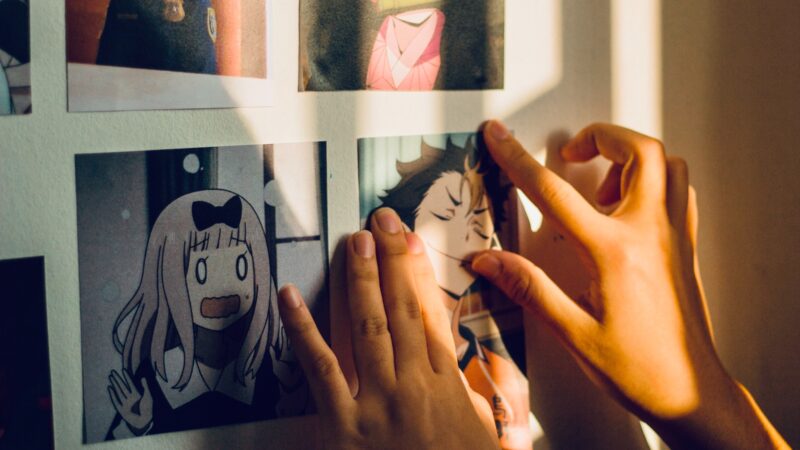
For an example, I submit Kaguya-sama: Love is War (Japanese Kaguya-sama wa Kokurasetai – Tensai-tachi no Ren’ai Zunōsen, “Kaguya Wants to Make Them Confess: The Geniuses’ War of Hearts and Minds”). Though a romantic comedy in the Slice-of-Life genre, it exemplifies anime’s ability to convey the heights and depths of inner experience of the characters—here Kaguya and Miyuki, a pair of high school teenagers who, as student council president and vice president, compete to be top of their class while being secretly in love with each other and too proud to admit it. As the English title conveys, a running metaphor through the show is the bellicose subtext of their attempts to maneuver each other into confessing their love first and, thus, losing the war; think Beatrice and Benedick with the extremizing effect of teenage hormones and motifs of heavy artillery.
Plot-wise, Love is War follows a standard rom-com formula, with tropes recognizable to Western audiences: the pride and prejudices of the characters, the much ado about things that end up being really nothing, the presence of a mutual friend who acts as an oblivious catalist and go-between in the relationship, etc. However, the show reinvigorates these tropes by portraying via hyperbolic narrator the deuteragonists’ experience of the episodes’ conflicts, bringing audience members into the all-consuming tension of how a teenager might see something as minor as whether to share an item from their lunch. The combination of chess and military metaphors conveys the inner conflicts of the initially cold but gradually warming characters (the “tsundere” character type common in such animes), and the consistency of such motifs creates a unified aesthetic that, due in large part to the disconnect between the over-the-top tone and, in reality, low-stakes subject matter, is hysterical. Another unique aspect about Love is War is that, due to its focus on the characters’ experience of the plot (all the better for being trivially mundane), it’s a technically Romantic romantic comedy.
Love is War is, of course, a low-stakes example of what modern anime can do, though it did score three awards, including Best Comedy, at the 2020 Crunchyroll Anime Awards. A more serious example, Death Note, similarly conveys much of its gravitas through voiceover—this time the first-person narration of protagonist Light Yagami, a high schooler who with the help of a book from the realm of the dead is able to kill anyone whose name and face he knows, and L, a mysterious and reclusive detective charged by Interpol to find him. Throughout the series—which employs similar, if non-parodic, attempts by characters to outwit each other as Love is War—Light and L articulate their planned maneuvers and the implications thereof through inner voiceover. Not only does the narration lay out elements of their battle of wits that the audience might have missed, but it conveys the growing tension the two experience—especially Light, who, as he amasses fame as both a menace and cult hero experiences a growing egotism and subsequent paranoia around the possibility of being found out.
Just as Love is War is, in many ways, a parallel of Pride and Prejudice (Elizabeth and Darcy, themselves, both being tsundere characters), Death Note’s focus on a young man who wishes to achieve greatness by killing those deserving of death and who subsequently develops a maddening neurosis is virtually the same as Crime and Punishment—however enormously their plots and endings differ (Crime and Punishment lacks an explicit demonic presence like Death Note’s Shinigami Ryuk, the Death Note’s otherworldly owner; Dostoevsky would not employ the spectre of a conversant devil until The Brothers Karamazov—yet another point of consanguinity between anime like Death Note and his writing). Regardless of their differing plots, the anime’s inclusion of the characters’ inner thoughts and imaginations convey an increasingly tense tone similar to how Dostoevsky steadily shows Raskalnikov’s moral unmooring, and the explanations and attempted self-justifications by both Light and L convey more than I think even the best cinema would be capable of showing.
I am not advocating that every narrative motif or figuration be included in page-to-screen renditions, nor that we cease trying to actively reinvigorate great works of art through judicious adaptations into new media. Yet, if the inner lives of teenagers—which are often exaggerated, if at times unnecessarily, to Romantic proportions—can be portrayed by anime to such comic and tragic effect, with the figuration and tone of the characters’ perceptions seamlessly paralleling the literal events without obscuring them, then I’d be interested to see what an anime Jane Eyre, The Alchemist, or Sula might look like. Based on the above examples, as well as anime heavyweights like Fullmetal Alchemist, Cowboy Bebop, and, if one is not faint of heart, Berserk, all of which present events in some measure through the background and perspective of the main characters, I could imagine the works of Milton, Hugo, Austen, Dostoevsky, and others in anime form, with the aesthetic experience of the original narration intact.
-
The Whitewash – A Review of ‘War on the West’ by Douglas Murray
To begin, it’s worth saying I owe something of a debt to Douglas Murray. He brought me to many of the positions I hold today, and while my overall impression of ‘War on the West’ was disinterest, it is only upon looking back at my own political journey I’m beginning to understand why I felt that way.
‘War on the West’ follows ‘The Madness of Crowds’ and the ‘Strange Death of Europe’ as Murray’s third book discussing the state of political affairs in the Western world. Murray’s thesis is best laid out by Murray himself:
“People began to talk of “equality”, but they did not seem to care about equal rights. They talked of “anti-racism”, but they appeared deeply racist. They spoke of “justice” but they seemed to mean revenge.”
Herein lies the problem with ‘War on the West’, and why I moved away from Murray in my own life: there is no examination of what equality is to mean, what anti-racism is to look like, or what kind of justice is to be enacted, if any. The primary objection Murray has to the armies waging a war on the West is that their vision is not a classically liberal one. Explicitly antagonising white people with terms like ‘white fragility’, ‘white tears’, or ‘white privilege’ is bad because it racialises things Murray believes to have been deracialised by the Civil Rights Movement and other changes that occurred between the 1950’s to early 2000s. In his previous work, Murray uses an analogy of a train of equality pulling into the station, only to careen off down the tracks at a greater speed than ever before without allowing its passengers to get off. Throughout Murray’s work is an unexamined liberalism, that at best, is only ever criticised for being too pure. Liberalism, by its nature, criticises social orders for creating barriers for individuals. The many freedoms the West has provided have always come at the expense of the social orders liberalism eroded. Freedom for women came with the erosion of a patriarchal social order, and took with it the benefits such a system provided – such as the ability to raise a family on one income, a high degree of social trust, and a defined relationship between the sexes. It was inevitable that liberalism would eventually critique itself, and many of the authors Murray cites, from Kendi to DiAngelo, often build on those drawing on Herbert Marcuse and Theodore Adorno. The former was given money by the Rockefeller Foundation, and even worked for what would become the CIA. In many ways, it was Western liberalism with its free flow of capital and revolving door between the academy and influential roles of state that enabled these theories to promulgate.
In his interview with the Telegraph promoting the book, Murray states:
“As long as people are armed with the right facts and the right arguments, I just don’t see how the cultural revolutionaries can win. I don’t know about you, but I’m not spending the rest of my life cringing and being told I’m guilty of things I never did. Not doing it, not guilty.”
This really begs the question of how exactly we got to this position to begin with. What’s most striking about ‘War on the West’ is that it does read almost like a recap of a war. Battlefields are specified, different players and their decisions are named, and Lord knows there are a huge number of casualties in the culture wars Murray describes. But, were the people who permitted things to reach this stage simply incapable of posing arguments against it? In one chapter, Murray notes that claims that America is founded upon stolen land are self-refuting because the many tribes of America stole the land from one another. Are we to believe Americans are so ignorant of their own history that this argument has never been made? Murray himself notes in the conclusion that outlets such as MSNBC and the New York Times will deny that Critical Race Theory is taught in schools, but acknowledge that it exists when forced. There are no arguments that can be used against such a thing.
Left out of ‘War on the West’ is any truly systemic analysis of the problem. The aforementioned New York Times moved to a paywall model in 2011, and from that point forward, the focus on things like ‘racism’, ‘sexism’, ‘homophobia’, and ‘transphobia’ increased many times over. Around this time, legacy media was dying slowly. So newspapers moved from selling papers to many people to selling stories to a niche audience. The niche audience of the New York Times is the kind of cosmopolitan liberal who is very interested in niche identitarian trends, and in pitching themselves as radical while at the heart of the very system they claim to dislike. Despite this being a veritable War on the West, according to Murray, the emergency powers of war are never called upon. There are no calls to take decisive action to halt or prevent these systemic changes that led to this point. And in the conclusion, he defends the same economic system of capitalism that gave the New York Times its power, and forced it to change its business model to appeal to a niche audience of people hostile to Western people.
This attachment to a liberal historiography, in which individuals are given The Arguments and Make The Case, with spontaneous and emergent bottom-up change coming about as a consequence blinds Murray to the economic and legal realities that influence and shape this War on the West. Multiple universities are stated as battlegrounds for this war, but there is not a single mention of the fact universities are public authorities under the Equality Act (2010). That they have an ‘equalities duty’ to publish routine equalities reports, and must legally keep permanent members of staff dedicated to pushing this anti-Western message.
The only law Murray appears to mention in this vein is the Civil Right Act, which he defends as an example of the kind of good equality that he desires. Yet it was the Civil Rights Act which created the Civil Rights Commission, which in 1973 wrote to the Civil Service Commission and had them drop the standards for algebra in order to allow them to hire more non-white civil servants. Similar acts can be found in the UK. The Race Relations Act of 1973 (which performed the same anti-discrimination function as the Civil Rights Act he praises) created the Commission for Racial Equality. Today, the Race Relations Act has been assimilated into the aforementioned Equalities Act, and the Commission for Racial Equality has become the Equality and Human Rights Commission, which forces compliance with the Equalities Duty. There is a clear through-line from the civil rights legislation both in the USA and the UK, to the situation we are in now. The back of ‘War on the West’ reads as follows:
“The anti-Western revisionists have been out in force in recent years. It is high time we revise them in turn…”
Fundamentally however, there isn’t much of a revision of dominant left-wing narratives within ‘War on the West’ at all. Instead, it seeks to remind leftists that their own heroes, from Marx, to Foucault are also not spotless figures. This can only go one of two ways: either they ignore this, and nothing changes, or they recognise this, and move away from those figures, and as a consequence have doubled down on their principles of removing any and all unsavoury figures from public life. Regardless, none of this is at all revisionary, nor does it fundamentally challenge the values and beliefs of the cultural revolutionaries. A truly revisionist view of things would challenge the dominant understanding of things like the Civil Rights Movement, which was not (as Murray describes) people ‘making the case’ for rights, that the American public was so blown away by that they accepted and endorsed. Academic studies like that done on Rosedale show the side of desegregation that was forced upon people, and came at the cost of schools, neighbourhoods, communities and lives. Rosedale was a segregated community, but desegregation and the tensions that came with it made it difficult for authorities to maintain peace. The result was that many of the former residents who didn’t move out of their homes, found themselves the victims of racial violence by those who moved into the area, and had no regard for the police, who stopped policing the area out of fear of creating tensions. When Brown v. The Board of Education ended the desegregation of schools in America, and people protested, the national guard was sent in to disperse the crowd at gunpoint.
All of these changes were not the natural unfolding of human progress. They came today as they did in the civil rights movement, through force. Eisenhower and the national guard did not make the case for desegregation in light of Brown, they imposed it down the barrel of a gun. Whether that was right or wrong is irrelevant, that fact alone disproves the notion Murray insists upon in his recent public life – that the train of equality was chugging along gently, and only recently got out of hand. Equality is not a train chugging along set tracks, it is an amorphous blob that seeks to desacralise everything and dissolve all boundaries between all things. It does not progress in one direction alone, like a train, but expands in all directions and infects all things, including our supposedly right wing public figures.
In light of this, I still see some utility in Douglas Murray. Challenging double standards and hypocrisy is a cheap tactic which ultimately will not defeat those Murray opposes. Yet it is often the first chink in the armour for many people. I know I first came to move away from liberal beliefs because I found them to be contradictory, it was only in time I rooted out my own inherently liberal views, and ultimately moved to the political views and positions I hold now. In this respect, Murray is useful – he can confirm people’s suspicions about the modern left, and give them comfort that there is a public figure who opposes these things. It’s incumbent upon people with more bravery and introspection to take that one step further, and marry it with a systemic analysis of the situation, and propose and action a plan to undo these things and institute something new in its place.
-
Flying Cars are a Terrible Idea
Last month, former President Donald Trump made a video announcement about his plans to implement a ‘quantum leap forward’ policy to increase the standard of living in America. He boldly harkened back to the days of Manifest Destiny, of an America that once tamed a continent and built incredible cities from coast-to-coast.
In a video address detailing this policy, the plan is to build new “Freedom Cities” that would be built on pre-existing government-owned land. A way for the American Machine to be restarted once again, to help revitalise the economy through domestic infrastructure projects, bringing back large-scale industrial manufacturing to the United States, and hopefully drawing citizens who are struggling in their own states with rental traps and shoddy housing opportunities to start anew in these proposed cities.
“Reigniting American imagination” as Trump himself puts it.
Personally, I think this is a great idea. It is high time that the United States needs a project such as this to really kick things into gear and realise just what Americans are capable of building when they are not distracted by foreign wars, social malaise, and being at each other’s throats.
Trump’s plan could act as a foundation to creating classically-designed, bold and truly great examples of American civil engineering and architecture. Not only this, but by perhaps emphasising walkable cities, with a second-to-none public transport network (my formerly proposed Great American Hyper-Rail) – it could serve as an inspiration for other American cities to change for the better.
An American city that could be free from needless congestion, have architecture that challenges the glass-and-steel shitboxes for dominance, and creates real job opportunities and a sense of community for the younger generations would be a very welcome change indeed.
Moreso, if conservatives and reactionaries populate these cities primarily (if not exclusively), they could act as much needed metropolitan safe-zones free from the common strife as well as the severe and petty crime that infects most of urban America today.
While we may not have control of the cities today, it doesn’t mean that we can’t create our own cities tomorrow to act as a powerbase for us to focus our efforts and project them onto rival cities.
All in all, a great and visionary proposal from President Trump.
However there is one thing that was tacked-on to this announcement which has me confused, if not completely mortified by.
Trump proposed that the United States should become the leader in developing ‘vertical take-off and landing’ vehicles – VTOLs, for short. He mentioned that currently “Chy-na!” is spearheading current developments of this technology, for both military and civilian use.
Now, while I get excited by the idea of Jetson-style vehicles as much as the next bloke, tutting along in big glass-domed vehicles. But I can’t help but think that having VTOLs becoming widely available for public and government use is, simply put, a fucking terrible idea.
I may sound like a luddite here, but I ask you to reflect on the changing nature of personal transport in just the last 100 years.
The car and combustion-engine, great inventions as they are (and one that I am demonstrably pro), have completely reshaped the way we get around. From the way our cities are laid out, to the way we travel across the country. We have reshaped entire landmasses to be more suited to automobiles – detonating mountains, building massive highways and turnpikes over natural landscapes. It has completely and possibly irreversibly changed both the aesthetic and function of the natural landscape that human-beings inhabit forever.
There are few areas now in nature where you can look over an unspoiled landscape that hasn’t been in some way corrupted by roads, highways, or massive bridges. The places that are few and far between, and they are hard to reach by design.
The whole point of going on massive hikes like the Appalachian Trail for example, is to get away from these reminders of modernity and industry. If we had VTOLs readily available for anyone to use, these final frontiers of natural escape would be corrupted by the sounds of engines, and the sights of zooming aerial vehicles overhead.
It’s bad enough already when you see hordes of foreign tourists powering up their obnoxious drones drowning out the songs of the birds or the sound of the wind through the trees, or teenagers with loudspeakers blasting grime or whatever unpleasant trap shit that comes onto their Spotify.
Imagine that same annoyance, amplified, en masse and inescapable. To look over a landscape, and to see lines of VTOL traffic from one end of the horizon to the other.
I’d be inclined to shoot these aerial vehicles down in whatever way I could, fully embracing the primal nature that has long been cornered and dormant, finally being unleashed when all sense of greenery and the peace of nature has been corrupted.
Not only this, but aerial vehicles means aerial billboards.
Hell, it’s already starting to happen across the world – massive drone light displays sponsored by our corporate overlords carpeting the sky and blocking our view of the stars. The sky, long-untouched other than by those who are able to navigate it by plane, will simply become another piece of real-estate to be bought up.
Who has the rights to the sky? Those who can afford it, of course.
I can’t think of anything worse than being forced into a scenario where I also have to purchase the real-estate over my house in order to avoid being pestered with unwanted ads, VTOL trespassing, and eyes in the sky.
Perhaps that last example is a little dramatic, but I find it easier to rule nothing out these days, no matter how ridiculous.
The final aspect of why personal VTOLs are such a terrible idea is that it’s completely impractical. With aerial traffic already incredibly congested by planes (look on a free online plane-tracker if you don’t believe me) how does anyone sensibly propose the idea that giving everyone access to the sky won’t lead almost inevitably to disaster?
Car accidents are frequent enough as it is – I can only imagine how much worse, and deadly, they’d be in the sky.
Well to avoid all these issues there would have to be certain controls. Limitations on altitude, certain lanes that aerial vehicles must stick to to avoid collisions, speed limitations, etc, etc. Congratulations, you’re doing all the things that you would’ve been doing in a car anyway, except you are doing them 30-40 metres in the air instead. Such a revolutionary change!
Not to mention, what are these vehicles supposed to look like?
Will they be jet-powered? Say goodbye to little Timmy’s face after he accidentally was standing under one that was flying too low coming in for a landing, and say hello to a frequency of forest-fires!
Will they be powered by rotary propellers? Incredible! You’ve reinvented the helicopter! True leaps and bounds in technology!
Compared to “flying cars”, even personal jetpacks look like more sensible and well thought-out solutions to our current transport problems. Realistically, the only practical implementation of VTOL technology would be usage through military application – and, practically speaking, it already exists through helicopters.
The idea is silly – so how Trump has seriously considered it to the point of outlining it in a policy video makes me laugh. I do sincerely hope that it will remain a mere gimmick of the “futurist” dream, rather than become a reality that will make the world a considerably worse place.