In the throes of the culture wars, it’s easy to get acclimated to the situation after some time has passed. It feels like a lifetime ago that the battlefield that has become of the issue of transgenderism was little more than a few videos on YouTube imploring viewers to cringe at ‘Die Cis Scum’, and if anything demonstrates the futility of the adage ‘twitter is not real life’, it would be the recent admission from Jamie Wallis that he considers himself a woman.
There is almost certainly some kind of meaning to the fact that Jamie’s desire to be a woman emerged after he was raped, as though he psychologically associates a lack of autonomy to womanhood. But I am not a psychologist, and Jamie’s warped feelings about his identity are irrelevant in and of themselves. What this turn of events creates however, is a moment of Decision for the Conservatives.
For a long time, the Conservatives have enjoyed playing both sides of the culture wars. At conference, they can laud Maggie Thatcher as the first female Prime Minister and reap the benefits of appearing to be progressive – knowing that opposition can be quickly labelled sexist, and something that even the Conservative party has outgrown. Simultaneously, they can point to the Labour party and remind us of what happens if we abandon them. A few cringeworthy remarks about supporting women into politics is certainly a preferable alternative to those same “women in politics” sporting a five-o’clock shadow and suspiciously broad shoulders.
Governments, political parties, and states, like individuals, can hold simultaneously contradictory beliefs. Those who do not act are fortunate enough to never have to confront these contradictions – for they never implement them. But it is through existential participation in life that these contradictions make themselves plain, and a moment of Decision must occur. Constitutional monarchies justified themselves with recourse to the people – but what happens when the monarch and the people (or at least, the institutions representing the people) are at odds over a decision? Who decides? The logic of constitutional monarchy legitimises the king with recourse to the people, and so those institutions closer to the people in the mind of the populace ultimately set the laws. It’s these moments of Decision that move history – a constitutional monarchy may retain the state form of monarchy but rest atop the principle of democracy, but the moment of Decision reveals the incoherence of this state form and opens up a state of exception to alter it.
Equally, the Conservatives present themselves as being opposed to wokeism, but like the constitutional monarch – justify themselves on the principles of equality, and the moment of Decision reveals the incoherence of their rule. Whilst the party had no skin in the game, and whilst it had no existential participation, it could ignore the incoherence because it never actually had to make any decision based on these two contradictory principles. But the moment of Decision has arrived, and what is in store for us as members of the party?
Jamie Wallis has been supported by Boris and Oliver Dowden, the CEO of the party. It is clear the Conservatives have no intention of removing this person from the party or even coming close to asserting that transgenderism is in no way conservative. Jamie Wallis will most certainly be in attendance at Conference and all Conservative events in the future. The Conservative party will now have to decide:
- How will it refer to Jamie, should he ask to be referred to by female pronouns?
- What will they do if Jamie Wallis decides he wants to use the female bathrooms?
- If they wish to affirm Jamie’s wishes, how will they then define what a woman is, since it clearly no longer conforms to a simple definition?
Once again, the failure of Conservatives to engage in philosophy rears its ugly head. When you don’t attempt to delve into your beliefs, when you rest everything on ‘Common Sense’, you actually rest your political order upon the principles of those who do wish to assert and articulate their beliefs. Then, when you inevitably go to implement your beliefs: you’re struck with the inability to implement them in accordance with the principles you’ve justified your beliefs on. It’s simply not enough to have a political philosophy which resolves political (read: economic, technical, bureaucratic, etc.) problems. Your political philosophy must blend, gel, mesh, and harmonise with your ontological beliefs about the very essence of what it means to be anything at all. The idea that culture, economics, and philosophy are distinct and separate spheres is an optical illusion brought about by extended periods of peace. Any of these things, driven to a sufficient extreme become political, and our only tool to navigate these new political realities is philosophy. Those who don’t use it will find themselves lost, both politically and spiritually.
-
Just Stop Crime!
Well, they finally got one. At long last, the notoriously useless Met has mustered the willpower to put down the biscuit tin and arrest someone worthwhile.
Too bad he got a measly fine, though.
Bacari Ogarro, also known as Mizzy, is a now infamous “Content Creator” (translation: obnoxiously unemployed) courtesy of his TikToks.
Ogarro’s most well-known ‘work’ includes stealing an elderly woman’s pet dog, threatening to kill random people, harassing women at night and in public places, trespassing into people’s homes and cars, and destroying books in local libraries.
Light-hearted stuff, for sure.
In a serious country, a viral Twitter thread and an online campaign wouldn’t be necessary to get the police to do its job; the modus operandi of any police force should be to keep anti-social types like Ogarro away from civilised society.
Unfortunately, as we all know, Modern Britain is not a serious country. Theft, harrassment, and trespassing are defacto legal, hence why Ogarro was able to post himself engaging in all three without consequence until a few days ago.
Many have remarked that Ogarro’s actions, especially waltzing into someone’s private property, wouldn’t end so well in the United States.
There’s some truth to this. Although any successful attempt at protecting one’s livelihood, even in the United States, carries the non-zero risk of media-assisted backlash – blubbering processions of apologists, resentfully insisting that a serial criminal was actually a sweet baby boy, and other pathetic delusions, potentially interspersed with some Peaceful Protests.
That said, those telling Ogarro to count his blessings overlook the fact he’s self aware:
“I’m a Black male doing these things and that’s why there’s such an uproar on the internet.”
“I always know outrage is going to happen. I know exactly what I’m doing and the consequences of my actions.”
Ogarro is likely aware that someone of his profile is disproportionately involved (or, perhaps to his ethnonarcissistic mind, racistly perceived to be involved) in gang violence in London, and understands how destructive it can be for people to behave as if this is the case, especially when threatened with violence!
Consequently, he’s unafraid to creep on random women in the early hours or threaten to kill men in broad daylight in pursuit of viral content.
Of course, all of this flies in this face of creating a high-trust society.
I’d like to imagine that any civilised society would respond to snatching an elderly woman’s canine companion – possibly her only companion – especially for the sake of clout, with a swift and painful execution.
Seeing that little dog, distressed and helpless, beholden to the self-aborbed malice of a TikTok prankster, makes it impossible to oppose death squads patrolling the streets, violently exploding the head of any pet-snatcher that crosses their peripheral vision.
After all, those that are cruel to animals will almost certainly be cruel to humans.
As Schopenhauer says, compassion for animals is intimately associated with goodness of character, and that he who is cruel to animals cannot be a good man.
It demonstrates an unrepentant lack of mercy or perspective.
Indeed, Ogarro’s more recent comments, made in an interview with Piers Morgan, show a total lack of perspective.
“This whole public uproar just makes me laugh because people are getting hurt over something that didn’t happen to them and that’s how I see it as.”
“But I wasn’t threatened with physical violence. But I didn’t have my dog stolen. But I did have breakfast this morning.”
Of course, and again, unfortunately, Modern Britain is too scared, incompetent, and unimaginative to pursue the purity of justice.
Instead, it prefers to oppress those who try to resist wanton mistreatment.
The backlash against Just Stop Oil’s recent protest is a contemporaneous example.
Already under economic strain, compounded by the unwillingness of the political class to build energy infrastructure, commuters didn’t take kindly to being met with a road blockade of eco-activists.
The commuters attempted to clear them out, but were swiftly mandhandled, and eventually arrested, by police officers – all of whom were happy to let the activists to create an obstruction, despite their insistence that they were “dealing with it”.
Given this, it’s unsurprising that MPs are using Ogarro’s rise to prominence as an excuse to hurry through the Online Safety Bill.
Putting aside the excessive and anarcho-tyrannic censorship contained within, the perverse implication is that TikTok’s “platforming” of Ogarro’s behaviour is more egregious than the behaviour itself.
“I’m cool with theft, intimidation, and trespassing, just do it in private” is as lolbert as it is psychologically revealing.
If the public doesn’t know about a problem, then the problem doesn’t exist. No wonder Hancock was so prepared to cheat on his wife!
In this case, politicians can’t be bothered (or don’t know how) to tackle crime, so they opt (or are forced) to pursue the pretence of tackling crime.
If Ogarro can point out the basic fact that our laws are superficial and weak, why can’t any of our politicians?
Condescending advertisements – “Mates Don’t Let Mates Be Perverts” – doesn’t prevent women from being harassed by sociopaths on the train, especially when bystanders know they’ll get into trouble if they intervene.
Politics is bloated with Very Important Very Nuanced Terribly Complicated Conversations; Conversations upon Conservations! Conversations we’re Having and Conversations we Should Be Having.
Ogarro? Very problematic. Very problematic, indeed. That’s why it’s important to ensure that he’s part of this conservation No Longer.
That’s right. You’re nicked, sunshine! Yeah. I BANISH YOU from The App for your overt and continuously criminal behaviour which you do literally In Real Life.Ah, another tinkering twist of the ol’ managerial-therapeutic apparatus never fails! GOD. We are a Sensible country.
No! For the love of God, no! Enough of the limp-wristed half-measures and cowardly indirectness, enough of the mate-mate-mateing and the PR voodoo.
Clear the smoke, smash the mirrors, and unleash the cops; restore the foundational principle of governance: Just Stop Crime!
Enjoying The Mallard? Consider subscribing to our monthly magazine.
-
Notes on the Social Democratic Party Conference
Upon arriving at Church House, I was asked for my name so I could receive my pass. I wasn’t on the list. After a few brief minutes, assuring the two very kind activists working the reception that I wasn’t a militant infiltrator, it turned out that I was on a completely different list – the VIP list. Jesus Christ, I thought, the Conservative Party never gave me a VIP pass!
Making my way up the stairs to the conference hall, I walked in on the SDP membership voting on various motions; policy proposals that may or may not be adopted into the party platform. The Labour Party is hated for a variety of valid reasons; I would know, I tend to hate them for such reasons myself. That said, one of the benefits of being a Labour member, compared to being a member of the Tory Party, is the ability to influence policy through voting. Unfortunately, it comes with a catch: sharing a party jampacked with gay race communists.
Conventional wisdom tells us that we cannot have our cake and eat it, but the SDP provides a pretty compelling counterargument. You can have a democratic party, one which gives people some degree of political influence in exchange for paying the membership fee, without having to contend with smelly environmentalists and minority-interest bandits.
Just before he started his speech, Clouston made an offhanded remark about his reputation for soft-spoken oratory; a huge relief, given he isn’t an exciting speaker. That’s not a bad thing, by the way. On the contrary, it shows Clouston is self-aware which is a good thing… a very good thing. The last time a quiet man decided to “turn up the volume” everyone wanted him to shut up.
For clarity, there is a difference between an exciting speaker and an engaging speaker. The former concerns form whilst the latter concerns substance, and there was plenty of substance to his speech, both in terms of delivery and content. Clouston knows he’s a natural priest, and there’s nothing more off-putting than a priest who tries to be exciting. As such, Clouston stuck to what he’s good at: giving clear, methodical, and authoritative sermons, dictating the creed to the congregation, plucking quotes from the writers and leaders of bygone ages like prophets from the Old Testament; an Apollonian counterbalance to the Dionysian rabble-rousing of the chain-smoking, ale-chugging Nigel Farage.
And what was this creed, exactly? What was he cooking? “Vote positively” (if you believe in something, vote for it; that is, participate in democracy), “don’t vote Tory” (self-explanatory, in more ways than one), “don’t vote for anyone who doesn’t know what a woman is” (it’s certainly preferable to the alternative), “elect national leaders not charity workers” (Leeds is more important than Lagos), “don’t divide us” (stop being anti-white and turning Britain into a low-trust hellhole), “support conviction politicians” (hear, hear), “trade deficits matter” (HEAR, HEAR), and consider standing for election (we’ll get to this).
Of course, Clouston wasn’t the only speaker. Rod Liddle gave an unreservedly pro-Israel speech, whilst Laura Dodsworth outlined the dangers of social engineering. Graham Linehan was brought out for his regularly scheduled post-cancellation rehab session. Hugo de Burgh, who really should get into voice acting, gave a good speech on the long-term consequences of short-termist politics. In other words, there was something for everyone, it wasn’t half-a-day of “The Left Have Gone Quackers!” and such.
In-between speeches, it was abruptly announced that the SDP had received £1,000,000 from an anonymous donor. I could be wrong, but I’m guessing it was Paul Marshall. My evidence? First: I suspect the SDP is too dirigiste for the likes of Jeremy Hosking, even if he enjoys the so-called culture war aspects of contemporary politics. Compare this to someone like Marshall, who stood for parliament in Fulham in 1987 as an SDP-Liberal Alliance candidate and has provided support to organisations like UnHerd and the Alliance for Responsible Citizenship.
Second: Marshall’s son was on one of the panels. Winston’s contributions largely revolved around wanting to do stuff, rather than talking about doing stuff. Too right! Pontification only get us so far. Eventually, reality itself must be confronted as it is. Best not to waste your courage on fixing problems made in your own head, so to speak.
Still, discussions, forums, debates, etc. all have their place, and were present at the conference in addition to stand-alone speeches. Ross Baglin’s comments on the civil service were particularly welcome, as were his caveats to proposed fix-all technical solutions. As I have stressed to people many times, the political aspect of politics cannot be denied; the sooner we normalise viewing the civil service as a political problem, rather than some technical banality to be tolerated as part of British civic life, the better.
Of course, as Baglin also pointed out, this partially relies on conservatives developing a politicised frame-of-mind, overcoming their instinctual tendency to pursue an undisturbed life. Indeed, this has been a challenge in the past and remains a challenge now, but it’s evident that right-wing ideology, having been pushed to the periphery of public acceptance, has also attracted a large contingent of anti-establishment dissidents. Instinctually open-to-experience and somewhat contrarian, most have no interest in leading a depoliticised existence. Any party prepared to meet them half-way is sure to benefit.
However, despite the varying merits of the aforementioned, one could sense Matt Goodwin’s speech was the most anticipated, actualising in the most explicit form of praise one can receive on such occasions: a standing ovation. Concluding the SDP’s diagnosis of contemporary British politics was correct, and the consensus of the British public could be found in the party’s manifesto, Goodwin reassured members the only thing between their policies and a political breakthrough was a matter of publicity.
Goodwin covered the bases you’d expect him to cover. Left-on-economy good, right-on-culture good, CRT is divisive, Gary Lineker is a libtard (please keep in mind, dear reader, that I am paraphrasing quite a bit). Goodwin’s insistence on using the term “political correctness” instead of “woke” – apparently, 95% of British people understand what the former means, compared to roughly 50% for latter – was a pleasant surprise, as was his call for total war against Britain’s public institutions and political duopoly.
I shan’t hash out all of my contentions with everything that was said at the conference as they’re mostly theoretical points – that is, not specific to the SDP or even party politics in general – and deserve their own piece, if anything at all. Nor shall I conclude with my thoughts on what the SDP should do going forward. Like a corporate multinational stooge, I have outsourced such menial, unpaid labour to a young SDP activist, whose perspective is surely more valuable than anything I can provide here.
Instead, I shall conclude with this: the last of Clouston’s eight points won’t be for everyone. For many, building a house and/or writing a book is obviously preferable to running for Parliament. However, if there is an SDP candidate standing in your area, and your MP isn’t Sir John Hayes or someone of reliable calibre, it wouldn’t hurt to support them (assuming you’re not planning to stay at home on election day).
Putting aside the hang-ups one might have with the party’s chosen aesthetics, rhetoric and sloganeering, the SDP platform isn’t half-bad: protecting civil liberties, civil service reform, bringing now-foreign-owned industries and assets back under national control, and a generational pause on immigration is preferable to the prevailing consensus of mass servitude, debt, and immigration. One activist described the party platform as “Singapore mixed with Blue Labour.” Indeed, it’s unconventional; like ordering a bowl of rice to go with your lamb and mutton. An acquired taste, for sure. Possibly in need of some refinement, at least according to some. Nevertheless, there are objectively worse options on the menu. Zimbabwe mixed with Judith Butler, for example. Human flesh served with… human flesh.
This isn’t so much an endorsement as it is a request to keep an open mind. As Barry Goldwater once said: “Extremism in the defence of liberty is no vice and moderation in the pursuit of justice is no virtue.” Similarly, conventionality at a time when national self-harm is standard procedure isn’t patriotic. When faced with such dire circumstances, a good dose of unconventionality may very well be in order, especially at the ballot box.
-
If There is Hope, It Lies in the NIMBYs
~ To my good friend Chris, who – despite the best available treatment – continues to suffer with YIMBY brainrot. ~
If there was hope, it must lie in the NIMBYs, because only there in those nonconforming disregarded boomers, ~22 per cent of the population of Britannia, could the force to destroy the regime ever be generated. The regime could not be overthrown from within a newbuild. It is them and them alone who are capable of preventing further mass migration into these isles. Collective animosity to the transformation of our country over the last seventy years can only be galvanised through the emergence of direct and inescapable negative externalities of the immigrant population being here.
The NIMBY’s dug-in heels expose the costs of the unnatural population boom that has been imposed on us, through hospital appointment delays, waiting lists, the lack of available school placements, etc. and through these problems the British are made incapable of following the path of least resistance and fleeing their local ship and scurrying to cheaper houses elsewhere. NIMBYism will push us all against the wall and ensure we confront the real and existential threat facing our people.
Let us suppose we disregard the NIMBYs, fall to the knees of our enemies, and beg them to build more houses regardless of the protestations of white Lib Dem voters: for whom would they really be for? Such housing would only be accessible to the middle class and subsidised immigrants.
Around 80% of the population increase since 2001 has been due to immigration. Many settlements across the country such as Sunderland have seen a population decrease since 2001, yet have had vast newbuild suburbs tacked on around the area, so it has to be stressed that these houses being built are not for those already here.
The goal of house building is instead an attempt to maintain a semblance of stability as our occupation government intends to push immigration each year into the millions. The price of housing can never be brought down under this arrangement. All we can currently control locally in our own communities is how much space is opened up for displacement populations to be moved in. For a country that has had a negative birth-rate for decades, you would think that there would be no seething cries for concreting over the remaining pleasant lands unless there were some unnatural force being pulled forth from abroad artificially ballooning the demand for housing.
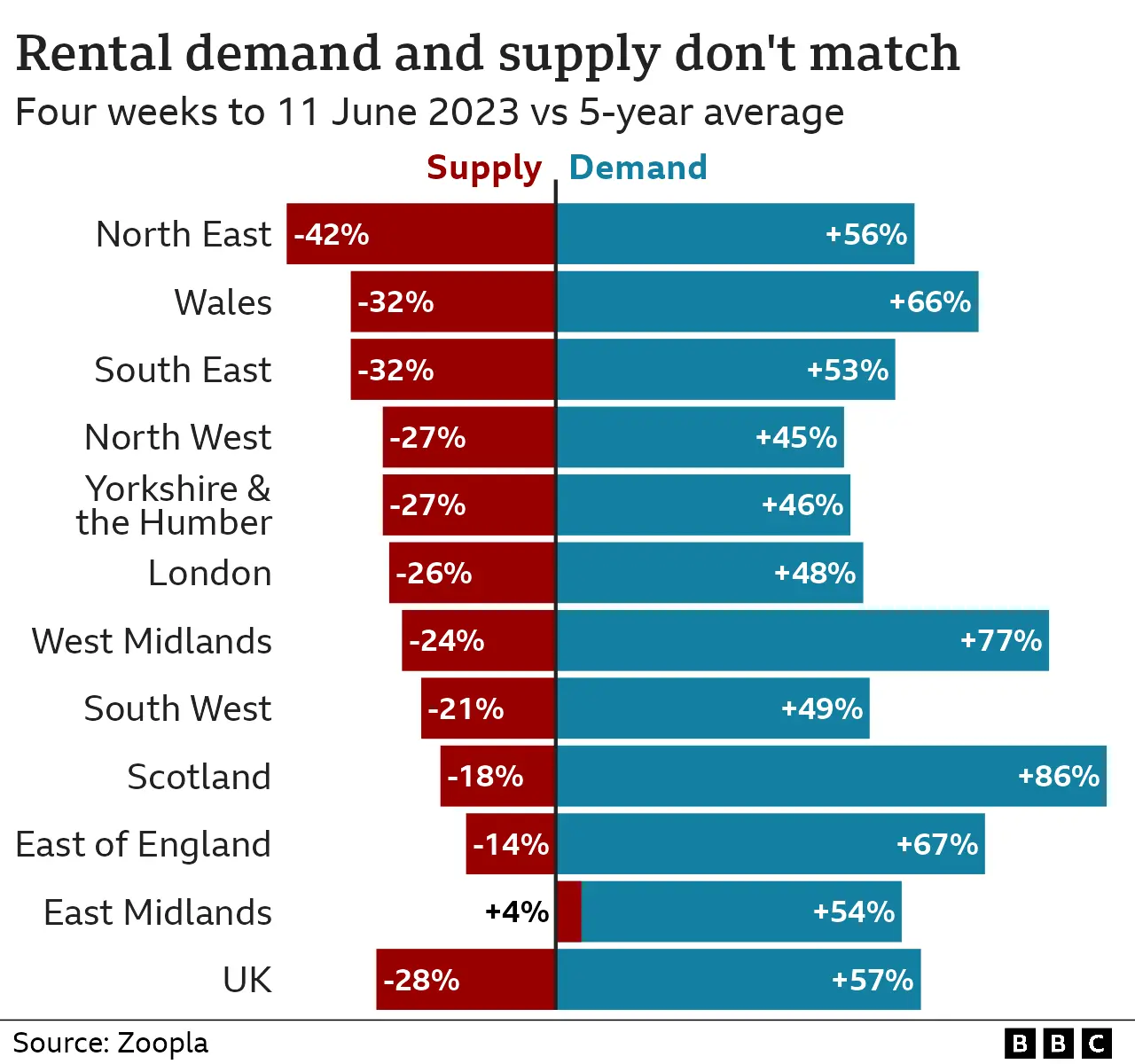
Quell your trivial lamentations, for if we are unable to own homes and the rent becomes too high we can always live with our families and they (the potential repopulators) can continue living elsewhere. The gap between rental supply and demand is like a Thermopylaen dam, holding back the forces of change and securing what remains of the villages and towns that we grew up in.
It is worth looking at the impulse towards YIMBYism before continuing on with the defence of NIMBYism. YIMBYs are, basically, a self-interested cohort of deracinated individuals incapable of feeling any sincere communitarian connection to the country they purport to care about. No one who ascribes to YIMBYism in the present could ever truly be right wing, and they are certainly not nationalists by any real definition.
The motivation for YIMBYs is the desire for personal material gain irrespective of the consequences to the wider nation as a whole. You would have to be deeply, spiritually indolent to be aware of the racial dimension to the present struggle yet continue to spend your time focused on pushing for as many things to be constructed as possible (lest the Roman goddess Maia smite you down from her Olympian high-rise building).
This can all be contrasted with NIMBYs, where, on the surface it seems to be primarily a cause wrought from self-interest, yet there is an implicit racialism, or at least communal collectivism, that animates them into spending so much of their time trying to stop the construction of anything near their homes.
There is a subconscious understanding granted to NIMBYs, by their blood and bones, that any and all development is wedded to the immigration issue, even if they do not articulate their reasoning as such. Even if they are outwardly liberal and vote for the uniparty, in one garish form or another, they have still been compelled to try and halt the stampede of construction; compelled by grander tribal considerations beyond their conscious control and far beyond the petty desires of their local area.
NIMBYs, God bless them, sit atop the large ball and chain shackled to the YIMBY bug man that is desperately trying to claw the nation towards total multiracial capitalist dystopia, under the guise of it being ‘based’ someday.
The NIMBYs, by their actions, are making it as difficult as possible for those in power to bring about their desired thousand-year panopticonic hell of global technocratic control. They exclaim with righteous fury ‘the character of the area will change’ and, with this implicitly reactionary rallying cry, they proclaim a stand is being taken in defence of what our ancestors left for us; in defence of what is ours, in defence of what we must dutifully preserve for those that will come after us. If you oppose these sentiments and side with the YIMBY cause of pro-building you are anti-white.
Who else is deserving of praise when these issues are discussed in our circles but the late great Richard Beeching, without whose cuts to our rail infrastructure we would be deprived of rural Britain in its frozen primordial state. This is the power of Levelling Down, the inadvertent preservation of what really matters, of what we conjure in our mind’s eyes when we hear the word ‘England’.
What would the demography and texture of life of rural areas look like had those arterial transport lines not been severed by the British Railways Board at that moment in time? Those geniuses of bureaucracy looked only at immediate cost-saving measures yet ensured much of Britain would progress far slower than the urban warts in the fore, much like how Eastern Bloc states were shielded from decades of societal and cultural degeneration occurring in the west.
This has already played itself out before in our past. In Victorian Britain, Peterborough and Swindon were enlarged and urbanised due to their status as railway towns, and in contrast, towns such as Frome and Kendal remained intact due to being bypassed by the main lines. What could be argued to have been unfortunate then has been insulating for rural areas affected in the same way now.
It is far harder to displace local economies and people when there is simply no infrastructure to enable newcomers moving in, and those in power know this. Even in official government reports, our overlords lament how the rural areas of our country continue to be white spaces (in contrast to our grey polyglot citadels to nowhere), which has only been possible because of our inefficient and underdeveloped infrastructure.
Even setting aside the more esoteric takes on NIMBYism, NIMBYs have plenty of legitimate reasons to be opposed to construction in the areas they live in. Villages and towns throughout the country are under threat of being subsumed into a mass of soulless commuter zones around the nearest city. Everything is set to be absorbed into a blob of suburban prison cells without community or belonging, all to line the pockets of parasitic housing companies and give ascent to the ethnic machinations of our destructors.
People who live in these places know that expansion means that everything outside of their front door will look and feel more like London and they correctly reject it. People instinctively recoil at the efficiency with which 5G towers were pockmarked across our landscape during the Covid ‘Lockdowns’ and people are right to be repelled by all of the slick technological wonders of ‘smart homes’ sold to us by our masters. None of these things are congruent with how anyone deep-down wants Britain to be.
YIMBYism is deceptive in its overall presentation as being the sensible or reasonable option, in contrast to the supposed extreme positions of many NIMBYs (which is a self-own in its own right), but YIMBYs do not actually care about real development of this country. Most, if not all, of the real solutions that would give us good-quality, affordable housing would be contrary to a policy of deregulating the economy and doing whatever international finance asks of us to be done to our land and people.
Such solutions would likely be decried as socialism or communism and with it the YIMBY would expose himself as but a pawn of the oligarchs, no longer a Briton in character or spirit. These points though are a distraction away from what really matters and such policy debates can only be relevant in a post-regime world without the albatross of near-imminent demographic erasure around our neck. The elephant in the room is quickly forgotten about if you even momentarily entertain the notion of house prices mattering beyond any other silly partisan issue discussed in Parliament.
But it is not just housing that is in contention. All forms of expansion and growth are, in the long-term, detrimental to our people whilst we are occupied. Everything done freely in our liberal, capitalist country in the last 50 or so years has been to the detriment of the people our economy is meant to be built around. Every power plant built or maintained allows Amazon warehouses to keep their lights on. Every railway built or maintained ensures employers can reasonably expect you to submit to the Norman Tebbit mindset for how we are to live and work. Every new motorway has facilitated increased population mobility and with it the new motley generation of white collar serfs defend their creators, scuttling across Britain’s surface unable to understand why the older, whiter parts of the country might have deep-rooted connections to the places they live.
This new generation, marketed as the ‘Young Voters’ or ‘Young People’, do not really exist in the same way that Boomers and Gen Xers do. Trying to appeal to or identify with this spectral universal generation of youths is to view these issues through an inherently post-racial lens, and by extension, to misunderstand the driving motivations of NIMBYism. The older generations, which are the bulk of those that sympathise with NIMBYism, are the only ones that matter politically and economically and counter-signalling them is implicitly a form of anti-white hatred.
The temporarily-embarrassed plutocrats in our midst are becoming more and more apoplectic when confronted with the reality that the vast majority of the British people want nothing to do with Singapore-style excess capitalism, no matter how desperately they attempt to sell to them the potential material gains and goodies.
We should aspire to be more like Iran, a Tehran-on-Thames, a country that actively restrains the degree to which businesses can expand so that everything stays small and localised. People yearn for flourishing high streets and dignified work local to where they were born, something Iran has succeeded at maintaining with its constitution and system of dominant cooperatives and Bonyads. This is tangential to the NIMBY/YIMBY divide but integral for understanding what is going on.
The British people want the things that they care about protected and secured and valued above the interests of capital or the growth of the economy. Our people have simply had enough of growth, progress and rapid change that they did not vote for, and their views on construction and economics are shaped by that impetus. Brexit Bonyads are inevitable.
If anything is to be conceded to the YIMBYs, it is that their urge to make things more efficient is understandable (natural really for any European man) and a good impulse to have. However, this impulse is being exploited against us, a form of suicide via naivety, where we continue pursuing these instincts in spite of the fruits of said efficiency. My position on nuclear power plants would probably be different if we were the ones in power, or perhaps the small percent chance of something going wrong and having all of Britain’s wildlife poisoned would prevent me from ever endorsing them.
Let us suppose we put pressure on our current regime, a regime similar to the Soviet Union except without any of its upsides, to build a nuclear power plant: can we trust that the diversity hires, rotten civil service and corner-cutting private contractors will not bring about a disaster worse than what occurred at Chernobyl?
Point being, many things which are bad for us now are not bad for us in principle (and vice versa), something atom cultist YIMBYs are incapable of understanding. YIMBYs are equally incapable of understanding why one might be averse to scientific innovations that amount to playing God and making Faustian economic bargains. Money spent on scientific research is better spent on just paying people to leave.
There is an alternative lens to look at everything through though. For those that do not just want to talk all day about nuclear power plants with people that wear polyester suits, for those that have higher values beyond ‘Jee-Dee-Pee’, for those that are capable of having principles they would put before their immediate personal comfort, there is the true way forward.
It is our duty to be revolutionaries, in the vein of Hereward the Wake, villainous rebels resisting the occupation government perched above us. NIMBYism is a successful strategy for a time, this time, in which we have no realistic chance at having power. Frustrating outcomes and disrupting their long march onwards is all we have in our illusory democracy.
Inefficiency is a good thing. We must crave blackouts like houseplants crave sunlight. Our only hope for liberation and true prosperity lies with our regime being as broken as possible. Our people must be pulled from their comfortable position in the warm, crimson-coloured bathwater and alerted to the fragility of their collective mortality. The international clique and their caustic bulldozer of modern progress now have a sputtering engine; it is all grinding to a halt and there lies the hope for our future.
Do not fret! Do not return like a battered housewife to those that wish to destroy us the moment things become inconvenient. Imagine pre-1989 Poles wanting to hold the Soviet Presidium to account, putting pressure on the government to be more efficient, the same government that is occupying their people – that is how ridiculous YIMBYs look to authentic British nationalists and patriots.
Our whole lens must be different if we are to meet the almost-insurmountable forces that tower above us, wishing for our end. As the Book of Job attests, the righteous suffer so as to test their faith in God, to make them more like Him, and to bring Him glory. So too must we be prepared to tolerate personal discomfort if we are to survive as a people, and it is absolutely a question of survival.
Existential threats require recalcitrant attitudes and policy positions and being unable to own a house or having to pay higher rent is a small price to pay to escape the present railroad we have been stuck travelling along since 1948. We all have a collective skin in the game. If the actual issue is not solved (the solution being our regime destroyed and immigration ended) then Britain, as it has existed for more than a millennia, is permanently erased off the map.
The inability to ‘live it up’ as a young voter in the supposed Gerontocracy is not something deserving of any hand-wringing, much less wall-to-wall tweets discussing housing and pensions every day. Some things, most things, matter more than housing being unaffordable and energy bills being costly.
Until they become conscious they will never rebel and until they have rebelled they cannot become conscious. Every wrench in the system creates another ripple, another scenario where the masses have their eyes opened to what has happened to their country and what is intended to be done with it in the future.
What lies before us is a task seldom asked even of our ancestors, it is a task of securing our existence before the brink, of pulling everything out from the abyss before it is brought to a state of total oblivion. There are no mechanical little fixes to any of this, civilisation does not work like that and all of the Poundburys and HS2s in the world will not improve our lot in this current epoch. The finest of McTrad housing estates will never be more beautiful than God’s raw, untouched nature.
NIMBYs instinctively know they are in a death battle and understand what really matters in this world. YIMBYs, on the other hand, think this is all algebra that requires university-brained midwits to solve. Damn the YIMBYs. Go forth thy NIMBY warriors, heroes of the fields and hedgerows, paragons of Arthurian legend; lead Britain back to its pre-modern, Arcadian state!
To conclude, a simplistic allegory will be provided: we are farm animals, farm animals on a big gay tax farm. If more barns and cottages are built things will not improve for the animals. More generators will just allow the farmer to expand the slaughterhouse. The solution is not more generators or more buildings on the farm. The solution is to shoot the farmer.