This article was originally published in November 2021.
I have a confession to make.
A few months ago I was made an official member of the Revolutionary Communist Group after being involved as a participating supporter for about a month and a half. The RCG are, in their own words, Marxist-Leninist, pro-Cuba, pro-Palestine, internationalist, anti-imperialist, anti-racist and anti-capitalist. They believe that capitalism is causing climate change, which they refer to as the ‘climate crisis’, and that socialism/communism is the only way to avert catastrophe.
They believe that the twin forces of imperialism and capitalism work today, and have been working for hundreds of years, to enrich the Western capitalist class by exploiting the labour of the proletariat and plundering the resources of the ‘Global South’. They publish a bi-monthly newspaper entitled ‘Fight Racism! Fight Imperialism!’ which acts as an ideological core around which centre most of the groups discussions.
After two months of twice-weekly zoom calls, leafleting in front of busy train stations and protesting in front of embassies, I was finally invited to become an official member. I rendezvous-ed with two comrades before being taken to a door which was hidden down a dark alleyway and protected by a large iron gate – certainly a fitting location for a revolutionary HQ. Inside was an office and a small library stocked with all manners of communist, socialist and anti-imperialist literature including everything from Chavs by Owen Jones to The Labour Party – A Party Fit For Imperialism by Robert Clough, the group’s leader.
I was presented with a copy of their constitution, a document about security and a third document about sexual harassment (the RCG has had issues with members’ behaviour in the past). It was here, discussing these documents for almost three hours, that I learnt most of what I know now about the RCG as an organisation and the ecosystem it inhabits.
The RCG is about 150-200 members strong with branches across the country – three in London, one in Liverpool, Manchester, Norwich, Glasgow and Edinburgh and possibly more. In terms of organisation and decision-making they use what they call ‘democratic centralism’ – a sprawling mess of committees made up of delegates that appoint other committees that all meet anywhere between once every two weeks and once every two years. They’re also remarkably well funded, despite the fact that their newspaper sells for just 50p. They employ staff full time and rent ‘offices’ up and down the country. They draw income from fundraising events, members dues, newspaper and book sales and donations (both large and small).
Officially, the RCG is against the sectarianism that famously ails the Left. However, one zoom call I was in was dedicated to lambasting the Socialist Workers Party who, I soon learnt, were dirty, menshevik, reactionary Trots. We referred to them as part of the ‘opportunist Left’ who routinely side with the imperialists.
The RCG doesn’t generally maintain good relations with many other major leftist groups. Central to RCG politics is the idea of a ‘labour [small L] aristocracy’ – a core of the working class who have managed to improve their material conditions just slightly and so work against the interests of the wider working class, suppressing real revolutionary activity in order to maintain their cushy positions. The RCG sees the Trade Union movement as the bastion of the labour aristocracy. They see the Labour party also as their greatest enemy – ‘the single greatest barrier to socialism in Britain’.
The RCG takes issue with the SWP specifically over their attitude to Cuba. They believe that most Trotskyists are too critical of socialist revolutions that have occurred in the past and so are not real communists – after all, no revolution will be perfect. The RCG’s issue with the Communist Party of Great Britain (CPGB) is that they resent how the CPGB claims to be the main organisation for communism in this country and uses its coziness with the trade unions as a signifier of legitimacy. However, the RCG believes that this makes the CPGB not much more than an extension of the Labour party, which it despises.
The CPGB-ML (Communist Party of Great Britain – Marxist-Leninist), on the other hand, are much closer politically to the RCG. They also share the same view on the Labour party. However, the CPGB-ML has recently taken a loud anti-trans position and so the RCG wants nothing to do with them.
Socialist Appeal are a group that has organised with the RCG in London before but the two do not get along due to, once again, the former’s (until recent) support for the Labour party every election. The RCG also shares views with Extinction Rebellion but XR now no longer wants anything to do with the RCG because of the RCG’s insistence on selling its communist newspaper at every event its members attend. The RCG insisting on trying to recruit members at every event it attends, including events co-organised with other groups, is a major source of friction and one of the reasons nobody wants to organise with them. It’s also one of the reasons why the RCG has stopped organising with LAFA – the London AntiFascist Assembly.
LAFA, I was told, are a chaotic bunch. They staunchly oppose all forms of hierarchy and make decisions on a ‘horizontalist’ basis. In true anarchist fashion, there are no official leaders or ranks at all in LAFA and decisions are made sort of by whoever takes the initiative. Unfortunately this means that those who become unofficial leaders in the group are accountable to absolutely no-one because they are not technically responsible for anything, and naturally issues arise from this quasi-primitivist state of affairs. Ironically, this makes the London AntiFascist Assembly kind of based.
Interestingly, one organisation with which the RCG has never had any problems is Black Lives Matter. The RCG and Socialist Appeal were (apparently) the only two groups out on the streets in solidarity with BLM last summer – BLM even allowed RCG members to speak at their events. The RCG enjoyed quite a close and amicable relationship with BLM right up until BLM decided at the end of last summer to effectively cease all activity, with the reason given to the RCG being just that ‘the summer has ended’. Presumably, the bulk of BLM’s activist base either had to go back to school or just got bored.
Although the RCG strictly prohibits any illegal activity at any of its protests, one clause of the constitution is ‘a revolution clause’ requiring members to leave their jobs and move house at the discretion of the RCG. I was told this clause has never been invoked and isn’t expected to be invoked for decades at least but is there in case a genuine communist uprising were to take place somewhere in the country and RCG leadership decided that it needed members to move into the area to help. The RCG is intent on staying firmly on the right side of the law for the foreseeable future – supposedly until class consciousness is raised to such a level that the time for revolution arrives. Whether or not history will pan out the way they think it will, only time will tell.
Perhaps most curious was the group’s confused stance on lockdowns. They are fiercely pro-lockdown and pro-mask, but also highly critical of the government’s approach for reasons that are quite vague. Why a communist organisation would want to place unprecedented power in the hands of a government – a Tory government no less – that it thinks operates as the right arm of global capital is beyond me. When I brought this up, a lone voice of dissent in my branch, I was told I had made a ‘valid point’ and that the group needed to discuss the matter further, but that was it. The only explanation I could arrive at was that unfortunately the RCG, and I think the Left generally, are deep in denial about being anti-establishment.
The RCG’s modus operandi is the weekly stall: three or four communists will take a table and a megaphone to a busy location and try to hand out leaflets and sell copies of the FRFI newspaper. The idea was that people whose values loosely align with those of the groups could be contacted and organised by way of these stalls. The law of large numbers means that these stalls are curiously successful – one two-hour stall at the weekend can sell a dozen newspapers and enlist a handful of people to be contacted by the group at a later date. The process of collecting people and funnelling them down the contact-member pipeline is a slow one with a low success rate, but they’re relentless.
Interestingly though, I believe their decades-old activist tradition is actually one of their biggest weaknesses. Ironically, so-called progressives are stuck in the past. The RCG has a very minimal online footprint – it uses its profiles on twitter and Instagram only to post dates for upcoming events. The RCG have so much faith in their traditional method of raising ‘class consciousness’ (translation: spreading communism) that they’re losing the internet arms race and thus their grip on young people – their traditional base. The fact that the group has a large proportion of older members might have something to do with it.
However, Leftists are good at street activism – they’ve been doing it for decades. Leftist activist groups have ingrained in their traditions social technology – sets of practices, behaviours and attitudes – that have developed over time and that their opponents would do well to familiarise themselves with, like looking at the homework of a friend (or in this case, an adversary).
The RCG believes that it is one of very few, maybe even the only, Leftist group in Britain today committed to maintaining a substantial street presence. One of the conditions for membership, after all, is promising to attend at least one street protest a week. The RCG no doubt take their activism seriously, with a comrade even describing the group to me as being made up of ‘professional revolutionaries’. They believe that they are growing and will continue to grow in strength, propelled by financial and then ecological crises. They are very excited for the collapse of the Labour party, which they believe is all-but imminent, because they think it will cause swathes of the Left to lose faith in a parliamentary means of achieving socialism and take to the streets, where the RCG will be waiting for them.
My time as a revolutionary communist has been challenging but what I’ve learned is no doubt valuable. I strongly encourage others to do as I have, if only just for a few weeks or so. Join your local leftist organisation – pick a sect, any sect! Expand your knowledge, see a different perspective and gain skills you might not gain anywhere else. Speak to people with a completely different viewpoint from yours and learn how they think, you’ll be a slightly better and more knowledgeable person for it.
Quote: Leftists are good at street activism. They have ingrained in their traditions social technology that have developed over time and that their opponents should familiarise themselves with.
-
10 Pages Minimum: A 2022 Book Report
At the end of 2021, I challenged myself to read at least 10 pages of a book a day. I was initially shocked at how difficult I found it to just sit down quietly and read a book. However, within the first month, I found it easier and easier to sit quietly, and enjoy reading. Having been unable to read practically anything for pleasure in the past few years, I am glad that I was able to accomplish this. By the end of 2022, I was able to read 14 books, and I decided that it would be prudent to compile a list of them, and to give a brief review of each one. All of these reviews were written within a few days of finishing the book, so as to give my most accurate opinions of them. This article, therefore, has been a year in the making! I hope that I am able to persuade you to take up this challenge in 2023.
Upon reflection, it has become clear to me that my reviews at the start of the year are not as good as the ones nearer the end of the year. Please excuse me for this, I have had no experience in writing book reviews up until now; but I feel as though this exercise has given me good practice in the area.
Book 1: American Psycho by Bret Easton Ellis
Read from: 01/01/2022 to 14/01/2022
Rating: 5/5
Review:
When I saw this for sale in Waterstones, I chuckled to myself because I have seen the film so many times, and am very aware of all of the references and memes it has generated. I immediately bought it and I am extremely glad that I decided to make it my first read of 2022.
The book is an extremely well-written and unique dive into the horror nightmare land of Yuppie culture in the 1980s through the eyes of an unreliable narrator, Patrick Bateman.
For anyone who has seen and enjoyed the film, you will love this book. This novel fleshes out the character of Patrick Bateman and the accompanying cast and really helps to add the context and depth which would be impossible (or at least extremely difficult) to show on film.
The book is intentionally written in a repetitive and confusing style to try and put us in the head of Bateman, who lives a life surrounded by repetitive and confusing people constantly lost in meaningless conversations over what kinds of socks match with a certain tie, or who is calling up the newest celebrity-owned restaurant to make a reservation. As a reader, you may find this jarring at some points. But I beg you to be mindful of the point Ellis is trying to make. By about a third of the way through you will begin to appreciate the pages and pages of text covering the newest album from Huey Lewis and the News, and Patrick’s running commentary on what he, his girlfriend, his friends, and his victims are wearing.
Please be aware that if you have a vivid imagination, this book can be extremely difficult to read at some points due to the levels of violence and gore it portrays in excruciating detail. (I actually found myself feeling sick at some points, but this just lends more credit to the incredibly descriptive abilities of Bret Easton Ellis).
I thoroughly recommend this book, and I hope that you read it and enjoy it as much as I did.
Book 2: The Art of Rhetoric by Aristotle
Read from: 15/01/2022 to 13/02/2022
Rating: 4/5
Review:
I had never been very interested in philosophy, I had always found it unnecessary for myself to learn it. However, after a few debates and arguments with some of my friends who did enjoy learning philosophy, I decided that I would finally get around to reading some.
As I am interested in politics and public speaking, one of my friends recommended to me the Art of Rhetoric. I bought this book some time ago last year and had never read it, so I thought it would be best to start off my philosophical education with this book… that was a mistake.
I soon came to realise that, if you have never read any of Aristotle’s work, he can appear to be a confusing writer. He seems to love tangents and diversions and references to his own and other people’s work. Whilst it was certainly interesting to read about all of these tangents, it did make it quite difficult and confusing at some points to really understand his point or what he was talking about. One minute he would be talking about the different reasons people debate, and then he would suddenly be discussing the benefits of slave ownership.
Another issue I had while reading the book is that it introduces some new terms and words that I had never heard of before such as ‘Enthymemes’ etc. I had to spend considerable time actually learning what all of these specific terms meant before I could even understand what a large amount of the book was talking about, otherwise, I would have completely missed the context of entire chapters. That is not the fault of the book but a fault of mine (as mentioned earlier this was the first philosophical book I have ever read, and that was my mistake).
The book is actually split into three books (all relatively short). Without spoiling anything, The first two books give a lot of context to the third book which is where the actual ‘art of rhetoric’ is discussed at length. This made the first two books feel very slow compared to the third. It is also worth noting that the first two books are where most of the tangents can be found, whereas the third book seems laser-focused on the topic at hand.
Overall, I found the book very enjoyable. It pushed me to actually learn new concepts and terms I had never heard of before, and gave me new ways of looking at debate and argument as a practice. I would definitely recommend this book to people interested in improving their debate and public speaking skills, however, I would also warn you that, if you have never studied philosophy before, don’t be surprised if you have to re-read a few pages and do some research on some of the concepts Aristotle talks about.
Book 3: Trans-Siberian Rail Guide by Robert Strauss
Read from: 13/02/2022 to 19/02/2022
Rating: 4/5
Review:
I found this book completely by accident at the ‘Barter Books’ second-hand book shop in Alnwick. I saw the cover, saw the low price, took a guess at what it might be about, and decided that I had to have it! At first, I assumed that this would be a simple guide for tourists of the Trans Siberian railway, but as soon as I started reading it, I discovered that it was so much more than that. It is a charming collection of history, anecdotes, and stories about the Trans Siberian Railway; and an assortment of (now obsolete) information about the various ways one could successfully navigate the journey across the Soviet Union to China and Japan (or vice versa) via train in the late 1980s.
This is by no means a history book, however, it is a very dated guidebook that was written for an 80’s audience, and it contains an absolute heap of useless and obsolete information about how to behave properly around Soviet border agents, the addresses of various consulates and embassies for countries which no longer exist, and tips on where best to buy camera film and cheap Hi-Fi’s when lost in Beijing. I found that this added to the charm of the book, and made it more interesting to read about the lived experiences of those bold adventurers making their way across Communist Russia, Mongolia, and China.
What makes this book even more endearing is that, when it was written, the author put out an advert for readers of the Times newspaper to submit their own stories of their travels along the Trans Siberian to him. He features these stories throughout where relevant, which really adds to the human touch of the book.
The book is broken down into 5 parts. Some of these parts are more focussed on the history of the railway and various anecdotes and stories of travelers’ experiences over the last 100 years on it. Other parts of the book are more instructional and list embassies, hotels, hostels, useful numbers for Visa applications, etc. The author, Robert Strauss, does an excellent job of weaving these two very separate kinds of information together to make for a very delightful read.
I would highly recommend this book to anyone interested in the history of the Trans Siberian Railway, anyone who wants a brief flashback to the late 1980s, and anyone who is sad enough to spend their time reading pages and pages of completely useless and obsolete information about how to purchase train tickets from the Hungarian Socialist Republic (people like me).
Book 4: Lolita by Vladimir Nabokov
Read from: 20/02/2022 to 08/04/2022
Rating: 4/5
Review:
This book was bought for me as a gift by my girlfriend after I had expressed some curiosity in it (it is her favourite book and I was interested to see why).
This book (sometimes referred to as ‘The Great Divider’) is a tricky one to get through at times, it brazenly challenges you to keep reading it, despite its cruel themes and evil characters. I found some parts of the book particularly difficult to stomach due to the horrible issues which it covers, but I did soldier on through it to the end. This is why it has taken me almost double the time to get through this book as it has to get through other books of a similar length.
The book tells the story of Humbert Humbert, a handsome young European academic who comes to America after the death of his first wife. The story is told in the past tense from his perspective as he desperately tries to convince the reader, using all of his intellectual charm and cultured European graces, that his attraction to young girls is completely fine, and that the rape of his landlady turned wife’s daughter, Lolita, is justified.
It is fair to say that the book is a heavy read, and forces you to stay on your toes in order to not sympathise with him. Humbert Humbert is the king of unreliable narration, and phrases the most disgusting events in ways that can become very palatable to the reader if not considered properly in context.
This is indeed the crux of the book’s appeal, it is astonishingly beautifully written, even if it leaves you feeling sick or sad afterward. The writing style of the author, Vladimir Nabokov, in this book is absolutely impeccable and suits the theme and character of Humbert Humber almost too perfectly. It made the characters feel so alive and real.
My main complaint about the book, and what is stopping it from receiving five stars in my opinion, is that some sections (specifically the road trips) seem unnecessarily drawn out and overcomplicated, whilst other parts (specifically the ending) seem too rushed and simple – it feels as though you waited through a huge build-up over hundreds of pages for an ending that is covered in less than 30! I understand that this is because the book is framed as a retelling of a story from one person’s blinkered perspective, but I would have enjoyed it a bit more if the book spent more time fleshing out other parts of the story, and perhaps cutting back on excessive detail in others. However, this issue did not kill to book for me and I did still find it very readable almost all of the time.
In conclusion, an absolutely fantastic read that I would definitely recommend to anyone bold enough to take on Nabokov’s challenge.
Book 5: Mine Were of Trouble by Peter Kemp
Read from: 08/04/2022 to 13/05/2022
Rating: 5/5
Review:
This book was completely unknown to me until I started being recommended it by various anonymous accounts on Twitter. My curiosity peaked after I had heard the general theme of it; and I must say, I am extremely glad that I took the decision to buy and read it.
This is arguably one of the most interesting, thrilling, and charming books I have ever read, and most certainly is a contender for my favourite of the year. The author, Peter Kemp, has a superb skill for structure, detail, and storytelling that makes it extremely difficult to put this book down. It gives you just enough detail to help you understand the situations he was in without being too heavy-handed and boring. At some moments, ‘Mine Were of Trouble’ reads almost like an adventure book; not because the events are so unbelievable, but because of the great lengths the author went to describe the acts of heroism and horror he saw in real life.
The book tells the true story of the experiences of Peter Kemp (the author), a 21-year-old English law student who was so moved by the stories coming to Britain of the horrors experienced by Catholic priests at the hands of the Republicans, that he decided to join the Carlists (a monarchist faction within the Nationalist army during the Spanish civil war). The book does not read like a diary, and instead is more of a lengthy account of his entire time before and during his service in the Spanish Nationalist military.
The true tales told by Kemp range from the humourous and charming to the horrendous and despicably ugly. At times during the book I was chuckling, and at other times I was almost crying. The book is not attempting to engender these emotions within you, it is simply telling you the story of Kemp’s fascinating journey through the civil war. It serves to remind us all that not all of war is horror; and not all of war is camaraderie, fun, and games.
This book has generated within me a great desire for travel and escapades. I would sincerely recommend this book to anyone interested in the history and politics of inter-war Europe and the Spanish civil war. I would also recommend this book to anyone interested in the concepts of masculinity, heroism, and the call to adventure. Whilst not saying it directly, Kemp touches on all of these topics in great detail. His time and actions in Spain reflect his values of faith, honour, courage, and compassion. This book has served as a great insight for me into all of these topics, and I am sure that it would do the same for you.
Book 6: Convenience Store Woman by Murata Sakaya
Read from: 13/05/2022 to 16/05/2022
Rating: 5/5
Review:
As I was strolling around the Waterstones near Monument Metro Station in Newcastle, my girlfriend and I came across a small ‘Japanese Literature’ section. I have never read any Japanese literature of any kind ever, so I was intrigued by it. I was curious to see what was on offer and, as I was looking at the table, I was passed a copy of this book ‘Convenience Store Woman’ by my girlfriend who said to me that she had really enjoyed reading it in the past. I took her advice and, as it was only £8.99, I decided to buy it. This was a very good decision, and I am very glad that I bought this book.
The book itself is very short at just 160 pages with barely more than 200 words a page on average, so you can get through this extremely quickly. I consider myself to be quite a slow reader and I managed to complete it in just 3 days! I found the book to be very difficult to put down, the pacing was just right and kept you hooked into the story all of the time. I didn’t feel as though the story dragged at any point, and the general theme was one which I found quite relatable.
The story itself centres around Miss Keiko Furukura, a 36 year old Japanese woman who has been working the same part time job at the same convenience store for the last 18 years. Whilst never stating it explicitly, it is obvious that Keiko has autism and struggles to understand the actions of the people in the world around her, except for when she is working in the store. Keiko’s whole life revolves around her job at the store and it seems as though, to her, it is the one thing that gives her a purpose. She sees no reason to keep herself healthy, except for the benefit of the running of the store; she sees no reason to take a shower and shave, except for the benefit of the running of the store etc. This all changes when a new employee, a man name Shiraha, enters the picture.
Both of these characters are outcasts who take a different approach to dealing with the similar situation that they find themselves in. Shiraha is a failure who cannot find a wife. He is angry at the world for forcing him to work and just wants to hide away and do nothing. Keiko, on the other hand, has no anger to the world and just cares about the running of the store. The author does an excellent job at contrasting their opinions and methods for dealing with their problems, and it proves to be an excellent commentary on the expectations that Japanese society places on men and women.
If you are looking for a light and quirky book, this is certainly one for you. I thoroughly enjoyed reading it, and I was sad to have finished it so quickly. It has been a refreshing brake from the other books I have read so far, and I will certainly make an attempt to read more Japanese literature in the future as a result of it.
Book 7: The Great Gatsby by F. Scott Fitzgerald
Read from: 16/05/2022 to 24/05/2022
Rating: 4/5
Review:
This particular book was of great importance to me because of how I came to have it. It was given to me as a gift by my English teacher back in 2016 just before I took my GCSEs. I had never read the book and we did not study it at school, I knew absolutely nothing of the plot and I used to ask her questions about it. Instead of giving the answer away, she bought me it as a present so I could come to the answer myself. Well, after almost six years of starting it, stopping it, and starting again, I finally got myself into gear and finished it. This was a great relief to me, as it means that I wont have to read the first chapter over and over again any more.
The book is relatively short but the pacing of the story can make it quite difficult to read at times. I found the start and end of the book to be very slow and drawn out whilst particular sections were very rushed. I’m sure that Fitzgerald was doing this for dramatic purposes, however I felt as though I should have been given more information at certain important moments. Fitzgerald is clearly a master of the English language and his usage of it in the book is interesting and unique. I found that some of the speech patterns in the book are very dated (this is the original unabridged version after all) which certainly gave it a 1920s feel. Whilst I had no problem with this, you do sometimes find yourself re-reading the same lines to make sure you understood what was being conveyed in this older style of writing. If you are not used to certain aspects of 1920s speech patters and history, try and buy a copy like mine which came with context explainers at the back. This helped me in my own understanding of what was going on in certain scenes.
The story is a somewhat reliable narration by Nick Carraway, a Midwesterner come to seek his fortune in New York City in the early 1920s. There he meets his neighbour Jay Gatsby, a mysterious and extremely wealthy man who, by complete chance, happens to be madly in love with Nick’s cousin Daisy, who lives just across the water from him. Daisy is married to the equally wealthy adulterer, Tom Buchanon. The story follows Nick as he is pulled further and further into a disgusting web of deceit, lies, and deception that surrounds Gatsby, Daisy, and Tom.
I found that the 2013 film adaptation of the book is fairly true to the source material, but it does skip over a large chunk of the relationship between Nick and Jordan Baker. The book does a better job of fleshing out the relationship between the two and it also does a much better job of making the characters less fantastical and more realistic. The film portrays Nick as a clueless do-gooder who just happened to be caught up in rich peoples cruelty whereas the book assures you that he knows what he’s getting himself in to.
In conclusion, a classic book which I would highly recommend. Not too long and certainly recommended if you have seen the film and wanted a bit more from the characters.
Book 8: Rules of Civility by Amor Towles
Read from: 24/05/2022 to 22/06/2022
Rating: 4/5
Review:
This is arguably the first book of the year that I have read that I went into with absolutely no idea of what to expect. I had never heard of Amor Towles or his works, and this book was more of an impulse purchase after a friend of mine saw it on sale for a ridiculously low price and recommended it to me. I am glad that he made such a frantic bid to get me to but it. I have also just noticed that this is the third book of the year that I have read to be based in New York City (with American Psycho and The Great Gatsby being the other two). I suppose, through the lens of these fictions, I have taken a journey of the history of New York from the 1920’s to the 1980’s.
This book follows the life of Katherine Kontent, a typist at a law firm, as she makes her way through the year of 1938 in New York City. The concept of time passing is a big factor in this novel, the book is structured heavily around the changing of the seasons and the progression of time. It is no surprise that the main story starts on New Years eve 1937 and ends on New Years eve 1938. She, along with her room-mate Eve, meet Tinker Gray, a very curious individual who they both take great interest in. Over the course of the year, this typist is pulled from the bottom of New York society to the top. She becomes close and personal friends with the wealthy and not-so-famous member of society who keep the machine of the city moving along. She seems to find herself both disgusted and fascinated by it, and keeps venturing into it for more.
This book had the ability to trigger a very strong emotional response from me. It reminds us (bluntly in some places and subtly in others) that time is indeed passing and slipping through our fingers, and that we are the total sum of all of our decisions and all the decisions of everyone around us. Fittingly, I found the ending of the book both beautiful and agonising; all of the separate story lines of the small array of characters that Katherine meats neatly come to their conclusions. It left me felt feeling so sad, and I am not entirely sure why this is. Perhaps it is because it reminds that, no matter how eccentric or interesting we try to be, we too are side characters in someone else’s story; and one day, our relationship with those people will end as well one way or another.
The book’s structure is well put together, and it is clear to me that Amor Towles has an incredible grasp on the English language. His writing style is very unique and enjoyable; however, the method he uses to represent conversations (long flows of text rather than broken up sentences with quotation marks) can be quite jarring at times and it sometimes became very difficult to tell who was talking to who. I would also argue that the pacing of the book was a bit strange. The story seemed to race at the start, then slow down toward the middle, and then jump to a breakneck pace at the end again.
In conclusion, this was definitely an enjoyable book and is one which I shall be recommending to others.
Book 9: The Communist Manifesto by Karl Marx and Friedrich Engels
Read from: 23/06/2022 to 23/06/2022
Rating: 3/5
Review:
Due to the nature of this book and my political biases, I think it unfair to attempt to give this book a true ‘rating’, so I have opted to give it a 3 out of 5 – truly, the most neutral of ratings you can award a book (or anything for that matter).
I read this book many years ago when I was only a child, and so I saw that it was high time to read it again. Whilst I do not agree with Marx and Engels, I found the book to be very interesting and insightful into the initial aims of Communism.
I think today in the world of debate, we get very caught up in politicking, good and bad looks, and the humdrum of boring arguments. Sometimes we forget what certain people actually sincerely believe. It was quite refreshing to read straight from the source. I appreciate the fact that there have been many different iterations and interpretations of communism over the last hundred or so years, but it was nice to actually be able to get a grip of what the original idea of it actually was. As we live in the age of gutter politics, Marx is someone who has been warped and twisted beyond disbelief by people on both sides. Rereading this book reminded me that the chap, at the end of the day, was a philosopher trying to make sense of the modern industrial world and make predictions on the upcoming class struggles between proletariat and bourgeoisie.
Has this book changed my opinions on economic and social relations? No. I am just glad to have been given a fresh perspective on what communism is, and what Marx and Engels were trying to put forward. I am curious as to what they would think of the modern world if we could reach through history and bring them to now. I wonder if they would rejoice or shudder at the state of the modern communist movements. I wonder what they would say about the history of the last 100 years. I wonder how they would view the states of China, Cuba, and the like.
In terms of the books structure, it is incredibly short. You can read this in an afternoon if you really wanted to. I found the first half and the last tenth to be the most interesting, whereas the middle of the book was very slow.
In conclusion, it’s a short read and I would recommend it to anyone interested in learning about the communist movement. I would be interested in reading more of Marx’s material after this as I personally found it very interesting.
Book 10: Silence by Shusaka Endo
Read from: 24/06/2022 to 16/07/2022
Rating: 5/5
Review:
I picked up this book at the same time that I got ‘Convenience Store Woman’ from the Japanese section at Newcastle Waterstones. It is funny as I had not intended to get any books at all and wound up buying two. I have also now purchased this book again as a present for a few friends as it is relatively cheap and extremely worth a read. I loved this book and I am glad that I made the impulse purchase after admiring its cover in the Waterstones.
This book follows the journey of Father Rodrigues as he journeys to Japan in the 1640s with his friend Father Garupe to act as a missionary and to discover the fate of his former teacher, Father Ferreira who has been rumoured to have apostatized and to now be assisting the Japanese government in hunting down and persecuting Christians. The journey of Rodrigues is a sad and miserable one. He starts with, what he believes to be, complete faith in God and the Catholic church. This faith is tested repeatedly by the misery and suffering of himself and the Christians of Japan that he sees around him. He is constantly doing battle with the silence of God when he sees injustice and cruelty done upon himself and his fellow Christians.
The novel’s author, Shusaka Endo, was a Japanese Catholic, and I believe the book itself was an attempt by himself to understand his relationship with God and his Christian faith through the abstraction of historical story telling. I believe, therefore, that this book is a good way of understanding my own faith better and coming to terms with the reality of the world around me and my relationship with God. If you are a Christian as well, I would thoroughly recommend this book.
The book, at just 267 pages, is relatively short and I found it very readable. The author uses letters, diaries, and reports from different sources as a framing device for good chunks of the story which helps to break it up and adds a layer of depth to the various characters that are met along the way. The general arc of the story is good and has a sound progression. Do not go into this book looking for a happy ending, you will not find one. The story does not finish with some grand triumph for any character, it merely reflects on the situations that they find themselves in.
Overall, I would certainly recommend this book. It is a brilliant example of 20th century Japanese fiction and, more specifically, provides an excellent retrospective on the persecution of Japanese Christians in the early Edo period by a practicing Japanese Christian. It is a great shame that the film adaptation by Martin Scorsese (himself a great admirer of this book) was such a commercial flop.
I would like to take a moment, if I may, to reflect on the books I have read so far. It is now the 17th of July 2022 and so much has happened since I started this challenge. Russia invaded Ukraine, I turned twenty-two, Boris Johnson has resigned, I bought my first house, and now we are all suffering through an absurdly hot heatwave and sky-high energy and commodity prices. It has indeed been a strange year for me, Britain, and most of the world. My one constant, however, has been the reading I have been doing. As I mentioned at the start of this piece, I barely read at all in the last decade, and it has been thoroughly enjoyable to burn my way through so many of the books that have been sitting gathering dust in my room.
I did not think, when I set myself this challenge, that I would have already finished 10 books by the end of the year… let alone the middle of July. I am very proud of this achievement, and I am looking forward to carry on reading throughout the year and into the next (and so on and so forth). I have learned so much from these books, not just what they contain, but also the foundations of what makes good fictions and non-fictions so enticing. I also think that my reading comprehension and patience has increased dramatically, and my ability to review the books has improved too.
If you are still reading this behemoth of an article at this point, I hope that you have been finding it of some use or interest. I sincerely hope that it motivates you to pick up some of the books laying around at your house that you’ve been telling yourself you would actually read too.
Book 11: Patriotism by Yukio Mishima
Read from: 17/07/2022 to 17/07/2022
Rating: 5/5
Review:
This book was recommended to me by a friend. I did not intend to read it so quickly but it is an incredibly short book and is an extremely compelling read. It is also the second Japanese book I have read in a row. I am glad that I bought it and I hope that I can convince you to buy it too.
The book is set over a period of three days and follows the story of a Lieutenant in the Japanese Imperial Army, Shinji Takeyama, and his beautiful young wife, Reiko. Being instructed to command troops destined to fight the forces of rebellious officers (many of whom are his close friends), Shinji is faced with the impossible choice of loyalty to his friends, or loyalty to the Imperial Army and the Emperor of Japan. Shinji, instead, chooses to commit seppuku (ritualistic suicide) with his wife as his witness.
The book describes, in graphic detail, the couple’s last few hours together on the night that they will take their own lives. It explicitly takes the reader through the couple making love multiple times before then agonizingly describing every moment of Shinji and Reiko’s suicide. Reading this part of the book was genuinely difficult at some points due to the gruesome nature of Yukio’s writing style.
Achieving a ‘glorious death’ was something that the author was very focussed on in his own personal life, so it is easy to understand why he would write about ritualistic suicide so positively. After further investigation, I discovered that the rebellion in the book was a real event that took place known as the ‘Ni Ni Roku’ Incident. This incident, along with many other events in Japanese politics, would shape Yukio’s worldview and drive him further into his beliefs surrounding right wing politics and the future of the Japanese nation and people.
In terms of structure, the book is incredibly short and can be read easily in less than an hour. I would thoroughly recommend the book to anyone interested in Yukio Mishima, this is an excellent way to ingratiate yourself with his beautiful and graphic writing style, and a good way to get a glimpse at his views and beliefs.
Book 12: The Sailor Who Fell From Grace with the Sea by Yukio Mishima
Read from: 17/07/2022 to 13/08/2022
Rating: 4/5
Review:
This is the fourth Japanese-authored book I have read this year, the third in a row of Japanese books, and the second from the esteemed author Yukio Mishima. I heard about this book from various accounts on Twitter and have seen it recommended numerous times but I had absolutely no idea what it was about. I am still not entirely sure if I have fully understood the book, but I will do my best to review it here.
The book is set in Japan a few decades after the second world war, and follows the story of the child Noboru and his wealthy widowed mother Fusako. Noboru is part of a gang of self-proclaimed genius boys led by ‘the chief’ who have become radically angered and dissatisfied with the modern world and modern rules and morality. Noboru is obsessed with the sea and ships and, when he is taken by his mother to the docks to actually see some vessels, they meet the ship’s second mate, Ryuji.
Fusako and Ryuji are smitten with each other and they have sex soon after meeting, whilst Noboru watches on from a peephole he has discovered in between his wall and his mother’s. Initially, Noboru is very pleased with Ryuji. He likes the fact that he is connected to the sea and he sees him as perfect. However, after a series of faux-pas on the part of Ryuji, and Noboru’s excessively high standards and non-standard morality, he soon finds himself disgusted by Ryuji.
This book is strange. I very much enjoyed it, but sometimes it was difficult to get into. Yukio Mishima was exploring his own philosophies and ideas on modern morality through the character of an extremely intelligent child, however, sometimes this came across as very unbelievable and annoying. The only truly sympathetic character is Ryuji.
Mishima, of course, uses his masterful command of language and metaphor to create beautiful images in the reader’s mind, especially when discussing sex and violence. This is a theme seen throughout all of Mishima’s work.
In terms of structure, I found that the pacing of this book was actually very good. The book is split into two halves, ‘summer’ and ‘winter’, each having its own distinct tone. The book is quite short at just over 100 pages and was paced in such a way that it never felt too quiet or too busy throughout.
Overall, a good book that I enjoyed. I would recommend it to you if you were especially interested in understanding Mishima’s personal philosophies and worldview.
Book 13: The Obesity Code by Dr Jason Fung
Read from: 14/08/2022 to 25/08/2022
Rating: 4/5
Review:
As someone who has struggled with weight their entire life, this book was a real eye opener. This book was bought for me years ago by my dad, but I never once opened it. I did not know who Dr Jason Fung was, and I had no intention to read what I assumed was just another self help book. Fast forward to a few months ago when a friend of mine suggested buying this book (as it had really helped them with their weight). I realised that I already had it buried away on my book shelf, and I made it my aim to at least try and get through it. As soon as I saw the cover, I realised that this Jason Fung was the same Jason Fung whose YouTube videos I had been watching for the past few months. Given the high quality of his channel, I went in with high expectations, and I was not disappointed!
Firstly, this is not a self help book. Dr Fung uses this book to meticulously and thoroughly dismantle commonly held misconceptions about diet, exercise, and weight loss. His calm and methodical approach to explaining problems with the diet and pharmaceutical industry (especially in North America and Europe) is eye opening and fantastically interesting. I found myself unable to put this book down (hence why I was able to read it so quickly).
I wouldn’t be doing the book justice by trying to fully explain Fung’s take on weight loss, but the general lesson he teaches is that insulin and cortisol are the two hormones that contribute the most to weight gain and obesity; that the post-70s western diet and lifestyle has made us prone to insulin resistance and excess cortisol; and that the standard ‘eat less, move more’ advice so often given out by doctors and government health agencies is unhelpful for people truly trying to lose weight. Dr Fung’s solution to these problems is intermittent fasting, which he claims is beneficial for reducing insulin resistance and being the most effective tool for obese people to lose weight.
The vast majority of the book is spent focussing on his main hypothesis that insulin causes weight gain. He only goes into fasting in the final section. This is why I do not consider this to be a ‘self help’ book. He spends far more time helping the reader understand what the problem is then actually giving specific solutions for this to be thought of as ‘self help’. Whether that is a good or a bad thing is up to you, but personally, I liked it. The book didn’t feel preachy or like quackery.
My only complaint, and the reason I don’t think I can award 5 stars, is that Dr Fung spends a huge amount of time going over the same points again and again. I appreciate that he is attempting to drill an idea into the reader, but it can get quite monotonous after a while.
Since watching his YouTube videos last month and reading his book, I have lost roughly 12kg in weight (about 2 stone/28lbs). This is evidence enough for me that his methods work, and I am fervently carrying on with them. If you struggle with your weight or are just interested in a fresh take on why the world has an obesity problem, I would most certainly recommend this book and his YouTube channel.
Book 14: No Colours or Crest by Peter Kemp
Read from: 28/08/2022 to 31/12/2022
Rating: 5/5
Review:
This book took a much longer time to finish than normal due to personal issues and should not be taken as a slight on the piece of work. This book is the second of Peter Kemp’s three books detailing his activities before and during the second world war (see review number 5 for a cover of his first book ‘Mine Were of Trouble’).
We follow him on his journey after the Spanish civil war, joining the British army as a liaison officer and being sent into Albania to act as a representative of Britain and to gather information on partisan activities in the area. Being parachuted into the country, he is forced to deal with the complex political issues that drown the region in mistrust and curtail any effort to form a united front against the Italian and German occupying forces.
This first section of the book was very interesting to me, Enver Hoxha (the post war Communist dictator of Albania) is a character which I have known about for a very long time, but never seriously investigated and researched. In this book, Peter tells of his regular dealings with Hoxha, along with his other Communist, Monarchist, Republican, and Reactionary counterparts in their desperate bid to repel the invaders and attempt to seize legitimacy in forming a new government for Albania after the war has ended. Peter’s writings about these figures and his travels through Albania showcase the chaos and unpredictability of a small nation at war not only with an outside power, but also itself.
The second, much shorter, section at the end of the book tells of Peter’s brief time in Poland in 1945, and his capture and mistreatment by the Soviet Red Army, who viewed him as less of an ally than a potential enemy once the war was over.
The book is an excellent read for any history nerds interested in the niche fringes of the second world war, featuring a very unique insight and detailed description of war stories not often talked about in Western media. Kemp’s keen memory and light-hearted nature make for, not only a detailed read, but also an enjoyable one.
The pacing of the book can be a bit slow at times. I thought it was a shame that Kemp talked for so long about his time in Albania, but very little about his time in Poland. I appreciate that he was in Albania for much longer, but it would have been nice if he could have been a bit more detailed in his discussion on his time spent in Eastern Europe.
Peter has a distinctive writing style which became more and more obvious as I read through this piece, and I would struggle to define it. He writes memoirs like no other memoirs I have read.
Overall, an excellent read which I thoroughly enjoyed and would recommend. I will be reading and reviewing his third book ‘Alms for Oblivion’ later in 2023.
It is the 1st of January 2023 and I cannot believe how much my life has changed since my last writing on here on the 17th of July (just after review number 10) and over the year as a whole. I am now a settled homeowner on the other side of a breakup, I have spent time living in London to escape family drama, and I am 30kg lighter than when I started the year. The war in Ukraine still rages on, and inflation seems to have calmed down just a little bit. I have been totally blown away by the rate of change I have experienced this year, and I am reminded whilst writing this that one of the only constants I have had throughout 2022 was the challenge to myself to read more this year. I am extraordinarily proud of what I have accomplished, and I sincerely look forward to doing it again in 2023, I hope that next year I am able to read at least 20 books.
I hope that these reviews and remarks have given you some encouragement to take up reading this year, it really was one of the best decisions I made at the start of 2022, and I hope that you see fit to make it one of your own resolutions for 2023.
-
Neoconservatism: Mugged by Reality (Part 2)
The Neoconservative Apex: 9/11 and The War on Terror
11th September 2001 was a watershed moment in American history. The destruction of the World Trade Centre by Muslim terrorists, the deaths of thousands of innocent American citizens and the general feeling of chaos and vulnerability was enough to turn even the cuddliest of liberals into bloodthirsty war hawks. People were upset, confused and above all angry and wanted someone to pay for all the destruction and death. To paraphrase Chairman Mao, everything under the heavens was in chaos, for the neoconservatives the situation was excellent.
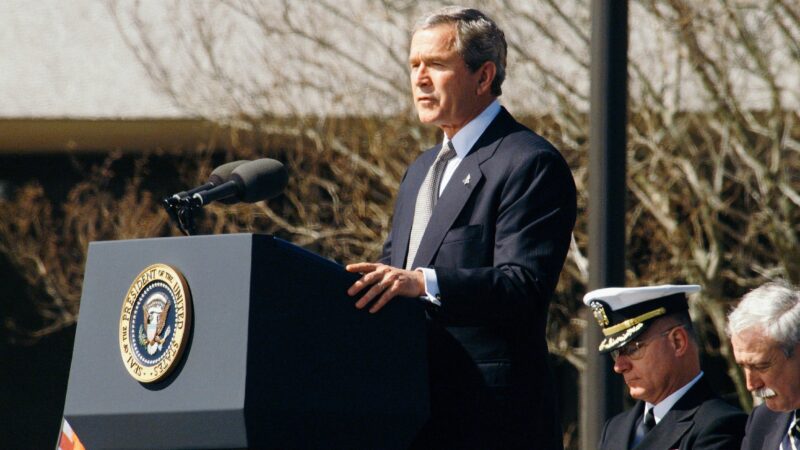
After 9/11, President Bush threw out the positions on foreign policy that he’d advocated for during his candidacy and became a strong advocate of using US military strength to go after its enemies. The ‘Bush Doctrine’ became the staple of US foreign policy during Bush’s time in office and the magnum opus of the neoconservative deep state. The doctrine stated that the United States was entangled in a global war of ideas between Western values on the one hand, and extremism seeking to destroy them on the other. The doctrine turned US foreign policy into a black and white war of ideology where the United States would show leadership in the world by actively seeking out the enemies of the West and also change those countries into becoming like the West. Bush stated in his 2002 State of the Union speech:
“I will not wait on events, while dangers gather. I will not stand by, as peril draws closer and closer. The United States of America will not permit the world’s most dangerous regimes to threaten us with the world’s most destructive weapons.”
The ‘Bush Doctrine’ was a pure expression of neoconservatism. But the most crucial part of his speech was when he gave a name to the new war the American state had begun to wage:
“Our war on terror is well begun, but it is only begun. This campaign may not be finished on our watch – yet it must be, and it will be waged on our watch.”
The ‘War on Terror’ became a term that would become synonymous with the Bush years and indeed neoconservatism. For neoconservatives, the attack on 9/11 reaffirmed their pessimism about the world being hostile to the United States and, in turn, their views on needing to eradicate it with ruthless calculation and force. A new doctrine, a new President, a new war – neoconservatism certainly held itself up to its ‘neo’ nature. With all this set-in place and the neoconservative deep state rearing to go, they could finally start to do what they had always wanted to do – wage war.
Iraq and Afghanistan became the main targets, with Al Qaeda, Saddam Hussein and the Taliban becoming public enemy’s number one, two and three. A succession of invasions into both countries, supported by the British military, ended up with the West looking victorious. Both the Taliban and Saddam Hussein had been removed from power, Al Qaeda was on the run, and various of their top leaders had been captured or killed. It was ‘mission accomplished’ and thus time to remould Afghanistan and Iraq into American-aligned liberal democracies. Furthermore, the new neoconservative elite saw to demoralise and outright destroy all those who had been associated with the Hussein regime and Islamic radical groups and thus began a campaign of hunting down, imprisoning and ‘interrogating’ all those involved. However, this is where the neoconservative project would begin to fall as quickly as it had ascended.The Failure and Eventual Fall of Neoconservatism
A core factor to note is that the neoconservative belief that one could simply invade non-democratic and often heavily religious countries and flip them into liberal democracies proved to be highly utopian. As Professor Ian Shapiro pointed out in his Yale lecture on the Demise of Neoconservatism Dream, the neoconservative’s falsely believed that destroying a country’s military was equivalent to pacifying and ruling a country. The American-British coalition may have swiftly destroyed the armies of Hussein of Iraq and cleared out the Taliban in Afghanistan but they did not effectively destroy the support both had amongst the general population. If anything, the removal of both created an array of intense power vacuums which the neoconservatives could only seem to fill with corrupt American aligned Middle Eastern politicians as well as gun-ho Generals and neoconservative elites who knew very little about the countries they were presiding over.
One such example is Paul Bremer who led the Coalition Provisional Authority (CPA) in Iraq after the Hussein regime was overthrown. His genius idea – that totally would get the Iraqi people on the side of freedom and democracy – was to disband the army and eradicate the Iraqi civil service and governmental authorities of those who were aligned with Hussein’s Ba’ath Party; terming it De-Ba’athification. Both led to a plethora of Iraqi’s losing their jobs and incomes and being smeared as enemies of the new American led regime – even low level teachers and privates were removed despite the fact that many of them joined the party simply to keep their own jobs.
While seen as a tactical way in which to remove any potential opposition to the CPA, the move created more opposition to the new government than any dissident anti-American group could have wished to have created – turns out making 400,000 young men, who know how to kill a man in sixteen different ways, unemployed isn’t the best way in which to show your care for the Iraqi people. It also didn’t help that Bremer and the CPA failed to account for a variety of funds and financial given to him for the reconstruction of Iraq, leading to a variety of financial blackholes and millions of dollars that simply disappeared.
Insurgent groups grew and assassination attempts on Bremer became commonplace to such an extent that even Osama Bin Laden himself placed a sizable bounty on Bremer’s head. Opposition to Bremer was so fervent that he was essentially forced to leave his position in the CPA by mid-2004 with his legacy being one of failure, instability and corruption, a legacy which the Former Speaker of the House Newt Gingrich called “the largest single disaster in American foreign policy in modern times”.
Removing opposition instead of attempting to work with it and use their expertise is something the US has done before, especially after WW2 with the fall of the Axis regimes, but the neoconservative mind has no tolerance or time for those who oppose American values – leading to brutal methods being used against those who do not comply.
It was under the neoconservatives that Guantanamo Bay was opened, a prison known for its mistreatment of prisoners and dubious torture methods. It was under the neoconservatives that Abu Ghraib prison, a feared prison under Hussein’s regime, became a place in which American soldiers and state officials were allowed treat and use interrogation methods on prisoners in manners that violate basic human dignity. And it was under the neoconservatives that began a mass surveillance state in their own country via the so-called ‘Patriot Act’ which put the privacy of American citizens in great danger. The Bush administration claimed that these abuses of human rights were not indicative of US policy, they were and the neoconservatives were the one’s responsible.
Luckily, these abuses were quickly all over mainstream news both inside and outside the US and horrified the population at large, even those who had once been pro the War on Terror. Furthermore, soldiers who had fought abroad came back with horror stories of their fellow soldiers abusing prison inmates and how they’d left Iraq bombed to the ground, displacing families and with casualty rates of up to and around 600,000 Iraqi civilians. The American mood turned against the war and by the end of Bush’s tenure in office 64% of Americans felt that the Iraq war had not been worth fighting.
The average American who felt angry and upset at their freedoms being threatened by Islamic terrorism became just as angry and upset when they saw their own country committing atrocities and taking away the freedoms of others. While it may seem cliche to point out the hypocrisy, this was one of the first times American’s had been exposed to the reality of what their state was really capable of. As Shapiro elucidates, the real legacy of the Iraq war and the War on Terror is that it destroyed America’s moral high ground. A high ground America has never been able to reach to since.
Barrack Obama and the Democrats attacked the Republicans and their neoconservative wing for their human rights abuses, the unjustified invasion of Iraq and implosion of America’s moral standing on the international stage. It is not unfair to say that Obama’s intoxicating charm and message of hope for America was desperately wanted in a post-Bush era in order so that Americans could try and forget the depravities that their country had fallen to in the early 2000s. He promised to pull out of Iraq, close Guantanamo Bay and replace the neoconservative doctrine for one based on diplomacy and moderation.
Bush and the majority of his neoconservatives left office after the election of Obama – in which he beat the then darling of the neoconservative right John McCain – and have since failed to re-enter the halls of power or indeed even their own party. The Tea Party movement supplanted neoconservatism dominance over the Republican Party and those still clinging on for dear life are being cleared out by the new America First aligned Republicans who wish to supplant the war-hawks and globalists with non-interventionists and nationalists.Conclusions
It is not radical nor unfair to say that not since the fall of the Berlin Wall has an ideological group lost its grip on power so completely as the neoconservatives have.
With the failure of nation-building in Iraq and Afghanistan, the grotesque violation of individual liberties at home and the deaths of hundreds of thousands of people, neoconservatism, and indeed even the US government, became synonymous with warmongering, authoritarianism and out and out international crime. To quote Stephen Eric Bronner in his book Blood in the Sand:
“Like a spoiled child, unconcerned with what anyone else thinks, the United States has gotten into the habit of invading a nation, trashing it, and then leaving without cleaning up the mess.”
Neoconservatives like to hand-wring about the ‘evils’ of Middle Eastern dictators while they allow dogs to tear off the limbs of prisoners in Guantanamo Bay, spy on innocent American citizens and bomb Afghani schools full of children into oblivion. Thanks to the neoconservative project of the early to mid-2000s – elements of which still are in place today – the United States became a leviathan monstrosity of surveillance, torture, corruption and warmongering.
It is interesting to see that after being the “cause célèbre of international politics”, neoconservatives are now the frequent targets of ridicule and scorn. And deservedly so, especially considering what neoconservatism has devolved into. The Straussian and genuinely conservative elements of the political philosophy have been ripped out, replaced with vague appeals to liberal humanitarianism and cucking for globalist organisations like the UN and NATO. The caricature of neoconservatives wanting drag queens to be able to use gender-neutral bathrooms at McDonalds in Kabul has shown to be somewhat accurate. After all, neoconservatives exist to promote ‘Western values’ in foreign countries, so naturally what they will end up promoting is the current cultural orthodoxy of progressive leftism, intersectionality and social decadence. An orthodoxy I’m sure Middle Easterners are desperately clamouring for.
However, despite their dwindling ranks and watering down of the ideology, the essence of neoconservative foreign policy remains intact; they still think the world should look like the United States. Therefore, it is unsurprising to see neoconservatives calling for every country in the world to be a liberal democracy along with the American model, or for Western troops to stay in Afghanistan indefinitely. Not only are these convictions still deeply held but are a direct expression of wanting American global hegemony to persist. On a deeper level, the recent pearl-clutching and whining from neoconservatives about the whole ordeal is simply a reflection of the anxiety that they now hold. Their ideas about what the world should look like have come collapsing before their eyes. And they can’t bear to face the fact that they were wrong.
This collapse has been occurring for some time and hopefully with the withdrawal of troops from Afghanistan, and the recent moves amongst elements of the right and left to adopt a more non-interventionist approach to foreign policy, the collapse of neoconservatism will remain permanent. After all, the neoconservatives who backed President Joe Biden – thinking he would spell a revival in their views – have now had an egg thrown in their face. Biden has proven himself to not be aligned with neoconservative foreign policy views.
Despite his claims that ‘America was back’ and his past support of foreign interventionism, it is evident that Biden has no real ideological attachment to staying in Afghanistan. In turn, he seems to have found it relatively easy to pull out and then spout rhetoric that wouldn’t be uncommon to hear at a Ron Paul rally. He stood against nation-building, turning Afghanistan into a unified centralised democracy and rejected endless military deployments and wars as the main tool of US foreign policy. Biden, alongside President Donald Trump, has turned the tide of US foreign policy away from military interventionism and back towards diplomacy. A surprise to be sure, but a welcome one.
However, while the ‘War on Terror’ may firmly be at an end – the American state has worryingly turned its eyes towards a new ‘War on Domestic Terror’. A war that political scientist and terrorism expert Max Abrahams worries will be catastrophic for the United States, quoting Abrahams:
“The War on Terror destabilized regions abroad. It’ll destabilise our country all the same… We cannot crack down on people just because we don’t like their ideology…otherwise the government is going to turn into the thought police and that is going to spawn the next generation of terrorists.”
The neoconservatives may have lost the war on terror but the structures and policies they put in place to fight that war are now being used, and being used more effectively, against so-called ‘domestic terrorists’. The American regime’s tremble in the lip is so great that it now believes the real threat to its existence lies at home. While this ‘War on Domestic Terror’ is still in its early stages, it is clear that the neoconservative deep state’s toys of torture, mass surveillance and war are now being put to other uses. Only time will tell if it will have the same consequences in America as it did in the countries it once occupied.
.
With the withdrawal of troops from Afghanistan and Iraq; the continued rise of anti-interventionism on the right and left; and the memory of the failure of conflicts in the Middle East fresh in people’s memories, neoconservatism has been all but relegated to the ideological graveyard – its body left rot under the cold soil for eternity. A fitting fate.
“A neoconservative is a liberal who has been mugged by reality” proclaimed the godfather of the ideology. But in the perusal of utopian imperial ambitions it has now suffered the same fate – neoconservatism has been mugged by reality. A reality it so desperately and violently tried to bring to heel.
-
Rousseau and the Legacy of Romanticism
One idea that I’ve fondly taken from Augusto del Noce is that ideologies have an internal logic to them, which unfolds as they interact with real-world events. Philosophies aren’t static, but constantly changing as they play out against one another historically. This view, while similar to the Marxist notion of praxis, finds ultimate inspiration from Joseph de Maistre. It’s de Maistre who writes that the French Revolution sweeps men up against their will and devours its own children.
Once put into practice, revolutions take on a life of their own, and like a wild tiger on a leash, drag their authors to new and unheard-of places. This isn’t to deny human free will; something I strongly affirm. It’s rather to recognise that rational humans, faced with circumstances, strive to act consistently with what they believe. This mechanism of consistency is what causes ideologies to evolve over time.
This insight is a powerful tool for understanding the long-term consequences of philosophies. The social sciences may quantify popular actions and opinions, but because human wishes are often nebulous, and people are fond of lying to themselves, there’s always room to dispute the results. The romantic primitivism of Jean Jacques Rousseau is one such ideology. Since being unleashed into the world from the bloody womb of the Reign of Terror, it has branched in many different directions and morphed into shapes Rousseau himself wouldn’t have recognised.
To define romanticism, I turn to Irving Babbitt and his 1919 work Rousseau and Romanticism. Romanticism sets itself in opposition to classicism. Classicism seeks standards for ethics and culture in universal types which it deems natural. It’s not the case that classicism seeks rules necessarily (lest we confuse it with Kantianism). Aristotle is the foremost classicist, yet he denies that norms are truly codifiable into rules. A universal type is rather an ideal based upon the nature of something. A classicist (like Aristotle) might say that being polite at the dinner table is something we should do, and this politeness consists of showing due moderation in eating, drinking, talking etc. But this isn’t a rule so much as a way of displaying the excellence proper to a human being.
Classicism isn’t opposed to emotion either. Rather, it subdues emotions to rational norms. Human nature has a standard of excellence which demands the proper use of emotion. In other words, emotions are good or bad depending on how we wield them according to a standard for the human species. The one able to do this is a universal type, what Aristotle calls the phronimos, or wise man. The later Stoics didn’t condemn emotions entirely, as the popular misconception of them. They rather encouraged natural emotions and discouraged the unnatural. Again, nature is a standard for ideal behaviour, external to individual fancy.
Romanticism, on the other hand, seeks standards in what’s unique and unrepeatable. Instead of conforming to generic ideals, goodness comes from spontaneous individual acts and thoughts. The cause for this is Rousseau’s doctrine of original sanctity. Classicism makes a distinction between ‘things-as-they-are’ and ‘things-as-they-ought’. Humans, animals, and plants don’t come into the world fulfilling an ideal; they arrive imperfect and must strive after their ideal. If we deny this, as Rousseau does, then to be good just is to be what one is. The generic ideal has no purpose and drops out. Authenticity to oneself as one is becomes the aim of life, and this can only find expression in unrepeatable spontaneous acts.
Indeed, once authenticity becomes central, it’s but a short step to rebelling against all standards which society imposes on the self. Since whatever standards society imposes must be ideal repeatable types, and no ideal repeatable types are authentic, no socially imposed standards can be authentic. And since goodness lies in authenticity, being truly good means casting off the standards society has imposed.
As Alasdair Macintyre wryly says in After Virtue, Enlightenment philosophes have the least self-awareness of all thinkers. They create new and revolutionary systems, but the content of their morality is entirely inherited from the civilisation they’ve inherited and which they despise. Thus, Rousseau’s ethics are stuffed full of quaint and puritanical Calvinist ideas from his Genevan upbringing. “Effeminacy” is one of his constant worries, and he applies the term, in boyish fashion, to anything he doesn’t like. Thus, in the Discourse on the Origin of Inequality, he can condemn civilised man:
“By becoming sociable and enslaved, he becomes weak, fearful, and grovelling, and his soft and effeminate way of life ends by enervating both his strength and his courage.”
Take these relics away, however, and Rousseau’s romanticism has only its sentimental primitivism to act as a limiting moral principle. Goodness is whatever lies in the untainted human heart, freed from social corruption. What becomes of it then? I wager it must enter an eternal spiral of liberation. Romanticism is built on the idea that we’ll be truly happy only when we free ourselves from all external rules and uncover a pre-social authenticity. Since this is a lie, no amount of liberation will ever create happiness. So, to remain consistent with itself, romanticism must seek ever more shackles of oppression to shatter. It’s either that or admit error.
The progressive radicalisation built into romanticism is visible everywhere. The sexual revolution, for example, has no brakes, because it’s built on a romanticised and primitivist vision of sex that would be falsified the moment brakes are applied. The radicals of the mid-twentieth century believed that socialised sexuality was corrupt, and once the orgasm was freed from all external restraints, pure happiness would result (Wilhelm Reich, for example, thought-free love was the precondition to utopian social democracy). Free love hasn’t made us happier, however. So, the answer is to find ever more previously unknown sexual taboos, whose chains we must shatter if we’re at last to be free.
In everyday morality, romantic assumptions have remade the life quest we each undertake for goodness, into a quest for authenticity. Finding one’s true self is now a drain on the wallet of the entire Western bourgeoisie. People of ages past underwent transformative moral journeys that turned them from sinners to saints, but theirs wasn’t a trek for authenticity. They did something far more mundane: they changed their minds. There’s an implicit vanity in the true-self doctrine. Changing your mind means admitting error. Finding your true self means you were right all along, but just didn’t notice it, because society was keeping you blind.
The cultural production of this quest is, I believe, simply inferior to the production of a mind that looks outwards from itself onto something else. Someone obsessed with finding his authentic self doesn’t have time to stand in awe of things greater than himself. What is falling in love, if not to be overcome by the sense of the intrinsic irreplaceable value of another person, without reference to oneself? We have all effectively become Rousseau writing his Confessions. A man who delighted in nature and other people only as frissons to express his authentic self, and could begin his book with the words:
“Here is the only portrait of a man, painted exactly after nature and in all her truth, that exists and probably ever will exist.”
In education, romantic ideas have done away with the rote learning that characterised pedagogy from Ancient Greece, through the middle ages and down to the Victorian Age. Twentieth-century educators like John Dewey, following in Rousseau’s footsteps, sought to remake schooling around the true self doctrine. Instead of moulding a pupil to conform to an ideal (a gentleman or citizen), modern education exists to help him discover his uncorrupted pre-social self. Self-expression without rules has become the educational norm, with the result that we have people who are experts in analysing their own minds and emotions, but incapable of self-denial or rigour. The excellence of mind and body requires constant training. We accept this more readily about the body because physical fitness is visible. But the mind, which is invisible, needs just as much training to be fit for purpose.
In the end, I see romanticism as an enormous civilisational gamble. The difference between classicism and romanticism is about what we think reality is truly like. The classicist sees a human race born lacking and sees culture as how a scaffold is to a building. Culture exists as an aid to human completion. The romantic, meanwhile, claims that human nature isn’t completable, but already complete, and merely corrupted. He wagers that if we accept this idea, we can remake the world for the better. Like any gambler, he doesn’t think about the stakes if the wager is lost. Here the stakes are social catastrophe if the assumption is untrue. If the truth is classical, then romanticism is akin to raising a lion on a strict vegetarian diet.