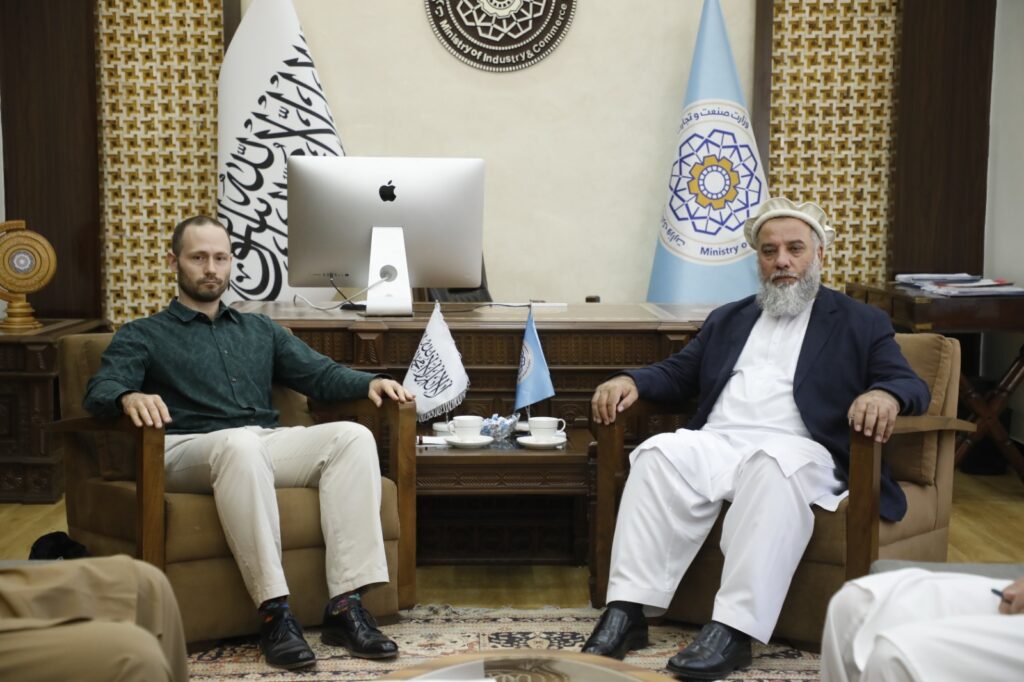
I can’t say I’ve ever hosted the Taliban, although if presented with the opportunity, the Worshipful Company of Brewers wouldn’t have been my initial choice of venue.
This irony wasn’t lost on Daniel Evans, frontier markets and technology investor, co-founder of the Gibraltar Stock Exchange Group, and Chairman of the newly-founded Afghanistan Advisory Council (AAC).
Evans joked the venue would allow him to lay claim to successfully organising a piss-up in a brewery, although it must be said the event wasn’t a piss-up at all – partially because the drinks were appropriately alcohol free, but mainly because the foundation of the AAC marks the first actual step at rapprochement with Afghanistan since the Taliban’s return to power in August 2021.
All-in-all, a pretty serious affair. Serious enough to receive a written endorsement from Nooruddin Azizi, Afghanistan’s Minister of Industry and Commerce:
“On behalf of the Islamic Emirate of Afghanistan, I want to emphasize that the investment environment in Afghanistan is feasible, with strong security and government policies focused on economic development. As many know, Afghanistan is an untapped country with significant business and investment opportunities across various sectors, including energy, industry, infrastructure, mining, agriculture, and health.
We welcome any proposals and investments in Afghanistan, assuring you that the government will fully protect and support all initiatives.”
The launch was attended by businessmen from a variety of interested parties; railway construction, petrochemicals, international finance, and so on. Michael Mainelli, current President of the London Chamber of Commerce and Industry and former Lord Mayor of the City of London was among those present, as well as Miles ‘Lord Miles’ Routledge, adventurer-turned-YouTuber-turned-junior member of the AAC.
Among other ambitions for a hospital, a hotel, a logistics centre, and a railway terminus, the AAC’s flagship proposal of a Special Economic Zone (SEZ), set to be attached to Kabul airport, has won the backing of Mohammad and Zahid Asif, Owner and Managing Director of Walid Titan Ltd respectively, who are providing the land for the zone.
The precise details of the SEZ have yet to be fleshed out, although it’s clear that the AAC is looking to Dubai’s International Finance Centre (IFC) as a model; a demarcated zone where the norms and customs of international commerce prevail, and regulations are to be drawn up on the advice of the AAC.
The SEZ is one of several projects set to be funded by a new National Growth Fund, which will provide resources to develop a diverse range of industries and projects, such as a far-reaching hospital construction programme. One of the hospital centres will be located in the SEZ. The AAC has been given the mandate to advise the creation of the fund.
One might ask why the Taliban would allow any of this. If one reads between the lines, the SEZ would allow what are essentially Western standards of conduct to take root in an otherwise Islamic theocratic state. Sure, it’s not exactly going to be Amsterdam but it’s hard to square such a proposal with the totalising ‘Islamofascist’ caliphate prophesised by thought leaders of the dilapidated pantheon of liberal-humanitarian interventionism.
The simple but surprising reality of the matter is the Afghans seriously want to get down to business. In fact, it’s becoming clear the Taliban are more eager to do business with the British than vice versa, and not without valid reason. They’re highly suspicious of the Americans, their opinion of the Russians isn’t much better, relations with Pakistan have massively deteriorated within the past year alone, and China and Iran look more like regional threats than potential allies.
As bizarre as it sounds, the Taliban’s view of the British continues to be informed by the Empire, which they regard in a similar manner to how many of us Moderns regard the Roman Empire; that is, as a milestone in human achievement. The British are viewed less as hated enemies and more as honourable and accomplished adversaries. If that’s not soft power, I don’t know what is!
As one would expect, the Afghans have zero appetite to be controlled by a foreign power, but they’re not completely isolationist; they’re quite happy to enlist the help of foreigners with the know-how required to stabilise their war-battered economy, having endured invasions from the USSR and the US-led coalition, ongoing skirmishes with groups like ISIS-K, and incoming Pashtun refugees from neighbouring Pakistan.
It’s a matter of political ideology whether it’s preferable to live in a less-developed but comparatively liberal country over a more-developed but comparatively illiberal one, but – as a general rule of thumb – it’s better to have functioning railways, roads, and hospitals than to not have them at all. Some things aren’t exactly ideological touchstones. Is it really so polarising to believe that Afghanistan should have a reliable supply of currency, rather than making do with sheets of borderline dust held together with glue and tape?
Beneath debates on the political and religious destiny of Afghanistan lies an economy which needs to be run regardless, and the AAC hasn’t so much muscled into this gap, but waltzed into it; partially because the organisation seems to be ahead of the curve on this issue, but also because its founding members felt they had nothing better to do.
On his release from jail in October 2023, having been arrested for not having his papers in order, Routledge – who described the experience as “the best networking opportunity I’ve ever had” – received an email from Evans with the subject line “Bored/gold mine lol” – a proposal which snowballed into setting up a full-on, nation-wide development fund with the blessing of the Afghan government.
Overall, the AAC is filling the vacuum left by a regime that doesn’t know what to do with Afghanistan. One suspects it’s pretty hard to see a path forward with that much egg on your face!
For the past two decades, Britain’s political system has stuck to the same playbook; a hodgepodge strategy of attempting to nag and bomb Afghanistan into becoming a liberal democracy with little-to-no regard for local idiosyncrasies and so forth.
Indeed, no country is a blank slate and Afghanistan is no exception, but more than an investment opportunity – that itself is laden with several obvious benefits; Afghanistan is rich with natural minerals – but a real chance to rehearse discombobulated statesmen and commentators in the virtues and practices which factor into good nation-building; which I cannot help but feel is the spiritual mission of the AAC, even if not said so outright.
Keir Starmer, take notes!
You Might also like
-
Neoconservatism: Mugged by Reality (Part 2)
The Neoconservative Apex: 9/11 and The War on Terror
11th September 2001 was a watershed moment in American history. The destruction of the World Trade Centre by Muslim terrorists, the deaths of thousands of innocent American citizens and the general feeling of chaos and vulnerability was enough to turn even the cuddliest of liberals into bloodthirsty war hawks. People were upset, confused and above all angry and wanted someone to pay for all the destruction and death. To paraphrase Chairman Mao, everything under the heavens was in chaos, for the neoconservatives the situation was excellent.
After 9/11, President Bush threw out the positions on foreign policy that he’d advocated for during his candidacy and became a strong advocate of using US military strength to go after its enemies. The ‘Bush Doctrine’ became the staple of US foreign policy during Bush’s time in office and the magnum opus of the neoconservative deep state. The doctrine stated that the United States was entangled in a global war of ideas between Western values on the one hand, and extremism seeking to destroy them on the other. The doctrine turned US foreign policy into a black and white war of ideology where the United States would show leadership in the world by actively seeking out the enemies of the West and also change those countries into becoming like the West. Bush stated in his 2002 State of the Union speech:
“I will not wait on events, while dangers gather. I will not stand by, as peril draws closer and closer. The United States of America will not permit the world’s most dangerous regimes to threaten us with the world’s most destructive weapons.”
The ‘Bush Doctrine’ was a pure expression of neoconservatism. But the most crucial part of his speech was when he gave a name to the new war the American state had begun to wage:
“Our war on terror is well begun, but it is only begun. This campaign may not be finished on our watch – yet it must be, and it will be waged on our watch.”
The ‘War on Terror’ became a term that would become synonymous with the Bush years and indeed neoconservatism. For neoconservatives, the attack on 9/11 reaffirmed their pessimism about the world being hostile to the United States and, in turn, their views on needing to eradicate it with ruthless calculation and force. A new doctrine, a new President, a new war – neoconservatism certainly held itself up to its ‘neo’ nature. With all this set-in place and the neoconservative deep state rearing to go, they could finally start to do what they had always wanted to do – wage war.
Iraq and Afghanistan became the main targets, with Al Qaeda, Saddam Hussein and the Taliban becoming public enemy’s number one, two and three. A succession of invasions into both countries, supported by the British military, ended up with the West looking victorious. Both the Taliban and Saddam Hussein had been removed from power, Al Qaeda was on the run, and various of their top leaders had been captured or killed. It was ‘mission accomplished’ and thus time to remould Afghanistan and Iraq into American-aligned liberal democracies. Furthermore, the new neoconservative elite saw to demoralise and outright destroy all those who had been associated with the Hussein regime and Islamic radical groups and thus began a campaign of hunting down, imprisoning and ‘interrogating’ all those involved. However, this is where the neoconservative project would begin to fall as quickly as it had ascended.The Failure and Eventual Fall of Neoconservatism
A core factor to note is that the neoconservative belief that one could simply invade non-democratic and often heavily religious countries and flip them into liberal democracies proved to be highly utopian. As Professor Ian Shapiro pointed out in his Yale lecture on the Demise of Neoconservatism Dream, the neoconservative’s falsely believed that destroying a country’s military was equivalent to pacifying and ruling a country. The American-British coalition may have swiftly destroyed the armies of Hussein of Iraq and cleared out the Taliban in Afghanistan but they did not effectively destroy the support both had amongst the general population. If anything, the removal of both created an array of intense power vacuums which the neoconservatives could only seem to fill with corrupt American aligned Middle Eastern politicians as well as gun-ho Generals and neoconservative elites who knew very little about the countries they were presiding over.
One such example is Paul Bremer who led the Coalition Provisional Authority (CPA) in Iraq after the Hussein regime was overthrown. His genius idea – that totally would get the Iraqi people on the side of freedom and democracy – was to disband the army and eradicate the Iraqi civil service and governmental authorities of those who were aligned with Hussein’s Ba’ath Party; terming it De-Ba’athification. Both led to a plethora of Iraqi’s losing their jobs and incomes and being smeared as enemies of the new American led regime – even low level teachers and privates were removed despite the fact that many of them joined the party simply to keep their own jobs.
While seen as a tactical way in which to remove any potential opposition to the CPA, the move created more opposition to the new government than any dissident anti-American group could have wished to have created – turns out making 400,000 young men, who know how to kill a man in sixteen different ways, unemployed isn’t the best way in which to show your care for the Iraqi people. It also didn’t help that Bremer and the CPA failed to account for a variety of funds and financial given to him for the reconstruction of Iraq, leading to a variety of financial blackholes and millions of dollars that simply disappeared.
Insurgent groups grew and assassination attempts on Bremer became commonplace to such an extent that even Osama Bin Laden himself placed a sizable bounty on Bremer’s head. Opposition to Bremer was so fervent that he was essentially forced to leave his position in the CPA by mid-2004 with his legacy being one of failure, instability and corruption, a legacy which the Former Speaker of the House Newt Gingrich called “the largest single disaster in American foreign policy in modern times”.
Removing opposition instead of attempting to work with it and use their expertise is something the US has done before, especially after WW2 with the fall of the Axis regimes, but the neoconservative mind has no tolerance or time for those who oppose American values – leading to brutal methods being used against those who do not comply.
It was under the neoconservatives that Guantanamo Bay was opened, a prison known for its mistreatment of prisoners and dubious torture methods. It was under the neoconservatives that Abu Ghraib prison, a feared prison under Hussein’s regime, became a place in which American soldiers and state officials were allowed treat and use interrogation methods on prisoners in manners that violate basic human dignity. And it was under the neoconservatives that began a mass surveillance state in their own country via the so-called ‘Patriot Act’ which put the privacy of American citizens in great danger. The Bush administration claimed that these abuses of human rights were not indicative of US policy, they were and the neoconservatives were the one’s responsible.
Luckily, these abuses were quickly all over mainstream news both inside and outside the US and horrified the population at large, even those who had once been pro the War on Terror. Furthermore, soldiers who had fought abroad came back with horror stories of their fellow soldiers abusing prison inmates and how they’d left Iraq bombed to the ground, displacing families and with casualty rates of up to and around 600,000 Iraqi civilians. The American mood turned against the war and by the end of Bush’s tenure in office 64% of Americans felt that the Iraq war had not been worth fighting.
The average American who felt angry and upset at their freedoms being threatened by Islamic terrorism became just as angry and upset when they saw their own country committing atrocities and taking away the freedoms of others. While it may seem cliche to point out the hypocrisy, this was one of the first times American’s had been exposed to the reality of what their state was really capable of. As Shapiro elucidates, the real legacy of the Iraq war and the War on Terror is that it destroyed America’s moral high ground. A high ground America has never been able to reach to since.
Barrack Obama and the Democrats attacked the Republicans and their neoconservative wing for their human rights abuses, the unjustified invasion of Iraq and implosion of America’s moral standing on the international stage. It is not unfair to say that Obama’s intoxicating charm and message of hope for America was desperately wanted in a post-Bush era in order so that Americans could try and forget the depravities that their country had fallen to in the early 2000s. He promised to pull out of Iraq, close Guantanamo Bay and replace the neoconservative doctrine for one based on diplomacy and moderation.
Bush and the majority of his neoconservatives left office after the election of Obama – in which he beat the then darling of the neoconservative right John McCain – and have since failed to re-enter the halls of power or indeed even their own party. The Tea Party movement supplanted neoconservatism dominance over the Republican Party and those still clinging on for dear life are being cleared out by the new America First aligned Republicans who wish to supplant the war-hawks and globalists with non-interventionists and nationalists.Conclusions
It is not radical nor unfair to say that not since the fall of the Berlin Wall has an ideological group lost its grip on power so completely as the neoconservatives have.
With the failure of nation-building in Iraq and Afghanistan, the grotesque violation of individual liberties at home and the deaths of hundreds of thousands of people, neoconservatism, and indeed even the US government, became synonymous with warmongering, authoritarianism and out and out international crime. To quote Stephen Eric Bronner in his book Blood in the Sand:
“Like a spoiled child, unconcerned with what anyone else thinks, the United States has gotten into the habit of invading a nation, trashing it, and then leaving without cleaning up the mess.”
Neoconservatives like to hand-wring about the ‘evils’ of Middle Eastern dictators while they allow dogs to tear off the limbs of prisoners in Guantanamo Bay, spy on innocent American citizens and bomb Afghani schools full of children into oblivion. Thanks to the neoconservative project of the early to mid-2000s – elements of which still are in place today – the United States became a leviathan monstrosity of surveillance, torture, corruption and warmongering.
It is interesting to see that after being the “cause célèbre of international politics”, neoconservatives are now the frequent targets of ridicule and scorn. And deservedly so, especially considering what neoconservatism has devolved into. The Straussian and genuinely conservative elements of the political philosophy have been ripped out, replaced with vague appeals to liberal humanitarianism and cucking for globalist organisations like the UN and NATO. The caricature of neoconservatives wanting drag queens to be able to use gender-neutral bathrooms at McDonalds in Kabul has shown to be somewhat accurate. After all, neoconservatives exist to promote ‘Western values’ in foreign countries, so naturally what they will end up promoting is the current cultural orthodoxy of progressive leftism, intersectionality and social decadence. An orthodoxy I’m sure Middle Easterners are desperately clamouring for.
However, despite their dwindling ranks and watering down of the ideology, the essence of neoconservative foreign policy remains intact; they still think the world should look like the United States. Therefore, it is unsurprising to see neoconservatives calling for every country in the world to be a liberal democracy along with the American model, or for Western troops to stay in Afghanistan indefinitely. Not only are these convictions still deeply held but are a direct expression of wanting American global hegemony to persist. On a deeper level, the recent pearl-clutching and whining from neoconservatives about the whole ordeal is simply a reflection of the anxiety that they now hold. Their ideas about what the world should look like have come collapsing before their eyes. And they can’t bear to face the fact that they were wrong.
This collapse has been occurring for some time and hopefully with the withdrawal of troops from Afghanistan, and the recent moves amongst elements of the right and left to adopt a more non-interventionist approach to foreign policy, the collapse of neoconservatism will remain permanent. After all, the neoconservatives who backed President Joe Biden – thinking he would spell a revival in their views – have now had an egg thrown in their face. Biden has proven himself to not be aligned with neoconservative foreign policy views.
Despite his claims that ‘America was back’ and his past support of foreign interventionism, it is evident that Biden has no real ideological attachment to staying in Afghanistan. In turn, he seems to have found it relatively easy to pull out and then spout rhetoric that wouldn’t be uncommon to hear at a Ron Paul rally. He stood against nation-building, turning Afghanistan into a unified centralised democracy and rejected endless military deployments and wars as the main tool of US foreign policy. Biden, alongside President Donald Trump, has turned the tide of US foreign policy away from military interventionism and back towards diplomacy. A surprise to be sure, but a welcome one.
However, while the ‘War on Terror’ may firmly be at an end – the American state has worryingly turned its eyes towards a new ‘War on Domestic Terror’. A war that political scientist and terrorism expert Max Abrahams worries will be catastrophic for the United States, quoting Abrahams:
“The War on Terror destabilized regions abroad. It’ll destabilise our country all the same… We cannot crack down on people just because we don’t like their ideology…otherwise the government is going to turn into the thought police and that is going to spawn the next generation of terrorists.”
The neoconservatives may have lost the war on terror but the structures and policies they put in place to fight that war are now being used, and being used more effectively, against so-called ‘domestic terrorists’. The American regime’s tremble in the lip is so great that it now believes the real threat to its existence lies at home. While this ‘War on Domestic Terror’ is still in its early stages, it is clear that the neoconservative deep state’s toys of torture, mass surveillance and war are now being put to other uses. Only time will tell if it will have the same consequences in America as it did in the countries it once occupied.
.
With the withdrawal of troops from Afghanistan and Iraq; the continued rise of anti-interventionism on the right and left; and the memory of the failure of conflicts in the Middle East fresh in people’s memories, neoconservatism has been all but relegated to the ideological graveyard – its body left rot under the cold soil for eternity. A fitting fate.
“A neoconservative is a liberal who has been mugged by reality” proclaimed the godfather of the ideology. But in the perusal of utopian imperial ambitions it has now suffered the same fate – neoconservatism has been mugged by reality. A reality it so desperately and violently tried to bring to heel.
Post Views: 1,700 -
The Post-Polar Moment
Introduction
Abstract: Nations and intergovernmental organisations must consider the real possibility of moving into a world without a global hegemon. The core assumptions that underpin realist thought can directly be challenged by presenting an alternative approach to non-polarity. This could be through questioning what might occur if nations moved from a world in which polarity remains a major tool for understanding interstate relations and security matters. Further work is necessary to explore the full implications of what entering a non-polar world could mean and possible outcomes for such events.
Problem statement: What would global security look like without competition between key global players such as the People’s Republic of China and the United States?
So what?: Nations and intergovernmental organisations should prepare for the real possibility that the international community could be moving into a world without a global hegemon or world order. As such, they should recognise the potential for a rapidly changing geopolitical landscape and are urged to strategically acknowledge the importance of what this would mean. More research is still needed to explore the implications for and of this moving forward.
Geopolitical Fluidity
Humankind has moved rapidly from a period of relatively controlled geopolitical dominance towards a more fluid and unpredictable situation. This has posed a question to global leadership: what would it mean to be leaderless, and what role could anarchy play in such matters? Examining the assumptions that make up most of the academic discourse within International Relations and Security Studies remains important in trying to tackle said dilemma.
From this geopolitical fluidity, the transition from U.S.-led geopolitical dominance, shown in the ‘unipolar moment’, to that of either bipolarity or multipolarity has come about. This re-emergence, however, has not directly focused on an unexplored possibility that could explain the evolving trends that might occur. Humankind is entering a post-polar world out of the emergence of a leaderless world structure. There is the possibility, too, that neither the U.S. nor the the People’s Republic of China become the sole global superpower which then dominates the world and its structures”. The likelihood of this occurring remains relatively high, as explored further on. Put differently, “it is entirely possibly that within the next two decades, international relations could be entering a period of no singular global superpower at all”.
Humankind is entering a post-polar world out of the emergence of a leaderless world structure.
The Non-Polar Moment
The most traditional forms of realism propose three forms of polar systems. These are unipolar, bipolar, or multipolar (The Big Three). There is a strong possibility that we as a global community are transitioning into a fourth and separate world system. This fourth and relatively unexplored world system could mean that anything that enables the opportunity for either a superpower or regional power to establish itself will not be able to occur in the foreseeable future.
It can also historically be explained by the end of the Cold War and the subsequent collapse of the Soviet Union, which led to the emergence of the U.S. as the leading superpower within global politics. For lack of better words, it was a generational image of a defining dominant nation within both international relations and security circles. From this, it was widely acknowledged and regarded that Krauthammer coined the’ unipolar moment’ in the aftermath of the Cold War. This meant that there was a period when the U.S. was the sole dominant centre of global power/polarity. This unipolar moment is more accurately considered part of a much larger ‘global power moment’.
This global power moment is in reference to the time period mentioned above, which entailed the ability for nations to directly and accurately project their power abroad or outside their region. This ability to project power will presumably but steadily decline in the following decades due to the subsequent decrease in the three core vectors of human development (Demography, Technology and Ideology). When combined, one could argue that the three polar systems allowed for the creation of the global power moment itself. Specifically, that would be from the start of the 19th until the end of the 20th century. Following that line of thought, the future was affected by the three aforementioned pillars somewhat like this:
- Demography: this means having a strongly structured and or growing population, one that allows a nation to act expansively towards other states and use those human resources to achieve its political goals.
- Technology: the rise of scientific innovations, allowing stronger military actions to happen against other nations. To date, it has granted nations the ability to directly project power abroad, which, before this, would have only been able to occur locally or at a regional level.
- Ideology: the third core vector of human development. That means the development of philosophies that justify the creation of a distinct mindset or “zeitgeist” that culturally explains a nation’s actions.
These three core vectors of development are built into a general human trend and assumption of ‘more’, within this great power moment. Existing systems are built into the understanding of more people, more technology development, and more growth, along with possessing generated ideologies that rationalise such actions. What this does, in turn, is help define a linear progression of human history and help develop an understanding of interstate relations.
Existing systems are built into the understanding of more people, more technology development, and more growth, along with possessing generated ideologies that rationalise such actions.
Nevertheless, this understanding is currently considered insufficient; the justification for this is based on developing a fourth vector to help comprehend power distribution. This vector is that of non-polarity, meaning a non-power-centred world structure. From this, the idea or concept of non-polarity is not original. Previously, it was deconstructed by Haass, Manning and Stuenkel, and, in their context, refers to a direct absence of global polarity within any of the Big Three polar systems.
Prior academics have shown that non-polarity is the absence of absolute power being asserted within a place and time but continues to exist within other big three polar systems. The current world diverges from the idea of multipolar in one core way. There are several centres of power, many of which are non-state actors. As a result, power and polarity can be found in many different areas and within many different actors. This argument expands on Strange’s (1996) contributions, who disputed that polarity was transferring from nations to global marketplaces and non-state actors.
A notable example is non-state players who act against more established powers, these can include terrorist and insurgent groups/organisations. Non-polarity itself being “a world dominated not by one or two or even several states but rather by dozens of actors possessing and exercising various kinds of power”. From this, a more adequate understanding of non-polarity is required. Additionally, it should be argued that non-polarity is rather a direct lack of centres of power that can exist and arise from nations. Because of this, this feature of non-polarity infers the minimisation of a nation’s ability to meaningfully engage in structural competition, which in turn describes a state of post-polarity realism presenting itself.
Humans are presented with the idea of a ‘non-polar moment’, which comes out of the above-stated direct lack of polarity. The non-polar moment inverts the meaning of the unipolar moment found with the U.S. in the aftermath of the Cold War, which was part of the wider period of Pax Americana (after WWII). This contrasts with the traditional idea: instead of having a singular hegemonic power that dominates power distribution across global politics, there is no direct power source to assert itself within the system. Conceptually, this non-polar moment could be viewed as a system where states are placed into a situation in which they are limited to being able to act outwardly. A reason why they could be limited is the demographic constraints being placed on a nation from being able to strategically influence another nation, alongside maintaining an ideology that allows nations to justify such actions.
The non-polar moment inverts the meaning of the unipolar moment found with the U.S. in the aftermath of the Cold War, which was part of the wider period of Pax Americana.
The outcomes of such a world have not been fully studied, with the global community moving from a system to one without any distributors of power or ability to influence other nations. In fact, assuming these structural conditions, -that nations need to acquire hegemony and are themselves perpetually stunted-, the scenario is similar to having a ladder that is missing its first few steps. From this, one can also see this structural condition as the contrast to a ‘rising tide lifts all boats’ situation, with the great power reduction. Because of this, the non-polar moment could symbolise the next, fourth stage for nations to transition to part of a much wider post-polarity form of realism that could develop.
The implications for this highlight a relevant gap within the current literature, the need to examine both the key structural and unit-level conditions that currently are present. This is what it might mean to be part of a wider ‘a global tribe without a leader’, something which a form of post-polarity realism might suggest.
A Global Tribe Without a Leader
To examine the circumstances for which post-polarity realism can occur, one must examine the conditions that define realism itself. Traditionally, for realism, the behaviours of states are as follows:
- States act according to their self-interests;
- States are rational in nature; and
- States pursue power to help ensure their own survival.
What this shows is that there are several structures from within the Big Three polar systems. Kopalyan argues that the world structure transitions between the different stages. This can be shown by moving between interstate relations as bipolar towards multipolar, done by both nations and governments, which allows nations to re-establish themselves in accordance with their structural conditions within the world system. Kopalyan then continues to identify the absence of a consistent conceptualisation of non-polarity. This absence demonstrates a direct need for clarity and structured responses to the question of non-polarity.
As such, the transition between systems to non-polarity, to and from post-polarity will probably occur. The reason for this is the general decline in three core vectors of human development, which are part of complex unit-level structural factors occurring within states. The structural factors themselves are not helpful towards creating or maintaining any of the Big Three world systems. Ultimately, what this represents is a general decline in global stability itself which is occurring. An example of this is the reduction of international intergovernmental organisations across the globe and their inability to adequately manage or solve major structural issues like Climate Change, which affects all nations across the international community.
Firstly, this can be explained demographically because most nations currently live with below-replacement (and sub-replacement) fertility rates. In some cases, they have even entered a state of terminal demographic decline. This is best symbolised in nations like Japan, Russia, and the PRC, which have terminal demographics alongside most of the European continent. The continuation of such outcomes also affects other nations outside of this traditional image, with nations like Thailand and Türkiye suffering similar issues. Contrasted globally, one can compare it to the dramatic inverse fertility rates found within Sub-Saharan Africa.
Secondly, with technology, one can observe a high level of development which has produced a widespread benefit for nations. Nevertheless, it has also contributed to a decline in the preservation of being able to transition between the Big Three systems. Technological developments have produced obstacles to generating coherence between governments and their citizenry. For example, social media allows for the generation of mass misinformation that can be used to create issues within nations from other countries and non-state actors. Additionally, it has meant that nations are placed permanently into a state of insecurity because of the proliferation of weapons of mass destruction (WMDs). The results mean there can never be any true sense or permanence in the idea of security due to the effects of WMDs and their spillover effects. Subsequently, technological development has placed economic hurdles for nations within the current world order through record levels of debt, which has placed further strain on the validity of the current global economic system in being able to maintain itself.
Technological developments have produced obstacles to generating coherence between governments and their citizenry.
The final core vector of human development is ideology and its decline. This has been shown with a reduction in the growth of new ideologies and philosophies used to understand and address world issues. This is an extension of scholars like Toynbee and Spengler, whose literature has also claimed that ideologically, the world has witnessed a general reduction in abstract thought and problem-solving. This ideological decline has most substantially occurred in the Western World.
The outcomes of the reduction in these human development vectors demonstrate a potential next stage in global restructuring. Unfortunately, only little data can be sourced to explain what a global world order could look like without a proverbial ‘king on the throne’ exists. Nearly all acquired data is built into a ‘traditional’ understanding of a realist world order. This understanding is largely correct. Nevertheless, the core assumption built into our post-WWII consensus is out of date.
This is the concept that we as nations will continue falling back into and transitioning between the traditional Big Three polar systems. This indeed contrasts with moving into a fourth non-polar world structure. Traditionally, states have transitioned between the Big Three world systems. This can only occur when all three vectors of human development are positive, when now, in reality, all three are in decline.
This is not to take away from realism as a cornerstone theoretical approach to understanding and explaining state behaviour. Realism and its core tenets are still correct on a conceptual and theoretical level and will remain so. Indeed, what unites all branches of realism is this core assumption of civilisation from within the system and that it will directly affect polarity. These structures are assumed to remain in place, presenting one major question. This question is shown upon investigating the current bipolar connection between both major superpowers, in this case, between the U.S. and the PRC. Kissinger argues that “almost as if according to some natural law, in every century, there seems to emerge a country with the power, the will, and the intellectual and moral impetus to shape the entire international system per its own values.” It can be seen in the direct aftermath of the declining U.S., which is moving away from the unipolar moment it found itself in during the 1990s, into a more insecure and complex multipolar present. This present currently defines Sino-U.S. relations and has set the tone for most conversations about the future of global politics. Such a worldview encapsulates how academics have traditionally viewed bipolar strategic competition, with one side winning and the other losing. This bipolarity between these superpowers has often left the question of which will eventually dominate the other. Will the U.S. curtail and contain a rising PRC, or will the PRC come out as the global hegemon overstepping U.S. supremacy?
Realism and its core tenets are still correct on a conceptual and theoretical level and will remain so. Indeed, what unites all branches of realism is this core assumption of civilisation from within the system and that it will directly affect polarity.
Consequently and presently, there remains a distinct possibility that both superpowers could collapse together or separately within a short period of each other. This collapse is regardless of their nation’s relative power or economic interdependence. It could rather be:
- The PRC could easily decline because of several core factors. Demographically, the nation’s one-child policy has dramatically reduced the population. The results could place great strain on the nation’s viability. Politically, there is a very real chance that there could be major internal strife due to competing factional elements within the central government. Economically, housing debt could cause an economic crash to occur.
- For the U.S., this same could occur. The nation has its own economic issues and internal political problems. This, in turn, might also place great pressure on the future viability of the country moving forward.
Still, the implications for both nations remain deeply complex and fluid as to what will ultimately occur. From this, any definite outcomes currently remain unclear and speculative.
Within most traditional Western circles, the conclusion for the bipolar competition will only result in a transition towards either of the two remaining world systems. Either one power becomes hegemonic, resulting in unipolarity, or, in contrast, as nations move into a multipolar system, where several powers vie for security. Nevertheless, this transition cannot currently occur if both superpowers within the bipolar system collapse at the same time. This is regardless of whether their respective collapses are connected or not. As both superpowers are in a relative decline, they themselves contribute to a total decline of power across the world system. From this, with the rise of global interdependence between states, when a superpower collapses, it has long-term implications for the other superpower and those caught in between. If both superpowers collapse, it would give us a world system with no definitive power centre and a global tribe without a leader.
This decline would go beyond being in a state of ‘posthegemony’, where there is a singular or bipolar superpower, the core source of polarity amongst nations, towards that of a non-polar world. This means a transition into a world without the ability to develop an organised world system from a full hegemonic collapse. With the collapse of bipolarity and the inability to transition towards either of the traditional remaining world systems, as previously mentioned, this would be like all nations being perpetually stunted in their ability to develop, like a ladder with the first ten steps missing. All nations would collectively struggle to get up the first few steps back into some form of structural normalcy. It could, for decades, prevent any attempt to transition back into the traditional realm of the Big Three world systems.
With the collapse of bipolarity and the inability to transition towards either of the traditional remaining world systems, as previously mentioned, this would be like all nations being perpetually stunted in their ability to develop, like a ladder with the first ten steps missing.
The result/consequence of any collapse directly caused by a link between economic, demographic and political failings would become a global death spiral, potentially dragging nearly all other nations down with its collapse. That considered another question would arise: if we as an international community structurally face a non-polar moment on a theoretical level, what might the aftermath look like for states and interstate relations?
Rising and Falling Powers
This aspect of how the international community and academia view the international sphere could yield a vital understanding of what may happen within the next few years and likely decades, will need to constantly reassess the core assumptions behind our pre-existing thoughts. One core assumption is that nations are either rising or falling. However, it may be worth remembering that it is entirely possible that both bipolar powers could easily decline significantly at any point, for multiple different reasons and factors. The outcomes would have substantial implications for the world as a whole.
It may be worth remembering that it is entirely possible that both bipolar powers could easily decline significantly at any point, for multiple different reasons and factors.
Ultimately, it implies that the international community will need to reevaluate how issues like polarity are viewed, and continue to explore the possibility of entering a fourth polar world – non-polar – and address the possibility that some form of post-polarity realism might begin to conceptualise. Nations and intergovernmental organisations should, at the least, attempt to consider or acclimatise to the real possibility of transforming into a world without a global hegemon or world order.
This article was originally published in The Defence Horizon Journal, an academic and professional-led journal dedicated to the study of defence and security-related topics. The original post can be read here.
Post Views: 1,307 -
Now more than ever, Farage must discern between converts and infiltrators
The recent defections of Nadhim Zahawi, Robert Jenrick, and Suella Braverman from the Tories to Reform have caused quite a stir – among both supporters and opponents – yet seemingly for the wrong reasons.
In theory, a political start-up winning the endorsement of a former Chancellor sounds like great news. It certainly looks good on paper. The support of a former high-ranking official potentially brings much-needed insider knowledge and some personal clout to the table.
Unfortunately, this endorsement isn’t just good on paper – it’s only good on paper. Despite it being his defining credential, Nadhim Zahawi was Chancellor for barely two months before being shuffled away under Liz Truss – probably for the best, all things considered.
Nothing of note was achieved during his brief internship at the Treasury. Zahawi’s tenure reminds us of a period of politics rather than any policy – specifically, the end of the last Conservative government; the unpopularity of which continues to contaminate the party’s standing with the public years later.
If Zahawi is known for anything of substance, it’s for being Vaccines minister; at best, some may recall him as a vaguely competent manager of the rollout, while others regard him as a sinister bio-authoritarian technocrat – most notably, the Reform voters who kept the party afloat during Lockdown, when it was jostling for third place with the Liberal Democrats.
Of course, he wasn’t just any Tory MP. Zahawi was among the core Cameron-era intake. When his defection was announced, commentators were quick to note his socially liberal positions, from his support for immigration – including mass amnesty for illegals – to his past support for progressive mainstays like DEI and BLM.
Moreover, his past attacks on Nigel Farage – such as comparing the Reform leader to Joseph Goebbels – and accusations of an unsuccessful bid for a Tory peerage a few months prior have all understandably created trouble for the supposed convert.
This all might sound a bit harsh. People do have Damascene conversions. However, Zahawi’s track record shows that authenticity is really not his strongest point. The day after his promotion to Chancellor under Boris Johnson – at the height of Partygate, no less – Zahawi publicly called for Johnson’s resignation. Only 48 hours earlier, he had agreed to serve in his government!
When Boris finally resigned, and Truss inevitably crashed and burned, Zahawi called for Johnson’s return to power – that is, only after support for his own leadership bid failed to materialise. Over the course of a month, Zahawi went from Boris loyalist to anti-Boris conspirator to Boris restorationist, and while people took wry enjoyment in his shamelessly serpentine manoeuvres at the time, it begs a question of loyalty now that he’s defected to Reform.
By contrast, Jenrick has been received more warmly by Reformers, although it’s hardly a match made in Heaven. Like Zahawi, he wasn’t just some Tory apparatchik. Jenrick won his Newark seat in a 2014 by-election at a time when UKIP was on-the-up and the Conservatives were under siege. Earlier in the year, UKIP beat the Tories to second place in the Wythenshawe and Sale East by-election. Later in the year, it would gain seats in the Commons following by-election victories in Clacton and Rochester.
As such, Jenrick’s election to Parliament was about more than filling space on the green benches; it was explicitly about refuting the idea that the Conservatives needed to move rightward on immigration, EU membership, political correctness, etc. – taking the form of strategic ignorance than anything overtly ideological. People don’t really want less immigration, so you can afford to ignore it; just marginally improve their living standards and they’ll stop voting for populists. Sound familiar?
A triumph for full-fat Cameronism over UKIP-lite, Jenrick was hailed by the kind of progressive interlopers who now view him as the second coming of Hermann Göring. Thereafter, Jenrick was identified with the centrist wing of the party. What little he did say about immigration was vague but ultimately liberal, and that was pretty much of the end of things until a few years ago.
The official narrative around Jenrick’s conversion is that his time at the Home Office was so gruelling that it pushed him rightward. This is certainly plausible. Jenrick’s tenure was mostly defined by low-grade cost-cutting measures and monitoring the situation. His most hardline decision was arguably the removal of a Mickey Mouse mural in a migrant detention centre. Such a record just as much indicates a Home Office strangling more ambitious proposals as a minister being insufficiently opposed to migration, so it’s hardly a slam-dunk example of ideological inauthenticity.
Nevertheless, Jenrick’s conversion was impeccably well-timed and rather recent. Dropped as Housing Secretary, Jenrick was appointed as Minister for Immigration in 2022 by then Prime Minister Rishi Sunak because he wasn’t particularly right-wing; allegedly, Sunak intended Jenrick to act as a counterweight to then Home Secretary Suella Braverman… who has also defected to Reform!
Out of the Tory Trio that have defected this month, Braverman’s is perhaps the easiest and toughest to square. Her credentials are far stronger than Jenrick’s and much stronger than Zahawi’s. The European Research Group’s former chairman does seem to have genuine socially conservative convictions, and is something of a ‘Deepa Kaur‘-esque figure of both hatred and ridicule for progressives.
Many will inevitably point to her track record as Home Secretary – and specifically, her inability to get the migration numbers down and presiding over the Afghan cover-up – but this (much like Jenrick’s record as immigration minister) is a question of authenticity rather than efficacy. matters, and Braverman needs to be criticised for this before being given any portfolio of any kind, but is not the central focus here. The point being is that she can’t be faulted on rhetoric; a vice in other contexts but technically a virtue here.
Her undeniable “uselessness” as Home Secretary aside, and resolve most likely born from conviction, it’s believable that she feels at home in Reform. The fact she didn’t run in the 2024 Conservative leadership race suggests sincere alienation from her former party, and the fact that pretty much everyone saw this coming down the pipe, are surely worth something even to sceptics.
Critics will continue to use the fact these people were Conservative MPs against them – including the Conservative Party itself, it seems – but this isn’t really the issue. Danny Kruger was a Tory MP, and everyone sees him as a major asset to Reform, and rightfully so; even Dominic Cummings had nice things to say about him, and he scarcely says nice things about anyone.
Douglas Carswell and Mark Reckless, winners of the by-elections in Clacton and Rochester, were Tory defectors. Much of UKIP’s presence in the European Parliament was comprised of former Conservative MEPs alienated by the party’s embrace of Europhilia, including Roger Helmer – former Conservative MEP for the East Midlands and Jenrick’s rival in the Newark by-election of 2014.
If not assets, other former Tories have proven inoffensive enough. Lee Anderson has long since shaken his association with his old party – indeed, he’s done it once before. Jake Berry was obscure enough to get away with defecting. Nadine Dorries – arguably the worst defection thus far, courtesy her contribution to Online Safety Act – is made tolerable only by the likelihood that she won’t have any real power.
The simple fact of the matter is that Reform was always bound to take some Tory flotsam on board. When your modus operandi for the next decade is to supplant and replace the Tories as the main right-leaning party in Britain, it’s pretty much a given.
Rather, the problem is the reliability of Reform’s converts. To have lived a life of sin is less problematic than never converting at all; this is true of religion and it is true of politics. Farage is headed for the belly of the beast; the antibodies of the regime are going to be working overtime to make his time in Number 10 as unfruitful and frustrating as possible. If the Blob is resistant to Keir Starmer, of all people, it’s sure to have an existential hatred of Mr Brexit. The next election is scheduled for 2029, and we’re already hearing murmurs from Whitehall about how to stop Reform from within.
Now more than ever, Farage needs true believers around him, and while Brexit Braverman’s defection is intuitive, I doubt he’ll be able to rely on “The Boy from Baghdad” when he inevitably comes under fire.
The jury’s still out on Bobby J.
As we’ve seen in the United States – especially during the first Trump administration, but increasingly during the second – the recycling of staffers, advisers, and appointees can destabilise and inhibit the leader from the next layer down. Given that Reform’s success verifiably hinges on Farage’s personal capital, meaning Reform’s success in Whitehall will hinge upon Farage’s personal ability to Do Things.
One might say this is true of all governments, not merely those controlled by populists, and while this is true, it’s especially true of one plausibly (not merely technically) campaigning on the expectation of real, fundamental change; change that, at times, may wholly necessary but still deeply unpopular. The failure to match voter expectations is politics as usual, but Reform is promising exactly the opposite. Failure to translate executive will into tangible results will not only be used as ammunition by rival parties, but by the establishment (from all parties and none) and reactionaries desperately seeking to retrench it.
Post Views: 647