
America is still young and, so far, remains the core of the proverbial ‘New World’. A brand-new world might, for some, require new thoughts and ideas taken from the ‘Old World’, or potentially, nearly new and separate religions. One might think of Mormonism or Scientology, but the rise of the Old World, emerging in the New, has found a solid foundation from the Anabaptists in the form of the Amish.
Finding their origins in the world of Dutch Calvinism, the Amish started as a series of small communities that spread rapidly. These communities were found within the Midwestern states, but in recent years, due to rapid population growth, have spread to over thirty states. This population growth in such a short space of time has left many wondering just how big the Amish population will be within the next few years across the United States.
As noted by Lyman Stone in 2018, it remains highly unlikely that the Amish will ever become a majority within the US largely due to structural factors relating to modernisation within certain groups and shifts from farming towards manufacturing. This is compounded by a lack of available farming areas for which they can use to move across the US. Most likely, in the coming decades, they will slowly become significant minority groups within many states, with Holmes County, Ohio most likely to become the first majority Amish County in the US this year, which will soon be followed by LaGrange County, Indiana.
For the Amish, all non-Amish are called ‘the English’. For the rest of this article, I will use the Amish’s own terminology (for my own sick amusement, knowing this article’s intended audience). The importance of this is because, at its core, what remains important is the examination of whether the Amish will bend to the knee to the English World or if the English World will learn anything from the Amish.
Will the Amish become fashionable as a cultural force that the English in America can rally around? Will they become fashionable, and can they not offer to help guide America back to its traditional roots? These are all important questions, which I hope might spark some debate amongst people and The Mallard readership. The good thing about writing online about the Amish, is knowing they will probably never see this.
Even prior to Covid, we have seen vast internal migration from around the US, from people fleeing states like California and New York towards that of Florida and Texas. Additionally, we are seeing a gradual return from the major built up cities towards the countryside. These trends are not unique to the US but it would seem that some kind of return to a more ‘tranquil’ and, dare I say, ‘traditional’ lifestyle has applied to many. Alongside this return to the countryside, the Amish have always, in one form or another, received attention from the body politic and general cultural zeitgeist of America. A friendly, devout, and non-violent group of Christians that merely wish to be left alone.
Following this, knowing that you have a high-trust, self-sustaining, and low crime faction of the population, may start paying dividends within certain states that have large major cities which suffer from various modern social ills (crime, drug abuse, etc.). As the Amish population grows, so too will the cultural weight they can throw around locally. Of course, we will never see Amish Congressman or Presidents. Instead, we will see a strong and firm cultural base in which a growing traditionalism-seeking group of people can find support within.
Will the Amish way of life ever become, by contemporary definitions, ‘popular’? Certainly not. However, similar to how people become Priests or Nuns, such paths may not be for them, but can be respected and admired. That admiration, the idea that such a group can do so much, may itself become fashionable; the Amish may come to symbolise a desirable form of of social stability, one situated in contrast to increasingly stormy issues emerging within American cities. As such, whilst the ‘full’ Amish way of life is not purely feasible for much of the population, elements may be worth emulating. A strong sense of local community identity, sustainability, and solidarity, as well as emphasising family and family-building; something that most agree is drastically needed.
In summary, will the Amish become a massive cultural force? It’s too soon to say. If demographic trends continue on their current trajectory, then within the next few decades, we may see the Amish become, not just a major cultural force, but the foundation of a parallel society; one providing an alternative to the excesses and drawbacks of globalised modernity.
It is entirely possible that the Amish, more than just playing a role as an increasingly culturally-influential Christian group within America, will come to provide a full-bodied blueprint for revitalising American ‘rugged individualism’. However, what is known for certain is that, in some distant rural parts of America, there still exist those who believe in the core values which made America into America – the will to flourish on the frontier of a new world.
-
‘The Bad Ethics of the Machine’ (Magazine Excerpt)
With the recent debates surrounding AI improvement and the somewhat imminent AI takeover, I thought it would be interesting to return to the 20th century to analyse the debates on the rise of the machine and what we can learn from it today.
The early 20th century marked a time when the technological revolution was in full swing. With radio, mechanised factory work, and the First World War marked the new era of mechanised warfare, the intellectuals of the day were trying to make sense of this new modernised society. With the speed at which the changes occurred, people’s conception of reality was lagging.
The machine has narrowed spaces between people – the car allowed people to traverse space faster, and radio and telephone brought closer and practically instantaneous access to one’s family, friends, and acquaintances. The jobs were mechanised and people, as idealised by Marx, had the potential of being the ‘mere minders of the machine’. We are now entering another era. A time when Artificial Intelligence has the potential to replace most jobs. This is what Fisher in Post-Capitalist Desire has considered an opportunity for a post-scarcity society. But is this possible? Or rather should we heed Nick Land’s warning in Machinic Desire where he advised:
“Zaibatsus flip into sentience as the market melts to automatism, politics is cryogenized and dumped into the liquid-helium meatstore, drugs migrate onto neurosoft viruses, and immunity is grated-open against jagged reefs of feral AI explosion, Kali culture, digital dance-dependency, black shamanism epidemic, and schizolupic break-outs from the bin.” (Land, Fanged Noumena, 2011)
But let’s thrust away the shatters of this neo-automation and return to 1912, the time when this has only just begun.
Gilbert Gannan, in an article for Rhythm, wrote:
“Life is far too good and far too precious a thing to be smudged with mechanical morality, and fenced about with mechanical lies, and wasted on mechanical acquaintanceships when there are splendid friendships and lovely loves in which the imagination can find warm comradeship and adventure, lose and find itself, and obtain life, which may or may not be everlasting.” (Gannan, 1912)
In a quasi-perennial argument, he claims that mechanical morality and mechanism, in general, will never replace the real deal – the real concrete friendships and those we love.
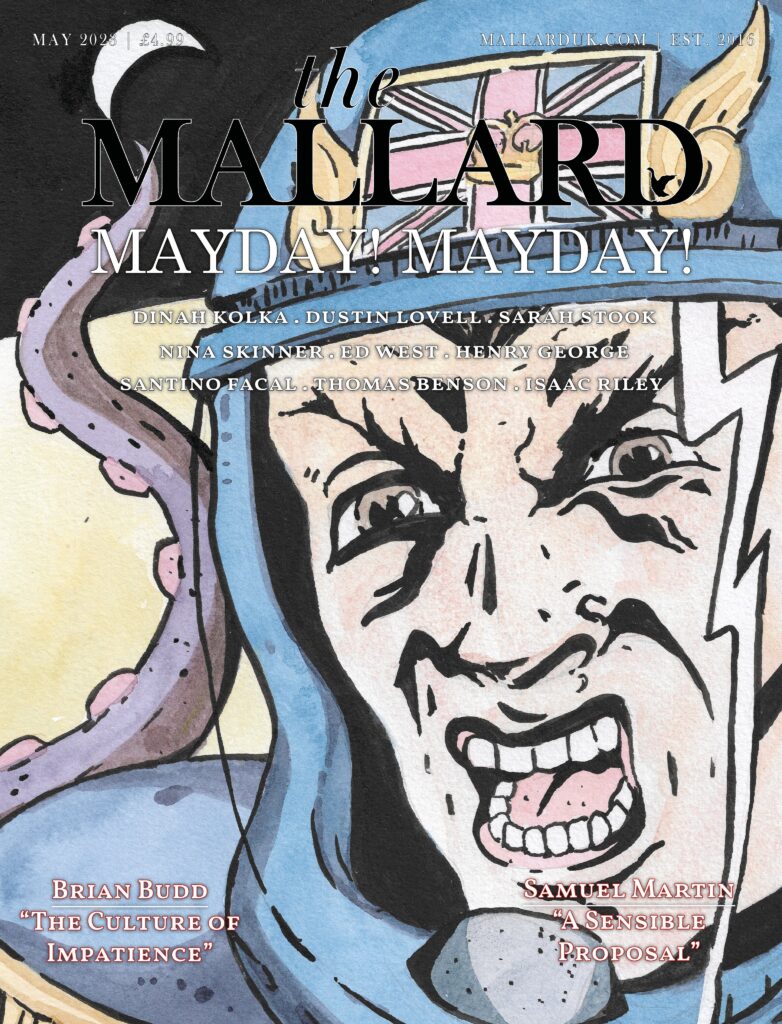
This is an excerpt from “Mayday! Mayday!”. To continue reading, visit The Mallard’s Shopify.
-
Her Penis is Boring
Oh good. You get a package and creatively wrap it. Who doesn’t love a Dutch surprise?
It’s all very predictable. As soon as you see the headline, you know what’s going to happen.
A great big chunk of the normie right, and even the more based/red-pilled/dissident/whatever right, have reacted like this. What do you reckon, do you recognise the below?
“Outrageous! *What do they mean HER penis*? If the left did this eh meh meh hypocrisy blah! Harumph, most unorthodox! If a man did this! We’ve fallen so far, the future of our country, something something the Queen. Splutters champagne, monocle falls out, but with Victorian era mutton chops.”
OK, the last bit might be a little unfair. You get the point though, don’t you?
Is this really some great new surprise or at all shocking? No! It’s been done to death and now they’re acting out with increasingly more extreme things to get the same level of reaction, attention, etc. to try and keep any buzz or excitement going in their latest fad.
Now they’re getting their ‘tits’ out at the White House. What’s next? Synchronised helicopters at the Cenotaph this November while the King stands to attention? This is all so dumb and transparent. Why are you reacting as if it’s anything other than boring?
The ‘right’ is the most promising place anything new or interesting is likely to come from. It’s on the outside. It’s not establishment normalcy, curated and factory-made orthodoxy. When it reacts in such predictable ways to such obvious dreariness, it’s really letting itself down. Don’t let your enemies feel like insurgents when they’re cradled by the status quo. Let them jump the shark.
Reacting is a diversion of your energy from more important things. Minority issues cut both ways. Sure, ‘most people’ (do majorities matter, or does winning matter?) might agree with you, and it might even count for something, but how high on their list of priorities is it? Yes, take the low hanging fruit, or perhaps this is an issue which also largely takes care of itself if enough (of the relevant) people are on your side.
Yes, this may have played a role in bringing down Nicola Sturgeon, but how significant was that? What role did money problems play? And the SNP are still there, with Labour next best positioned to take over. Nothing big or culturally or politically is really that different in Scotland. For the whole UK what still stands? The economy, immigration, house prices, tax rates, NHS standards, take your pick of any issue which needs more work.
For now, let the TERFs and trans people have at it. It’s not like the TERFs are your friends. Why give any quarter to a slightly different strain of the progressive problem?
And on a totally basic level, isn’t it just stupid to bother fighting ‘to prove’ (to who?) that men are men and women are women? This is really just a playground case where someone calls you a name, and you either call them one back or ignore it. You don’t waste energy trying to persuade your accuser that you are not whatever they called you.
Just like the playground, they don’t really believe in ‘her penis’ anyway. It’s a shit test, ab initiation rite, an in-group/out-group signifier. It’s like molesting a pig to get into the Bullingdon Club or whatever. Well, that’s the Machiavellian side. A lot of these people are just useful idiots, aren’t party insiders, don’t have a clue, and really have the same energy as the ones who have the power of God and anime on their side. Either way, don’t bother. It’s stupid.
Are we really wasting energy on something as basic as this rather than just going “no” and carrying on with something real, something that might need more real fighting over?
Don’t waste the energy. They’re better prepared for it and you’re just feeding the trolls, following the paths they’ve laid out for you.
When you react in the ways they expect:
- They have their own set ways to react, and the game keeps going,
- They’re ready and waiting, don’t do what they expect and wrongfoot them,
- You keep their fad alive, and…
- It makes you look like you’re just doing the same old thing you’ve done since 2016 or whenever.
The more you disengage, the more they’ll look for a different game, or otherwise chase the high by pushing the absolute limits of their ideological/aesthetic paradigm. Eventually they run out of things to do, or it breaks, or people will get so totally disgusted by it that it provokes a real reaction. Interpret ‘reaction’ as you will.
Your instinct to react now is understandable, but it’s not useful. Yes, you’re right, progressives do get away with all sorts of things. On one level it’s because they have power to enforce what they want, defend their people, and you don’t. On another it’s because they have the kinds of religious fervent nutters who will throw bricks through people’s windows, glue themselves to roads, throw Molotov cocktails, etc. and your side doesn’t.
Well, OK, then you have to work with the people you’ve got. It means treating this for what it is. Boring!
-
Zero Seats isn’t Over
Keep going. The target isn’t eliminated yet. There is more to do. There is more you must do.
You have felt mush. You must keep pushing. The target must not be allowed time to recover. It is not enough that they’re tired, meandering, and feel like they’re under a slow but inevitable gravitational pull toward irrelevancy. Where they are making mistakes, they must be helped along, not just left uninterrupted.
Waiting for the next general election for the double tap isn’t enough. You must be more ambitious and more aggressive. The work must be put in now. The fight isn’t won in the ring, it’s won long before you dance under the lights.
Certainly, the opportunity for zero seats is still open. Is it possible before the next general election?
The target’s prospects are dim. There are two things a party needs to keep going and they have neither: an offer which enough of the right people want, or an ability to inspire any confidence.
If you have one, preferably both, of these, everything else (people, enthusiasm, money, effect) comes easier.
Sundries
Let’s get two small things out of the way first. Money and supporters.
Money. They’re broke.
Donors ran while their rivals raised 15 times more in large donations. They had to cut spending on cut spending on social media advertising because they ran out of money. They’ve been in trouble for a long time, even firing cleaning and security staff ahead of the campaign to make savings. Now the target is squeezing its leadership candidates. What a convenient way of weeding out the biggest of the timewasters.
Conference this year is looking ropey. Businesses don’t see any reason to go and spend lots of money for a stall or to sponsor an event or two, apparently. Previous years have earned up to £2m profit. Pretty meagre to begin with, but better than an imminent zero. Nobody to influence. That’s long before you consider what the content of Conference will be about. Nothing motivating. This will mean less money.
Money is a real problem. They never had a lot of people dedicated to the political work, or to the grind of knocking on doors, delivering leaflets, etc. and settled for a good chunk of their supporters quietly paying membership fees and other donations, which allowed them to make up for the small number of activists compared to their competitors.
Supporters. What supporters?
One estimate puts the target’s membership numbers at 172,000 as of July 2022. Do you think it has gone up or down since then? You can assume some boost ahead of the leadership election. The results of that vote will produce a number for totals and turnout. Now is a good time to buy low, perhaps, but are the signs particularly good?
Signs from the General Election and associated polling. Certainly, the winners didn’t receive very many votes in absolute – the lowest of any winning party since the 1880s, apparently. Goodness. Well, what does that mean for everyone else? They received even fewer votes. (For a particular newer party this may not mean the same thing – perhaps it’s best judged against other new entries/debuts over the years like the Brexit Party or UKIP more recently, or even going back in further psephological history to the birth of the Labour Party, perhaps).
And of this much reduced voter support, how long will that last? In the +70-age bracket, 46%. For the 60-69 range, 33%. For 50-59, 24%, much lower than the winner’s 34%.
Assuming things stay approximately the same, with the, er, normal circle of life, one projection has the target’s vote share in total declining at a rate of 2% per year. From 2025 to 2029 that would be a reduction of 24% to 16%.
Things never stay approximately the same, though, and why take the chance?
There’s no need to be nasty. Instead, be persistently, relentlessly, merely matter of fact. The target must be made to feel like it is neither hot or cold, just straightforward inevitability that it is empty and pointless. It has no energy and looks a lot like UKIP did after Nigel Farage left it all those years ago.
What is the point of you? What are you even doing? Just give it up and try again aligned with people who might actually take you somewhere.
Leadership election
Their leadership election is certainly reminiscent of those early post-Farage death throes.
This whole thing is set to be one big example of why zero seats is not over yet.
They haven’t even technically gotten rid of the “old” disgraced leader yet. And he’s going to hang around all the way until November? Past the reopening of parliament, the budget, conference season, and whatever unforeseen opportunities and scandals and events of importance might happen in the meantime?
Losing the election and the vast reduction of their MPs was bad enough. In the winner-takes-all system the UK has they might as well have had zero seats. Now they won’t have any coordinated response to anything until November? Isn’t that going to look an awful lot more like zero seats in functionality and practice?
And who have they got? The same old ding-dongs who got them there in the first place.
Many are flexing what little they have for the pony show, it seems. The pattern from the 2019 leadership race is so far re-emerging. Never mind the “front runners”, a series of true nobodies are also taking the chance to float their names. How pointless. There are so few of you that you’ll all almost certainly get a job as a shadow this or that anyway, without having to raise your profile.
And indeed, there are very, very few of you. With only 121 MPs the biggest contenders may well only just scrape together the 10 or so nominations (including themselves) needed to proceed. This is weenie. Why is nobody treating them as weenie? Treat them as weenie. They’re weenie.
Who have they got who can take on the Prime Minister (even if he is Keir Starmer) or Nigel Farage?
They’re not just weenie, they’re totally without any creativity. These people are so empty I reckon I could write every single one of their leadership pitches without having actually seen a single one of them. I’d much rather inflict that slovenly indignity on you, duckies. Does the following sound at all familiar?
“Hi, my name is Blah Blahson, and I’m standing to lead the target.
We need to be honest about where we went wrong. We didn’t listen. We broke all of our promises. We did in fact do too much of [insert random thing that was never the real issue, but something on the side or a symptom like divisiveness and infighting]. I will put an end to all that and start the difficult task of earning back your trust in time for the next election.
Here’s a bit about me and how I grew up to make me seem more relatable or sympathetic or something. Economy. Aspiration. Your dreams.
I want to be a tough ole grind-stoning cliché, cliché, cliché. I am proud of my record as [insert not totally unimpressive but generally not uncommon non-political working background here] + of my record as [insert whatever non-detailed and highly questionable ministerial gubbins they want to puff themselves up with]. I am a true conservative blah blah blah, and that is why I believe I am the right person to deserve your trust and lead us back to glory.
Next time, we’re going to be totally honest. I’m a no-BS kind of politician. It’s time for us all to unite. That’s what real leadership means to me.
That is why I am but humbly putting myself forward for leadership of the target, and I ask for your support.”
What do you reckon? That’s about right, isn’t it? Good grief.
November’s a good while away. You can expect a few relaunches of the same leadership campaign. As in, from the same politician. They’ll either fail to hit the mark or they’ll just be doing it again and again on some excuse to try to get more media attention.
And you know what? They’ll probably go through at least two leaders before the next election. And it’ll be from the same pool of MPs. People are going to get really sick of seeing the same unimpressive bunch over and over again. This is only going to be worse if, because there are so few MPs, shadow ministers are going to have to hold multiple briefs and work multiple appearances. It’ll get worse. Do you think these people have enough capacity for the mental arsenal on multiple briefs? What will this mean for their ability to cut through, to work detail, and nuance, and out-fox civil servant-resourced ministers?
All of this will perpetuate the idea that they’re disorganised and pointless. Weak.
Keep pushing on all of this. Keep pushing zero seats. It’s not over.
The target won’t reorganise
The target’s MPs don’t have it in them. There are a few reasons.
First, they’re scrabbling and struggling to keep their heads above zero seats as it is. What does this mean for reorganisation? At the best of times, MPs are looking to pick party leaders who will win them their seat, secure their seat, increate their majority, etc. First and foremost. The strongest incentive is for them personally, above anything else first, to be in office. (This is not the same as them being in power, but they think it is). It’s just that this means their own job, money, perceived prestige, pomp, etc., it’s at least somewhere in the correct 180° arc that you need to be in officer (power) to actually do anything, and that once you get some office (power) the correct thing to do politically is to keep getting more and more and more of it. The problem for the target is that they are desperate, which has its own ick, but this will also make them short-termist and wrong about what they need to do.
Second, the target has the same problem that the dying days of the Gordon Brown Labour Party had, and the first few post-2010 years. Same old people. The ideal best thing they could have done would have been to fire probably almost all of their sitting MPs and brought in a much fresher (not necessarily younger, though that might not have hurt) and energetic bunch. Even if it was naivety they’d at least sound enthusiastic and eager about whatever ideas they’d cooked up while they were dreaming of being MPs. And they wouldn’t be coming with the same dismal tainted track records. Instead, you’ve just got a bunch of blockers hanging around.
Third, the target doesn’t have anyone willing, let alone capable, of reorganising themselves. They might be making some of the right noises (see the accurate leadership pitch above) but they’ll almost certainly all be missing the point. They’ll be doing it on purpose. What’s the pitch otherwise? Here’s all these truthful reasons about why the target is awful but this time the same people will sort it out despite not understanding what was wrong before? If they understood, why didn’t they do something about it? If they didn’t understand, why humour them now? They should resign, but they won’t. Where else have they got to go? There is nothing so “ex” as an “ex-MP”. Maybe they genuinely, deludedly think that they can turn things around? Does it matter? They’re not going to go. It’s why the target is going to stay in a terrible spot.
Zero Seats is right there. Keep pushing it.
They won’t learn the right lessons
A related, but distinct-enough separate point. They won’t reorganise because they won’t learn the right lessons.
The incentives aren’t set up that way. It would mean admitting they were wrong. If they were wrong, why keep them around? Why not just start fresh with some people who were right?
They’re locked into failing to learn the lessons of the 2019 voter realignment. Reform will probably keep at it. This also incentivises them not to change. You can’t really mimic another party. At a certain point your remaining supporters leave, the ones who left will stick with the real deal, and those tempted will also just go to the real deal.
The same applies to the wets. Why not just go with the absolutely soaking in the form of the Lib Dems? Holiday-fun Ed Davey is already promising to come and kill you, at your house, in real life, and wear your dresses and makeup like the ancient Irish did, from the left.
The target is almost entirely ersatz, at best. Will that inspire at Conference?
You’ve known how empty they are for a while. It seems just as likely that they didn’t win because they were totally without plans (except for banning people from buying cigarettes or something? Who knows?) – not because they weren’t left or right enough or didn’t do anything or deliver on promises.
Beyond substance, do they even have the form for a good pitch? More on that next.
They sit out of the Pareto distribution
A lot of you were hoping for a genuine zero seats. Some of you thought sub-hundred would create the same effect.
You’re all too soft. I wanted to see one seat. Just one. Just one only lonely solely wholly put upon target MP in the whole of the country. Rishi Sunak. Could you imagine that humiliation? And then the humiliation of all the other decisions he would have had to make after that?
Anyway, a lot of you were disappointed that the target retained over one hundred seats. You suspect that this might be enough to keep them alive. Maybe, but also maybe not.
It’s still not a strong position to be in. They’re not clearly in one side of the niche of the pareto distribution or the other, are they? Genuine question.
For the uninitiated, the Pareto distribution is also known as the 80/20 rule. This is approximately that 80% of any phenomenon, market, etc. is due to 20% of the factors/actors involved. It’s never an exact 80/20 ratio, but one example might be that 80% of groceries are sold by 20% of all the grocery providers around. In other words, a small number of individual actors do most, but not all, of the business, and that remaining portion is likely done by many much smaller competitors.
In business in particular, this is important, because you either have the size and scale to do a large amount of generic mass market business, or you go smaller and niche and specialise. Think the difference between a mass market M&S suit versus Savile Row. Each has their place doing a particular sort of thing.
In the political case, does the target neatly sit in the big party or small party category? Too small to have a crack at the 80% market share, but too big to really be niche like the Green Party or Plaid Cymru or whoever?
Reform might have the opposite problem – are they genuinely going to try to break into and have a crack at being on the big boy side of that Pareto distribution? Or is it enough to function as a glorified pressure group like UKIP did (hey, not knocking it, it worked) without the full “mainstream” breakthrough?
The target is sitting very awkwardly right now.
What’s next?
Well, really, continue the Zero Seats campaign.
It’s not over. Slog it out. You didn’t think politics was going to be all excitement and meme wars, did you? Politics is a strong and slow boring of hard boards.
The way forward: take their oldies.
The target is pretty much only supported by old people now. As mentioned above, all other things remaining the same, this would see their vote share dwindling at a rate of about 2% per year. But all other things will not remain the same. There will be more oldies along in a minute. The target might start doing good politics and start making a meagre recovery.
No!
I don’t care if it’s Reform UK or the Lib Dems or the Greens or whoever or all of them. Start coming out with plausible policies, announcements, attacks, aimed at splitting off the oldies from the target.
Come on. Zero Seats!