The scene in The Patriot where Mel Gibson rides across the early dawn horizon bearing the Betsy Ross flag has always stirred a latent fervour in me. I never felt the same patriotic twitch looking at the modern, 50 star flag. That flag flies in front of government buildings of a state that no longer stands for me.
In the Covid-era, we experienced a de facto coup of long brewing forces of tyranny. As we enter its aftermath, a true and full-hearted Americanism is the supreme counter culture. It is easy and tempting in times of such horrendous decay to see America as a corrupt empire, but behind its aggressive export of proto-Luciferian global progressivism is a nation of forgotten men with a great lust for life.
The true America is a nation of explorers. Exploration is the zenith of vibrant and vital youth. Curiosity and drive for mastery of self and surroundings bred a stock of men seeking God, wisdom and adventure. As the 50 star banner and the government it represents becomes more hostile to these values and the men who inspired them, I submit that our countercultural Americanism should rally behind the banner of a man who embodied our spirit with great zeal – John C. Frémont.
The Frémont flag looks much like the traditional American flag. In the place of stars, the blue field seats an eagle holding an olive branch in one claw and a fistful of arrows in the other. Frémont carried it on his expeditions so as not to provoke war in Indian territory while identifying himself as an American. The symbolism was clear; you can have peace or war with America, but regardless of your choice, it will be on our terms.
To be entirely honest, that message is one for another time, in which our Republic was very different. The intended meaning of the flag is less interesting than its namesake. John Frémont was one of the greatest Americans to ever live, and an exemplar of the spirit we must thrust upon this modern age. Frankly, it doesn’t hurt that it looks cool as hell.
An explorer, commander and politician, Frémont was born with nothing and never accepted a fatalistic life of destitution. He gained marginal status as a military officer and brilliant mathematician. After courting the daughter of politician Thomas Hart Benton, he was pushed away by the senator for his low status. Indignant, the young Frémont ran away with his beloved and eloped.
The senator’s outrage subsided in time and he sponsored the young couple’s expeditions into the untamed west. Frémont would lead five major expeditions, plant the American flag on the peaks of the Rockies, create maps and literature illuminating the romantic wonder of our frontier and inspire thousands to brave the Oregon Trail and settle new territory.
Frémont’s adventures as an explorer were put on pause by the Mexican-American War. The adventurer commanded the conquest of California and was appointed the military governor. He was such a beloved leader that when he was displaced as governor, he staged a mutiny with the fervent support of his regiment. He was court-martialed for the rebellion and stripped of rank. In recognition for his indispensable service in the conquest of the west, he was granted a presidential pardon.
The adventurer’s spirit was never broken. After the Mexican-American War he would find himself commanding new armies, governing new territories and taking on several other new ventures. While he died destitute, he fought at every point to thrust his vision upon the world. He was unwavering with power that was granted to him and he never ceased to chase adventure. The circumstances of his birth were never allowed to be a limiting factor in his drive for an unbridled and wildly whole life. He never pitied himself nor despaired of his misgivings, he was ever relentlessly free.
Frémont was a child born in sin. His mother, seed of the southern gentry, was arranged at the age of sixteen to be married to a wealthy landowner in his late sixties. She began an affair with her tutor, an educated man of French extraction. They conceived John and ran away together, living in poverty. Frémont was born of passion. A forbidden passion, the very nature of his conception was filled with that fiery force of life that possesses us in moments of ecstasy. His birth was by the work of Eros and it baptised him with a great fire and zeal for life that he carried through him into his final days.
This fire of passionate, ecstatic life is inseparable from the American spirit. We are of the great stock of the mighty Englishmen who created an empire upon which the sun never set – though we are a branch of that family filtered by possessing the daring to board wooden ships and cross the most treacherous of oceans, to a land of hostile natives and untamed lands. We arrived upon a continent with nothing but what we could carry and we made it our own. Nothing we have achieved would have been possible without this fiery spirit of passion for life! Frémont is among the greatest of Americans and a symbol of the American spirit manifest in its most uncompromising, violent and arrogant excellence. Under his banner, I see an America made new, cleansed by its own zealous, willful, vicious, wholly alive spirit.
Let us rally behind Frémont’s banner. It is now our time to embrace a heroic spirit of adventure, to be unwavering in our use of power. In times of national crisis, we cannot bind ourselves to convention. The great men of our era must be unforgiving and wield the power that they can acquire with absolute strength. The system is against you. You will face setbacks, perhaps situating you at square one. Embrace the spirit of adventure, and wander on.
-
Book Review: Ten Year Anniversary, The Demon in Democracy, by Ryszard Legutko | Ryan Anderson
A rarely remarked upon effect of Covid-19 has been the neglect of works that would have ordinarily garnered broader acclaim. Thus, as we’ve been distracted by the medical events, an assortment of commendable offerings have largely escaped public attention. One such work is ‘The Demon in Democracy: Totalitarian Temptations in Free Societies’ by Polish academic and European Parliament member, Ryszard Legutko. Originally published in 2012 as Triumf Człowieka Pospolitego (Triumph of the Common Man), then edited and first appearing in English in 2016, Legutko’s book is a rare recent work of real import. A decade on from its original publication, Legutko’s book is still one of the best indictments yet of our liberal age
In a similar vein to the works of Christopher Lasch and John Gray, Legutko’s is an account that is tepid towards the Thatcherite consensus that has come to define the right whilst resisting the easy overtures of our dominant left-liberalism. It’s a book that illuminates the errors of the age as it rejects the pieties that our epoch demands.
Like Ed West, Michael Anton and Christopher Caldwell, Legutko is one of few contemporary writers willing to provide an honest account of the liberal status quo. By not succumbing to our assorted unrealities, Legutko is able to articulate the inadequacies of liberal democracy without the pusillanimous equivocation that’s sadly all too prevalent. The book is thus a welcome addition to what is an otherwise bleak scene for the conservatively inclined, entrapped as we are in the all-pervasive mould of liberalism.
Such commendations aren’t restricted to this reviewer, however. Figures such as Harvard’s Adrian Vermeule and Notre Dame’s Patrick Deneen have been equally effusive. For as Vermeule wrote: “Legutko has written the indispensable book about the current crisis of liberalism and the relationship of liberalism to democracy”, while for Deneen the book is a “work of scintillating brilliance. [With] every page…brimming with insights.”
High praise, undoubtedly, yet it’s well vindicated upon reading. The central thesis is that despite an outward appearance of difference, communism and liberal democracy share a range of similarities. An observation that appears prima facie preposterous, yet after 180-odd pages of tightly-packed prose the reader is unable to avoid this unsettling insight.
The rationale for this claim is as such: both are inorganic systems that involve unnatural impositions and coercive zeal in their pursuit of illusory utopias. Utopias that are to be achieved practically through technology and ‘modernisation’ and buttressed theoretically by the purported fact of human equality. The two are thus historicist projects, seeking to ground human affairs in delusions of ‘progress’ in lieu of any underlying nature.
Both platforms are thus mere dogma. They are, as Legutko states:
“Nourished by the belief that the world cannot be tolerated as it is and that it should be changed: that the old should be replaced with the new. Both systems strongly and – so to speak – impatiently intrude into the social fabric and both justify their intrusion with the argument that it leads to the improvement of the state of affairs by ‘modernizing’ it.”
The two systems are hence unable to accept human beings and political affairs as they actually are: man and the polis must be remoulded along the lines of each respective ideology. For the communists, this involves the denial of man’s natural egotism and the subordination of his individual efforts towards an ostensible communal good. That this requires extreme coercion in implementation, unfathomable violence in practice, and has been deemed a delusion since at least Plato’s Republic, is a tragedy that’s all too commonly known.
So far, nothing new. Yet it’s the author’s elucidation of the unsavoury aspects of liberal democracy that is of particular note, especially for us here at the so-called ‘end of history’ and in light of the easy-going liberalism that permeates our societies, even as they slip further and further into evident decay. As Legutko suggests, liberal democracy shares a proselytising urge akin to that of Leninist communism, yet it’s as equally blind to its theoretical errors and its evangelical impulses as was its communist forebear.
As Legutko sees it, a liberal-democratic man can’t rest until the world has been vouched safe for liberal democracy. Never mind that this liberal-democratic delusion requires a tyranny over the individual soul – we’re neither wholly liberal nor democratic – and entire groups of people. An emblematic example is the recent US-led failure to impose either democracy or liberalism (terms that Legutko fuses and distinguishes, as appropriate) on the largely tribal peoples of Afghanistan.
The justification for this liberal-democratic ‘imperialism’ is, of course, its final and glorious end. Once there’s a left-liberal telos insight, then all means to its achievement are henceforth valid. For the communists, their failures are now common lore. Yet for our liberal-democrats, their – still largely unacknowledged – fantasies continue apace, aided as they are by their patina of ‘enlightened improvement’ and by the imperial patron that enables them.
That the effects of all this liberalising are unnatural, usually unwanted and often utterly repulsive to the recipients tends not to matter. Like all movements of ‘true believers’, there is no room for the heretic: forever onward one must plough.
The ideological spell cast by liberalism is thus as strong as any other. As Legutko observes:
“The liberal-democratic mind, just as the mind of a true communist, feels as inner compulsion to manifest its pious loyalty to the doctrine. Public life is [thus] full of mandatory rituals…[in which all] must prove that their liberal-democratic creed springs spontaneously from the depth of their hearts.”
With the afflicted “expected to give one’s approving opinion about the rights of homosexuals and women and to condemn the usual villains such as domestic violence, racism, xenophobia, or discrimination, or to find some other means of kowtowing to the ideological gods.”
A stance that is not only evident in our rhetoric, but by material phenomena as well. One need only think of the now-ubiquitous rainbow flags, the cosmopolitan billboards and adverts, the ‘opt-in’ birth certificates, the gender-neutral bathrooms, the Pride parades, the gender-transition surgeries, the biological males in female events and so on to confirm the legitimacy of Legutko’s claims and our outright denial of physiological reality.
Indeed, here’s Legutko again: [the above] “has practically monopolized the public space and invaded schools, popular culture, academic life and advertising. Today it is no longer enough simply to advertise a product; the companies feel an irresistible need to attach it to a message that is ideologically correct. Even if this message does not have any commercial function – and it hardly ever does – any occasion is good to prove oneself to be a proponent of the brotherhood of races, a critic of the Church, and a supporter of homosexual marriage.”
This sycophantic wheedling is practised by journalists, TV morons, pornographers, athletes, professors, artists, professional groups, and young people already infected with the ideological mass culture. Today’s ideology is so powerful that almost everyone desires to join the great camp of progress”.
Thus whilst the tenets of liberal democracy clearly differ from those of 20th Century communism, both systems are akin in their propagandistic essence, as he writes:
“To be sure, there are different actors in both cases, and yet they perform similar roles: a proletarian was replaced by a homosexual, a capitalist by a fundamentalist, exploitation by discrimination, a communist revolutionary by a feminist, and a red flag by a vagina”.
Variations on this theme inform the entirety of the book and are developed throughout its five chapters: History, Utopia, Politics, Ideology, and Religion. Whilst there is some overlap, the book is written with a philosophical depth reflective of Legutko’s status and which only a few contemporary writers can muster. As Deenen remarks:
“I underlined most of the book upon first reading, and have underlined nearly all the rest during several re-readings. It is the most insightful work of political philosophy during this still young, but troubled century”.Yet the book isn’t exclusively an arcane tome. Aside from Legutko’s evident learnings, what further enhances the work is the author’s ability to draw upon his own experience. Born in the wake of the Second World War, raised in the ambit of Soviet communism, and employed in the European Parliament in adulthood, Legutko’s is a life that has witnessed the workings of both regimes at first hand.
The author recalls that the transition from communism to liberal democracy was greeted with an early enthusiasm that soon devolved into disenchantment. As he states, any initial exuberance steadily subsided, with Legutko sensing early on that “liberal democracy significantly narrowed the area of what was permissible – [with the] sense of having many doors open and many possibilities to pursue [soon evaporating], subdued by the new rhetoric of necessity that the liberal democratic system brought with itself.”
An insight which deepened the longer he worked within that most emblematic of our institutions of modern-day liberalism: the European Parliament. He writes:
“Whilst there, I saw up close what…escapes the attention of many observers. If the European Parliament is supposed to be the emanation of the spirit of today’s liberal democracy, then this spirit is certainly neither good nor beautiful: it has many bad and ugly features, some of which, unfortunately, it shares with communism.”Even a preliminary contact…allows one to feel a stifling atmosphere typical of a political monopoly, to see the destruction of language turning into a new form of Newspeak, to observe the creation of a surreality, mostly ideological, that obfuscates the real world, to witness an uncompromising hostility against all dissidents, and to perceive many other things only too familiar to anyone who remembers the world governed by the Communist Party”.
And it is this tyrannical aspect of liberal democracy to which Legutko ultimately inveighs. After some brief remarks on the eclipse of the old religion (Christianity) at the hands of the new, Legutko’s parting words are an understandable lament that liberal-democratic man – “more stubborn, more narrow-minded, and…less willing to learn from others” – has vanquished all-comers. As he adds:
“With Christianity being driven out of the main tract, the liberal-democratic man – unchallenged and totally secure in his rule – will become a sole master of today’s imagination, apodictically determining the boundaries of human nature and, at the very outset, disavowing everything that dares to reach beyond his narrow perspective.” A sad state whereby “the liberal democrat will reign over human aspirations like a tyrant”.In this regard, Legutko’s remarks echo the German proto-fascist-democratic-dissident, Ernst Junger, who ‘hated democracy like the plague’ and saw the triumph of America-led liberalism as an utter catastrophe. A posture which is also evident in Junger’s compatriot and near contemporary, Martin Heidegger, and in his notion of the ‘darkening of the world.’
Yet it’s perhaps the most famous German theorist of all, Friedrich Nietzsche, to whom we should finally turn and in whose light Legutko ends the book. Largely accepting the popularised Hegelianism of Fukuyama – that there’s no alternative to liberal democracy – Legutko nevertheless muses over whether our current status as Zaruthustrian ‘Last Men’ is a concession we must make to live in this best of all possible worlds or an indictment of our political and spiritual poverty.
As he concludes, the perpetuation of liberal democracy “would be, for some, a comforting testimony that man finally learned to live in sustainable harmony with his nature. For others, it will be a final confirmation that his mediocrity is inveterate.”
A more accurate precis of our current situation I’ve yet to see, and one of many such reasons to read this most wonderful of books.
-
Oligarchic Oafs
British cultural critics, in my opinion, suffer from an insularity which prevents them from connecting the events of their own country to any wider patterns of civilisation. This is truest for those who are the most correct with their criticisms. Take for example Theodore Dalrymple, whose 1998 article Uncouth Chic in the City Journal was prophetic in diagnosing a distinctly British pathology. I give a lengthy quote to showcase the depth of his description:
“The signs — both large and small — of the reversal in the flow of aspiration are everywhere. Recently, a member of the royal family, a granddaughter of the queen, had a metal stud inserted into her tongue and proudly displayed it to the press. (…) Middle-class girls now consider it chic to sport a tattoo — another underclass fashion, as a visit to any British prison will swiftly establish. (…) Advertising now glamorizes the underclass way of life and its attitude toward the world. Stella Tennant, one of Britain’s most famous models and herself of aristocratic birth, has adopted almost as a trademark the stance and facial expression of general dumb hostility to everything and everybody that is characteristic of so many of my underclass patients.”
Dalrymple lays the blame for this “uncouth chic” on moral relativism: “… since nothing is better and nothing is worse, the worse is better because it is more demotic.” This much may be true, but it sidesteps an important matter. There’s an area where the British remain elitists: money. Whatever relativism now reigns upon our morality, it has areas of preferred emphasis. With manners we are relativists, but with cash we are a nation of absolutists who think being rich is better than being poor. Indeed, the very need to transform the uncouth into a type of chic (a word meaning sophisticated and fashionable) betrays such a mindset. Nobody is demanding unfashionable uncouth trash.
To be an elitist about your wallet and a vulgarian about your manners. I wager this combination isn’t accidental but vital. The latter flows from the former.
The Greek philosopher Aristotle, who defines a lot of things near-finally, defines an oligarch as someone who is both wealthy and has a wealth-based idea of goodness. That is, an oligarch isn’t just rich; he thinks being rich is identical with being good. This is why he thinks only the rich should hold political office, for example. So, it’s not that money is the root of all evil and the rich the wickedest. The one who has his character in order only benefits the more money he has, because he understands money as a tool for acquiring other goods. The oligarch grasps for money like an idolum and hates anybody who doesn’t have it.
But why does the oligarch think this? Hasn’t he observed all the good poor people in the world? Is he blind to the honest pauper? Aristotle’s answer is simple: the oligarch thinks money equals goodness because he thinks living well is gorging every appetite with no limit. “For where enjoyment consists in excess, men look for that skill that produces the excess that is enjoyed”[ii]. In other words, if the good of life is endless pleasure, and endless pleasure needs endless money to buy it, the good of life requires endless money. Those without money are unable to get endless pleasure, so the oligarch looks down on their lives as inferior.
The collection of norms we call “etiquette” or “manners” have emerged organically over a long period. Some are obviously arbitrary or meant to exclude people unjustly (the outmoded and snobbish dress code of “no brown in town” comes to mind). But a great many are there to limit personal behaviour, to channel action into a disciplined pattern.
Why chew with your mouth closed? Because it shows consideration for your fellow diners. Why take small bites? Because it controls you to eat at a healthy pace. Why not deliberately get drunk? To not impair your reason. Why avoid constant use of foul language? To show that your mind dwells on higher things than bodily functions. In all these there’s a standard of excellence, mental or physical, drilled into the person through control of their actions.
It’s a principle properly summarised in a line from Confucius: “Therefore the instructive and transforming power of ceremonies is subtle; they stop depravity before it has taken form, causing men daily to move towards what is good, and keep themselves farther apart from guilt, without being themselves conscious of it.”.
Is there then any reason for an oligarch to cultivate manners? I think none of weight. An oligarch might make a show of good manners, if he thinks this displays wealth. But once the cultural association of money with good manners is gone, he’ll stop this act. An oligarch who sees money as the means to swelling himself with pleasure actually has an incentive not to cultivate manners. Why would he cultivate something designed to limit his appetites? If the purpose of eating is to shovel as much food into your mouth as possible, and not to nourish yourself, then you can dispense with the cutlery, even possibly the plate.
But this leads to a further thought. Money for its own sake is necessarily vulgar because any constraint on it points to a standard other than pleasure. If we accept that the manners and etiquette we call aristocratic have developed over time as a way of disciplining wealth into excellence, then an oligarchy engorged on pleasure must reject them. Rather, manners that the underclass have adopted out of lack of correction or poverty now become the fascinations of the rich. A poor man wears ragged jeans because he can’t afford anything else. An oligarch wears designer torn jeans because money compels him to wear whatever he wants however he likes it. The expression of “general dumb hostility” which Dalrymple notes, may have been born from the Hobbesian nightmare of a slum; but for an oligarch, it’s the hostility of wealth to any external correction.
In an oligarchic society the top and bottom begin to resemble each other in customs even as they drift apart in income, and even as the top despises the bottom. We may explain the vulgarity of British elites in terms of class guilt, demoralisation, or political posturing. But the issue remains that love of gold doesn’t protect you from barbarism. It’s the passion that unites the highest emperor with the coarsest bandit.
-
A Romantic Case for Anime
We’ve all felt it—the mixed excitement and dread at hearing a beloved book is set to be made into a movie. They might do it right, capturing not only key plot events but also (and more importantly) how it feels to be swept up in the work as a whole; 2020’s Emma with Anya Taylor-Joy comes to my mind, most of all for the way it captures how someone who understands and loves Austen’s ubiquitous irony might feel when reading her work. However, they also might do it poorly; despite both 1974 and 2013 attempts’ being worth watching, I’ve yet to see a rendition of The Great Gatsby that captures the book’s plot and narrative tone in the right proportion (in my opinion, the 1974 version emphasizes the former but misses some of the latter, while parts of the 2013 version exagerrate the latter just to the border of parody). My readers have, no doubt, already imagined examples of works they’ve always wished could be faithfully put onto the screen and others they’d rather not be risked to the vicissitudes of translating from one medium to another.
The last decade has thankfully seen a growth in long-form, box-office quality productions that makes it more possible than ever to imagine longer works being produced without curtailing their lengthy plotlines—example, the BBC’s 2016 rendition of War and Peace. However, this leaves another, perhaps more important, hurdle to hazard: while live-action media can now faithfully follow the plots of the originals, there still remains the difficulty of conveying the tone and feel of the works, especially when different media necessarily have different capacities and limitations of representation. Though I’ve enjoyed productions that have been made, I don’t know that I would expect live-action renditions to reproduce the aesthetic impression of, say, Paradise Lost, The Hunchback of Notre Dame, or Crime and Punishment, and I worry that attempts to do so might mar more than measure up. The problem lies in the difficulty of translating characters’ inner experience—which is usually conveyed by a stylizing narrator—via the essentially externalistic medium of the camera eye.
While a live action movie or series might remain faithful to the selective events in a plot, the lack of an interpretive narrator removes a key element of what defines epic poems and novels. Paradoxically, the narrowing of perspective through a stylizing narrator allows story to move from the limits of natural events into the limitlessness of human perception and interpretation. Voiceover narrators can provide thematic stylization in film, as well as essential plot coherence, but it is still primarily the camera that replaces the literary narrator as the means of conveyance. Furthermore, if too ubiquitous, voiceovers can separate the audience from the action, which is the focus of film. Film’s power inheres in its ability to place the audience in the midst of a plot, removing as many frames between the watcher and the story’s events as possible. However, this is also why books are so difficult to translate: motion pictures focus on events when the aesthetic experience of literature inheres in how characters and narrator experience said events.
The literary movement that focused most on the character’s experience (and, vicariously, ours) as the purpose of art was Romanticism. Romantic literature and poetry were less concerned about the subject matter than about their effect on the character’s emotions—in the sense that, from the generally Platonic metaphysics of the Romantics, the incidental reaches its fullest meaning by provoking an aesthetic experience far beyond it. From Hawthorne’s rose bush growing outside Salem’s prison, to Shelley’s secondhand rumination on the ruined feet of Ozymandias, to Keats’s apostrophe to the Grecian urn, the Romantics showed how part of the reality of an object involves its significance to the observer, and it was the role of the Romantic narrator and speaker to draw out that effect for the reader.
It is this essential influence of the narrator and characters’ inner lives on the great works’ aesthetic experience that makes me skeptical of even the best acting, camera work, and post-production effects to sufficiently replace them. It may be possible, and, again, I have very much enjoyed some renditions. Furthermore, not wanting to be the audience member who misses the Shakespeare performance for the open copy of the play on their lap, I tend to watch movie adaptations as distinct works rather than in strict relation to the originals. However, this, itself, may be a concession to my hesitance to trust film to live up to the aesthetic experience of certain books. I would, however, trust anime to do so.
While a history of Japanese manga and anime is beyond the scope of this piece (or my expertise), since choosing to explore the artform as a post-grad-school reward (or recovery—one can only stare at the sun that is Paradise Lost for so long) I’ve watched plenty of anime over the past ten years, and I have become convinced that it might serve as, at least, a middle ground when seeking to capture plot, narrative tone, and inner character experience in a motion medium. Anime is capable of handling virtually every story genre, and while it contains many of the same ridiculous hi-jinks and satire of Western cartoons and CG animation, it can also capture tragic pathos and sublime catharsis in ways that would be out of place in the vast majority of Western animation. This makes sense: originating in early 20th-century Japan, manga and anime were not subject to the same skepticism about artistic representations of transcendent value that characterized Western art after the move from 19th-century Romanticism and Realism to 20th-century modernism and post-modernism.
Of course, there have been exceptions; 20th-century Disney animation, or Marvel and DC Comics, were iconic because they attempted to be iconic—they unironically tried to depict in images those values and stories that are transcendent. However, even these were created predominantly with the child (or the childlike adult) in mind. Furthermore, while anime certainly has deserved elements of ambivalence, if not cynicism, and while there are many incredibly satirical and humorous series, anime as an artform is not implicitly dismissive of narrative trustworthiness and characters’ experience of the transcendent in the same way that much of Western motion art is. Rather, anime conventionally allows for the sublime heights and deepest horrors that previously characterized Romanticism, all of which it presents through the stylization of animation. This stylization is able to act as an interpretive medium just like a novel’s narrator, contextualizing events through the experience of those involved in a way often eschewed by, if not unavailable to, film.
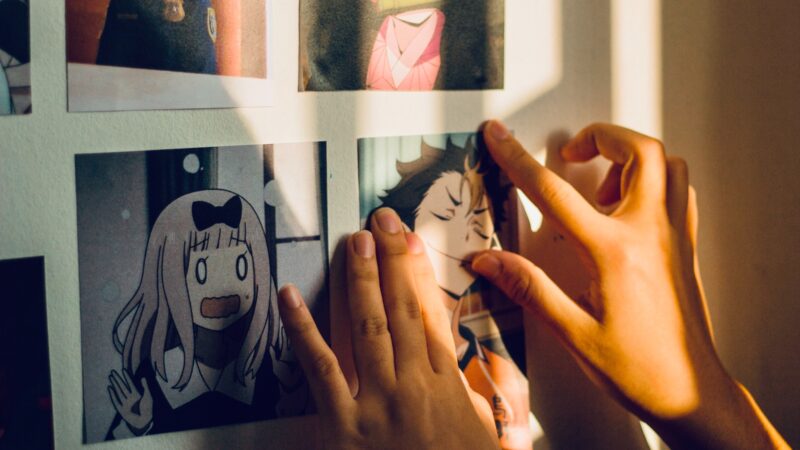
For an example, I submit Kaguya-sama: Love is War (Japanese Kaguya-sama wa Kokurasetai – Tensai-tachi no Ren’ai Zunōsen, “Kaguya Wants to Make Them Confess: The Geniuses’ War of Hearts and Minds”). Though a romantic comedy in the Slice-of-Life genre, it exemplifies anime’s ability to convey the heights and depths of inner experience of the characters—here Kaguya and Miyuki, a pair of high school teenagers who, as student council president and vice president, compete to be top of their class while being secretly in love with each other and too proud to admit it. As the English title conveys, a running metaphor through the show is the bellicose subtext of their attempts to maneuver each other into confessing their love first and, thus, losing the war; think Beatrice and Benedick with the extremizing effect of teenage hormones and motifs of heavy artillery.
Plot-wise, Love is War follows a standard rom-com formula, with tropes recognizable to Western audiences: the pride and prejudices of the characters, the much ado about things that end up being really nothing, the presence of a mutual friend who acts as an oblivious catalist and go-between in the relationship, etc. However, the show reinvigorates these tropes by portraying via hyperbolic narrator the deuteragonists’ experience of the episodes’ conflicts, bringing audience members into the all-consuming tension of how a teenager might see something as minor as whether to share an item from their lunch. The combination of chess and military metaphors conveys the inner conflicts of the initially cold but gradually warming characters (the “tsundere” character type common in such animes), and the consistency of such motifs creates a unified aesthetic that, due in large part to the disconnect between the over-the-top tone and, in reality, low-stakes subject matter, is hysterical. Another unique aspect about Love is War is that, due to its focus on the characters’ experience of the plot (all the better for being trivially mundane), it’s a technically Romantic romantic comedy.
Love is War is, of course, a low-stakes example of what modern anime can do, though it did score three awards, including Best Comedy, at the 2020 Crunchyroll Anime Awards. A more serious example, Death Note, similarly conveys much of its gravitas through voiceover—this time the first-person narration of protagonist Light Yagami, a high schooler who with the help of a book from the realm of the dead is able to kill anyone whose name and face he knows, and L, a mysterious and reclusive detective charged by Interpol to find him. Throughout the series—which employs similar, if non-parodic, attempts by characters to outwit each other as Love is War—Light and L articulate their planned maneuvers and the implications thereof through inner voiceover. Not only does the narration lay out elements of their battle of wits that the audience might have missed, but it conveys the growing tension the two experience—especially Light, who, as he amasses fame as both a menace and cult hero experiences a growing egotism and subsequent paranoia around the possibility of being found out.
Just as Love is War is, in many ways, a parallel of Pride and Prejudice (Elizabeth and Darcy, themselves, both being tsundere characters), Death Note’s focus on a young man who wishes to achieve greatness by killing those deserving of death and who subsequently develops a maddening neurosis is virtually the same as Crime and Punishment—however enormously their plots and endings differ (Crime and Punishment lacks an explicit demonic presence like Death Note’s Shinigami Ryuk, the Death Note’s otherworldly owner; Dostoevsky would not employ the spectre of a conversant devil until The Brothers Karamazov—yet another point of consanguinity between anime like Death Note and his writing). Regardless of their differing plots, the anime’s inclusion of the characters’ inner thoughts and imaginations convey an increasingly tense tone similar to how Dostoevsky steadily shows Raskalnikov’s moral unmooring, and the explanations and attempted self-justifications by both Light and L convey more than I think even the best cinema would be capable of showing.
I am not advocating that every narrative motif or figuration be included in page-to-screen renditions, nor that we cease trying to actively reinvigorate great works of art through judicious adaptations into new media. Yet, if the inner lives of teenagers—which are often exaggerated, if at times unnecessarily, to Romantic proportions—can be portrayed by anime to such comic and tragic effect, with the figuration and tone of the characters’ perceptions seamlessly paralleling the literal events without obscuring them, then I’d be interested to see what an anime Jane Eyre, The Alchemist, or Sula might look like. Based on the above examples, as well as anime heavyweights like Fullmetal Alchemist, Cowboy Bebop, and, if one is not faint of heart, Berserk, all of which present events in some measure through the background and perspective of the main characters, I could imagine the works of Milton, Hugo, Austen, Dostoevsky, and others in anime form, with the aesthetic experience of the original narration intact.