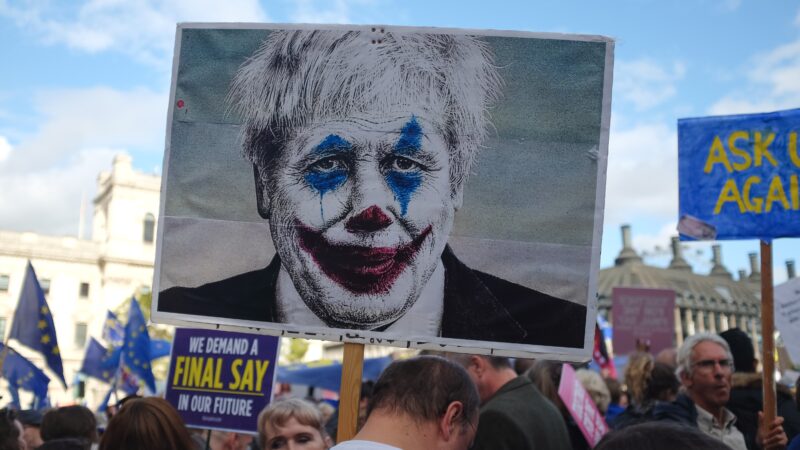
The Trojan horse has made its way inside the Conservative Party with an egalitarian agenda it will stop at nothing to implement, including rooting out any trace of actual right-wing policy. However, the enemy within has only been given power by the fact that the Conservatives themselves have no clue what they stand, giving space for leftist ideology to creep in through these infiltrators.
The Conservatives’ abandonment of conservative principles in favour of identity-driven equality can be exemplified through the Equalities Minister speaking at an LGBT event of “Celebrating 50 Years of Pride” with the new, even more hideous pride flag behind him. For one, there should be no such thing as a “Minister of Equalities” (as there also shouldn’t be a “Minister for Women and Equality”). These positions are divisive and identity driven. Secondly, a Conservative MP should not be proudly endorsing a flag that represents gender ideology which encourages children to go through harmful surgery in order to “change gender” and for women to have their toilets and changing rooms infringed upon by perverted males who are into autogynephilia.
Then there are the Conservative Members who are more concerned about Laurence Fox posting an edgy tweet making fun of gender ideologues than the actual gender ideologues themselves. They seem to be silent when the left captures our institutions and calls for destructive and disturbing policies. However, when a Conservative decides to stand up for conservativism in the slightest, they go ballistic. While they claim to be “economically conservative”, they spend all their time arguing with right wingers about social issues, lecturing them that there’s “bigger fish to fry” (while they themselves barely even discuss or talk about these “bigger fish”). Who’s going to tell them that they are participating in the culture war they claim to hate by trying to silence any conservative who stands up for our culture? It would be better if these crypto leftists left the party and joined the Liberal Democrats or the Labour Party.
Conservatives should be against equality, both in the economic and social terms. This doesn’t mean you should be cruel to people. You can argue for better treatment of groups without having to advocate for equality. I don’t treat people nicely based on whether they’re equal to me. I don’t treat people of different races or sexualities the same because we’re equal, I treat them the same because I believe it’s nonsensical to base my treatment of someone on irrelevant characteristics. Furthermore, we shouldn’t treat people equally. A ten-year-old should treat an adult stranger different to the new kid in the playground. A teacher shouldn’t give equal attention to the kid who doesn’t need help and the kid who does. These are both forms of discrimination. We discriminate every day.
However, leftism has convinced the public that “discrimination” is represented by its worse examples and “equality” on its best examples. However, doing things for the sake of equality is stupid. We should embrace that everyone is unique with both skills and weaknesses. We should promote people’s unique skills through the free market. Capitalism is a system that that discourages people discriminating for reasons that do not impact people’s skills (for example, the economist Thomas Sowell has done incredible work to show how racism is unprofitable for businesses). Yet capitalist systems tend to be the most unequal in terms of wealth and income. You can favour social progress and be against unfair treatment without favouring equality.
Eammon Butler states in his book Economic Equality:
The universal case for equality is that, in all important respects, human beings are alike. They have a similar identity, which implies that they are essentially equal and should be treated equally. There are problems with this suggestion. For a start, we cannot infer equality from identity. The numbers 3 and 5 share the identity that they are both integers. But they are not equal; and nor can we make them so. Though people speak glibly of humans being “born equal”, the plain reality is that they are not. They differ naturally in many ways – physically, intellectually and morally.
If the Conservatives want to win, they need to show conviction and know what they believe in. Equality is antithetical towards right wing ideology, and we should not be ashamed of this fact. We shouldn’t have a party where MPs can easily switch between “the left wing” and “the right wing” parties. To the people in the party who are more concerned with the right than they are the left, we should politely guide them to the door. No Blairites please!
-
The Anglo-American Alliance: Neither Special Nor Subserviant
The ongoing crisis between Ukraine and Russia has once again put into the limelight the strong Anglo-American alliance in foreign affairs. Both the United Kingdom and United States have been resolute in their efforts to avert a crisis by diplomatic dialogue and agreement. Their rhetoric has also been aligned in telling Putin to back down and warning of a “barrage of sanctions” for Russia’s invasion of Ukrainian sovereign territory. These threats have been backed up by the severe sanctions imposed against individuals linked to Putin’s regime.
The alignment of actions by the US and the UK against Russian aggression has given credence to two different views about the nature of the Anglo-American alliance. First, that Britain is a lapdog doing everything that the greater power America tells them to do. Secondly, that the alliance is simply a restatement of the ‘special relationship’ between Britain and the United States because of shared values and principles. This dichotomous view of the Anglo-American alliance misses the Archimedean point; the Anglo-American alliance is contingent on shared domestic and foreign interests and the commonality of these interests is not eternal.
The Anglo-American alliance has a long history beginning with the ‘great reproachment’ (1895-1915), where both countries’ interests aligned leading to the alliance in the First World War. Despite the United States’ isolationism after the Great War, the Second World War brought the two countries together again in opposing Fascism and Communism leading to Winston Churchill’s in 1946 describing the alliance as the ‘special relationship.’
The ‘special relationship’ has seen the US and the UK standing side by side during the Cold War, Gulf War and the War on Terror. Hence, it shouldn’t be surprising that the US and UK have acted together and within the same foreign policy line during the Russia-Ukraine crisis. Furthermore, the level of intelligence, military and economic cooperation is unparalleled between major powers in the international sphere. The latest example of this cooperation is the security pact between Australia, the United Kingdom and the United States known as AUKUS in response to the growing power of China in South-East Asia.
This strong alliance between countries is also reflected in the strong relationship between US presidents and British prime ministers. The most notable example is the relationship between Ronald Reagan and Margaret Thatcher. Leaders who shared the same political and philosophical outlooks and had a common disdain for communism. Similarly, the ‘bromance’ between Tony Blair and George W. Bush particularly in relation to the Iraq War is reflective of how strong an alliance can be when both leaders get along. Simply being political soulmates, however, is not a necessary prerequisite for a strong relationship.
This strong relationship between countries and leaders has also resulted in accusations that Britain is America’s lapdog adopting policy positions to please the United States. Since the UK has usually followed American foreign policy positions.This is, once again, an overly simplistic view of British Foreign Policy. We only need to look into the modern history of the Anglo-American alliance to see these two countries disagreeing when their national interests are at loggerheads . For example, British and American interests collided in the 1956 Suez crisis when President Eisenhower forced Britain to back down in its intervention in Egypt, Harold Wilson’s refusal to send British troops to Vietnam, David Cameron’s approach to China and the US invasion of Grenada. These examples aren’t reflective of Britain’s lapdog status or a special relationship, but of a realistic relationship between two powers.
The Anglo-American alliance is strong because both countries share many interests, namely, security and free trade. Crucially it is also a pragmatic alliance, where both countries will not entirely agree on everything since foreign policy is directed at maximising the interests of the state. This maximisation of interests leads both countries to take the path that best suits their interest. If the UK’s and US’s interests coalesce or not this merely reflects the volatile nature of foreign affairs.
The alliance should not be viewed as a special relationship nor as an alliance where the lesser power unquestioningly follows the greater power. Understanding this is vital to demonstrating the alliance’s significance to the preservation of peace, security and economic prosperity domestically and internationally. Hence, the strong ties between the US and the UK will continue to be pivotal to coordinating the west’s response to the ongoing war in Ukraine. In short, The United States and the United Kingdom are partners, but it’s time to have a more realistic view of their relationship instead of categorising it as either special or subservient.
Ojel Rodríguez Burgos is a Policy Fellow of The Pinsker Centre, a campus-based think tank which facilitates discussion on global affairs and free speech. The views in this article are the author’s own.
-
An Interview with the JFvD
In late September, a few members of the Mallard team were fortunate to get the opportunity to sit down with representatives of the JFvD, the youth wing of the Dutch ‘Forum for Democracy’ (FvD) party. We discussed the incredible success of their political and cultural youth movement; the founding and future of their party; and their views on what the future of the Netherlands and Europe should be.
The Mallard (TM): We want to get a sense of what the FvD is; what it stands for; and what the JFvD does within that.
Massimo Etalle (ME): So the FvD was founded in 2015 as a think tank. Our party leader (Thierry Baudet) was a journalist, and he had a critique on the world around him but did not believe that these problems could be solved through politics. So, he founded this think tank to influence the ideas in our society. Politics is downstream from culture, so to influence politics you have to influence culture. We had a unique opportunity at the time due to the referendum with Ukraine [the 2016 Dutch advisory referendum on the proposed Ukraine – European Union Association Agreement]. The FvD has always been a very Eurosceptic organisation, so when the association agreement was proposed in a referendum, we campaigned against it. When the referendum was held, it was overwhelmingly opposed by 62% of the Dutch people. In response, the government ignored it and signed the agreement anyway. At this moment we realised we needed to do more than just influence ideas. You have to get closer to power to influence society. So we started a political party and we won 2 seats out of 150 in parliament. The energy was unmatched and, as soon as we started, we flew through the polls. The youth movement (JFvD) was founded in March 2017. Due to the lateness of its founding, we had to have 100 members before midnight to secure subsidies and funding. Before midnight we had over 1000 members and by the next day we had 2000 members. We were the fastest growing youth movement ever in the history of the Netherlands.
Iem Al Biyati (IAB): So we (The JFvD) know we are a youth political movement but we don’t see politics as the number one way to change stuff. It’s a part of it but not the most important thing. We believe in transforming peoples mentality and influencing culture from bottom-to-top instead of top-to-bottom. We want to bind them to history and culture; identity and family instead of the modern view of the Dutch people which is to hate themselves and their culture – we want to oppose that. We think a lot of young people are aimless with no sense of identity anymore, and we are trying to make them see this and give them an opportunity to evolve this feeling and better themselves. We have a culture of losers who are afraid of risks and not being part of ‘the group’. We embrace these things, and we are proud of it. We stand totally against the modern degenerate culture.
ME: Exactly. I wouldn’t describe us as a counter-movement. The modern world is the counter-movement. Ugly buildings are the counter-movement. They are anti-European. We embrace who we are, and all we see around us is opposition to who we are. This starts at the first day of school when we are taught things like participation being more important than winning. This is a total inversion of truth. There is no point in human history when this was true. It breeds a country of losers who don’t want to excel, instead they want to be equal. We want to return to this truth and to who we are. We want to go back to what we have always been and to what is our ‘eternal fate’. That is what we do. We want to mentally and physically challenge our members to become who they truly are.
TM: Do you think that young people in the Netherlands are becoming more radical?
IAB: I think that the youth are becoming more radical, but it goes two ways. I see that there are less centrist people and they go towards the ends. We have more communists and left-wingers and more radical right-wingers. Maybe this is a good thing or not, I’m not sure. But it’s because everyone feels that there is something not right. We no longer live in harmony, and I feel that that is the similarity between the radical left and radical right. We both feel something is off but the left have a different solution and cause. They think that lack of equality is a problem and want to form the world to eliminate stress and struggle. We believe in embracing struggle and accepting that life is this way instead of complaining and whining.
TM: Would you say that you prioritise changing the way people think over advocating for certain political policies?
IAB: Yeah. Policy changes aren’t even possible in our party’s current position. Maybe we never will be. We see it more as a metaphysical and philosophical struggle.
ME: Whilst you cannot change a policy, you can change your resilience to a bad policy. You can become more immune to things that the government does to hurt you.
TM: It’s interesting you say that because, in the UK, a lot of right-wing movements focus entirely on policy. Maybe it’s due to the homogenous nature of our politics. We don’t really have a movement that tries to affect culture instead of specific policies.
ME: The failure of Brexit proved the irrelevance of policy. Whilst you left the European Union, your politicians are now proud to say that your immigrants don’t come from Poland any more, instead they come from Pakistan. The problem you had wasn’t just the European Union, it was that your mentality was wrong. If you could change that mentality even a slight amount, the influence would be bigger in every new policy. Whilst if you change one policy, everything that will be built around it will still be rooted in perverse thought.
IAB: The most important thing to do is to implant those ideas in people to make them feel as though they are good and true because they are. That is what the JFvD and FvD is trying to do. We still participate in politics of course and try our best but the ideas are what is important. We had the state opening of parliament a few days ago when all the politicians came and met up. This is quite rare in the Netherlands. Two days of debate and all they talk about are the same boring stories: rising energy prices and cost of living. They are too afraid to tell a different story. We got our opportunity to speak for about 15 minutes, but after about 10 minutes our party leader made a criticism of one of the other members of parliament, and our speaker of the house turned his microphone off after members of the government signalled her to do so. The entire government stood up and walked out to avoid listening to him. After this stunt the Prime Minister came back to act upset about it and, when Thierry came back to speak he was only allowed to do so if he apologised. He refused to apologise and his right to speak was taken away. He had to leave.TM: Yes that happens in this country as well. A lot of politicians have cottoned on to the fact that, if you get kicked out, it makes headlines. So, people will say things that they want in the newspapers and then they will accuse someone of lying which will result in them being kicked out. This gets them in the papers and videos of it go online.
IAB: That’s actually pretty funny but of course it goes to show that it’s a theatre. It’s all a show.
ME: Just to be clear, our youth movement doesn’t focus on policy, but the main party does. We have ideas on how to solve the energy crisis, for example. We have the largest gas reserve in Europe and we give it away to the Belgians. We do propose and fight for policies but, especially as a youth movement, we have a very cultural and ideological task. Everyone is in the process of becoming an adult.
TM: So what do you do to promote cultural things?
ME: So we have a few things that we do. We have a summer camp and some other events which Iem will talk about and then we also have a magazine ‘The Dissident’ which I will talk about.IAB: So we have so many young members, and it’s very uncommon to be a member of a political party as a young person in the Netherlands. So, the first step was to attract the members and then we had to do something with them. We can’t just take 5 Euros from them a year and then not do anything with them. We want to select and train people how to be potential members of the future party as a nurturing role. We have a summer camp which takes about 80 people. It’s a shame because hundreds apply but we don’t have the space to take any more than 80. But we also want to connect with people on an individual level which is hard to do as a massive group. We engage in sport and physical activity and also lectures. We try to attract a different range of people.
ME: We don’t want to do just lectures. We believe in the unity of mind and body. It’s not just who is the smartest or the strongest. It’s the person who is expressing his desire to fight on all fronts.
IAB: Someone who can write stuff should also be able to express things physically in their lifestyle and not just academically. We look for these people and try to give them ideas in the lectures about politics, philosophy, health etc. We even do singing lessons and things. We try to challenge individuals and the group to create the ‘aristocrat’. We scout talents and we invite them to more exclusive academic training weekends. We obviously have other events but those are smaller and more specific. That’s how we try to make our ideas true.
TM: And the magazine?
ME: So, people can have a certain feeling about ideas but struggle to express them. They know the FvD is what they want, but the ideas are a struggle. Everything is so fast and changes all the time and your brain can get completely overloaded with information. To do something about that we started our magazine. It talks about all aspects of who we are. Our ideals, our actions, our history. You name it, we do it. It’s a very open platform which we allow people to pitch to. It’s our testament of who we are as a permanent record. Hopefully it will inspire people for a long time. It declines the chaos of every moment; we have no articles about quick news. Everything we talk about is timeless and we strive to keep it eternal.IAB: We didn’t have this before and we don’t want to lose the ideas that we have. We believe in action. We should try to make these ideas physical and then do things about these ideas. Putting the ideas into a physical record helps this. What I see a lot on the internet are people who have ideas that are similar to ours. They really believe in the traditional idea but they are a bit stuffy and get upset about more modern things. They make things like magazines, but their covers are old school. They are trying to hold on to ash.
TM: Like LARPing?
IAB: Yeah, just like LARPing. It’s not real. It needs to be more real. They like to pretend it’s the 1950’s.
ME: We went to Trafalgar square earlier and it felt a lot like being in a very very big museum. We were surrounded by all this beautiful art, but it felt like being in-between a museum and Pompeii. The volcano is erupting but the guard is still standing on duty. The monuments in Trafalgar square are still being cleaned but they are monuments to an idea, a people, and an empire that aren’t there anymore. That feels a lot like a museum. It was the main impression we got from Trafalgar Square.
TM: To focus more on the Netherlands in particular. How do you feel about the farmers’ strikes? What do you think is going to happen with that?
IAB: They have obviously been angry for a long time now and with the visits to ministers houses it’s getting more radical. I’m not really sure what will come out of it.ME: I think the government has a trick up its sleeve, honestly. Obviously, I fully understand and support the farmers. The big problem that caused this is the nitrogen storage and emissions laws. It’s a rule that they only apply when they want to hurt someone. The land the farmers have is valuable and it’s worth only a tenth as much as a farm when compared to housing. There is a very strong economic impulse to build on it and move the farmers elsewhere. Our land is too valuable. The farmers obviously don’t want to leave but the government is trying to use these economic sanctions to get them to leave. I don’t know what tricks they have up their sleeves. This will escalate and the rules will become more stringent. So, they have our full support and I hope they manage to resist this.
TM: I’ve been reading the FvD’s views on the Netherlands’ future in Europe. What do you think the future will be like for Dutch people and the Dutch nation in Europe at the moment if nothing changes, and what would you like the future to be?
ME: I think at the moment we are on the way to becoming a big metropole. There is a plan called the ‘Three State City’ which seeks to unite most of the big cities in the Netherlands with some cities in the Ruhr in Germany and the port of Antwerp in north Belgium. It would be a massive 50 million population city. That’s why they want to hurt the farmers to take their land.
IAB: I hope that our party will have a leading role in Europe to try and stop this. We have seen what has happened in Sweden and the trends in Italy and France. Maybe soon there will be a topple. Hopefully this will happen in the Netherlands, but our government has always been the leader of liberalism. I think this is the opposite of the Dutch soul. I hope that we can change this and become a leader in Europe in a more traditionalist way.
TM: So earlier you said that you think Brexit has been a failure. Does that imply that you want the Netherlands to stay in the European Union?
ME: I totally oppose the so-called ‘European Union’. It is very anti-European. It is built to castrate Europe and to keep it small and weak. It blocks everything Europe is good at. They promote the idea that participation is worth more than winning. This keeps everyone down and from excelling. Our ideal is a country where the people on every scale from individual to collective can express their fate and the European Union crushed it.
TM: It feels as though your opinion is that the wrong people carried out Brexit. Would you agree with that?
ME: Yes, definitely. After Brexit they built a structure around it that was done by the wrong people.IAB: This is why changing policy doesn’t change anything. Our countries are run by managers, they are not leaders. They are people who were bullied at school and now that they have the taste of power, they use it to bully successful people. They have no idea how to run a country and should be managing a Tesco instead.
ME: The civil servants are the ones who actually tell politicians what to do. The politicians come up with general policy ideas and then the civil servants are the ones who tell them what to do.
TM: There are generally two different schools of thought in the UK about influencing power. Either you infiltrate existing structures, or you set up parallel structures. Obviously, your party isn’t in power but you do sit parallel to it. Do you think there is any use in infiltration into institutions?
IAB: If there is a war, you don’t just use one tactic. You use land, air, and sea. You also use spies and infiltration. It’s a combined offensive. That is how I view politics. This is a sort of war and you have to fight it on all fronts. You have to infiltrate and also set up parallel societies and organisations. We are in the process of setting up schools and apps and other things. Our planned app for example allows people to do commerce and provides alternatives for maps and things. You can also use it to see what businesses are run by FvD supporters. They get discounts at these shops and things. You don’t have to go to a leftist’s or a communist’s pub or shop by accident anymore. You can support people who agree with you and who are like you and stop helping people who hate you.
TM: Yeah, that would probably be illegal in the UK. We have a few acts of parliament that would make that not even an option.
ME: Wouldn’t you say that that actually makes you sort of stateless? I mean, you can say you are fighting for a state which defends your ideals and who you are. Your current state doesn’t just not have a place for you, it actively opposes who you are. It stops you from expressing yourself. I would think that you are stateless and that you should orient your actions as a stateless person.
TM: In the UK we talk a lot about how a fair amount of our problems are caused by older people. They were the recipients of low house prices and a well-funded welfare state. Now that they are in a position of money and power, they have pulled the ladder up and made it harder for young people. We call it the ‘gerontocracy’. Do you agree with that? Do you have something similar?
IAB: That group was very mediocre throughout their lives too.
ME: Are they really that united against you though? It feels sort of like a false dichotomy. Think of a company like Blackrock which buys up huge amounts of land and property to turn it into rental property in Amsterdam and here too. The influence of one such company is vastly superior to one group of Baby Boomers who, to some extent, have taken actions to hold on to their wealth. I don’t think it’s necessarily the Boomers fault, they are a product of the world around them. They were posed different challenges than us. That’s life, I think.
IAB: Being a Boomer is of course an age thing but I think it can be a part of someone’s soul. People can have a Boomer mentality even if they are young. They believed that we are able to become anything we want. My parents said to me that I can just go to school and get a diploma and just do whatever I wanted. They gave us this box with all these things we could achieve and when we opened it, it was actually full of nothing. We had to work with that. Old people will complain about young people but that’s because they just don’t know what the reality is. I agree with Massimo though that a lot of these problems are actually caused by big companies like Blackrock.
ME: The greatest crime of the Boomer is raising a generation of spoiled kids. It’s the reason why people don’t understand that things are hard and that you have to struggle to get things. They didn’t have to fight in wars or do anything. Our greatest challenge is undoing this mindset and bringing struggle back to people’s lives.
TM: Yeah I think a lot of these older people, the Boomers, were raised in a more harsh or ‘Victorian’ way. They reacted to that by raising their children in a very hands-off and spoiled kind of way.
ME: They get their kids spoiled and then they scream when they grow up and find out that life is not as easy as they thought.
IAB: The weakest people are praised for it all the time. They are drained in the face, and they are rewarded for it. The few people who are actually struggling to carry everything and fight for things are seen as dangerous.
ME: Life in the end turns out to be hard and it implodes a lot of people. This is a renunciation of real life and it never had to be like this.
TM: Especially in the short-term things are seemingly getting worse with the war and the strikes and the prices of things rocketing. As things get harder, do you think maybe people will embrace struggle?
ME: It can go one of two ways. People are either going to rely much more on the state for handouts and welfare to make their lives easier. If there is no support offered and people start having to struggle, that may awaken something in people that shifts them.IAB: The whole ‘Build Back Better’ thing implies that something has to be destroyed. Things like social credit may be actually destroyed by this. We may end up going down the communist path of trying to make the world malleable and changeable. Or you can accept life as it is and build back something that’s true. You can’t avoid struggle and I don’t think our current artificial way of life is sustainable. There will be a time maybe in 10, 100, or 200 years where it does collapse and we might not even realise until after it’s happened. We think we probably aren’t going to be the generation that goes through that and turns it all around, but we will be the first people to lay foundations and make way for it so that future generations can continue this project and we can return to who we are.
-
Removing Boris Johnson was never about morality
Boris Johnson has been effectively removed from office under the guise of moral outrage, but there is far more to this picture than righteousness.
Let’s not forget the primary reason Boris Johnson assumed office after Theresa May and was voted in with a landslide majority in the General Election that followed, was because he was considered the man who could ‘Get Brexit Done’. There was never any pretence about his morality, we knew what we were getting. A man who would make jokes seen as politically incorrect by some and casually racist by others; a man who is known for adultery and promiscuity, despite being married – several times; a man with an unconfirmed number of children by different mothers. By no standards is Boris Johnson a morally upright man.
The last time I saw Boris Johnson, he was joking in his apartment above No. 10 about not knowing how the Roman Catholic Church had even managed to marry him and Carrie, in consideration of his previous two marriages.
If the Conservative Party wanted moral leadership, they would have stuck with Theresa May. There are very few in politics with a stronger moral compass than Mrs May. The vicar’s daughter whose most rebellious act as a youngster was to run through fields of wheat. Compared to Boris Johnson and his time as a member of the Bullingdon Club – famous for burning wads of cash in front of homeless people – she was an outright angel. However, she didn’t have the strength of leadership to get Brexit over the line, and that was the national issue that mattered most at the time.
So, to hear parliamentarians arguing about Boris Johnson’s lack of moral fibre, as if to suggest they’ve only just been made aware of it, is laughable. Chris Pincher groped a couple of men in a gentlemen’s club in central London and it wasn’t dealt with appropriately, but that is not the reason Boris Johnson was dethroned. Nor was the fact that he ate some cake and received a fine for breaching COVID regulations. He has previously done far worse, and his colleagues have turned a blind eye.
What we have here is the culmination of multiple fronts of attack. The mainstream media has sustained a continuous attack against the Prime Minister for a number of months now. Sky and the BBC in particular have taken every opportunity to undermine the Prime Minister and paint him as a criminal – not for taking away peoples’ civil liberties, but for briefly attending the most boring party to ever grace the premises of Downing Street. Of course, their real agenda is probably more in line with the second group who has been attacking the PM incessantly, the Remainers and Rejoiners – or Remoaners for the sake of convenience. People who cannot get behind the democratic will of the British people to support one of the largest mandates in our nation’s history; people who, for their own selfish purposes, want to undermine and undo the EU referendum.
The third camp targetting the Prime Minister, is the most devious of all. The political genius Dominic Cummings. Cummings is arguable our country’s greatest campaign strategist, but is not exactly known for his empathy or compassion. Cummings was absolutely the right guy for the Vote Leave campaign, and the 2019 General Election, but he is a campaigner, not a governor. He should have been kept well away from the levers of power during the pandemic. Cummings held far too much influence for a man who was not democratically elected and therefore practically unaccountable. When Cummings was unceremoniously deposed, promised revenge on the Prime Minister and Cummings is a man who cashes in his cheques.
The Remoaners and Cummings are not natural allies, but together – perhaps uncoordinated – along with the mainstream media, they have succeeded in toppling the Prime Minister of the United Kingdom and painting themselves as the good guys in the process.
None of this was about morality. The entire situation was both political and personal. A joint venture of vendettas that we may very well yet come to regret, depending on what happens next.