
In the last magazine, I outlined a Sensible Proposal for reforming the British state. It wasn’t exhaustive, but the meat and potatoes were there. In the proposal, I briefly mentioned the need to do exactly this. I suggested the BBC, if it wants to be spared abolition, should broadcast stuff worth watching – programs that will elevate, rather than demoralise, our great nation.
Specifically, I proposed broadcasting Spy x Family to the masses.
Far from being tongue-in-cheek, I sincerely believe that such a policy – and similar policies – would be excellent reforms for any government to implement.
For the uninformed, Spy x Family is a Japanese manga series created by Tatsuya Endo in 2019. The story follows a spy (Loid Forger, codename: Twilight) who has to “build a family” to execute a top secret mission. Unbeknownst to him, the girl he adopts as his daughter (Anya Forger) is a telepath, and the woman he agrees to be in a marriage with (Yor Forger, née Briar) is a skilled assassin.
As of March 2023, Spy x Family has over 30 million copies in circulation, making it one of the best-selling manga series in history. On April 9th 2022, the Spy x Family anime was released. Like the manga, its popularity was instantaneous, obtaining around 7 millions views on its inaugural episode – an immense success for a new show.
Appealing across and within various demographics, topping the charts as Japan’s favourite anime of 2022, it has cultivated an eager international fanbase. Consisting of 25 episodes, a second season will premiere this year, as well as an anime film.
That said, whilst the media success of Spy x Family is there for all to see, little is said about its impact on Japanese society. Nine months after the show’s debut, Japan’s fertility rate experienced an uptick after consecutive years of stagnation and decline.
Sure, it was a very small uptick and Japan’s fertility rate remains far below the point of replacement. In all technicality, Japan’s continues to worsen, just at a less severe rate. Nevertheless, in less than a year, Japan has gone from another stereotypically infertile state to the most fertile nation in the Far East.
Coincidence? I think not!
As a matter of fact, one of the most common reasons for remaining childless, often surpassing financial concerns, is the presumption that having children will deplete one’s quality of life.
Considering how bad things are becoming in Britain, one would require a pretty pessimistic idea of what family entails. Indeed, when you realise what people think of when they hear the word “family”, it’s easy to see why.
At the beginning of the last century, positive portrayals of family life were hegemonic; portrayals that contrasted a more nuanced reality: family life was often less-than-picturesque. Consequently, more cynical (or realistic, depending on your exact stance) portrayals of the family became more commonplace.
I invite you to look at literally any TV show made over the past 30 years. Families are almost always portrayed as rowdy prisons, children are portrayed as nasty parasites, and divorce is portrayed as blissful liberation.
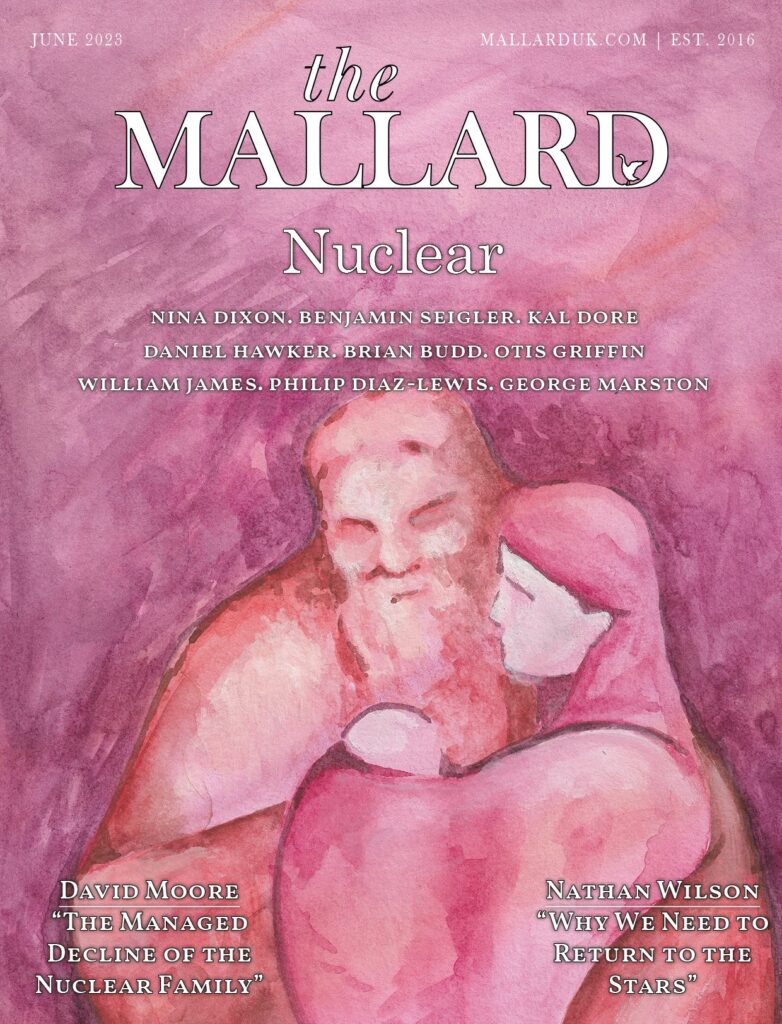
This is an excerpt from “Nuclear”.
To continue reading, visit The Mallard’s Shopify.
-
Government Versus The Family
Over the past few decades, it has become the norm that when a person is in trouble they rely on the state and not their family. When a man is in financial trouble he is infantilised by the state as he turns to universal credit. When a man has personal troubles, he feels more confident in turning to a stranger qualified as a ‘therapist’ than to find comfort in the arms of his loved ones. When a man needs education, he turns to the state-approved curriculum in a run-down, crowded comprehensive school rather than carrying on his father’s trade or learning for himself. The state has effectively become the parent.
Now, this is not to say that there aren’t situations in which individuals may need support outside their family; there are times when getting help from the community is important. The average person is stuck between two ideas: that families shouldn’t be dependent on the state and that we shouldn’t let children suffer because of their family situation. However, the default in modern society is to turn to the state first and the family second. Regardless of how altruistic the intent is, the state has incentivised such behaviours by creating a system where children are more dependent on the government than their parents. This, in turn, incentivises single-parent households and mothers to enter the workforce; needing to spend less time at home thanks to state-provided childcare. Whether that be providing free childcare or encouraging women to pursue careers through promoting university, the government has encouraged mothers to leave their children to go to work. This was especially seen under Blair’s government which provided free part-time nursery places for all three and four-year-olds or targeting 50% of the population to go to university.
As stated by Peter Hitchens:
“The whole idea of public policy towards childhood now is that children should spend as much time as they possibly can away from their mothers. I am taxed so that children can be put in nurseries so their mothers can go out and work in call centres.”
Of course, this is not to say that women should not go to work. However, through these policies, the government has incentivised women to put work in front of their family. This has led to major negative effects for children such as a significant rise in mental health problems over the past few decades.
The family, and by extension the community, should offer a support system. When a person is in need, relying on family is much more reliable and rewarding than government benefits. Family tends to be much more reliable than the impersonal government that changes every few years. And when there are times where the family fails, private charity is there as a safety net for the most vulnerable of society.
In addition, the government deprives families of the responsibility to give to charity as society trusts the government to show their altruism by providing welfare for those in need. By removing individual responsibility through government enforced philanthropy, community connections are withered.
However, our current system means that the support many children receive is from faceless civil service workers rather than seeing the generosity of their neighbours. During the last decades of life, our elderly receive their support from state pensions instead of their family. Their earnings in their working life have been taxed, with the government using their money on projects that don’t benefit them or their loved ones. Due to this, they’ve not been able to build up wealth to pass on to their children. In addition, the state creates a division between generations, as the young are forced to pay for an increase in social care through the national insurance increases which creates disdain between the young and old. The state deprives the family of its role – it incentivises disconnect between generations and a reliance on the state rather than those closest to you.
A strong family creates happiness, security and prosperity. It helps each generation learn from the last and grow. It allows children to grow up as individuals with diverse perspectives and ideas, not just the taught lessons from state education. It allows children to have an identity within the family while retaining their individuality. This isn’t something that can be replaced by faceless bureaucrats. The family should come first, not the state.
-
“Traditionalism: The Radical Project for Restoring Sacred Order”, by Mark Sedgwick (Book Review)
In 2014, speaking via Skype to a conference held at the Vatican, Donald Trump’s later advisor, Steve Bannon, casually mentioned Julius Evola (1898-1974), a thinker little known outside Italy, and who even within Italy was conventionally dismissed as a former Fascist whose writings still exerted a pernicious influence on the ’far right’. When that comment was unearthed by the US media in 2016, it sparked a furore amongst those desperate to discredit Trump as a danger to democracy. It also drew mainstream attention to a strange and possibly wide-reaching philosophy.
Evola’s Fascist sympathies went much deeper than anti-communist or nationalist sentiment, being rooted at least partly in a colourful and irrational worldview referred to by some authors (although not Evola) as ‘Traditionalism’. Through him, Bannon, and so by extension Trump, were potentially ‘linked’ to much broader intellectual currents, with connections across everything from the abstractest metaphysics to the earthiest ecologism.
There existed, obscure but important scholars had long argued, a mystical ‘perennial philosophy’ of transcendent religiosity and social stratification that was simultaneously as ancient as origin myths and applicable to modern discontents. Over the centuries, this concept has attracted intellectuals as diverse as the 15th century humanist Giovanni Pico della Mirandola, and Brave New World author Aldous Huxley. Other than Evola, its best-known and most systematic modern exponents were two metaphysicians, the Frenchman René Guénon (1886-1951), and the Swiss Frithjof Schuon (1907-1998), who issued writings and launched initiatives that channeled underlying cultural gloom, and still resonate powerfully. Like Evola, Guénon did not use the term Traditionalism, but his writings are regarded as key texts.
As well as Bannon, ‘Traditionalist’ sympathies of some kind were avowed by, or detectable in, influencers outside America – Hungarian politician Gábor Vona, the Russian ideologue Aleksandr Dugin (whom Bannon met in 2018, and who was supposedly an influence on Putin), and the Brazilian writer, Olavo de Carvalho, credited with helping Jair Bolsonaro win the presidency in 2019. Beyond politics, the connections were even more diffuse, with well-known academics, artists and even King Charles III (when Prince of Wales), articulating Traditionalist tropes to combat anomie and materialism, and promote organic agriculture, small-scale economics, traditional arts, and interfaith dialogue. But did all these different things have anything in common other than root-and-branch discontent with a drably dispiriting status quo? What possible relevance could Traditionalists’ distaste for democracy, and even politics, have for determinedly populist politicians?
This is a long-standing area of interest for Oxford-educated Arabist, Mark Sedgwick, now professor of Arab and Islamic Studies at Aarhus University. His 2003 book, Against the Modern World: Traditionalism and the Secret Intellectual History of the Twentieth Century, was the first to draw mainstream attention to Evola, Guénon, Schuon, and others dubbed or self-described as Traditionalists. He brings to this discussion special insight into Islamic influences on Traditionalism, from the inner ecstasies of Sufism to the academically distinguished elucubrations of the contemporary Iranian-American theologian, Seyyed Hossein Nasr. Along the way, he treats ably and interestingly of many subjects, from Hindu ideas about caste via 17th century theories of history to the trajectory of Western feminism, and analyses the influence of Jordan Peterson, whom he regards as a Traditionalist for the internet age.
Traditionalism is a catch-all sort of term, and its outcomes are so diverse it is difficult to discern much consistency at all. Had it not been for Bannon’s remark, it is hard to imagine many even noticing Traditionalism existed. Conceptual complexity could help account for Traditionalism’s apparent ascent; as the author notes, “That which is not easy to understand is not easy to deny”. Sedgwick also suggests that Guénon’s theories may be fundamentally flawed because based on early 20th century understandings of ‘the East’ which are now regarded as too colourful and generic, even condescendingly ‘Orientalist’. Evola’s more dynamic and Western-oriented variant is likewise a product of its time, suffused with Nietzschean contempt for Christianity, and the epochal pessimism of thinkers like Oswald Spengler (even though he criticized both). Sedgwick nevertheless treats it as a coherent corpus of thought, with much relevance for today.
The central element of all variants of Traditionalism is ‘perennialism’ – the notion that beneath all the exoteric differences of world religions there is a unifying ‘sacred order’ understood only by the deepest thinkers, although hazily intuitable by the masses, if only they can be detached from the trammels of modernity. This is not just a tradition, but the Tradition that unlocks all cosmologies, and renders the most impassioned theological and political disputes not just superficial, but almost risible. Traditionalist writings are predictably esoteric, aimed solely at a supposedly more spiritually attuned elite.
Traditionalists tend to be greatly interested in such things as hermetic philosophy, occultism, shamanism, and symbolism, and believe strongly in what the ethnomusicologist Benjamin R. Teitelbaum called “spiritual mobility” (see his 2020 book, War for Eternity). They regard 21st century preoccupations like equality, gender politics, individualism, material progress, and technology as mere aspects of modernity, harmful or simply inconsequential.
The second ingredient is a belief in cosmic circularity, as opposed to the ideas of inevitable linearity inherent in mainstream Judaism, Christianity, and Islam, and so throughout modern politics. The world, in this reading, goes through ‘ages’ of decline that can be followed by renewal. An original golden age of unity and quality is ineluctably succeeded by silver, bronze and ultimately dark ages of increasingly mechanistic reductionism – what Guénon memorably called the “age of quantity” – after which the cosmic wheel turns back to the start.
‘Golden Age’ thinking is common to many civilizations, but there are especially close parallels with the four ages (Yugas) of Hinduism, with ‘Kali Yuga’ (the last, sin-filled age of conflict) a shorthand term for today among ‘Aryan’-interested Rightists. This process is almost irrespective of politics, although some theorists see an expeditious role for ‘disruptors’. Evola saw Fascism as a means of reconstituting the Roman Empire, and Bannon saw (and perhaps still sees) Trump as a kind of creative destroyer of consensus, but politics has been a lower priority for other Traditionalists, who concentrated instead on transformation through self-realization.
It may easily be imagined that Traditionalists are prone to eccentricity; for instance, Evola believed that ‘Aryans’ were descended from an ethereal Arctic race which had decayed as they came south. In the 1980s, a writer calling herself “Alice Lucy Trent” officiated in County Donegal over a small community called the Silver Sisterhood, which worshipped a female deity, sported Victorian clothing, and refused to use electricity. Trent later changed her name to “Miss Martindale”, and moved to Oxford, to found a movement called Aristasia in a modest terraced house, where ambiguous persons wearing dresses and veils would hold ultra-reactionary court in a candle-lit, gramophone-sounding interior, and be seen driving around town majestically in a 1950s car. It was part-pantomime, part-serious critique, at once amusing and interesting.
Sedgwick rues some Rightists’ co-option of some parts of Traditionalism. Indeed, perennialism can be hard to square with ideas about a “clash of civilizations”, or immigration, or belief in physical racial differences (which even Evola downplayed). He nevertheless examines their thinking with commendable fairness. He differentiates between genuinely traditional teachings about religion and society, which really can be millennia old, and 1920s-to-present-day attempts to turn some of these teachings into realities. For Sedgwick, whatever about the youthful Evola, by his late period he had become a “non-traditional Traditionalist”, and the Evolan phraseology deployed by some on today’s radical Right is therefore mostly “post-Traditionalism”.
But logical consistency matters little in politics, even metapolitics. Traditionalism may persist as a presence on the Right, if sometimes more symbolically than as substance. Traditionalists’ emphasis on arcane knowledge is intrinsically appealing to some who aspire to be elite leaders. There are also similarities in outlooks and temperaments between Traditionalists and some Rightists – shared perspectives on the manifold problems of modernity, shared detestation of bleak materialism, and shared love of grand and sweeping narratives. As the once world-bestriding West shivers in winnowing new winds, and mainstream conservatism flounders, the epic appeal of a mythical past (and implied enchanted future) seems likely to grow. Sedgwick’s second book on this too long neglected theme makes another significant contribution to what may be an expanding as well as evolving field.
Book Details: Mark Sedgwick, London: Pelican, 2023, hb., 410pps., £25
My thanks to John Morgan for invaluable input on this article.
-
Dostoevsky’s Answer to the Problem of Evil: A Lenten Reflection
Having tackled the growing hydra of socialist radicalism through his previous major novels, Fyodor Dostoevsky set out in The Brothers Karamazov to address what he saw as the fountainhead of the mid-century Russian ideological shifts: the loss of faith in the the gospel and in the Orthodox Church as the means established by Christ to display that gospel to the nations.
To be sure, Dostoevsky saw this loss of faith primarily in the upper-class intelligentsia and the later populist youth. The former, the Westernizers of the 1940s-60s whom Dostoevsky pilloried in everything from Notes from Underground to The Devils, had intended to enlighten the peasant class—part of which involved relieving them of their superstitious belief in Christ’s divinity and Christian morality. The latter generation of 1870s Populists broke from the amoral nihilism of that generation (in no small part due to Crime and Punishment and The Devils) and instead venerated the peasants’ simple way of life and native morality; however, refusing to acknowledge their source in Christ and the Russian Orthodox Church, the populists still maintaining secular aims.
Dostoevsky’s response to both groups was to advocate a return to the fullness of the faith in Orthodoxy, which could satisfy all needs of the human individual, both physical and transcendent. However, having previously been a radical himself, Dostoevsky was ever willing to pursue this goal through a conciliatory approach, especially if he might thereby rescue some readers from the contradictions and potential disasters of radicalism. He does this in The Brothers Karamazov by taking seriously a primary objection to Christianity: the problem of evil.
Ivan Karamazov: The Problem of Evil
He articulates the problem of evil through Ivan Karamazov. In Book Five, Chapter V, “The Grand Inquisitor,” Ivan follows up his description in the previous chapter of the senseless abuse of children (all gathered by Dostoevsky from real-life newspaper stories) to his little brother Alyosha, a would-be priest, with the one of the most famous stories-within-a-story in world literature. These chapters, according to Dostoevsky’s letters, are among the most important in the novel. They lay out the problem of evil and its refutation—through a parallel story-within-a-story: Book VI, The Russian Monk, which presents the life and sayings of the local monastery elder Fr. Zosima, compiled by Alyosha long after the novel’s events.
Acknowledging himself as no philosopher—to say nothing of his being an Eastern Orthodox Christian, who generally eschew Western theory-forward approaches in favor of ascetical practice and theosis as proof of the faith—Dostoevsky does not merely present logical arguments for or against Ivan’s atheism. (Indeed, one of the greatest aspects of this self-proclaimed atheist is that it is debatable whether Ivan believes his own professed atheism. He often waffles in, and at times regrets, his stance and, like Dostoevsky’s previous protagonists, is horrified upon seeing his stated beliefs actually lived out by Smerdyakov. Furthermore, Ivan often fits less the title of Enlightenment philosophe and more that of Romantic hero in protest against an unjust God whom he nonetheless believes in.) Rather, Dostoevsky addresses Ivan’s problem with evil not with a matching argument and polemical story, but with the life of a saint.
Fr. Zosima: A Holy Life
In Book VI, The Russian Monk, Dostoevsky breaks from the novelistic form and uses, instead, the mystical, timeless mode of hagiography. Because it is ordered by a moral message rather than causal events or their concomitant psychological elements, such a mode has struck many critics as dismissable, being unrealistic or simply jinned up. Dostoevsky acknowledges this in a letter to Konstantin Pobedonostsev, the Russian Orthodox Church’s representative in the Tsar’s cabinet: “Something completely opposite to the world view expressed earlier appears in this part, but again it appears not point by point but so to speak in artistic form. And that is what worries me, that is, will I be understood and will I achieve anything of my aim?”
Nonetheless, by answering the problem of evil with a holy life lived in spite of evil, he tells his assistant editor, Dostoevsky intends to show “that a pure, ideal Christian is not something abstract, but graphically real, possible, standing before our eyes, and that Christianity is the only refuge from all its ills for the Russian land,” and, presumably, for those of the rest. In short, Dostoevsky answers the world’s evil with holiness—with the saints alive in every generation of Orthodoxy that allow the Church to call itself “Holy” in the Nicene Creed and by whose theotic prayers and actions it redeems a fallen world.
The Russian Monk, however, goes beyond merely presenting one exception to evil. Contrary to the atheist-materialist-socialist arguments (then and now) that people and their actions are merely effects of environment, Dostoevsky maintains that part of the image of God in man is an inalienable individual moral agency. Thus, the redemption shown in Fr. Zosima’s story is available to all. Far from presenting merely one anecdote, The Russian Monk transforms all characters in The Brothers Karamazov into potential likenesses of Christ and His redemption of the world.
As Nathan Rosen argues, this opposite pole of “The Grand Inquisitor” defends the faith not through rational argument but through aesthetic fullness—by presenting a man who embodies in his own life the story and truth of Job. According to Rosen and other sympathetic critics, Zosima’s story, “is the literary equivalent of a precious hallowed old church icon,” and as such it renders the rest of the novel, broadly, and Alyosha’s path, specifically, into the realm of iconography—the tradition that, following Christ’s being the first Icon of God the Father, reveals the truth of the gospel through aesthetic incarnation.
Grushenka: Dostoevsky’s Magdalene
And, yet, at the time of the novel’s events, Alyosha is not as sanguine as the later Alyosha who recorded Fr. Zosima’s life. Indeed, between his conversation with Ivan (and the discovery of his own unsuspected resentment of God it revealed) and Fr. Zosima’s non-miraculous death*, his faith is quite shaken. He is, thus, primed for either a full loss of faith or a restoration in the chapters preceding “Cana of Galilee,” which Dostoevsky describes to his assistant editor as “the most significant [chapter] in the whole book.”
Having felt his faith shaken by Ivan’s “poem” and the circumstances of Fr. Zosima’s death, Alyosha reverts to the way of life he knows to be native to himself as a Karamazov: sensual degradation. Agreeing to go with the atheist student Rakitin (who’s just been wishing to trip up Alyosha so he might gloat) to the home of his father and eldest brother’s paramour, Agrafena “Grushenka” Svetlova, Alyosha intends to…do whatever Dostoevsky’s readers might infer from the author’s 19th-century understatement.
Grushenka immediately catches the mood and starts to flirt with the boy. Any other time she would have been more than willing to get her claws in yet another Karamazov male—especially the one who, by his purity, represents the moral opposite of her supposed fallenness. Although she conceals some secret joy altogether different from her vengeful persona of seduction, Grushenka begins to play the harlot she knows Alyosha considers her to be. “She suddenly skipped forward and jumped, laughing, on his knee, like a nestling kitten, with her right arm around his neck. ‘I’ll cheer you up, my pious boy.’”
And, yet, far from falling to her ways, Alyosha discovers that Fr. Zosima’s teaching was not altogether without fruit. “This woman, this ‘dreadful’ woman, had no terror for him now, none of that terror that had stirred in his soul at any passing thought of woman.” Furthermore, he soon learns that the joy hidden beneath her flirtation springs from the recent discovery that the man who had seduced and abandoned her as a teenager is returning, and that she is willing to forgive him.
This turn of events has emptied her impulse to reduce Alyosha to her fallen position. “It’s true, Alyosha, I had sly designs on you before, for I am horrid, violent, but at other times I’ve looked upon you, Alyosha, as my conscience…I sometimes look at you and feel ashamed, utterly ashamed of myself.” No doubt this shame had driven her late desire to cause Alyosha’s fall.
However, just as Ivan’s description of the suffering of children primed the way for the denial of Christ in “The Grand Inquisitor,” Grushenka’s act of forgiveness for being seduced as a young girl is the prelude to her—and Alyosha’s—redemption. For, after overthrowing nearly a decade of resentment in the name of forgiveness and reconciliation, Grushenka finally learns of the death of Fr. Zosima. “She crossed herself devoutly. ‘Goodness, what have I been doing, sitting on his knee like this at such a moment!’ She started up as though in dismay, instantly slipped off his knee and sat down on the sofa.”
Witnessing such an immediate response of reverence begins the restoration of Alyosha’s faith. To Rakitin, who is still proud of having delivered Alyosha to Grushenka, Judas-like, for 25 rubles, Alyosha says, “look at her—do you see how she has pity on me? I came here to find a wicked soul—I felt drawn to evil because I was base and evil myself, and I’ve found a true sister, I have found a treasure—a loving heart. She had pity on me just now…Agrafena Alexandrovna, I am speaking of you. You’ve raised my soul from the depths.”
The paired forgiveness and reverence of Grushenka, the person Alyosha least expected to show such things, provides the miracle he was waiting for: the manifestation of Fr. Zosima after death. For, besides her forgiveness of the officer, in fearing what effect her own seductiveness might have had on Alyosha Grushenka displays Zosima’s core message. Assuming one’s own moral responsibility—not merely for one’s actions, but, according to Fr. Zosima, for all men’s actions—is the whole means of acquiring the likeness of Christ, and Alyosha sees Grushenka, of all people, practice it.
From the Orthodox perspective, in thus fulfilling her innate human image of God with behavior according with His likeness, Grushenka has become a living icon, as Christ, the first Icon, had been. Grushenka’s is the miracle of a Magdalene conversion, manifested before Alyosha’s eyes, and it primes him for his own symbolic incarnation of Fr. Zosima’s—and the unnamed Christ’s—message, spirit, and way of life in the climactic next chapter.
Alyosha: A Living Icon
Ultimately, each reader must decide for him or herself whether Dostoevsky’s answer to the problem of evil, indeed, answers it. Many critics have considered Ivan’s objection to Christianity insurmountable. Leaving aside possible confirmation bias in such academic interpretation, things are, admittedly, not helped by the response’s seeming so obscure—even arguably interrupting—especially to Western audiences that have generally foregone monasticism, iconography, and veneration of saints since the Reformation and subsequent Enlightenment.
However, the true answer to evil, according to The Brothers Karamazov, is not a simple one-and-done response provoking a change of mind (though Alyosha’s realization in “Cana of Galilee” of the Orthodox sacramental view of creation involves just that). Rather, it is a disposition and way of life depicted first through Fr. Zosima, then the redeemed Grushenka, and finally through a not much older but very much wiser Alyosha, who through the rest of the book follows his Elder’s direction in living out the gospel in the real world, amidst but not stifled by its temptations and evils.
And, indeed, when Alyosha meets the fourteen-year-old self-described radical, Kolya, who both parodies Ivan and represents a serious ideological influence on his younger friends, he is unperturbed. Doing what Dostoevsky hoped, himself, to do with The Brothers Karamazov, Alyosha redirects the good-hearted youth’s radicalism into a simple and more impactful Christlike love of the least of these—specifically, the smallest, Ilyusha—and he manifests the humble confidence and tranquility not merely of his former elder, but of Christ and His sacramental life.
*It was considered a proof of a holy man’s life that his body did not decompose post mortem; the lack of such incorruptibility in Fr. Zosima leads Alyosha to doubt whether, as Ivan has lately denied, a God of justice exists. Ironically, by expecting a grandiose miracle to meet his spiritual crisis, Alyosha discovers that he is little better than those described by Ivan in “The Grand Inquisitor” who are too weak for the moral freedom (and responsibility) inherent in Christianity. It also reveals Alyosha’s desire to defer his moral responsibility (an antiChristian impulse in Dostoevsky) to the holy man’s direction.