The leadership election has brought about a wave of Conservatives flexing about how diverse and inclusive the Conservative Party is compared to Labour. Among the first days of the elections, there were endless tweets about how the party has the most diverse leadership election in history.
Andrew Bowie, Conservative MP for West Aberdeenshire and Kincardine tweeted that the reasons why he’s proud to be a Conservative MP include “first trans MP” and “the most diverse cabinet in history.”
The online publication Spiked, released an article on how “The Tory leadership race is the most diverse in history. And this has sent the left into meltdown.”
The founder of Tories for Equality tweeted: “I feel proud that British children today, whatever their race, can look at the talented & diverse slate of conservative leadership candidates & think “I could do that”. I didn’t have that growing up under the U.K. Labour government. Proud of my country & proud of my party.”
This is a new attempt to call the left the real racists while celebrating how greatly diverse the Conservatives are. It appears that too many Conservative party members truly believe that to defeat the libs you must become one. Die a hero or live long enough to see yourself become the villain.
This is not to say that a candidates’ ethnicity and gender may be a key aspect of their campaign. After all, there’s merit to having a story of being an outsider or overcoming a struggle related to their identity. However, these MPs have been completely tokenised by those on the right. It doesn’t matter what they’ve done to these identity obsessed Conservatives, as long as their identity is good optics. And despite the attempted revision of history, this is not new for the Conservative Party.
The Conservatives have ridiculed the Labour Party’s anti meritocratic all female shortlists. However, it appears that the Conservatives are also guilty of identity politics hiring…
Under Cameron’s government, there was an active attempt to make the government less pale, male and stale. From David Cameron’s own account in a recent article, he wrote for The Times:
“I immediately froze the selection of Conservative candidates. I said that from our broader candidates’ list we would draw up a priority list, of which half would be female and a large proportion would be from black and minority ethnic backgrounds. Associations in winnable seats would have to choose from this “A-list”, and they would be encouraged to select candidates through “open primaries” that were open to non-party members.”
Cameron admits that the call for positive discrimination was because “this wasn’t happening naturally”. Despite denying this was an act of positive discrimination, and instead dubbing it as “positive action”, Cameron states that “We headhunted great candidates from ethnic minorities and pushed them forwards.”
Despite Cameron’s doublethink to frame choosing candidates for the sake of their ethnicity as meritocracy exemplifies how the party has been poisoned by Blairism. How can the Conservative Party differentiate themselves away from Labour’s positive discrimination when it can be seen they acting in a similar nature?
Of course, this isn’t to state that the party leadership candidates aren’t deserving. The strongest, popular candidates are those from minority ethnic identities and/or women. It would be doing them an injustice to only celebrate them for their identity rather than what they believe. While the Westminster bunch pander to identity politics, it is clear that the party membership is focused on what a candidate wants advocates for more than the colour of their skin or what is between their legs.
-
‘The Bad Ethics of the Machine’ (Magazine Excerpt)
With the recent debates surrounding AI improvement and the somewhat imminent AI takeover, I thought it would be interesting to return to the 20th century to analyse the debates on the rise of the machine and what we can learn from it today.
The early 20th century marked a time when the technological revolution was in full swing. With radio, mechanised factory work, and the First World War marked the new era of mechanised warfare, the intellectuals of the day were trying to make sense of this new modernised society. With the speed at which the changes occurred, people’s conception of reality was lagging.
The machine has narrowed spaces between people – the car allowed people to traverse space faster, and radio and telephone brought closer and practically instantaneous access to one’s family, friends, and acquaintances. The jobs were mechanised and people, as idealised by Marx, had the potential of being the ‘mere minders of the machine’. We are now entering another era. A time when Artificial Intelligence has the potential to replace most jobs. This is what Fisher in Post-Capitalist Desire has considered an opportunity for a post-scarcity society. But is this possible? Or rather should we heed Nick Land’s warning in Machinic Desire where he advised:
“Zaibatsus flip into sentience as the market melts to automatism, politics is cryogenized and dumped into the liquid-helium meatstore, drugs migrate onto neurosoft viruses, and immunity is grated-open against jagged reefs of feral AI explosion, Kali culture, digital dance-dependency, black shamanism epidemic, and schizolupic break-outs from the bin.” (Land, Fanged Noumena, 2011)
But let’s thrust away the shatters of this neo-automation and return to 1912, the time when this has only just begun.
Gilbert Gannan, in an article for Rhythm, wrote:
“Life is far too good and far too precious a thing to be smudged with mechanical morality, and fenced about with mechanical lies, and wasted on mechanical acquaintanceships when there are splendid friendships and lovely loves in which the imagination can find warm comradeship and adventure, lose and find itself, and obtain life, which may or may not be everlasting.” (Gannan, 1912)
In a quasi-perennial argument, he claims that mechanical morality and mechanism, in general, will never replace the real deal – the real concrete friendships and those we love.
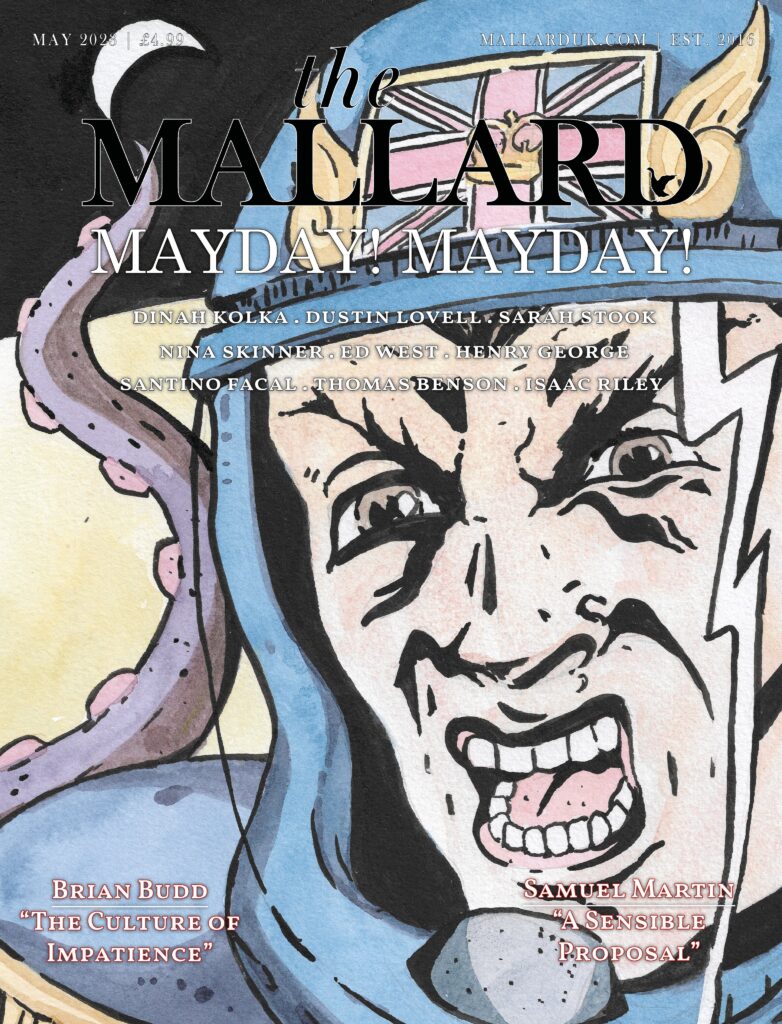
This is an excerpt from “Mayday! Mayday!”. To continue reading, visit The Mallard’s Shopify.
-
Watch Out for The New Labour Playbook
Yes, Labour is still the party of identity fetishists, true-believer yet Dad’s Army-esque revolutionaries, end of times Gaia environmentalists, and public transport strike supporters, groomers, and much else, but so was New Labour. They just knew how to keep the lunacy contained, repackaged, and were desperate enough to try Blair.
Fortunately, Blair did a lot of damage to his own side, not just the country. Blair’s incrementalism didn’t manifest their objectives quickly enough. They were willing to grumble and tolerate it until the Iraq War. From that point on, it became impossible to contain the lunacy; spiralling down through more and more left-wing figures, from Brown to Miliband and then to Corbyn. Consequently, they have tuckered themselves out.
The loss of monolithic public news and broadcasting will also make it much harder, New Labour’s ilk will try to come back. You can still see them. They haven’t gone anyway. They won’t just come from the party, they’ll come from all the people and organisations on their side. Blair himself is still knocking around. The advice comes regularly to ditch the overt progressive evangelism e.g. November last year, May this year.
There’s been a slow trickle of pieces which say things like “Labour need a big personality to take on the Tories”. They’re trying their best to manufacture this. Have you seen the attempts to make Wes Streeting out as if he’s interesting and not just another factory pipeline student union politician, in career background and mindset? Good grief. Progressives used to rob banks, fight guerrilla wars, and write their defiance in their own blood. Sure, threats should be taken seriously, and it’s unpleasant, but Wes, what are you doing sending limp tweets to old ladies?
Anyway, it’s good news! As it stands, the two go-getting types of the progressives are (at least, temporarily) inhibited: the energised, violent, “true believers”, are somewhat withered, and the “professional” sorts have a monumental amount of work to do. They are rebuilding, though, so keep an eye out.
If they can become credible on the following, they’ll be doing well: 1) Tough on Crime, 2) Pro Business, 3) Strong on Foreign Policy, 4) Strong on Defence, and 5) Solid on Our Public Services. It’s going to be difficult. A lot of Labour supporters don’t want to engage on those policy areas at all in the first place, let alone have workable answers to them.
The thing to watch out for is Blair’s two main tricks, which are closely related 1) talking out of both sides of their mouths and 2) presenting progressive solutions in their opponents’ terms.
Regarding the first trick, let’s use immigration as an example: one of the big progressive no-nos, a big right-wing concern, but which they really need to answer.
Just look at the headlines, which tell their own story. Blair admits he didn’t realise how many migrants would come to the UK after EU expansion. OK, but then he also says that immigration is good for the UK economy. Finally, he said that if you want to stay in the EU you have to curb immigration.
None of this is about lowering immigration based on principle or reflects right-wing concerns, or even the general popular reasons why people want it lowered. It’s about tactical necessity, in service of bigger picture goals – staying in the EU and reinforcing hegemony at home. Blair doesn’t admit he was wrong or that mass immigration has been damaging – he is talking out of both sides of his mouth! This helps him to try to flank his political opponents with positions which superficially appear to speak to right-wing concerns.
The reason he does this is very simple and not at all an original observation. In democratic politics it’s (sometimes) a viable strategy to go for (what you think is) the “centre ground”. Labour leaders who won – Ramsay MacDonald, Clement Atlee, Harold Wilson, and Tony Blair, all toned down the crazy in pursuit of the “sensible” and “moderate” centre ground.
Not that it seems to matter – progressives run all the main institutions and the nominal Conservative Party acquiesces and even adopts their agenda and aesthetic – but the key realisation of Blairism is that you must have power to do anything. Public support certainly helps reinforce the perception of complete hegemonic power and the justification for it.
Until Labour gets this by winning an election, the Conservative Party might just safely trundle along. God have mercy on you, Conservative Party. Govern! Or if you must insist on such dull imbecility, get out of the way. Go, all of you, retire to the House of Lords or wherever else you think gives you a veil of dignity, and whatever place can use the content, unaware, and immobile.
Anyway, if Labour doesn’t learn the lessons of Blairism, it risks being confined to 1) old style tax and spend and state power economics, 2) foreign policy which is anti-UK in one way or another, 3) marginal identity fetishism, and 4) screeching denunciation of anyone that dissents. This is because 1) misreads the lessons of the financial crisis, 2) misreads the proper responses to 9/11 and the Iraq War, 3) sees the progressives stuck in the tar-baby of the Culture War (which I am certain it will lose), and 4) just shows them to be unstable, and therefore as unfit to rule.
All of this would be a bit clapped out, but it would be safe and familiar for them, and do they even have the vision to see beyond? Reality and the general zeitgeist have moved on. Conservatives would do well to keep them stuck here.
There are ways out, and Labour seems to be doing a few of these things, though it’s hard to know if they really get it, half get it at someone else’s instruction, or if it’s accidental or coincidental. It’s also unclear how much any of the following will help them.
First, they seem to be hinting at a new progressive coalition i.e. Lib Dems, Greens, etc. tactical voting, selective standing of candidates, to avoid splitting the progressive vote. Will this work? Many use these parties as protest votes and you’d be surprised how many Conservative voters, for example, vote Green or Lib Dem at different elections, for all sorts of reasons, but who would never do it at a general election.
Second, watch out for Labour updating its policy agenda. Safe on this one so far. If they’re sensible it would stop being economically illiterate and suspicious of technology. It would also mean the progressives fully realising that corporations can be used and are willing to side with them if the conditions are right, no matter how temporary. The capitalists really will sell you the rope with which they’ll be hanged. It’s quite something!
Third, watch out for Labour re-discovering the mentality of government. The right needs to do this too, it must be said. The task is to amass power and to assume that (of course) it should be you governing. To do this the left will need some more self-discipline and less self-indulgence. The Labour Party’s sins are pride (how fitting!), envy, wrath, and gluttony. The Conservative Party’s sins are pride and sloth. This tactical swallowing of (some of) their pride doesn’t burden them to pursue policies people actually want. They’ll continue to insist that what voters want aligns with what the Labour Party wants, albeit overlaid with a veneer of sincerity and concern made possible with a more “moderate” leadership. New Labour was subtler still.
New Labour worked because people knew that Blair was prepared to discipline and channel the more insane parts of the Labour Party. Superficially, denial and discipline look very similar. It gave Labour the appearance of normality, reassured enough extra voters, and afforded them the cover of public acceptance to proceed with full-on nation-mutilating progressivism.
Watch out for the New Labour playbook. It will start with Labour controlling its incontinence. It’d be great if the Conservative Party got ahead of the problem by governing. Keep them busy responding to you, keep them too busy to get out of where they’re stuck.
-
Stop Pigeon Hate
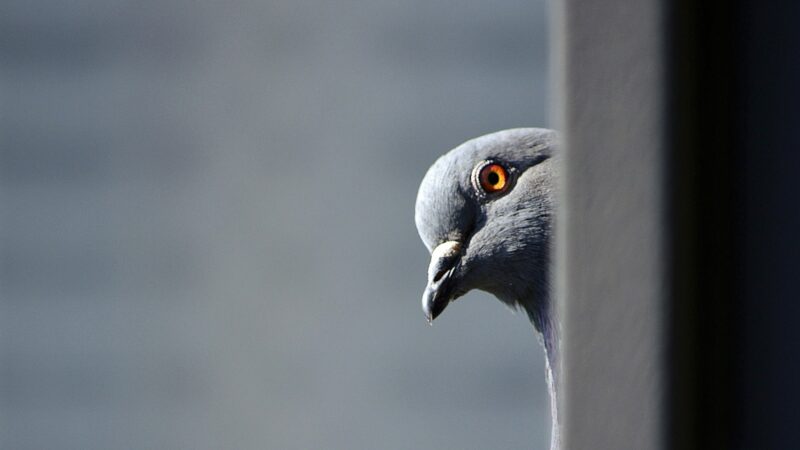
Why is the pigeon so hated? Is it due to his availability as a target? After all, he is a common sight in our towns and cities, so common he can seem like an omnipresent nuisance.
Maybe it’s his appearance? Admittedly, he is less stunning than other birds; his generally grey countenance is far less pleasing than the radiant scheme of a kingfisher or the sparkled wings of a starling.
Perhaps it’s his stature? Small and stout, he’s certainly an easier target than any bird of prey, lacking the brawn of an eagle or the sleekness of a falcon.
Whatever the case, the pigeon does not have a good reputation. Recently, he has faced criticism for a variety of reasons, from trying to liberate mankind from its self-imposed enslavement to mass media, to taking over a house after the landlord made the avoidable mistake of leaving the windows open for four weeks.
In my view, the public’s attitude towards pigeons can be best summarised with a well-known, albeit not entirely original, comment from Ken Livingstone, former Mayor of London: “pigeons are rats with wings.”
Now this is simply not true. Given the opportunity, the pigeon shows himself to be a considerate and upstanding member of our society, which is certainly more than can be said for many of its human participants.
Naturally, some nuance is required. After all, there are many different types of pigeon and there is no strict distinction between a pigeon and a dove, the latter of which has marginally better connotations, such as being a symbol of peace and salvation.
The largest and most common pigeon in the UK is the woodpigeon. Shy and tame, they are mostly grey with white patches on its neck and wings. Although primarily found in rural areas, they can also be found in more urban areas.
Due to their sizeable presence, you’ve definitely heard their call, especially if you live in suburban England. The soundtrack to a gloomy Sunday evening, their gentle cooing stirs a sense of melancholy in the local children, reminding them they have got school tomorrow.
Secondly, there is the collared dove, which gets its name from the black mark which stretches around the back of its neck. Pale brown, with reddish eyes and feet, unless there’s a buffet on offer, they’re almost exclusively seen on their own or in pairs.
Indeed, the collared dove’s unwavering monogamy is arguably more defining than the mark to which it owes its name. Wrapping only half-way around it’s neck, hence it’s comparison to a collar, when united with another collared dove, it becomes a full matrimonial ring. How’s that for nature’s poetry?
Then, there are rock doves. Also known as the feral pigeon, they are ancestors of domesticated pigeon. Coming in a diverse range of colours, from dark blue to black, from pale grey to white, from a rustic brownish orange to a brick-red.
These are the urban sprawl of pigeons. Whilst all creatures are innocent until proven guilty, should you find a stray blob of poop on an inner-city pavement, he’s going to be your prime suspect. When people speak of rats with wings, they think of the cooing greaseball known as the rock dove.
Similar to rock doves, stock doves have darker feathers, especially on their rump and wings, a distinct green neck patch, and a pink chest. Concentrated in the English midlands and southwest, becoming rarer in northern Scotland and Ireland, the UK is home to over half their European population.
However, unlike the rock dove, the stock dove is less likely to be seen in urban and suburban areas, preferring farm life to big city living. This is because he is generally shyer and more averse to humans than his cosmopolitan cousin.
Finally, the turtledove is the runt of the flock, being only slightly bigger than a blackbird. Arriving in the UK in spring and leaving for Africa in winter, its feathers are a distinctive mottled mix of a black and golden brown, with a white-rimmed black tail.
Unlike his relatives, the turtledove is a picky eater, choosing to indulge on cereal grains, oilseed rape, and chickweed. Unfortunately, due to his refined tastes, the turtledove has been in decline since the mid-90s, largely due to a lack of his favourite delicacies.
Given this, we can see that the pigeon is not merely a rat with wings. All at once, the pigeon is a sensible everyman, a young lover, a boisterous yuppie, a country bumpkin, and a persecuted aristocrat. They are diverse and endearing creatures with varying personalities and habits, reputations and interests, but much of the public want to exterminate him over a few measly droppings.
Every bird defecates, but the pigeon is solely hated for doing so. It’s for this reason I militantly oppose anti-pigeon architecture. Every public building in Britain is glazed with spikes, ruining their appearance in the name of protecting it.
On several occasions, I have sat in York station, waiting for my train home, with a quiet emotional investment in pigeons looking for somewhere to perch, watching them steer clear of the spikes, mentally cursing the communist station master who had them installed.
I’d prefer railway staff clean up bird droppings than behave like members of the Cheka, indulging their pathetic power fantasies by shouting at people for standing less than a country mile behind the yellow line. Mate, mate, mate. Health and Safety, yeah?
Following the riots of Oxford Street, which included looting and violent clashes with the police, one left-wing academic suggested the chaos could’ve been avoided if the rioters had access to public swimming pools.
As most people realised at the time, this suggestion is ridiculous on a number of levels. For one, unlike animals, humans have an innate tendency towards evil. It is easy to imagine machete brawls between illiterate migrants and fake bomb threats by TikTok pranksters overrunning such places.
However, it raises an important, if only loosely related question: why are there so few public birdbaths?
Despite his reputation as a feathered hobo, the pigeon is quite a cleanly creature, taking every chance he gets to fastidiously groom himself.
We have a birdbath in our garden, and we have many regulars, our most well-known being an especially rotund and fluffy woodpigeon, whom my mother affectionately refers to as Fat Wilbur.
I do not see this ‘winged rat’ Livingstone speaks of. Wilbur makes his stop, does what he needs to do, takes in the atmosphere, before moving on his way, not wanting to overstay his welcome. Should other pigeons accompany him, he makes room, as they do for him, and all is well.
The idea that such tranquillity could emerge in a society as presently low trust as ours is simply absurd. Of course, being a pigeon, it’s unlikely he does this for any pretentious, perception-based reason. Indeed, his fixation must be rooted purely in the value of cleanliness itself!
However, contrary to pervasive anti-pigeon sentiment, the pigeon is not only a cleanly creature, but a clever one too.
It can be hard to accept that pigeons, creatures known for flying into windows and pecking at cigarette butts, can distinguish between Picasso and Monet, but they can. In fact, according to the scientific research we have, pigeons are amongst the most intelligent birds in the world, showing a variety of relatively complex cognitive abilities.
Of course, whilst it is undeniable that humans are much smarter than pigeons, we do not use our superior faculties particularly well.
Whilst humanity may be threatened by the whims of idiots or a lack of imagination, hindering our ability to innovate and develop, our kind is similarly threatened by overthinking.
As a result, we deny ourselves the ability to be authentic, we shun risks in the name of avoiding embarrassment and pain when such risks could just as easily bring us laughter and joy. In the words of Paglia: “consciousness has made cowards of us all.”
As such, we should not be surprised when pigeons manage to be funnier than us. Just by being what they are, pigeons are funnier than basically every living comedian. Every wannabe BrewDog-sipping funny man, with his safe-edgy humour and hashed-out irony, fails to be more amusing than a random birb going about its business.
Walking around in circles, sporadically pecking the pavement, stopping occasionally to exhibit his dumbfounded ‘the lights are on, but nobody’s home’ expression, bobbing its head like its listening to a really good song, it is a grave fault in our being that a character as innocently absurd as this is considered less amusing than James Acaster.
Even the mere idea of a pigeon is funnier than most human attempts at humour. Go ahead, in your mind, visualise a pigeon (don’t worry, the cops can’t do anything… yet). You see that? Now that’s comedy. If you deny this, you Just Don’t Get It. Not much I can do about that.
Looking at these odd creatures, has nobody once thought: what are they up to? What’s their game? Why did they peck there and not there? Why did he take flight for seemingly no reason? Is there some secret pigeon meeting he needs to get to? What’s his schedule? Does he have time for an interview?
Yet, despite his apparent gormlessness, it is clear pigeons are far more sensitive than the average human.
If you’ve ever commuted anywhere via public transport, you’re no doubt familiar with the hectic nature of it all. From the loud noises to the chaotic stampedes, from the excruciating delays to the dodginess of certain folk, commuting isn’t exactly what most people would call an enjoyable experience.
Of course, whilst we might find certain aspects of commuting more annoying than others, we all agree on one thing: the worst part of commuting is other people.
Compare this to the pigeon, who shows consideration for personal space, does not play loud music, doesn’t try to con you out of your money, and generally minds its own business, preferring to get out of your way, rather than get into it.
If what Sartre says is true, that hell is other people, perhaps heaven is to be in the company of animals. More to the point, who is better company on a long commute than a pigeon?
Undoubtedly, the pigeon is not a faultless creature, and the shortcomings of us and other beings cannot excuse or undo this fact. That said, any fault which can be found with the pigeon can easily be remedied by human custodianship. We must spare him from the misguided disdain of busy adults and the clumsy tyranny of misbehaved children.
Pigeons are not flying rats, nor are they government spies. They are our friends and we should treat them as such. Stop Pigeon Hate!