Month: January 2023

Against Common Sense Conservativism

What a sad and wretched world we live in. The decline of Free Speech, British Values, and Common Sense has let the loony left and Radical Woke Nonsense destroy our Institutions.

Remix these words enough and you too can qualify to be a conservative commentator in the contemporary British political landscape. Looking across the commentariate of the right wing, you’d be forgiven for believing that these figures were grown in test tubes. One part ‘cultural Christian’ (with “mixed feelings” on gay marriage and abortion), another part straight-talker, with a dash of ‘political incorrectness’ (always tempered by a well-to-do attitude) and some kind of minority identity as a sting in the tail for the left, and you’ve got a Common Sense Conservative.

The Common Sense Conservative isn’t hard to find: they fill the ranks of GB News and do the talking for Talk Radio – what underlines the whole project is a constant bewilderment with the modern world, and an ability to formulate programmatic responses to the latest trends from the left wing. They are the zig to the liberal zag, but both invariably pull in one direction – towards more of the general decay they claim to lament.

One Common Sense Conservative is very quick to point out that identity politics allegedly places an expectation on what he, a non-white man should believe. This, in his view, is a form of racism, which ipso facto debunks identity politics. What goes undiscussed, is that the dispute between the Common Sense Conservative and the “Woke Left” (who are really just more internally consistent leftists) is simply the narcissism of small differences. The leftist project of the modern world is one of liberation, where liberation is defined as the absence of restraint. Identity politics comes to be viewed by the Common Sense Conservative as one such restraint, and must therefore be rejected. The fundamental metaphysic is the same: atomised selves, who cannot be infringed upon by collective projects. The modern left recognises that for the self to be liberated, they have to be embedded within a social context in which their self-expression is affirmed. To this end, collective action is necessary, and proven to work in the success of the Civil Rights movement. Ironically enough, the Common Sense Conservative often appeals to the MLK Jr. attitude of the ‘content of character’ to resist identity politics. The disagreement between these two forces is not a philosophical one, but a pragmatic one – do we undergo collective action to liberate the self, or do we rely on an atomised individualistic approach which denies group differences?

These inherent parallels make nice-sounding hollow appeals to buzzwords necessary. To actually explicate a coherent philosophy would be to fundamentally challenge not just the desirability of things like free speech, but the real possibility of such a thing to begin with. No-one believes free speech means you can broadcast the position of all nuclear submarines, and this belief has to be justified somehow. Put simply, you’re not allowed to do this because it threatens the political order atop of which your right to free speech rests. The principle is simple then: you cannot extend your principles to those who would threaten their existence. Yet, when Novara Media, an outlet which calls consistently for deplatforming is itself deplatformed – the sycophants from GB News and UnHerd flock to fill the void, with Tom Harwood claiming they have a right to be heard.

What this underscores is a hesitance to actually give limits on rights and so-called freedoms, preferring instead to defer to whatever seems reasonable in the given circumstance. Consequently, the Common Sense Conservative often finds himself shaped by the social context he inhabits; these environments quickly become targets for Gramscian takeover and ensure that what qualifies for Common Sense tomorrow will be assuredly more left wing than Common Sense today.

An example of this emerges in the way we discuss positive discrimination, quotas, or diversity. Quite recently, Andrew Bridgen MP posted a photograph of him and his supporters at the 41 Club in Castle Donington. In response, he suffered anti-white racist abuse due to the fact his supporters were White. Among these responses, someone mentioned the only diversity in the room was the waiting staff – and it was this response one Common Sense Conservative took to highlight the ‘bigotry’ of the progressive opposition. For this individual, it was not at all noteworthy that a gathering of white people was apparently subject for abuse, but instead a passing comment about non-whites was the indicator of racism. Again, we see that the framing of the discussion is always limited by social context. It goes with the general flow of society to defend even the most minor form of prejudice towards non-whites, before defending overt prejudice towards whites – and so the latest iteration of Common Sense dictates that this must be where the opposition is mounted.

The argument that affirmative action, quotas, and diversity are actually bad for those they claim to help is 50 years old now. Thomas Sowell made it in its honest and earnest form in the 1970s, and since then conservatives have used it to defeat the left – on their own terms. What continues to go unaddressed is that the primary victims of affirmative action are not ethnic minorities, who lose their ability to provide for themselves by being given grants or get placed in educational facilities that have workloads they are mismatched for. The primary victim is the majority population which loses money to pay for these grants but do not benefit from them, and lose places they otherwise would have achieved in educational facilities.

Ultimately, these unexamined priors which are justified under the edifices of ‘Common Sense’ reveal an intellectual vacuum in the modern right. The only attempt to form an alliance between intellectualism and conservatism in recent memory was the Conservative Philosophy Group in 1974, restarted with the help of Sir Roger Scruton in 2013. One exchange highlights the differences between the traditional form of conservatism with its modern vacuous counterpart:

Edward Norman (then Dean of Peterhouse) had attempted to mount a Christian argument for nuclear weapons. The discussion moved on to “Western values”. Mrs Thatcher said (in effect) that Norman had shown that the Bomb was necessary for the defence of our values. Powell: “No, we do not fight for values. I would fight for this country even if it had a communist government.” Thatcher (it was just before the Argentinian invasion of the Falklands): “Nonsense, Enoch. If I send British troops abroad, it will be to defend our values.” “No, Prime Minister, values exist in a transcendental realm, beyond space and time. They can neither be fought for, nor destroyed.” Mrs Thatcher looked utterly baffled. She had just been presented with the difference between Toryism and American Republicanism. 

In Thatcher, we see appeals to values with no underpinning of where they emerge from and their justification, and in Powell we see a world-view which justifies itself from the ground up. It’s no wonder that today we see Thatcher emblazoned all across conference, to the extent that one Common Sense Conservative even has a cut-out of her in her room. Thatcher represents the true beginning of the vacuous conservativism that reduces Political problems to technical ones, and exists to retroactively justify the decisions of the mercantile class. To this end, it is incapable of creating anything new, and so invokes its own previous iterations with new coats of paint to provide a veneer of consistency over an economic order which fundamentally requires constant flux.

The flux of modernity is only truly possible because of the aforementioned metaphysic that we are atomised selves, who contract or compete to create the social, Political, and economic orders in which we live. We can therefore not be infringed upon as individuals, but are reconfigurable units in these wider orders, and by virtue of our individual nature – have no right to dictate what these wider orders are, as this would be an infringement upon the individual.

Appeals to ‘common values’ will never work as long as this individualistic ontology is accepted; it offers no justification as to why these common values cannot be departed from at will. For this reason, it is necessary to invoke ‘Common Sense’ as the reason to remain within the common set of values. But of course, by the time you must invoke common sense, it’s hardly common any more. I’m yet to have an argument over the common sense notion that one ought to look both ways before crossing the road, but I’ve had plenty of arguments about the fact that men aren’t women. Truthfully, these beliefs need justification beyond appeals to common sense. The categories of men and women need to be defined not just in a taken-for-granted social manner, but in a metaphysical, biological, and philosophical manner. Only when these beliefs are deeply rooted and interconnected with not just the fabric of oneself, but of the fabric of reality itself, can people be driven to the depths of passion necessary to rebuff the challenges of the modern world. To that end, a right-wing intellectual vanguard is necessary to any movement which seeks to overturn the new orthodoxies of modernity.


Photo Credit.

Fact and Fortune: A Note on The Particular

Writing this article makes me feel guilty. Like a manic scientist hunched over a microscope, I am hunched over a keyboard, conducting research into pinpointing the unpinpointable. For decades, conservatives have disapprovingly commented on the widespread adoption of once-alternative socially liberal concepts and arrangements, lamenting the desacralization and deprivileging of more “traditional” outlooks. This is very much in step with classic political dynamics: Liberals will tell you “Yes”, Leftists will tell you “Yes, and more!”, and a conservative will tell you “No”. Whilst I generally agree with such disapproving commentary, I will not be contributing to it. Instead, I shall be addressing that which animates the conservative’s disapproval; stating what love is, rather than what is not, all while resisting its substitution with other concepts (pleasure, happiness, etc.) as has been done before. Consequently, I hope to form a fragment of a “moral-social vision” to which a conservative can forcefully say: “Yes”. Moreover, it should be prefaced that I do not care for contemporary fads, such as “making sense”.

Underpinning all human relationships lies an implicit and relative distinction between what is familiar and strange. Courtesy of the innate biological, geographical, and psychological limits of (for lack of a better term) the self, from birth to death most of humanity is a stranger; their existence is affirmed without personal interaction and their initial relation to the self is ambiguous. As proximity to the self transforms, so does the nature of the relationship – strangeness gradually fades away and familiarity increasingly emerges. However, whilst technically specific, the self is a mosaic; it is downstream from various approximations which give identity and demand obligation: the family, the local community, and the nation, all exist as approximations to what is familiar, stretching out towards the stranger.

In the most irremovable fundamental and primordial sense, the family and the self are the same, thus describing the family as a realm of the self, as opposed to what the self is, does not make sense. As such, the first approximation which exists beyond the self, the one more intimate and more familiar than the much wider community, as if it was Venus slotted between Mercury and Earth, is that of the Particular.

The Individual and The Particular are not totally distinct. Whilst technically different, a Particular cannot deny its necessary origins as an Individual, that is to say: certain residual characteristics of an Individual will remain within the Particular even when an Individual becomes Particular. The key commonality between the Individual and the Particular is that both are necessarily unique and singular; they both refer to one. The fundamental difference between the Individual and the Particular is therefore twofold: the nature of [the] reference, and the nature of [the] one.

The Individual One is strictly numerical, it concerns isolated quantity amid implied greater quantity. Conversely, The Particular One is non-quantifiable. It is not perceived mathematically, but in a qualitative and subjective manner; the self-realised reality that there can be no concept of greater quantity when concerned with the existence of something radically specific. However, bound up in the nature of [the] One is how it is referred to. Unlike the Individual, the Particular is realised by a person; it emerges, rising above individualised mass. In this regard, whilst the Individual is an impersonal concept, the Particular is deeply personal.

Facts are the unbending exoskeleton of reality. Hardly negative, they are nevertheless mere matters of being, they are acknowledged by all for the sake of all; they are granted and therefore taken for granted. On the other hand, Fortunes emerge from an incomprehensible conglomerate of probabilities. More than simply being, the total feasibility of Fortune’s non-existence gives it subjective value; to exist as it does makes it remarkable, as if it were a roaring fire in a field of snow. As such, the “impersonally perceived quantifiable” Individual constitutes an existential Fact, whilst the “personally perceived non-quantifiable” Particular constitutes an existential Fortune.

Like every conceivable Fortune, it is discovered through action. Ways colliding through distinct affirmations of life as part of civilised existence, the Particular incrementally emerges into view. The glamourous unthinking of the animal, lurking beneath such civilised folk, smoothens rough edges into idiosyncrasies. It is only during this way-splicing journey that one is eventually obstructed by the wretched bluntness of Fact. The Particular is particular. Made radically specific by intersections of time and space, The Particular is temporary. Mortality, granted and therefore taken for granted, is never acknowledged for its wretchedness until compared to the shining novelty of Fortune. Icarus, made ecstatic by the heights to which his wings could take him, is blighted by the unmissable sun and is reacquainted with reality. Realisation of temporality is the highest realisation of the Particular and thus the undoing of the Self’s tranquillity. It is because of this that all love is bittersweet. A volatile spirit, it wrestles to be total, to be free of its own contradictions; it is humanity’s purest extremity.

Unfortunately, contemporary notions of love have come to be dominated by material transaction, in which material things are exchanged for something in return all while being divorced from direction, tailored only to generalised individual mass rather than the Particular, Regardless of whether material transaction is a consciously cynical effort or just well-meaning naivete, it should be considered a perversion of the material’s true role of expression: the act of turning the immaterial into something material, internal motion into an external display. Even if both are in want, the former deals in expectations whilst the latter deals in hope. Consequently, given the ritualistic importance, just as one who wants to receive must be prepared to give, where one does not wish to give, one must refuse. 

Far from pedanticism, there must be immovable details, actions, and sentiments which are confined to the realm of The Particular. If it lacks these, there is no such thing as a distinct romantic approximation; the Particular would cease to be particular at all. Hence why a private realm, knitted together by a veneer of secrecy and the consequent warding off transgressions is not only required, but the very essence of love. The contradiction of this private realm is that it can only be fully secured through public recognition; signifying that there are boundaries which those inside and outside cannot bend if the realm is to exist at all. It is the inability to reconcile this private realm with the world that lies beyond, especially the family and community, that produces the Romeo and Juliet tragedies we all intuitively understand.

At bottom level, these perversions stem from having been confronted by temporality which afflicts us all. Like madmen, they hurry to evade the inevitable. Impending fates, they make frenzied decisions, no sober consideration of what would do them better. Attempting to hoard the whole of humanity in your heart, being subject to the neurotic clamouring for more, made unawares that all will have so much less; you less of them, and them less of you. Just as a nation that attempts to contain the world within its borders does not enrich itself, and consequently makes a world in which the nation no longer exists.

Nobody makes a conscious decision to love, they simply do (on its own, it is Fact which precedes the Fortune of the Particular). It is those deluded folks who choose to act against love that engage in a conscious decision. Like building a dam to obstruct a coursing stream, it is a crude denial of motion. It is because of this motion that the emergence of the Particular cannot be reduced to a meticulous list of preferences. The mechanised procedure of romance has been attacked as a neutralising reconfiguration of love, implying it to be an organic development instead – which it is. If an organic something has stagnated it is either dead or on the verge of death – making compatibility the project, rather than the immediate gratification of love. Just as a flower’s idea of itself animates the contortions of its growth, giving clear form to lofty substance, the idea of two-minded unity is the grand project to which love draws its form and loyally commits its efforts. Unlike the machine which facilitates fleeting relations and heavy-handed intimacy, the Becoming force of love, that which sought to forge beyond the self and in the direction of the Particular, if found to be requited by life’s chances, necessarily reorients itself to go beyond life itself.

The afterlife exists as a Fact. Calling this afterlife “death” makes no difference. There are two certainties: our certain uncertainty of the exact nature of the afterlife and our absolute certainty of our heading there. Whether it’s the minds of men, eternal darkness, or literal new life, it matters not; there is a flipside to this state which gives this life so much meaning. The totality of the Particular and the fullness of heart it provides, ever-driving the two-minded unity, ushers the secret realm into existence, giving us a place not only within explicit life, but within implicit afterlife. Two radically specific souls, becoming one radically specific unit, find themselves undivided by death.

The first approximation, the most intimate and warmest flame, with correspondence to be earnestly followed up or to be dutifully waited on, mends the disjointed nature of life and afterlife. By forging a chain that can never be broken, mere existence is transformed into terrain traversing adventure. The ability to stare into the reaper’s eyes as if they were the eyes of the Particular; that is the essence of love. Never will the strange feel so familiar.
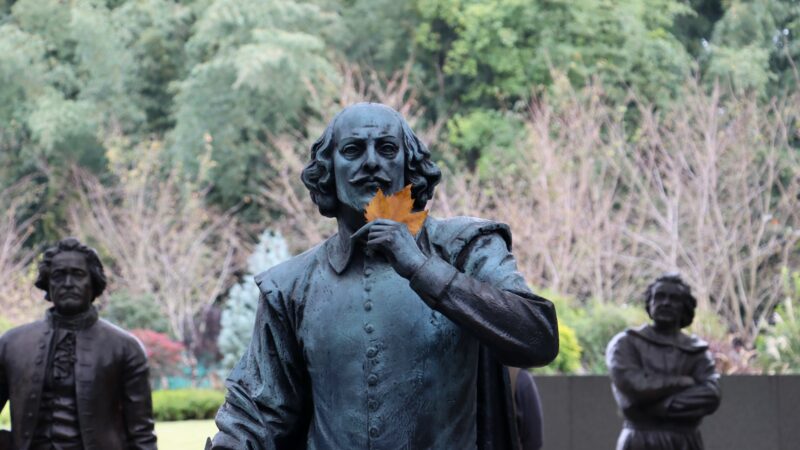


Photo Credit.

It’s probably a good time to re-colonise Shakespeare

The Renaissance was a spectacular time for literature, arts, and anatomy. The sheer wealth of geographical expansion reinvigorated Europe and invited it to explore, research, and discover. This period was crucial for the conflict between religion and knowledge, a subject thoroughly explored in Doctor Faustus. The Italian Renaissance especially brought forward many crucial questions about life and death, religion, exploration and other issues.

But this is no longer at the forefront of Renaissance studies. The calls for decolonisation have been sounding for quite a while and it’s slowly becoming a subject mainly discussed by right-wing self-proclaimed pseudo-intellectual political commentators. Is it still worth talking about? It might be. 

Many students join the English departments armed with an entire collection of Shakespeare’s works and a copy of Doctor Faustus, anticipating learning all there is to know about Renaissance in literature. 

Well, those students would be sorely disappointed. The loudest calls for decolonisation have been coming from The Globe, the first Shakespearian theatre. On the very front of their website, we can see ‘Anti-Racist Shakespeare’ in big red letters. When looking at their blog entry from August 2020, a completely innocuous and not totally coincidental date, the quote from Professor Farah Karim-Cooper sheds a lot of light on what’s happening with Shakespeare: 

As the custodians of Shakespeare’s most iconic theatres, we have a responsibility to talk honestly about the period from which he emerged and challenge the racist structures that remain by providing greater access to the works and demonstrating how Shakespeare speaks powerfully to our moment.

This is fascinating, as this then led to many movements to decolonise the literary genius. Universities advise students to listen to a podcast about the importance of ‘decolonising Shakespeare’ and the first lecture is basically a lesson on why Shakespeare is not universal and must be redefined. 

The lecture material encourages students to look out for ‘colonial oppression’ and invites students to not only decolonise Shakespeare but also the Renaissance. Put your Marlowe in the rubbish, the reading list is now filled with race-related, women-related plays, geared not at looking into the genuine literary wealth of Shakespeare, but at intersectionality. The anti-Semitism in The Merchant of Venice is barely visible under the colossal shadow of the potential ‘queerness’ within the novel. The patriarchy and the search for something that isn’t there take precedence over trying to uncover important truths. 

The lecturers may find it laughable that some people oppose decolonisation. They seem to be engaging in strawman ‘oh does that mean that we’re not going to teach Shakespeare? Of course not!’ But that’s not the point. 

I think that if we’re tearing down statues in Bristol and across the US, Shakespeare is potentially one of the cultural statues that could come down

Professor Ayanna Thompson, ‘Shakespeare Teachers’ Conversation’

If universities endorse the above message, what signal are they sending to their students? Of course, they may laugh trying to explain that it doesn’t mean literally tearing down Shakespeare, but the point stands. What they are trying to do is to reconstruct the existing understanding of Shakespeare and re-create it in order to accommodate people who hate them. 

Shakespeare was a white Anglo male and lived during the beautiful age of colonial expansion. No one should be worried about saying this one way or another. There’s nothing wrong with it either. I personally believe that Doctor Faustus is a far more important novel than ‘The Masque of Blackness’ by Ben Jonson who wrote quite a dull play about black people searching for the land where they can become white and beautiful. 

I understand that this is supposed to make the students uncomfortable and convince them to engage critically with the racism in the past; but don’t we all already know this? Isn’t it much more productive to focus on the plays that could relate better to contemporary issues? Apparently not. 

Midsummer Night’s Dream is apparently about patriarchy and The Merchant of Venice is gay.  The problem with academia these days is not that there are modules that are ideological; no, the ideology very easily just seeps into everything. There is no way out anymore – most academics are left-wing so naturally their modules will be geared in that direction also. This wouldn’t be an issue as this has been happening for aeons. The problem is that this then creates a whole army of impressionable young people whose main focus will be the discussion on intersectionality and race when there is so much more that Shakespeare can offer. The only way to circumvent it is to rediscover the truths that Renaissance literature has to offer. Reject intersectionality and race and embrace tradition. 


Photo Credit.

The possible booster/lockdown trade-off

At the time of writing, the UK is facing a sharp rise in cases of the novel Omicron variant. As a result, after a relatively normal summer and autumn, the government has now enacted ‘Plan B’, a series of non-pharmaceutical interventions (NPIs) including mandated mask wearing as well as work-from-home and vaccine passport recommendations, all intended to slow the virus’ spread. Further, despite having previously denied having any intention of doing so, it now appears to be floating the possibility of a third national lockdown or lockdown lite, limiting indoor dining (in winter…) and socialising. Amidst this, the government’s messaging continues to be that Omicron’s defeat lies in widespread uptake of the covid vaccine’s booster dose, which is not really surprising as we had previously been warned that the emergence of new variants would likely require cycles of booster jabs. This may not seem like terribly controversial advice in a country like the UK where, up until now, vaccine acceptance has been high. However, it is naïve to assume that all those who accept the jab do so for the same reasons. And, by that token, short-sighted not to consider the negative impact that another lockdown (or indeed the mere threat of one) could have on future levels of vaccine acceptance amongst some.

Given the toxicity of vaccine discussions (consider, the boogieman figure of the antivaxxer as the epitome of wilful ignorance and callousness, even before covid), the vaccine-hesitant report being unlikely to share their reservations with vaccine-acceptant peers for fear of encountering derision or scorn. As a result, vaccine accepters seldom have to engage with anything other than a David Icke-esque caricature of vaccine hesitancy. This obscures how, far from belonging to separate realms of ‘reason and science’ and ‘irrationality and conspiracy’, vaccine attitudes exist on the same spectrum, tipped by out-and-out refusal and full acceptance, and filled in by a gamut of vaccine hesitancies. Similarly, the binary outcomes of a vaccine decision (either you get jabbed or you don’t) obscure how people with different degrees of hesitancy will opt to receive covid vaccine but, given their differing stances, may respond differently to future policy changes regarding boosters and lockdowns.

Through a study based on a series of online surveys March 15th and April 22nd, 2021, academics from Swansea University identified at least two sorts of attitude amongst accepters of the covid vaccination. Being vaccine-accepters, both had received at least one dose of a covid vaccination or indicated their intentions to do so when it was offered to them.

However, whereas ‘full-accepters’ experienced few qualms about their decision to get jabbed, often just seeing it as an extension of a well-established social-norm, ‘accept-but-unsure’ accepters were more ambivalent, thus flirting with vaccine hesitancy. Though they did accept a jab (or said they would when it came to it), they did so with some concerns about its safety and effectiveness.

In explaining their eventual decision to accept the vaccine, they emphasised a trust in science (“I was a bit suspicious… but the science today compared to years ago is outstanding isn’t it?”) and sense that, whatever their reservations, the vaccine was in some way necessary to allow for a return to ‘normality’. Vaccination was seen as “the only way forwards, to get on with our lives”. Anecdotally, I find that this certainly chimes with my experience of social media last spring when Twitter was briefly aflood with clips of fully vaccinated Israelis rediscovering the pleasures of legal public-gatherings and indoor dining, and promising a happier, freer summer than the last. More academically, surveys carried out by the ONS this

September found that 65% of previously hesitant accepters gave a desire for restrictions to ease and life to return to normal as one of their motivations for getting jabbed (interestingly, only 21% gave potential vaccine passports as one of theirs but this is another story).

Importantly, this recognition of the vaccine’s necessary role in our return to normality often involved a recognition that this was not a ‘one off’, that is, that there would in all likelihood be cycles of boosters in response to novel variants of the virus. It was largely recognised that as these emerged, we would need to continue receiving jabs to protect normal life and stave off life-destroying NPIs like lockdown.

This means that for some accepters, vaccine acceptance is a trade-off between some degree of hesitancy and a desire to see normal life resume. They got jabbed (and accepted that they would need to do so again in the future) on the understanding that this guaranteed their ability to live as before. As a result, the UK government’s re-threatening of this ability each time crisis looms may start to gnaw at these people’s levels of vaccine acceptance. If each time numbers climb my being vaccinated is not enough to protect normality from threat, the accept-but-unsure accepter might think, why should I swallow my hesitations and continue to accept the jabs? Though there are surely those who (for whatever reasons) will accept round after round of booster as necessary, even as authority continues threaten their civil society and flourishing, I think that it would be naïve to assume that this will be the case of all those who accepted the first, second and even third jab.

I do not know what the scale of this problem is, the quantitative research into various types of vaccine acceptance in the UK seems somewhat limited. However, if we are to trust government’s claim that the already limited numbers of unvaccinated people pose a significant threat to public health, whilst also seeing how they are unlikely to respond positively to coercive measures like vaccine passports, I do not see how adding to their future numbers would not be, on the government’s own terms, damaging to the effort against covid. Resorting once more to anecdote, over the last fortnight or so, I have heard more than one (generally young) person express their grumpiness at having to accept a third, and potentially fourth, jab given the limited risk the virus poses to them and the disruptions the fresh barrage of NPIs has caused in their lives. However minor this problem turns out to be, the government needs to consider the impact that their continued treatment of normality as a privilege could have on some people’s future vaccine acceptance.


Photo Credit.

The First Year of Joe Biden | Sarah Stook

At just past 12PM on Wednesday, the 20th January 2021, Joe Biden was inaugurated as the 46th US President.

It’s been a year since Biden became President. A lot has happened to put it lightly. The COVID pandemic saw no signs of slowing down. Afghanistan fell back in the hands of the Taliban. Prices shot up. Legislation stumbled through Congress. It’s not been an easy ride for America’s oldest President.

What’s Year One been like for Biden?

● COVID Testing & Mandates

With 50 states, the United States was never going to have a streamlined response to the virus. When campaigning for the presidency, Biden criticised Trump’s blasé attitude to the pandemic and promised to be more serious about it.

Biden has taken a federal government approach to COVID or as much as he can in a decentralised system. The government has mandated masks on federal property and pushed for mandatory vaccines in as many areas as he can. Unfortunately for Biden, there has been pushback in several states on mandatory masking and vaccines.

Vaccines have been rolled out with relative success within the USA, though there has been a significant number of people who refuse the jab. Certain minority groups are concerned about the vaccine. Others are concerned about a vaccine that was introduced relatively quickly. Mandates are extremely controversial and it is yet to be seen if this strategy will work for Biden.

There has also been a huge problem with testing. Widespread, free testing at home has generally been unavailable in the US. It was only recently announced that rapid testing would be available to order from home, but these tests would take 7-12 days to ship. Yeah, people could have had it by then. This follows a u-turn after widely criticised comments from Jen Psaki, Biden’s Press Secretary. She said:

‘Should we just send one to every American? Then what happens if every American has one test? How much does that cost and what happens after that?’

Not the greatest idea.

● COVID Economics

Passing legislation has not been easy for Biden and many, mainly Democrats, have blamed two figures. They are Democratic Senators Kyrsten Sinema (Arizona) and Joe Manchin (West Virginia). Seen as conservative Democrats, the pair represent states that are usually red on a federal level. They dug their heels in when legislation got a little too spendthrift, mainly when it came to a raised minimum wage.

The full scope of the economic plan that was passed can be found here. Biden also passed executive orders on deferral of student loans and the extension of a memo on foreclosures and evictions.

Stimulus cheques are included in the aforementioned plan. The ceiling for these cheques is a yearly earning of $100K. Not everybody received these and they have also apparently stopped. A petition for $2K a month stimulus cheques has crossed three million signatures.

● Non-COVID Economics

Biden has pushed towards left-wing economic policies. Some, like raising the minimum wage, have been put on the back burner in order to get other legislation passed.

Biden’s main economic legislation is the Build Back Better Act. Costing roughly $2.2 trillion, the bill includes money for climate change provisions, housing and Medicaid among others. It passed the Democratic-held House of Representatives with ease. Unfortunately, it’s in limbo in the Senate due to Joe Manchin. He has concerns about the bill and political climate. At the time of writing, discussions are undergoing.

Other economic plans have included the explanation of the welfare state, reducing unemployment and expanding help for parents and educators.

● Energy and the Environment

The Keystone XL Pipeline, an oil pipeline that travels through Canada and America, is controversial. Environmentalists oppose it, as do the Native Americans whose land it goes through. Barack Obama temporarily delayed it, Donald Trump continued the permit and finally, Biden revoked it. Many Dems generally approve of this, while Republicans and others worry that it robs Americans of their energy independence.

Planned legislation would spend $555 billion on combating climate change, a larger sum than what has been given to other issues.

Biden has also signed a number of environmental executive orders, including having the USA rejoin the Paris Agreement. He attended the COP26 summit in Glasgow, though he did seem to nod off a bit.

Other proposals include limiting leases for oil and gas on federal land and expanding offshore wind energy.

● Education and Childcare

The American Families Plan plans to boost child tax credits, make Pre-K free for all and make community college universal among other things. As this was part of the Build Back Better plan, it is yet to pass.

One campaign pledge was the forgiveness of student loan debt, something that many young Democrats pinned their hopes on. As it stands, this pledge has barely been delivered. Some have received student loan forgiveness, but not all are eligible.

A notable issue that has come up is that of CRT- Critical Race Theory. Simply put, it is a theory that presents history, law and other social areas through the lens of race. Proponents argue that it’s a legitimate theory, that racial history needs to be taught and that America’s systems are embedded with racism- either intentionally or not. Critics argue that it’s racist towards white and is indoctrinating young people.

Controversial in schools, it was something used in the Virginia Gubernatorial election. Democratic candidate Terry McAuliffe was winning what should have been an easy race until he disparaged parents deciding what their children should be taught. Republican Glenn Youngkin ran with that and along with a good campaign, he won a race that should have been blue.

This is of course not necessarily Biden’s fault, it is symptomatic of his administration. Yes, the opposition party usually does better during midterms, but Virginia should have been blue. Even New Jersey came close to going Republican- perhaps if the GOP had put the effort in, they’d have taken it.

● Immigration

Quite easily Trump’s most criticised area- and that’s saying something- immigration is of huge importance to many Americans.

Biden immediately undid many of Trump’s policies- the ‘Muslim’ ban and building the wall being two of the first to go. Unfortunately, there was also the issue of unaccompanied minors. Upon hearing news that they would not be turned away, more children came across the border. Trump was criticised for ‘kids in cages,’ but Biden had even more children in detention centres.

There are also plans to soften immigration policy by offering a path to citizenship for illegals and making it easier for those who came to America as children to stay. Biden is yet to see those proposals come to any fruition.

Unfortunately for Biden, there were more bad optics in the form of a bridge in Texas. Around 15,000 migrants, mainly Haitians, crowded under a bridge in the city of Del Rio. Concerns were raised about conditions and the risk of COVID. Both sides were worried for different reasons. Eventually, the bridge was cleared.

Biden seems to want to push for a new immigration policy, but the makeup of the Senate means he most likely won’t get anything through. Democrats from border states also need to toe the line.

● Afghanistan

Oh boy.

The US government had signed an agreement in 2020 that would see their troops pull out of Afghanistan. As that date approached, the Taliban started gaining new ground. It was expected that they would possibly have Afghanistan by the end of 2020, but it came much quicker than most people thought. As they approached Kabul, experts said that it would last for a few more months. The capital soon fell.

Government leaders fled and the Taliban immediately took over. The only place of exit was Kabul Airport. Foreign countries, including the US, were allowed to evacuate personnel.

The scenes, however, were shocking. Desperate Afghans fell to their deaths from high altitude, having held onto the planes as they flew into the air. Families stood in the baking heat in hopes of being allowed out. Parents attempted to pass their children onto servicemen in a last ditch attempt to get them out.

It soon transpired that Americans had given the Taliban a list of all those who were to be allowed into the airport. This, of course, wasn’t a great move, as the Taliban now knew of those who had assisted the West. Many of those who should have been evacuated weren’t.

Then a suicide bomb exploded in the crowd. Among the dead were thirteen American soldiers, many of whom weren’t even old enough to drink.

This widely dented Biden’s popularity on all fronts. Months later and the Taliban still have their tyrannical grip on the country. Many question what was the point of the two decades of occupation that led to Afghanistan metaphorically turning back the clock.

● China and Russia

Biden has continued the policy of sanctions and boycotts towards China. He has encouraged a boycott of the Beijing Olympics and has criticised China’s human rights violations. Despite talks with Xi Jinping, his Chinese counterpart, there has not been much leeway. Some imports are still banned and sanctions have come from both sides.

Unfortunately, Biden’s son Hunter seems to have some dealings with the Chinese. There have been investigations into this but they are yet to come up with anything close to criminal convictions.

Russia has proven a complication once again. They’ve started circling Ukraine. Secretary of State Anthony Blinken is about to start talks with his Russian counterparts but we do not know how this will go. The US has also been the subject of a number of attacks by Russian hackers. It is possible that Russian aggression will lead to the Americans

Approval Ratings

Joe Biden’s approval rating for his first year is 48.9%. This is the second-lowest since records began, only edging out Trump. As of writing, Biden is on a pretty measly 42%. His lowest so far was 36% in November. His current disapproval rating is 52.3%.

He’s broken 50% at least, something Trump himself struggled to do. Still, it’s clear Biden isn’t doing super well in his first year. Most worryingly for him, approval among Democrats is going down.

Relationship with Kamala Harris

Let’s put it bluntly. The VP isn’t super important. It sounds harsh, but they don’t really have any constitutional power besides overseeing the Senate. In modern times, they serve to balance the ticket, be it geographically, ideologically or something else.

Very few Presidents and Vice Presidents have actually been friends. In living memory, you can only really count Jimmy Carter and Walter Mondale.

Biden and Harris may put on a front of friendship, but they’re likely more just colleagues. She has mainly been dispatched to greet foreign dignitaries- a job the president should really do- and handling the border.

Unfortunately, Harris has even worse approvals than Biden. Her all time low was 28% in November and her first year approvals were only 32%. They are certainly not ideological soulmates and do not seem to work very closely together. Harris was picked to be VP as Biden promised to have a woman on the ticket- and being an ethnic minority helped too. He has pledged that she will be his ticket mate in 2024.

What’s Next?

Well, COVID is still a thing for a start. Biden needs to ensure a downturn in cases, though we must admit that’s not really in his control.

With prices rising, especially fuel costs, people are getting angry about the cost of living. That is an essential area that Biden needs to address. Nearly every voter will see this directly. Employment also needs to go up and inflation down.

There are more than a few people who think Biden will get another term, whether he chooses not to or will lose to the Republican ticket. There could be a rematch with Trump in 2024. It could be Florida Governor Ron DeSantis or somebody else entirely.

How would you rank Biden’s first year in office?


Photo Credit.

On the Defamatory Lynching of Eric Zemmour in the British Media | Oliver d’Astreville

When faced with the utter treachery of progressive intellectuals, there are times when one is tempted to go back to the old ways. Show up to their threshold, give them a slap with your glove and then hopefully grant them eternal peace from their nightmarish debility in a duel at the next daybreak. Peace would then return and one would tread home with the gratifying thought of having served mankind. But alas, the time of blood feuds is spent, and the resting lion who could once easily crush the hyenas troubling his sleep is now constrained to articulate his maw into words; explaining to them why it is uncourteous and inappropriate to come to his dwelling and trouble his sleep.

So be it. Let us contend defamation with apology, caricature with truth, and cede the arma to the togae; after all, we have no army at our disposal to cross the Rubicon. 

An anglophile, and an admirer of Anglo-Saxon famed freedom of speech and liberalism, I must say I have been rather disappointed by how sententious the analysis of British and American newspapers of Mr Zemmour’s political position has been. After having observed now for two months or so the unceasing manhunt of the candidate by mainstream British media, I thought that one should not let this monochord blabber follow its course without a single objection. For example, let us take a look at this stereotypical leftist hit piece from The Guardian.

Written by what many would call an academic demigod, Didier Fassin, professor in anthropology at the Collège de France, one could have expected this article to be a dense synthesis of a profound analysis of French society and politics. How mighty was my astonishment when I found that the author’s main source regarding Zemmour’s ideas was one pamphlet from the junk information website Slate. I can easily guess that Professor Fassin never thought it worthy of his rank to listen to Mr Zemmour with his ears once in the past decade. Here is the only grounded and meaningful paragraph extractable from Professor Fassin’s article about Mr Zemmour:

“Indeed, he [Mr Zemmour] has said that parents should only be allowed to give their children ‘traditional’ French names, approvingly referred to people comparing Nazism with Islam, propagated the so-called ‘great replacement’ theory and argued that employers have a right to turn down black or Arab candidates. He believes that political power should belong to men and that women’s role should be to have and raise children. He has claimed to be on the side of General Bugeaud, who massacred Muslims during the colonisation of Algeria, has contended that Marshal Petain saved Jews during the second world war, and would like the death penalty to be reinstated. His overarching narrative is reversing France’s supposed national decline, which featured again in the video announcing his candidacy.”

Let us dissect these eight claims, in which the author restitutes eight of Zemmour views that he thinks should be problematic and let us try to display to the reasonable and discerning Anglo-Saxon reader how Zemmour’s real positions are not as grossly fascistic and vulgar as Professor Fassin wishes to make it seem.

1. “He has said that parents should only be allowed to give their children ‘traditional’ French names.”

Zemmour argues that the civility under which French citizens are recognised in the public space should be a French traditional first name. That is either from the calendar of Saints or prior traditions such as Greco-Latin history. Let us be clear, he does not speak of the use of a foreign name in private life. He does say that one’s ID and passport are not of the private but of the public domain, which is true.

Indeed, the elites of the now frighteningly multicultural city of London might be revolted by this proposal. These “enlightened divines”, as Burke would call them, would also be edified to know that this was a French law, passed by Napoleon. It was only repelled in 1993 when it was stated that parents had the right to freely choose their children’s names. Still to this date judges may forbid names that are judged disadvantageous to one’s future, such as: ‘Borat Miller’ or ‘Mr Bean Smith’. Anglo-American progressives are prompt to project their multicultural conceptions on France, but our histories differ.

At any rate, for most great societies until the twentieth century, the adaptation of foreign names or their outright changing, especially between Western nations, was the rule. In particular, virtually all French Jews between the eighteenth and twentieth centuries, adopted French names as they were finally integrated into French society after centuries of rejection.

“We must give the Jews everything as individuals, but nothing as a nation” is a quote from the revolutionary nobleman Clermont-Tonnerre, often uttered by Zemmour, for it matches entirely his own family’s choices and trajectory, that of Jewish France. This cultural assimilation was the way of integrating migrants in France for the past 200 years, since the founding of the Republic and before.

2. “[Zemmour] approvingly referred to people comparing Nazism with Islam.”

Muslim people do not share this tradition of adapting names and they never have. After all, Muslims seldom moved to a country outside of the context of invasion and this wasn’t to change until the 20th century when Muslims immigrated to countries for other reasons. Like Judaism, Islam is a religion of law but even more so. Islam requires not only material compliance of its followers but sets a legal and political order of which they are a part. Thus, the historical distinctions of Muslim countries (Caliph, Sultan, Emir, Sheik) are both religious and feudal titles.

Islam also took from Christianity its universal purpose. Islam sought to establish a universal caliphate. But the lector knows of this, as recent history does not cease to recall us that fundamental difference.

In that aspect, Islam is of all religions the closest one to modern totalitarian ideologies, because it seeks to change every detail of private life in a codified manner, and seeks to bring about these changes universally, willingly or by legitimate force. In short, Islam seeks to transform the individual and the world in their totality.

Hitler himself was an admirer of Islamic values, and said, quoted by Albert Speer:

“Theirs [mahomedans] was a religion that believed in spreading the faith by the sword and subjugating all nations to their faith. The Germanic people would have become heirs to that religion. Such a creed was perfectly suited to the Germanic temperament.”

The comparison of Islam and Nazism has at least this much relevance but, of course, it does not aim at saying that Muslims are Nazis, nor that Imams are Gestapo officers.

3. “[Zemmour] propagated the so-called ‘Great Replacement’ theory”

Here, there is no need even for discussion, let alone debate, but just for a brief word.

The ‘Great Replacement’ is but the junction of two simple facts. Firstly, contrary to America, which is based upon no ethnicity, France, as most nations or peoples in the Old World, is very much based upon ethnicity, although not limited by it. France emerged as a nation of people who had shared the same land, history, culture and even religion for 2000 years. In terms of ethnology, France is much closer to the Iroquoian confederation than to the USA. As General Charles De Gaulle famously said to an American diplomat telling him “I know France well, I have lived here for 10 years”, De Gaulle answered, “Well, we have for 2000 years!”

Now, the second idea is even more genuine: The fact that several hundred thousand migrants enter France each year, mainly from African and/or Muslim countries, and that the birthrate of women from these countries is on average twice that of white French women, mathematical law implies that there is a demographic landslide, or “Grand Remplacement” of “European” descendants. Whether it is desirable or not, whether it is even worth discussing, is a question begging to be answered.

So there isn’t anything for Mr Zemmour to propagate but a trivial collection of facts. Most of the people who are willing to vote for him would consider this a major issue independently of his candidacy. Someone ignorant of the ethnic change that France is going through was either in hibernation and has only just woken up, or a very biased leftist who would rather point out the risk of alien invasion than the risk of Islamisation.

4. “[He] argued that employers have a right to turn down black or Arab candidates.”

Zemmour indeed argues that it is an employer’s right to refuse or grant someone a position for any reason he should see fit, whether it is competence, character or skin colour. To discriminate is to choose. It is a most rational and simple argument: an employer is not a public service and refusing to give someone a job, lease him a car or a property cannot be earnestly considered as harm done to this person.

Let’s be clear, a crime committed for any reason related to race, sex, sexual orientation, colour, religion or even competence, regardless of the reason, is a crime and should be punished as such. But rejecting an application is not a crime. How could an act that is not a crime in itself, be called a crime once the intention underlying it is known? In the end, this is nothing but an impugnation of motives. Undoubtedly, society should in any way possible facilitate the life of those who suffer from objective physical and mental handicaps. I ask Professor Fassin and his Londoner friends: Is Muslim religion a mental illness? Is dark skin a physical handicap? Is sexual orientation an objective deficiency?

No, will they will inevitably answer, but it is perceived as such, and this law should be in effect until all prejudice has been removed from society. Should law have a curative purpose? Justice is absolute, and so are good and evil. Crime is a crime, regardless of the time and context. The circumstance may affect the gravity of it, but not the nature of the act. Therefore, by mindlessly stuffing everything they find disagreeable into the criminal category, the left yields to the reproach made to it by conservatives for two centuries: the progressive idea of justice a contingent one, they ultimately subscribe to sophism, that is believe in nothing except themselves.   

The proof that recruitment discrimination cannot be called a crime or an offence, is that it is in practice undetectable. How do you prove that someone was hired or rejected based on their ethnicity rather than on their competence? In most cases, you cannot. How do you prove an organisation has a hiring bias? You have to organise tests, which is akin to pursuing a fly with a sledgehammer.

5. “He believes that political power should belong to men and that women’s role should be to have and raise children.’’

The French candidate says some qualities are more closely related to one or the other gender. He states that political power belongs by default to manhood. A clear example of this is the traditional virtue of virilitas so cherished by Republican Rome. For biological reasons, the functions of power, war, and political decision making were, for dozens of millennia, by default masculine functions. Those of education, housekeeping, cooking and, even I dare say, finance were by default feminine ones.  

He is right. Of all the folks and communities of mankind ever known on this planet, there was never a single matriarchal society. Some societies are more matriarchal than others, but it is only relative and never absolute. Processor Fassin knows this perfectly well, for he is himself an anthropologist, and in order to disagree with Mr Zemmour, he would have to go against the scientific consensus in his own field.

This again should not be an inspiration for fixed laws in a Republic founded upon the principle of equality between individuals regardless of their sex, and it would be absurd for a patriot of the nation of Joan of Arc to try and relegate women to the household. But that it is not in any way part of Zemmour’s agenda, even by extrapolation.

6. “He has claimed to be on the side of General Bugeaud, who massacred Muslims during the colonisation of Algeria.”

None will disagree that the massacre of innocents can be excused or even explained. But then again, this is not what Zemmour did: Zemmour lauded a military man’s uncompromising patriotism. He did not excuse this particular command of Bugeaud to suffocate an entire tribe into the cave where they had taken refuge.

Being coherent with my own words, I believe that statues of General Lee should not be taken down in the US, because despite fighting for an evil cause, he was still a great military leader, a patriot, and even freed slaves that he should have received has inheritance, before the war. Alas, few heroes of American, French or British history were saints, and fewer even by modern standards of sanctity. If Lee is taken down, how long before Nelson, Napoleon, Churchill and De Gaulle receive the same fate?

To remind Anglo-Saxon readers of the historical context, one of the casuum belli of the French conquest of Algeria from 1830 onwards was to put an end to slave raids that had plagued the Mediterranean for a millennium. And this was far from being a pretext, as some historians like to put it. When the French expedition took Algiers it immediately freed several hundreds of French slaves – thousands of European slaves altogether. This excuses nothing but explains how the struggle between the Western and Muslim worlds is not a recent, superficial or arbitrary one, and how the situation cannot be naively diagnosed in all abstraction of history.

7. “[Zemmour] has contended that Marshal Pétain saved Jews.”

Marshal Pétain and the regime of Vichy generally speaking – despite being regimes founded upon the treason of the French nation, forsaking the alliance with Britain, and collaboration with Nazi Germany – spared France from total defeat. Fighting to the end would have meant that the whole of France would have been conquered and placed under direct German governance, like Poland, Czechia or Greece. One knows that in the latter countries, the proportion of Jews who died in the Holocaust reached 90%, in the case of Greece or the Netherlands. In France, it was around 10%. Vichy leaders still instinctively rejected Nazi racist axioms. In France, in Italy, in Spain, Jews undeniably found a better shelter from hatred and deportation than under direct German rule.

This does not mean that Mr Zemmour ignores the existence of the Vel d’Hiv deportation, of the Lois Juives, or of the militia’s massacres, and general servility of Vichy towards Germany. He acknowledged it and maintained his position all the same.

Be that as it may, this historical thesis was not at all invented by him. It was generally accepted in France, even defended by Jewish and Israeli historians, until the publication of Robert Paxton’s book Vichy France which condemned Vichy as altogether evil. Recently, an Israeli historian has published sources that demonstrate the active role of Vichy in attempting to protect French citizens, regardless of their religion, from the Gestapo and the SS.

I think that Pétain was a traitor to France, but history is complex. This matter is still an area of academic debate, and I believe it will forever remain a matter of opinion. Only the party that wants to censor the other one will truly be wrong.  

8. “[He] would like the death penalty to be reinstated.”

One can reasonably disagree with Mr Zemmour, and join the liberals who believe, like Victor Hugo, that “Vengeance is human, Justice is divine. The State is in between, its role is to heal, to better the men.”  

Nevertheless, support for the re-establishment of capital punishment is widespread among French people. Some months ago, the Rwandese refugee who burned the cathedral of Nantes, that had been left to roam about by the police because “He was not subject to detention under European laws of asylum” said the French interior Minister Darmanin, eventually found the primary target of his arson, the vicar of the cathedral, and stabbed him to death, in the Vendée. Most of the perpetrators of the past ten years were known to be dangerous by the intelligence services but were still left free because of lack of space in prisons or EU legal restrictions.

But there again, Mr Zemmour’s support for the death penalty is anecdotical in the greater picture of his battles and it is certainly not something he would have the leisure and popularity margin to reinstate if he managed to beat Le Pen and Macron.

As a way of conclusion, I will say that it matters greatly for foreign conservatives or reactionaries to understand their French comrades and comprehend the hope we put in Mr Zemmour. For every new decay brought by progressivism in any one of our nations inevitably ends up plaguing the other ones, and we have a common interest in vanquishing deconstructivism in the West as a whole. One could not forget how the French theory (it is a shame in itself that such devilry should be characterised as French) crept from the intellectual boroughs of Paris, insidiously wrecking itself on the shores of New England, and eventually mutated into the notorious, dreadful and destructive cancel culture that scourges our time.

The fact that a member of the Collège de France, pretty much the equivalent of Cambridge Trinity College in England, should write a derogatory article about a French presidential candidate in the British media demonstrates what is wrong with France’s establishment. The establishment of my country lives in an enclosed penthouse, more concerned about what foreign elites think of them than about what their own people think about them. Sound familiar? 

Where their fate might be worse than that of Britain’s establishment, is that their minds and their logos are colonised by Anglo-Saxon structures, and they play the role of New-England progressives more readily than that of French scholars. Professor Fassin is probably eminent in his field, but in this particular case, he blatantly used his position and network at The Guardian to cast a stone at My Zemmour, because of political enmity. Even in the case that The Guardian did ask him for his contribution, he could have passed, quite obviously not being an expert in the matter.

I will also indulge in begging The Guardian, or any British media outlet, that if they should wonder about Mr Zemmour’s views they should simply ask him directly and let Professor Fassin return to his studies, by which he is certainly much beguiled so that he has no spare time to come down from Mount St Genevieve and seek quarrel in the political arena.

One last sting: The Guardian seems to gather and spread information about France only through those with whom they are in ideological communion; the same way that the American or Soviets informed themselves about the countries they invaded or ‘freed’, only with the local communists, pro-West or Shia Muslims. I think I am fair to call this a colonial method.


Photo Credit.

A Reply to Lea Ypi | Vilma Djala

A few months ago, I came across a book titled “Free” in a book section of a renowned magazine. As a pathologic bibliophile, I was curious but I was also filled with pride to see the Author of “Free” has an Albanian sounding name, Lea Ypi. Indeed, Ypi is an Albanian that fled Albania during the ’90s and is now a Professor in Political Theory in the Government Department of the London School of Economics, not to mention the author is also a woman, adding even more appreciation on my part. The voice of Albanian women hasn’t always been heard in our society, so you can imagine the level of joy I felt. Just to be crystal clear, this feeling of pride is not a mere reflection of any kind of nationalism on my part. It only describes a feeling that many other of my compatriots share: the genuine joy of our country being mentioned abroad, without any relation to crime and poverty. To no surprise, I followed Ypi’s interviews with great anticipation, as she would promote her book and her upbringing in communist Albania.

However, anticipation was soon followed by great disappointment. I must confess, I held high expectations that Ypi would provide a strong and clear-cut condemnation of the communist regime. Reading her interview proved to be an emotional rollercoaster. In Ypi’s interview with what happened to be my professor Ferenc Laczó at Maastricht University, whilst Ypi condemns the communist regime, she somehow waters down its effects on the Albanian people. Every bland admission of a shortcoming on the part of communism is followed by a much fiercer criticism of liberalism. Misinforming the reader of Albanian history, leading them to believe that communism was evil, but a far lesser evil than what was about to follow. When I asked my professor, with disdain, how he agreed to allow someone to skew the truth or, at least, downplay it, his response was, “what do you want from me?.. This is her story, her perception, write your own book then.”

Since I am afraid my book would take too long to write, I feel the urge to clarify a few things for the readers. Indeed, my professor Ferenc Laczó was correct, what Ypi presents is not the truth but indeed her perception. Perhaps, the book “Free” is an account of how Ypi digested our history, and it is that exact digestion that pleases Western readers. Ypi goes as far as feeding the western readers the idea that we were obsessed with symbols such as Coca Cola cans, hence the cover of Ypi’s book. A mixture of pop and folkloristic representation of our grief. If you are seeking a true representation of the horror Albania endured during the communist regime, I regret to inform you that the right person is not someone that defines themselves as a “Kantian Marxist”, not someone with a fallacious view on freedom – thus definitely not Lea Ypi.

Ypi talks about the importance of free will and the ability to make choices by suggesting that, in communist Albania, “you could choose whether to spy on your neighbour. You could pretend you didn’t see something” she adds “there were some good officials who exercised a little discretion”. Ypi believes that “morality is not something created by institutions, there is a kernel of goodwill in everyone”, without mentioning that morality in Albania was often punished and that it becomes really difficult to keep your integrity when you are starving. Ypi goes on to claim that communism had important things to offer, such as solidarity, by saying that in our society nowadays solidarity takes the form of charity and that this distracts us from asking where that wealth comes from. But, I’d like to remind Ms Ypi that solidarity in Albania was achieved through the forced appropriation of private property. These are important details she surely forgets to mention. My father, a member of a family of Kulaks, at the time, was a warehouseman and decided to falsify the figures to give extra flour to a very poor family he knew in his village. This family was one of many around him struggling to survive. The poor family went on to report him to authorities and my father risked his job. A few years afterwards he decided to illegally migrate to Italy. If this is the freedom Ms Ypi talks about, it is a freedom I struggle to aspire to.

Two points are especially misleading about the recollection she gives about those times:

Education and competitiveness:

 Ms Ypi argues that education was currency under communism and that in Albania people were extremely competitive on intellectual grounds. She adds that people could freely ask how much money others were making because the competition was not based on material things. This is a statement bordering on incredulity as many people, from persecuted families could not even go to school or pursue any higher education. And when they were allowed, it was the party who decided what subject they could study. My paternal family serves as an example: my father and some of his siblings were not given the concession to pursue higher education. For others, my grandfather had to pay someone a sum to convince them to give that permission. I wonder if we could call a schooling system “competitive” if many did not even have access to it. In fact, this created a division between first and second class citizens, the educated and the uneducated. A division that had repercussions even within an individual family.

She has gone on saying that the system “was unforgiving in terms of performing well, and reading all the books that could be read and knowing all the culture that could be known.” This sounds like a contradiction; how can a system be competitive if it puts a limit to the knowledge you can access? My mother recalls having to write a paper on “why is Albania the best country in the world” and being silenced when she asked the teacher how could she know if it was best when she had never seen any other country. Of course, very few people were allowed to leave the country and many were killed when they tried. Can a system that was based on Marxist propaganda and censorship be considered competitive?

Mass emigration and its causes:

Similarly, Ms Ypi seems to misplace correlations between events. She seems to suggest that what caused the mass emigration of Albanians all along with the 90s was the financial disaster that took place at that time. Indeed, two-thirds of the population was estimated to have invested in Ponzi schemes that mostly collapsed, leading to a lot of families losing all their savings. But can the exodus be blamed on this last misadventure or on the over 40 years of a command economy that left Albanians in financial illiteracy and unable to manage their own money for so long? The exodus was provoked by decades of lack of all basic freedom, among them the right to private property. It comes to no surprise that when freedom came, people of Albania acted  like a dog trapped for so long, finally unleashed and without a master.

Albania is going through a dark phase, where freedom is in peril once again. More than ever in our republican history. When the parliamentary elections were held in April 2021, the government of Edi Rama won for the third term. One of the bastions of his party is the digitalization of public administration. However, it is a pity that this process has been used to monitor its own citizens. In fact, a scandal followed these elections, revealing that the government had access to a database containing names and last names, their phone numbers, their ID number, addresses, place of work and voting preferences of 910,000 citizens. Since then it has been revealed and confirmed that each person was assigned a “patron”, basically a canvasser who tracked their political preferences. Additional comments, recorded by the patrons, reportedly detail their interactions with citizens, with some instances amounting to possible voter intimidation. 

The Prime Minister has confirmed that the system of patrons is in  place but he has claimed that the collection of data happened through door-to-door meetings. Since then, no investigation has been performed. In the meantime, many journalists have identified that among the 9,000 “patrons” there are public sector employees, police officers and even army personnel. And, Albania’s Ombudsperson has already declared that the collection and processing of sensitive information seen in the database are unlawful, in the first place. This would not cause indignation if this monitoring had received any consent, which was clearly not the case. It is a chilling feeling that reminds me of the times when spying on your fellow citizens was encouraged. Moreover, as I write this article, other sensitive data was released on salaries and cars possessed by citizens. Why don’t you know about it? Because people are too tired to fight back.

It is also quite puzzling how Ypi decided to present her book in the villa that belonged to the dictator along with Prime Minister Edi Rama. She replied to accusations about this choice saying that for her it was a powerful message to send for someone with persecuted ancestors to present her book there. Instead, I believe, an even more meaningful signal would have been that of presenting that book in what was the house of Musine Kokalari or the dedicated museum? Musine, being the first published Albanian women author, and the founder of the Social-democratic party, died poor and neglected after decades of forced labour by the regime. A commemorative placard dedicated to her was vandalised last year. The question around the role that writers and artists, in general, have to play in our society is a timeless one, but since Lea Ypi has decided to write about our history she holds a duty to be truthful to facts. Especially when our country is experiencing increasing limitations of freedom, and appalling breaches of privacy.

I have tried in these past months to understand what can push a person to minimise the evils of our regime. Nobody in their  right mind would do that with Nazism and I have acquired the personal conviction that Lea has to still overcome a sense of inferiority towards the West and that she also holds personal interests in a future political career. What gives me this conviction? In her interview with the Guardian, she claims that “there is a special pleasure in observing the empty shelves and educational chaos of post-Brexit Britain because, after years of being lectured about the supposed failures of where she comes from, the tables are reversed for once”. My mother, who migrated to Italy, along with my father, and many other Albanian immigrants would have no problem admitting the failures of where they come from.

Those failures are not supposed, they were real. Admitting them is the first step to rebuilding our country better. Those failures need to be acknowledged in order to not be repeated. The reason why Ypi takes pleasure in seeing her host country, the United Kingdom, suffering while my mother would never do the same, struck me: my mother being 50 years old experienced both the regime and the chaos of the days where the country fell into anarchy, while Ypi was only 10 when the regime fell. Ypi only experienced a fraction of the strict communist regime. She herself admits that her parents had opted to keep their children safe by letting them believe everything they were taught at school during the regime. So, is she the right person to weigh in if it is liberalism that has failed the country or communism? In her interview, she also admits that one of her childhood dreams was  that of being a president one day. Given the welcome she received from the ruling Socialist party, I would not entirely exclude it. The party needs repainting and new faces. What better than a young female professor in a prestigious university such as LSE, in times where symbols matter more than substance? After the criticism her interviews received, she claimed those are only defamatory voices. But, shouldn’t someone who knows her country well protect herself from any affiliation and appropriation of her work? Once again, this is either a sign of naivety or ignorance.

Although the interviews provoked a lot of sorrow and outrage in my own and other descendants of persecuted families, her words were also essential in providing yet further evidence about the fact that our country is in desperate need of a decommunization process. Thirty years on from the fall of communism, people know so little about the past, who were the perpetrators and how much they are still involved in our current institutions. I find it emblematic that another book was published almost at the same time by a Polish author, whose book I promptly bought. The book is titled “Mud sweeter than honey” by Margot Rejmer, whose homeland of Poland has done far more to address its communist past wounds. Perhaps, the book is less of an intellectual grabbing at straws or mental gymnastics but it also demonstrates that the minds behind our regime were able to produce atrocities that defy the imagination of the best science fiction writers.

Communist Albania was often compared to a European North Korea. Although it is true that freedom has not always represented peace for us, it was worth fighting for. It is better than a system that decided what we could study, what we could eat and how much of it and whom we could marry. The last step for freedom that we still have to take is owning our shaded areas. Many of us, second and third-generation Albanian migrants spread around the world, who often speak better foreign languages than our own mother tongue, had to grasp a past that our parents were too traumatised to tell. It was only when I turned 25 that my father finally let go and he told me about his past made of betrayal, deceit and lack of chances and freedom. 

However, it is also in us, the children of these emotionally broken people, that rests the power of healing our country of origin. If our parents and grandparents are not strong enough to recount their past, we can be their megaphones. We cannot let people who have egos and inferiority complexes do it instead of us. Because all of that pain cannot be minimised; healing only rests in accepting you are sick first.


Photo Credit.

Reading Kant’s Significance in the History of Political Ideas

The purpose of this short enquiry is into the significance that Immanuel Kant’s essay, “An Answer to the Question: What is Enlightenment?” (1784) played in the development of political thought. It is widely known and remarked upon that the Answer is a major intervention in the apotheosis of the Enlightenment, and its remarkable brevity has provided great philosophical inspiration. My concern here, however, is the specifically political implications of Kant’s observations and the wider Enlightenment (Aufklärung in Kant’s native German). The fact that German is the original language might seem a minor point, but in reality is the central issue to my enquiry: German is famously difficult to translate directly into English, the most common philosophical examples being Geist (Hegel) and dasein (Heidegger). Kant is, quite obviously, not spared this. 

The opening lines remark that Enlightenment is “man’s emergence from his self-imposed immaturity”. Immediately we are faced with a semiotic problem: some translations of Kant’s phrase are “self-imposed nonage”, whilst some also use the more evocative minority. In this sense, “immaturity/nonage/minority”, might seem interchangeable but in the history of political ideas hold varying degrees of weight: immaturity is the most commonly used term because of its relationship to the wider Enlightenment’s project of reason, rationality and clarity of thought, which is a state of achievement of the intellect. Nonage and minority, however – which is the chosen translation of Columbia University and, as Mary J. Gregor shows, was Kant’s intended meaning – mean more specifically a state of dependence, as Kant quickly moves onto, arguing that it is the “inability to make use of one’s own understanding without direction of another”. 

The reason minority is more appropriate than immaturity is that the latter implies a lack of critical faculties, whereas the former implies a denial of their existence. It is not that “man” or “the human” cannot make use of rational thought, but that he is not allowed to do so – in a state of self-imposition, of course. Kant is not claiming that the human race has been enslaved, but that it has thus far displayed a “lack of resolution and courage” to use its own powers of intellect. None of this is particularly original or insightful commentary: indeed, Kant deals with it in the first paragraph of the Answer. What matters, however, is the historical context of political thought which was inevitably in the back of Kant’s mind. 

As the Answer moves on, Kant claims that it is unlikely individuals in their own lives will be able to embrace this rational freedom fully, and that those who do will “only make an uncertain leap over the narrowest ditch”. Kant directs, instead, his call to courage to “a public” (ein Publikum) which has made the mistake of allowing its thinking to be done by a minority (and here the word is specifically denoting a numerical minority) and not itself. “Publikum” offers another linguistic indeterminacy, unfortunately, on both sides of the linguistic barrier: in translation, for instance, “publikum” might mean people, or public, or audience; in English, meanwhile, ‘people’ might mean several individuals, a single mass, a multitude, a greater entity than merely the sum of those alive, and so on. Here, we can reasonably assume, due to Kant’s context, he means “the public” in the pre-democratic tradition, of the wider numbers of individuals who are not “fit to rule”. 

It is this proto-democratic move that makes Kant so significant, and his comment on “minority” often passed over by political theorists. To understand why, we must take a brief detour to the medieval jurists. In late-twelfth and early-thirteenth century England, there arose the idea of a specifically public realm that belonged not to the King, but to the wider entity of the public world; again, not public in the sense of the multitude of undifferentiated people, but the “eminent domain” that, as Ernst Kantorowicz observed, belonged to the continuity of a domain whose matters”touched all”. 

At the same time in history was the slow transference of ideas from the religious to the secular, specifically the application by Baldus de Ubaldis of St. Augustine’s idea of the “mystical body” (corpus mysticum) of the Church, to the public, using the same terminology – a corpus populus mysticum, a mystical public body. The first, emergence, and then alignment of the public with the “political realm” is significant when we read Kant’s appeal to the public, as he was speaking to a surprisingly recent development of political thought, which was still much-resisted by monarchs and republics across Europe (it is important to remember ‘republic’ and ‘democracy’ are not synonymous). 

Before understanding Kant’s significance fully, however, there was another major development by Baldus that requires explanation: the idea of the public as a legal minor. Indeed, “the public” was more a legal creation than anything else, but its legal definition and status was as yet undetermined. As Joseph Canning details, Baldus argued in the fourteenth century, that the populus could not possess a “legally valid will”, as it was incapable of acting entirely on its own. Instead, it “acts and wills” through its representative: the King (as in a monarchy) or council (as in a city-republic), whose actions are taken as synonymous with the realm. It was following a rediscovery of a Roman Law Edict, moreover, that the legal terminology which anticipated Baldus’ claim arose in the thirteenth century. This Edict observed that those people “under the law” were “madmen, children, and cities”. The conflation with children and madmen implied that a public had no mental maturity that would allow it to govern alone. It did not merely require a King – it depended on one.

This is why Kant’s use of the word “minority” holds so much significance in the history of political thought up to the Enlightenment; Kant directly and boldly refuted the very basis of anti-democratic thought, by claiming that man – in the public sense – was not a minority but in fact did possess the rational intellect capable of making its own choices and, therefore, ought to be given the freedom to exercise that intellect.

There is, however, a short comment to make in conclusion. Kant’s proto-democratic claims did not prevent the nineteenth century thinker, John Stuart Mill, from making the argument that whilst some “publics” (to use Kant’s term) had achieved maturity, others had not – and it was therefore the responsibility of the mature publics to guide the immature publics to civilisation in a benevolent imperialism that, illiberally enough, would influence the imperial project for the rest of its existence. As Jennifer Pitts makes clear, in Mill’s eyes, “progressiveness, the cardinal human quality, was also the monopoly of a select group of societies”. 


Photo Credit.

Oswald Spengler: Prophet of Doom? | Boško Vuković

The legendary German historian, Oswald Spengler, was born in the German Empire on the 29th of May, 1880 AD. He is best known for his two-volume book The Decline of the West, published after the First World War, and his “pessimistic” and “deterministic” views on History – or so the liberal academia claims. In truth, Oswald Spengler postulates that Cultures play the central role of world history, and are analogous to biological entities, each with a limited, predictable and predetermined lifespan which he would define as Destiny. He proposes a Copernican revolution of historical science, substituting the progressive linear course with the conservative cyclical model of history. Although one could find a few obvious mistakes in Spengler’s entire narrative, which were upgraded by other authors such as Arnold J. Toynbee and Amaury de Riencourt, many of his theses are on point. He has indeed discovered the hidden rhythm of History, the ebbs and flows of Cultures and Civilizations – which are completely different terms in Spengler’s model.

Cultures are the original spiritual organisms, born from rural areas, characterized by a unique and deep spirituality, manifested through the Culture’s art and architecture. They are young and vigorous, representing the Spring and Summer seasons of a High Culture’s life-cycle. A Culture’s values are aesthetic, religious and, usually, aristocratic. Civilizations are overripe Cultures, mechanized spiritual organisms bound by ethics – secular and democratic in nature. Civilizations are born in the Autumn Stage of a High Culture’s lifespan, lasting out until the very end of its Winter Stage. By the coming of Winter, a series of powerful figures rise to tame the chaotic waves of Democracy as Civilization crumbles. These figures are, out of convenience, named as “Caesars”. Caesarism is will-to-order personified, a century-long process of societal militarization under the watchful gaze of absolutist dictators. Spengler believed that Western Civilization would bow itself before its Caesars somewhere between 2000 AD and 2200 AD, just like its predecessor, the Civilization of Rome, which was overtaken by its Caesars between 100 BC and 100 AD.

In Hitler’s National Socialism, or Mussolini’s Fascism, Oswald Spengler saw no Caesars – just reckless adventurers who would go on to destroy their countries. In 1933 AD, Spengler accurately predicted that the Third Reich would collapse by 1945 AD. Thus he was, and remained, a stark critic of Nazism and Fascism. However, in the appearance of Benito Mussolini, Spengler saw the shadow of the future Caesars. He saw their shadow in the person of the legendary British colonial entrepreneur and adventurer Cecil Rhodes as well. Spengler predicted that by the year 2000 AD, Western creativity will cease. Any observer of modern cultural trends can see the devolution of music, film, video games and art in the last three decades – in different rhythms, of course. He also believed that a Second Religiousness will follow the footsteps of the future Western Caesars. The seeds of this future Second Religiousness could be seen in the de-secularization of society, either by New Age cults or the impulses of more traditional religious forms across the West.

All of these predictions he made are just the beginning…

The mind of Oswald Spengler provides future historians (and historiosophers!) with far deeper insight than mere predictions about the future. An often forgotten fact is Henry Kissinger’s senior undergraduate thesis, titled The Meaning of History: Reflections on Spengler, Toynbee and Kant, which was over 400 pages long. And the role of Henry Kissinger in international affairs, as well as his relationship with the American political or business establishments, needs no introduction. Thus, an objective analyst of international relations should ask himself – what role did the ideas of this now-forgotten German historian play in the shaping of the modern world as we know it. Other important discussions started by Spengler are concerned about themes quite relevant to our time: the relationship between Man and Technics, the need for a Conservative Revolution across the West, the role of Socialism in the coming centuries, and many others – each a topic for itself.

What was sparked by Ibn Khaldun in the Islamic Civilization, carried by the Italian and Russian historians – Giambattista Vico and Nikolay Danilevsky, respectively – was finally delivered by Oswald Spengler, whose mind forged a new perspective on History. This torch was then carried by Arnold J. Toynbee – whose erudition and classifications reached unseen heights, Amaury de Riencourt – whose insight discovered even deeper currents of History, or Carroll Quigley – whose purely scientific method of analysis broadens some of the arguments proposed by Spengler, and especially Toynbee.

His ideas have been influential among right-wing and left-wing thinkers alike. Socialist figures such as the German intellectual, Theodor Adorno, or the Afro-American revolutionary, Malcolm X, saw merit in the theories and models of Oswald Spengler. Conservatives, such as the Spanish philosopher, Jose Ortega y Gasset, Ernest Junger or Leo Strauss, were influenced by Spengler’s ideas. The American policy maker, George F. Kennan, as well as the famous American horror writer, Howard Phillips Lovecraft, were also interested in Spengler’s view of History. Joseph Campbell, an American analyst of comparative religion, claimed that his view on religious history would be impossible without the ideas proposed by Oswald Spengler. Fascists, like Francis Parker Yockey, Karl Haushofer, Oswald Mosley and Julius Evola, were quite impressed by Spengler’s revolutionary theses. Even the notorious Russian philosopher, Alexander Dugin, quotes Oswald Spengler quite extensively. Islamic radicals are well-acquainted with his ideas as well. Various, often opposing parts of the political spectrum have shown support or praise for the insights offered to us by this, often ignored and easily dismissed, German historian.

It should be noted that Oswald Spengler deals in quite interesting terms – such as Destiny, Will, God, Blood and others – while remaining neither a religious nor a secular historian. Thus, from his quite objective standpoint in the dispute between the faithful and secularists, he more often than not affirms the important role religion plays in the development of a Culture’s Soul. Some of Spengler’s ideals are derived from Goethean science, sparked by the German writer, Johann Wolfgang von Goethe, and later popularized, at least in the Anglo-Saxon world, by the works of the Austrian occultist, Rudolf Steiner. 

But another important question must be asked before this essay about the great German historian ends…

The importance of Spengler’s ideas for the philosopher and the social scientist are quite obvious by now. However, of what importance are his ideas for the common man?

In his book, Man and Technics, Spengler paints a very bleak future for the West in the coming centuries. But at the same time, he offers a very simplistic solution. Spengler advises the Western Man to behave like the Roman soldiers stationed at Pompeii during the eruption of Vesuvius – a stoic resistance to the inevitable currents of History which will be remembered by future generations until the End of Days. A last stand, if you will, against the inescapable Doom which eventually awaits the West, whose sheer willpower will stand the test of time as one of the most tragic, yet the most epic tales of all time. In the end of all things Western, against the encroaching Darkness, Oswald Spengler offers a manly solution – worthy of the old Germanic warrior sagas whose motifs still inspire the last aristocrats of the soul across the modern West.

As the cult-classic American fantasy novel written by George Martin, A Song of Ice and Fire declares: “Winter is Coming.”

And Western Man should brace for it…

 For this Winter may prove to be the harshest one of them all…


Photo Credit.

One simple way to fix the government | Daniel Evans

Sorry, not this government. The idea of proportional representation seems to be fluttering about, but you don’t even need to go that far. There’s a much simpler solution which doesn’t rely on changing the electoral system. Even better, all you have to do is lean into existing political expectations. And, well, it’s not so much one simple way to fix the government. First comes the political party, which then becomes the government.

Solution

Put party appointments, candidates, and occupants of elected positions under the direct and total command of the party leader. Yes. Run the party like a company, military unit, the mafia, etc. whatever comparison works for you. In other words, like any group organised to actually achieve a common purpose in the face of external pressures.

But what about party members?

Shouldn’t the members have a say? No. At least not the way they do now. It’s better that way. They’ll come around when their party wins.

Party members don’t really have much, if any, of a say in party matters as it is. Whether it’s council, parliamentary, or leadership candidates, there’s quite a lot of filtering which goes on before they are presented to members. At the lower level, staggeringly few party members vote on internal party association positions, or even council candidates, so there’s no real loss there. At the higher levels, in the Conservative Party, for example, Kemi Badenoch was the most popular choice for leadership this time around, among the members, before MPs filtered her out and narrowed the field to Truss and Sunak. Now it looks like the party isn’t even really getting Truss. (A lot of that is her fault to be fair).

As a party member, what exactly are you losing by not getting a say? Even after all that, you were almost certainly going to vote for the party anyway, so what are you even complaining about? Isn’t it more important to get behind those who reflect your principles, or back who you think is the best shot, etc. rather than “having a say” exactly?

The reason you want a say isn’t that you want power, exactly, it’s that you want to feel like you matter. Trying to get thousands of cooks to meddle in the broth isn’t the way to matter. When you identify the leader and plan that you want to back, fall in line, and follow their lead. As part of the masses, you have a very small amount of individual energy. If you want it to do anything, it needs to be focused like a laser. Let yourself be focused.

Success happens when there’s a plan and everyone sticks to it. It doesn’t happen when everyone starts fighting over their own ideas. Make the party leader ultimately responsible not just for their plan but for all the resources and people they will need to execute it. That means party members do not get a say. Party members must be rewarded in other ways, but that’s a topic for another piece.

Loyalty

There is one aspect of party candidate selection which is worth keeping: loyalty. The selection process today selects for loyalty above all else, to the party, and to nebulous groups of insiders within the party itself.

Loyalty is important. You need everyone to act as one, working to the same goal, with the same ethos, presenting a strong, united front. The leader at the top should have a plan and will need loyal people to get it done. Make it obvious where that loyalty is going to – to the leader – rather than vaguely to the party, which really means planless, disorganised, venal, behind-the-sceners.

Members don’t really have a say as it is. When it comes to it, most don’t seem to mind and vote for the party in elections anyway. Activists keep knocking on doors, delivering leaflets, donating, etc. Lean into that political reality, clear up the leadership structure, and, even better, make it much more honest by showing plainly where that loyalty really goes.

Just in that regard, putting everyone under the direct and total responsibility of the party leader would make everything better for the candidates, party activists, and the party as a whole.

For candidates, they don’t need to waste time with the chaos and pettiness of the local party and activists. They don’t need to waste untold hours doing pointless tasks to prove their loyalty. If they owe their position entirely to the party leader, that’s where you get the loyalty. Remove some big obstacles to getting the best candidates 1) the time they have to spend doing politics instead of whatever highly demanding civilian job they have, and 2) the risk of not getting selected even after all the loyalty-proving they have to go through.

Do you want better politicians? Make it easier for the better ones to put themselves forward.

For the party leader, the benefits are obvious. He squashes the potential for distraction and dissent, potential rivals from within his own camp, and gets to act much more pragmatically.

This all increases the chances of winning. You like winning, don’t you?

What If It All Goes Wrong?

If the leader turns out not to be a winner, at least it’s totally clear where the problem is – the leader. If the party can only go where the leader does, and the party fails, you know what to do. This makes it much easier to cut your losses, move on, and try again with someone else in a new party.

This criticism is more or less a criticism of the status quo anyway. When party leaders don’t work out, the leaders change. Often the party as a whole changes, merely the branding stays familiar. How many of you have asked whether the Conservative or Labour Parties are really Conservative or really Labour?

What’s the difference, practically, between junking an entire party with its leader and starting again fresh, and more honestly?

Better Government

If you were reading closely enough, you noticed that the solution included total responsibility over those in elected positions.

Let’s face it, people don’t really elect the individual MP. They vote by party or leader. Lean into that political expectation. Use it to clear up and prevent parliament becoming whatever it is now. Stuffed full of has-beens, inadequates, and failures, many occupying “safe seats”.

The party leader should be able to fire and hire as they see fit to the parliamentary seats they/their party has already won. Accepting this should be a condition of candidacy in the first place. It could even be the first law the party passes.

The ability to replace bad MPs might keep them good for longer and allow for a proper cycle of “tested and done” out for “promising and new”. For example; what is the point of Matt Hancock? He’s just blocking someone potentially useful, or at least someone who is not a net negative. Let’s be real, nobody voted for Matt Hancock. Come on. Why wait around? Fire him and get someone else.

Spent losers hanging on is one of the reasons the Conservative Party today is having so much trouble. It happened to the Labour Party too in the dying days of the Gordon Brown government too. Too many MPs hanging around long past their usefulness. It diminishes the pool of potential ministers.

Before you know it, we’re all pretending that Dehenna Davison is a minister who actually does any governing.

The Party Leader

Command over all party appointments, candidates, etc. would include the party leader himself.

No party leadership elections. Most people vote by party or for a party leader, presidential style. Lean into that. Spare everyone the mixed and mashed chaos of whatever normally goes on in the background of party politics. Spare everyone the same mixed and mashed chaos of what goes on in the foreground of party politics!

But isn’t it a problem if you can’t remove a leader from the party? No. Just back the leader you want in a new party. It doesn’t really matter if someone can’t be removed as leader in a party if everyone leaves to do something different. Just look at UKIP/Nigel Farage/the Brexit Party. And now Reform UK or whatever the Brexit Party rebranded as.

The solution for fixing the government

In summary: there’s a leader, a plan, their team, who they will hire and fire to get the job done, and do you want it or not? If yes, you have a structure which might actually be able to get something done. If not, don’t vote for it, and from your perspective, nothing is lost. Simple.


Photo Credit.

Scroll to top