Month: January 2023

Little Dark Age and Murdering the Author

Roland Barthes’ essay Death of the Author is required reading for many students who wish to study the humanities, such as English Literature. The general thesis of the essay is that narrative intent from the author cannot be discovered as it is impossible to know what the author’s thoughts were at the time of writing. Thus, Death of the Author can be understood to mean “art without the artist” – by the reader is the only true reading. The authority of the author, and therefore the author himself, perishes.

It is an interesting and incredibly influential essay that has played a large part in the development of critical theory over the course of the 20th century. Using this as a basis, it is my belief that we can take the theory further.

Rather than experience the art in a passive way, accepting what the author produces as is, and making our own interpretations from that point, I propose that we instead take an active participation in taking art from the artist and use it to our own ends. This is much easier to do thanks to the internet, and the emergence of meme culture.

It is from meme culture that murdering the author rises. 2016 can be seen as the black swan moment for this with the election of Donald Trump and the reignition of right-wing populism. In this moment, a new breed of meme was born, and it is one of these memes that I think best exemplifies how effective murdering the author can be.

In 2017 MGMT released their song “Little Dark Age”, a protest song lamenting the election of Trump. As the title suggests, the zeitgeist as the artist saw it was regressing back into a period of ignorance, ultimately taking the past 70 years of Progress with it. As recent as 2021 however, the meme remixes of this song have become increasingly popular. The song is used as a backdrop over footage designed to ignite reactionary pride – praise of Christianity and the heroic spirit are commonplace within this. My personal favourites are the ones that glorify the British Empire.

The popularity of the meme is an example of the remix culture unique to the internet, an issue with 21st century creations in general. 21st century art is stunted, and we can only find creative outlets in what has come before. This is a problem with all art and culture in the West, but has been commented on before so I will not belabour the point, except to say that our obsession with nostalgia seems to have left us bereft of creating our own cultural milieu and we are forced to stand blindly on the shoulders of giants.

We are indeed in a little dark age, and MGMT clearly felt that. It just isn’t the dark age they think it is. For a generation of people brought up in countries whose hour of greatness was over, and on whom all the world’s ills could be blamed, it is little surprise that a song like Little Dark Age could be used in the way it did. With lyrics like “Forgiving who you are for what you stand to gain/Just know that if you hide it doesn’t go away”, the song seems to be calling out to those who are trodden on by the current regime, such as political dissidents, delivering the Evolian message of riding the tiger. In the remix culture that epitomises internet trends, this is an example of destroying the meaning of a talented, well intended but misinformed artist and rewiring it for a different purpose.

No matter how MGMT feels about the current political and cultural climate, the fact remains that Little Dark Age is reactionary. It speaks of cultural degradation, inauthenticity – the sense of something being lost. MGMT have put their finger on the pulse, and their diagnosis seems apt – but the wrong patient has died.

Their anger is correct but misdirected, which is why we on the right see the song as something to be hijacked. We are not witnessing the death of the author here – instead, we are the author’s murderers. We are Lenin storming the Tsar’s palace in 1917. We take what is theirs and subvert it to our own ends.

The fact is that reactionary media, be it music, film, literature or television, is entirely hegemonic to the left’s favour. Reactionary discourse is repeatedly shut out of the Overton window, which is panned by boomeresque false idols on one side and comical Marxist villains on the other. In order to make a point, we must use the tools of the enemy. We must be the Vietcong stealing M16s from a US military base. We take from the author what is theirs, deconstruct their arms and create something entirely new using the skeleton of their works.

We are the murderers of the author and this is our strongest weapon.


Photo Credit

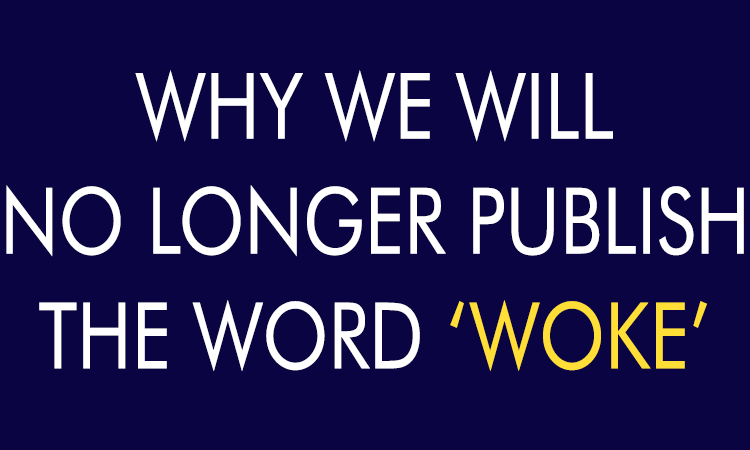
Why We Won’t Publish the Word ‘Woke.’

As of today, the Mallard is no longer publishing articles that include the word ‘woke’, in either print or online. 

Too many submissions, not just to the Mallard, but other publications – have become reliant on this word to explain away current trends that people find unappealing, yet cannot articulate why beyond anything other than this word. It is the responsibility of all outlets to contribute to the public discourse, and when a word, concept, idea, or individual, fails to contribute to the discourse – they have to be removed.

When pundits of the right use ‘woke’, they are using a word spawned by the online Left to denote their being ‘awake’ to the ‘injustices’ of the world, which are usually spawned from an ideological conviction rather than an actual understanding of the complex issues of the world. It suggests these people – the ‘woke’ left – are awake to the things that we are not, as if they have some deep insight that surpasses the average person. It is simply the latest expression of ‘real consciousness’ derived from Marxism.

Of course, we all know that the word is used sarcastically – but to use it at all is to make the eternal mistake of the Right, and to fight the Left on their own terms. We have been making this mistake for seventy years, and to reverse this trend, we need to stop appealing to their language, their values, their goals. 

But even when the word is used derisively, it adds virtually nothing. Issues around pronouns and bathrooms pale in comparison to the economic, cultural, and demographic changes brought about by the respective trends of globalism, liberalism, and immigration. There is nothing substantively different in the current cultural trends than in the previous cultural trends. What is happening today should not be described with a new word, because what is happening today is not new. That is the reality of where we are now – ‘woke’ is not sufficiently different from what came before it to really merit a separate topic of discussion. It is just an extension of the logic of the sexual revolution, the Civil Rights era, and the great liberalisation of the last sixty years.

One of our assistant editors, William Yarwood, last year recorded a short podcast begging us to stop calling groups like Antifa ‘fascists’ or the Left ‘the real racists’, and recognise that they are just communists. Stop calling the Left ‘woke’ as shorthand for a broad range of things you just ‘don’t like’. 

It is useless to say ‘look, I agree with what they stand for, I just don’t like how they’re going about it’. Then your disagreement is technical, it is not fundamental, so really you’re just the ones putting the brakes on their movement. They will come for you eventually, so you might as well recognise that now. 

Calling something ‘woke’ is a lazy caricature that lets (what passes for) the right wing commentariat get away with murder; the liberals of yesteryear are allowed to displace conservative voices in media, politics,  and culture. They pretend, in their sarcastic overtones, that leftists are weak and hypersensitive, when in reality they want to put children on hormone blockers, let men into womens’ changing rooms, open our borders to people who hate us, and teach the next generation that they have nothing to gain from the civilisation that birthed them. 

These individuals are not weak. These people are not hypersensitive. Instead, they pass laws to put people in prison if they so much as joke about them. The notion these people are weak is a reflection of decades of failure of conservatives to actually do anything about them. If these individuals were weak, they would not find it so easy to break down the barriers that protect the most vulnerable in society: women and children.

These are not just simple activists, by the way. They are in our institutions, running our universities, pioneering our civil service, ‘decolonising’ our curricula, all the while entrenching their culture by building parallel careers that have no real world purpose or function. The massive, tumorous growth of the ‘human resources’ machine has seen to it that busy body unemployable humanities graduates have a reason to exist once more, only now it is self-perpetuating cancer that simultaneously cannot abide the existence of leftist heresy whilst relying on it like a parasite.

And as we see continuously, the online right is just as bad. If there are necessary discussions about poverty, living crises, genuine injustices that actually harm peoples’ lives, the right shrieks ‘woke!’ in such a hypersensitive way that the actual discussion disappears behind parody and caricature. TalkRadio’s infamous Mike Graham recently told an Extinction Rebellion member that we can ‘grow concrete’ in an effort to ‘own the lib’ – to which the XR member, who is stupid for different reasons, was left speechless. By consequence, Mike Graham made XR look reasonable – an own-goal, if ever there was one. 

When war broke out in Ukraine, it was necessary for the right to attempt to make sense of it. This was done well in some circles – with people drawing attention to the Realist school Regardless of your thoughts on the Realist school, it was undoubtedly an intellectual contribution to the discourse. If you looked at the mainstream discourse however, you would know nothing of this contribution. Instead, it became another flashpoint to discuss this word, those they associate with it, and how these people were ‘weak’, ‘hypersensitive’ and made it so we were incapable of fighting a war against Putin.

It couldn’t possibly be that nuclear war is a possibility, or even – as the neoconservative lobby implicitly recognises but refuses to admit – that we have nothing to gain from getting involved in the war. No, it must be the woke. We end up in some perverse eternal Spy vs Spy scenario, where ‘woke warriors’ seek out racism/sexism/whateverism in any place they can find it, while the ‘common sense rightists’  only try to define what they consider ‘woke’ to make it work, rather than criticise it on its own grounds.

So we are not publishing the word any longer. Here is a list of publications that are likely interested: The Sun; TalkRadio; The Critic; Compact; Breitbart; GB News. I am sure they will find your work fascinating. We won’t. 
Post-liberal politics and why we should reaffirm a uniquely British way of life

Post-Liberalism is a term that is often used in our discourse with far-reaching implications for the future of British politics. It refers to a vision of society opposed to Francis Fukuyama’s claim of the ‘End of History’, and the inexorable expansion of liberalism. A post-liberal society is therefore one where liberal ideas such as individual freedom and treating people with equal respect, as well as government and juridical neutrality, are left behind. The decline of such principles has clear risks for the nature and quality of political discourse, such as occurred in the vituperative nature of interactions between some ‘Remainers’ and ‘Brexiteers’ post- 2016 referendum.

Political polarisation is, however, most noticeable in the formation of the woke left and the populist right, which have filled the vacuum left by the weakening of liberalism in Britain. How can Britain avoid a dichotomous post-liberal future? I argue that an important alternative is still available, one that entails a reaffirmation of the British way of life guided by the institutions, values, traditions and history that have made Britain a free society.

The first ideological force seeking to divide Britain is ‘wokeism,’ a neologism that has come to the forefront of political debate during the past decade. The woke left in Britain aims to create a moral identity for Britons, predicated on specific characteristics such as race, gender and sexuality. The widespread application of this ideological force would render the individual almost servile to woke culture.

Thus, individuals are told to think, say and write only narratives that are branded as ‘correct’. The latest example was the hounding out of Kathleen Stock from the University of Sussex for having ‘incorrect’ views about gender. This shows that wokeness seeks to paint British values such as free expression as something wholly ‘bad’. Such a reductionist approach totally neglects the positive, inclusive and forward-looking nature of much of British society.

         Furthermore, wokeism also led to a rise of the second divisive trend in post-liberal politics – the ascension of the p and social coopulist right. Populism is a stance and rhetoric of politics that claims to speak for the silent majority or ‘the common person’ against the liberal, and increasingly ‘woke’ establishment. Right-wing populism builds on these themes by leaning on rhetoric and policies that foreground at least one of the following: economic nationalism, ethnic nationalism, and conservatism. Through these, right-wing populists claim to give voice to the people neglected by the modern liberal society. Giving voice to the people has amounted to unrestrained authoritarianism, with the populist right presenting itself as the messianic solution to all the problems of society. 

         Although the woke left and the populist right have different political objectives, they possess remarkable similarities. Namely, both see the ballot box as the sole legitimiser of their actions, and their populist rhetoric constructs a battle between ‘oppressors’, the establishment, and the ‘oppressed’ masses. Finally, both seek to hijack the power of the state in order to achieve their political aims, in the name of some intangible promise of a better future, for specific social groupings, whether that is specific ethnic minorities or the white working classes. These political aims are summed up in slogans such as “Black Lives Matter” and “Take Back Control”. Consequently, post-liberal Britain is presented with ideological forces which seek to undermine the very freedoms that have made this country great.

         In this reality of two ideological extremes, we must pursue ‘a middle way’. This approach is called the British way of life, centred on the moral life of the individual. This moral life is demonstrated through the ability of individuals to choose and act in accordance with often unwritten norms and traditions. This helps to mitigate the effects of cumbersome bureaucracy as symbolised by Whitehall and Holyrood, which squeeze the freedoms, lifestyles and preferences of the individual. The British way of life should, therefore, centre on a view of freedom, where individuals have the autonomous power to choose their own conception of the good life. However, this view does not mean advocacy for a licentious free-for-all society. The moral life requires individuals to appeal to social institutions such as the community, religion, and the family. Only this approach to politics will be able to temper the excesses of wokeism and right-wing populism.

In short, the British way of life centres on the importance of choice, rights and duties, fundamental to a free society. This nurtures a healthy society, where people’s individuality is shaped by our community, values, history, traditions, and their own choices. Therefore, Britain should be fearful of attempts to change our religious, historical, habitual practices in favour of ideological preferences over the role of the state, speech, statues etc…

To conclude, wokeism and right-wing populism seek the concentration and preservation of power they approve of, by either appealing to social justice and identity politics, or to populist rhetoric. In face of this, politics should affirm the moral identity of the individual. A uniquely British way of life, therefore, remains the best defence against the divisive forces of post-liberalism.


Picture Credit

Ojel L. Rodriguez Burgos is a Policy Fellow of The Pinsker Centre, a campus-based think tank which facilitates discussion on global affairs and free speech. The views in this article are the author’s own.

The Moment of Decision

In the throes of the culture wars, it’s easy to get acclimated to the situation after some time has passed. It feels like a lifetime ago that the battlefield that has become of the issue of transgenderism was little more than a few videos on YouTube imploring viewers to cringe at ‘Die Cis Scum’, and if anything demonstrates the futility of the adage ‘twitter is not real life’, it would be the recent admission from Jamie Wallis that he considers himself a woman.

There is almost certainly some kind of meaning to the fact that Jamie’s desire to be a woman emerged after he was raped, as though he psychologically associates a lack of autonomy to womanhood. But I am not a psychologist, and Jamie’s warped feelings about his identity are irrelevant in and of themselves. What this turn of events creates however, is a moment of Decision for the Conservatives.

For a long time, the Conservatives have enjoyed playing both sides of the culture wars. At conference, they can laud Maggie Thatcher as the first female Prime Minister and reap the benefits of appearing to be progressive – knowing that opposition can be quickly labelled sexist, and something that even the Conservative party has outgrown. Simultaneously, they can point to the Labour party and remind us of what happens if we abandon them. A few cringeworthy remarks about supporting women into politics is certainly a preferable alternative to those same “women in politics” sporting a five-o’clock shadow and suspiciously broad shoulders.

Governments, political parties, and states, like individuals, can hold simultaneously contradictory beliefs. Those who do not act are fortunate enough to never have to confront these contradictions – for they never implement them. But it is through existential participation in life that these contradictions make themselves plain, and a moment of Decision must occur. Constitutional monarchies justified themselves with recourse to the people – but what happens when the monarch and the people (or at least, the institutions representing the people) are at odds over a decision? Who decides? The logic of constitutional monarchy legitimises the king with recourse to the people, and so those institutions closer to the people in the mind of the populace ultimately set the laws. It’s these moments of Decision that move history – a constitutional monarchy may retain the state form of monarchy but rest atop the principle of democracy, but the moment of Decision reveals the incoherence of this state form and opens up a state of exception to alter it.

Equally, the Conservatives present themselves as being opposed to wokeism, but like the constitutional monarch – justify themselves on the principles of equality, and the moment of Decision reveals the incoherence of their rule. Whilst the party had no skin in the game, and whilst it had no existential participation, it could ignore the incoherence because it never actually had to make any decision based on these two contradictory principles. But the moment of Decision has arrived, and what is in store for us as members of the party?

Jamie Wallis has been supported by Boris and Oliver Dowden, the CEO of the party. It is clear the Conservatives have no intention of removing this person from the party or even coming close to asserting that transgenderism is in no way conservative. Jamie Wallis will most certainly be in attendance at Conference and all Conservative events in the future. The Conservative party will now have to decide:

  • How will it refer to Jamie, should he ask to be referred to by female pronouns?
  • What will they do if Jamie Wallis decides he wants to use the female bathrooms?
  • If they wish to affirm Jamie’s wishes, how will they then define what a woman is, since it clearly no longer conforms to a simple definition?

Once again, the failure of Conservatives to engage in philosophy rears its ugly head. When you don’t attempt to delve into your beliefs, when you rest everything on ‘Common Sense’, you actually rest your political order upon the principles of those who do wish to assert and articulate their beliefs. Then, when you inevitably go to implement your beliefs: you’re struck with the inability to implement them in accordance with the principles you’ve justified your beliefs on. It’s simply not enough to have a political philosophy which resolves political (read: economic, technical, bureaucratic, etc.) problems. Your political philosophy must blend, gel, mesh, and harmonise with your ontological beliefs about the very essence of what it means to be anything at all. The idea that culture, economics, and philosophy are distinct and separate spheres is an optical illusion brought about by extended periods of peace. Any of these things, driven to a sufficient extreme become political, and our only tool to navigate these new political realities is philosophy. Those who don’t use it will find themselves lost, both politically and spiritually.


Photo Credit.

Five Truths from Dostoevsky’s The Devils

Whenever I scroll through the news on Twitter or listen to talk radio, I like to play a game called “Dostoevsky called it.” As one can guess, it consists of identifying events or trends that correspond with those in Feodor Dostoevsky’s novels and letters. Because Dostoevsky devoted so much ink to warning about the motives and effects of atheist-utilitarian socialism from the radical left, the game often points to his most direct attack on those ideas: The Devils.

Published between 1871 and 1872 and written in response to the Nechaev affair, where an underground group of socialist-atheist radicals, planning to ultimately overthrow the Tsarist government through propaganda, terrorism, and assassination, murdered a former comrade who had left their secret society, The Devils (Бесы; also translated as Demons or The Possessed) is Feodor Dostoevsky’s most explicit expose of and polemic against the revolutionary nihilism growing in late nineteenth-century Russia. Although, due to his own participation in a socialist plot aimed at educating and ultimately liberating the serfs, he often gave the benefit of the doubt to the moral idealism of the younger generation of radicals—assuming their hearts, if not their methods, were in the right place—in The Devils he nonetheless skewers the radical ideology and his generation and the next’s culpability for it.

While his main focus is on the characters’ psychologies and their symbolic significance, Dostoevsky nonetheless lays out many of the ideas populating late-nineteenth-century Russia, displaying a thorough understanding of them, their holders’ true motives (which, like those of that other ideological murderer Raskalnikov, are rarely the same as those consciously stated by their loudest advocates), and what would be the results if they were not checked. In several places, Dostoevsky unfortunately calls it right, and The Devils at times reads as a preview of the following fifty years in Russia, as well as of the modes and methods of radicalism in later places and times.

It would be too great a task to cite, here, all the places and times where Dostoevsky’s visions were confirmed; at best, after laying out a few of the many truths in The Devils, I can only note basic parallels with later events and trends in Russia and elsewhere—and let my readers draw their own additional parallels. Nonetheless, here are five truths from Dostoevsky’s The Devils:

1: The superfluity of the preceding liberal generation to progressive radicals.

The Devils is structured around the relationship between the older and younger generations of the mid-1800s. The book opens with an introduction of Stepan Trofimovich Verkhovensky, father to the later introduced radical Peter Stepanovich. A Westernized liberal from the 1840s generation, Stepan Trofimovich represents the upper-class intelligentsia that first sought to enlighten the supposedly backwards Russia through atheistic socialism (a redundancy in Dostoevsky).

However, despite his previously elevated status as a liberal and lecturer, by the time of The Devils Stepan Trofimovich—and, with him, the 1840s liberals who expected to be honored for opening the door to progress—has become superfluous. This is highlighted when his son returns to the province and does not honor his father with figurative laurels (when such a symbol is later employed literally it is in satirical mock).

Though never the direct butt of Dostoevsky’s satire, Stepan Trofimovich cannot (or refuses) to understand that his son’s nihilism is not a distortion of his own generation’s hopes but is the logical, inevitable product of them. The older man’s refusal to admit his ideological progeny in his literal progeny’s beliefs, of course, enables Peter Stepanovich to mock him further, even while he continues to avail himself of the benefits of his father’s erstwhile status in society. This “liberal naivete enabling radical nihilism” schema can also be seen in the governor’s wife, Yulia Mikhailovna von Lembke, who believes that she can heroically redirect the passions of the youth to more socially beneficial, less radical, pursuits but only ends up enabling them to take over her literary fete to ridicule traditional society and distract the local worthies while agents set parts of the local town ablaze. Stepan Trofimovich, Yulia Mikhailovna, and others show that, despite the liberal generation’s supposed love for Russia, they were unable to brake the pendulum they sent swinging towards leftism.

The same pattern of liberals being ignored or discarded by the progressives they birthed can be seen in later years in Russia and other nations. While it would historically be two generations between Belinsky and Lenin (who was born within months of Dostoevsky’s starting to write The Devils), after the 1917 Revolution, Soviet Russia went through several cycles of executing or imprisoning previous generations who, despite supporting the Revolution, were unfortunately too close to the previous era to be trusted by new, socialistically purer generations.

In a more recent UK, Dostoevsky’s schema can also be seen in the Boomer-led Labour of the ‘90s and ‘00s UK paving the way for the radical, arguably anti-British progressivism of the 2010s and ‘20s (which, granted, sports its share of hip Boomers). In America, it can be seen in the soft divide in congressional Democrats between 20th-century liberals like Nancy Pelosi and Chuck Schumer and “the squad” comprised of Alexandria Ocasio-Cortez, Ilhan Omar, and others who have actively tried (and arguably succeeded) in pushing the nation’s discourse in a left progressive direction.

2: Ideologies as active, distorting forces rather than merely passive beliefs.

“I’ve never understood anything about your theory…” Peter Stepanovich tells the serene Aleksei Nilych Kirillov later in the book, “I also know you haven’t swallowed the idea—the idea’s swallowed you…” The idea he is referring to is Kirillov’s belief that by committing suicide not from despair or passion but by rational, egotistic intention, he can rid mankind of the fear of death (personified in the figure of God) and become the Christ of the new utilitarian atheism (really, Dostoevsky intends us to understand, not without pity for Kirillov, an antichrist thereof). The topic of suicide—rising in Russia at the time of the book’s writing and a result, Dostoevsky believed, of the weakening of social institutions and national morality by the subversive nihilism then spreading—is a motif through the book. Countering Chernyshevsky’s romanticized revolutionary Rakhmetov from What is to Be Done?, Kirillov is Dostoevsky’s depiction of the atheist rational egotism of the time taken to its fullest psychological extent. Like others he had and would later write (Raskalnikov, Ivan Karamazov), Kirillov is driven mad by an idea that “swallows” him in monomania and which he has admitted to being obsessed with—the idea of a world without God.

Though Dostoevsky considered it the central issue of his day (which still torments Western culture), my focus here is not on Kirillov’s idea, itself, but on his relation to it. Countering the Western Enlightenment conceit that ideas are mere tools to be rationally picked up and put down at will, Dostoevsky shows through Kirillov that ideas and ideology (ideas put in the place of religion) are active things that can overwhelm both conscious and unconscious mind. Indeed, the novel’s title and Epigraph—the story of Legion and the swine from Luke 8—already suggests this; for Dostoevsky, there is little difference between the demons that possessed the pigs and the ideas that drive characters like Kirillov to madness.

Of course, a realist-materialist reading of Kirillov’s end (I won’t spoil it, though it arguably undercuts his serenity throughout the book) and the later Ivan Karamazov’s encounter with a personified devil would contend that there was nothing literally demonic to the manifestations, but for Dostoevsky that matters little; for him, whose focus is always on how the individual lives and experiences life, being possessed by an ideology one cannot let go of and being in the grasp of literal demons is nearly synonymous—indeed, the former may be the modern manifestation of the latter, with the same results. In his work, such things almost always accompany a lowering of one’s humanity into the beastial.

The problem with ideology, Dostoevsky had discovered in Siberia, was in their limited conception of man. By cutting off all upper transcendent values as either religious superstition or upper class decadence, the new utilitarian atheism had removed an essential part of what it meant to be human. At best, humans were animals and could hope for no more than thus, and all higher aspirations were to be lowered to achieving present social goals of food, housing, and sex—which Dostoevsky saw, themselves, as impossible to effectively achieve without the Orthodox Church’s prescriptions for how to deal with suffering and a belief in afterlife. Of the lack of higher impressions that give life meaning, Dostoevsky saw two possible results: ever-increasingly perverse acts of the flesh, and ever-increasingly solipsistic devotion to a cause—both being grounded in and expressions not of liberation or selflessness, but of the deepest egotism (which was a frankly stated element of the times’ ideologies).

From this view, Dostoevsky would have seen today’s growing efforts to legitimate into the mainstream things like polyamory, abortion, and public displays of sexuality and increasingly aggressive advocacy by groups like Extinction Rebellion or NOW (he predicted both movements in his other writing) as both being attempts to supply the same religious impulse—which, due to their being cut off by their premises from the transcendent metaphysic required by the human creature and supplied by Christianity, &c, is a doomed attempt.

3: Seemingly virtuous revolution motivated by and covering for private vices.

By the time he wrote The Devils Dostoevsky had seen both inside and outside of the radical movement; he had also depicted in Notes from Underground and Crime and Punishment characters who discover, to their angst and horror, that their actions were not motivated by humanitarianism, but by envy, cravenness, and the subsequent desire for self-aggrandizement. The Devils features the same depth of psychology beneath the main characters’ stated ideas and goals, and the book often shows how said ideas cannot work when applied to real people and real life.

As the chronicle unfolds, characters often speak of the petty vices that undermine the purity of the revolutionaries’ stated virtues and goals. “Why is it,” the narrator recounts Stepan Trofimovich once asking him, “all these desperate socialists and communists are also so incredibly miserly, acquisitive, and proprietorial? In fact, the more socialist someone is…the stronger his proprietorial instinct.” So much for those who seek to abolish property; one can guess to whom they wish to redistribute it! The revolutionary-turned-conservative Ivan Shatov later continues the motif, digging deeper into the radicals’ motives: “They’d be the first to be terribly unhappy if somehow Russia were suddenly transformed, even according to their own ideas, and if it were suddenly to become immeasurably rich and happy. Then they’d have no one to hate, no one to despise, no one to mock! It’s all an enormous, animal hatred for Russia that’s eaten into their system.”

Leftists might accuse Dostoevsky of merely wishing to make the radicals look bad with such an evaluation; however, as addressed by Joseph Frank in his chapter on the topic in Dostoevsky: The Miraculous Years, 1865-1871, the “bad for thee, fine for me” mentality of The Devils’s radicals (if their ideology doesn’t completely blind them to such inconsistency in the first place) was straight from the playbook of men like Nechaev: the Catechism of a Revolutionary. Far from trying to evade contradictory behavior, such a work, and other later analogues (Marcuse’s “Repressive Tolerance”; Alinsky’s Rules for Radicals) advocate being inconsistent and slippery with one’s principles for the sake of the revolution. Indeed, contradicting the rules one was trying to impose on others was and is seen not as an inconsistency but as a special privilege—of which several examples can be found, from upper party opulence in the USSR to modern champagne socialists who attend a $35,000-per-seat Met Gala while advocating taxing the rich.

4: Social chaos and purges as necessary and inevitable in achieving and maintaining utopia.

Perhaps the single most prophetic scene in The Devils occurs in the already mentioned chapter “‘Our Group’ Meets,” which depicts the various local radicals meeting under cover of a birthday party. A cacophony of competing voices and priorities, the scene’s humorous mix of inept, self-serving idealists is made grotesque by the visions they advocate. Most elaborate of the speakers is Shigalyov, whose utopian scheme for the revolution was insightful enough that Boris Pasternak and Alexander Solzhenitsyn both referred to the Russian government’s post-October Revolution policies and methods as “Shigalevism.” 

While Shigalyov’s whole speech (and Peter Stepanovich’s commentary) is worth reading as a prophecy of what would happen less than fifty years after the book, here are some notable excerpts:

“Beginning with the idea of unlimited freedom, I end with unlimited despotism…One-tenth will receive personal freedom and unlimited power over the other nine-tenths. The latter must forfeit their individuality and become as it were a herd [through re-education of entire generations]; through boundless obedience, they will attain, by a series of rebirths, a state of primeval innocence, although they’ll still have to work…What I’m proposing is not disgusting; it’s paradise, paradise on earth—there can be none other on earth.”

A direct goal of the purges in Soviet Russia, and of the alienation of children from their parents, was to create a new, purely socialist generation unburdened by the prejudices of previous or outside systems.

“[We’ve] been urged to close ranks and even form groups for the sole purposed of bringing about total destruction, on the pretext that however much you try to cure the world, you won’t be able to do so entirely, but if you take radical steps and cut off one hundred million heads, thus easing the burden, it’ll be much easier to leap over the ditch. It’s a splendid idea…”

While hundred million murders may seem like hyperbole in the scene’s darkly comic context, in the end it was an accurate prediction of what communism would accomplish if put into systemic practice; however, we should also not miss the stated method of destabilizing society via conspiratorial groups aimed not at aid but at acceleration—a method used in early 20th-century Russia and employed by modern radical groups like Antifa.

“It would take at least fifty years, well, thirty, to complete such a slaughter—inasmuch as people aren’t sheep, you know, and they won’t submit willingly.”

Besides the time element, the identifying of the individual human’s desire for life and autonomy as a lamentable but surmountable impediment to revolution—rather than a damning judgment of the radicals’ inability to make any humanitarian claims—is chilling.

“[Shigalyov] has a system for spying. Every member of the society spies on every other one and is obliged to inform. Everyone belongs to all the others and the others belong to each one. They’re all slaves and equal in their slavery.”

A corrollary to the section above on freedom-through-slavery, this part accurately identifies the system of paranoid watchfulness in the first half of the USSR, as well as the system currently in place in the DPRK, among other places.

“The one thing the world needs is obedience. The desire for education is an aristocratic idea. As soon as a man experiences love or has a family, he wants private property. We’ll destroy that want: we’ll unleash drunkenness, slander, denunciantion; we’ll unleash unheard-of corruption… [Crime] is no longer insanity, but some kind of common sense, almost an obligation, at least a noble protest.”

Anti-traditional-family advocacy and the flipping of the criminal-innocent dichotomy as a means of destabilizing the status quo all took place in the early years of the Soviet Union. Unfortunately, they are all too familiar today in the West, whether we’re talking about the current argument in the US that children’s education belongs to the community (i.e. teachers, public unions, and the government) to the exclusion of parents, or the argument heard at several points in the 2020 that crimes and rioting committed during protests were an excusable, even “noble,” form of making one’s voice heard (while nicking a TV in the process!).

More recently and ongoing here in California (often uncannily parallel to the UK in certain policy impulses), our current District Attorney George Gascon, in an attempt to redefine the criminal-victim mentality in the state, has implemented policies that benefit criminals over victims by relaxing the definitions and sentences of certain crimes and refusing to try teenagers who commit felonies as adults (among other things); as many expected would happen, crime has risen in the state, with the Los Angeles PD recently advising residents to avoid wearing jewelry in public—which, to this resident, sounds oddly close to blaming the victim for wearing a short skirt by another name, and is certainly a symptom and example of anarcho-tyranny.

To nineteenth-century readers not as versed as Dostoevsky in the literature and ideas behind the Nechaev affair (which was publicly seen as merely a murder among friends, without the ideological significance Dostoevsky gave it), this section of The Devils would have seemed a comic exaggeration. However, to post-20th-century readers it stands, like a clarion pointing forward to the events later confirmed by Solzhenitsyn, as a dire warning not to forget the truth in the satire and not to dismiss the foolishly hyperbolic as impotent. Even in isolated forms, the ideas promoted by Shigalyev are real, and when applied they have been, as Dostoevsky predicted, disastrous.

5: Socialism not as humanitarian reason, but as religious poetry; revolution as primarily aesthetic, not economic.

An amalgam of, among other members of the 1840s generation, the father of Russian socialism Alexander Herzen, Stepan Trofimovich is, by the time of the 1860s setting of The Devils, an inveterate poet. This reflects Dostoevsky’s evaluation of his old theorist friend, whom he nonetheless cites as the enabler of men like the nihilist terrorist Nechaev, despite Herzen’s claims that the terrorist had bastardized his ideas (see truth number 1, above).

The brilliantly mixed critique of and homage to Dostoevsky’s own generation that is Stepan Trofimovich presents one of the book’s main motifs about the nihilist generation: that they are not pursuing a philosophically rational system of humanitarian goals, but a romantically poetic pseudo-religion. “They’re all bewitched,” cries Stepan Trofimovich about his son, “not by realism, but by the emotional and idealistic aspects of socialism, so to speak, by its religious overtones, its poetry.” Later, at the aforementioned pivotal meeting scene, Peter Stepanovich shows he is completely conscious of this fact—and willing to use it to his advantage. “What’s happening here is the replacement of the old religion by a new one; that’s why so many soldiers are needed—it’s a large undertaking.” In the next scene, Peter Stepanovich reveals to Stavrogin his desire to use the enchanting nobleman as a figurehead for revolution among the peasantry, intending to call him Ivan the Tsarevich to play off of the Russian folk legend of a messianic Tsar in hiding who will rise to take the throne from the “false” reigning Tsar and right all the world’s wrongs with his combined religious and political power.

Peter Stepanovich, himself, is too frank a nihilist to believe in such narratives; focused as he is on first destroying everything rather than wasting time pontificating about what to do afterwards, he even treats Shigalyov’s utopian visions with contempt. However, the rest of the radicals in the book are not so clear-sighted about the nature of their beliefs. Multiple times in the book, susceptibility to radical socialism is said to inhere not in reason but in sentimentality; showing Dostoevsky’s moderation even on a topic of which he was so passionately against, this critique often focuses on younger men and women’s genuine desire to good—which ironically makes them, like the naive and forthright Ensign Erkel, susceptible to committing the worst crimes with a straight, morally self-confident face.

It is this susceptibility to the art of revolution that causes Peter Stepanovich to be so sanguine about others’ romanticism, despite its falling short of his own nihilism. His intention to use others’ art for his own advantage can be seen most clearly in his hijacking of Yulia Mikhailovna’s  literary fete to use it, through his cronies, as a screed against the social order and to mock artistic tradition. His doing so is just a follow-through of an earlier statement to Stavrogin that “Those with higher abilities…have always done more harm than good; they’ll either be banished or executed. Cicero’s tongue will be cut out, Copernicus’s eyes will be gouged out, Shakespeare will be stoned…it’s a fine idea to level mountains—there’s nothing ridiculous in that…we’ll suffocate every genius in its infancy.”

Against his son’s leveling of mountains, Stepan Trofimovich, to his infinite credit and speaking with his author’s mouth, declares, with the lone voice of tradition amidst the climactic fete, that “Shakespeare and Raphael are more important than the emancipation of the serfs…than nationalism…than socialism…than the younger generation…than chemistry, almost more important than humanity, because they are the fruit, the genuine fruit of humanity, and perhaps the most important fruit there is!” In this contrast between the Verkhovenskys, it is not different views on economics but on art—on Shakespeare, among others—that that lie at the heart of revolution, with the revolutionaries opposing the English Poet more viscerally than any other figure. This reflects Dostoevsky’s understanding that the monumental cultural shift of the 1800s was not primarily scientific but aesthetic (a topic too large to address here). Suffice it to say, the central conflict of The Devils is not between capitalists and socialists (the book rarely touches on economic issues, apart from their being used as propaganda—that is, aesthetically), nor between Orthodox and atheists (though Dostoevsky certainly saw that as the fundamental alternative at play), but between the 1840s late Romantics and the new Naturalist-Realists.

The prophetic nature of this aesthetic aspect of The Devils has many later confirmations, such as the 20th century’s growth of state propaganda, especially in socialistic states like Nazi Germany or the USSR, though also in the West (Western postmodernism would eventually make all art as interpretable as propaganda). Furthermore, the Stalinist cult of personality seems a direct carry over of Peter Stepanovich’s intended desire to form just such a pseudo-religious cult out of Nikolai Vsevolodovich.

Having written a novel on the threat posed to Shakespeare by the newest generation of the radical left (before reading of Verkhovensky’s desire to stone Shakespeare—imagine my surprise to find that Dostoevsky had called even the events in my own novel!), I hold this particular topic close to my heart. Indeed, I believe we are still in the Romantic-Realist crossroads, and in dire need of backtracking to take the other path that would prefer, to paraphrase Stepan Trofimovich, the beautiful and ennobling Shakespeare and Raphael over the socially useful pair of boots and petroleum. Like Stepan Trofimovich, I believe comforts and technical advancements like the latter could not have come about were it not for the culture of the former—and that they would lose their value were their relative importance confused to the detriment of that which is higher.

Conclusion

There are, of course, many other truths in The Devils that have borne out (the infighting of radical advocacy groups competing for prominence, radicalism as a result of upper-class boredom and idleness, revolution’s being affected not by a majority but a loud minority willing to transgress, self-important administrators and bureaucrats as enablers and legitimators of radicals…). While the increasingly chaotic narrative (meant to mimic the setting’s growing unrest) is not Dostoevsky’s most approachable work, The Devils is certainly one of his best, and it fulfills his intended purpose of showing, like Tolstoy had done a few years before in War and Peace, a full picture of Russian society.However, while Tolstoy’s work looked backward to a Russia that, from Dostoevsky’s view, had been played out, The Devils was written to look forward, and, more often for ill than good, it has been right in its predictions. Not for nothing did Albert Camus, who would later adapt The Devils for the stage, say on hearing about the Stalinist purges in Soviet Russia that “The real 19th-century prophet was Dostoevsky, not Karl Marx.”


Photo Credit.

Audubon’s Legacy of Birds and Tomfoolery

For someone who has anger issues, entering the Audubon’s The Birds of America exhibition was like entering a whole new world. Upon the entry, I saw giant screens showing details from Audubon’s work and I could hear quiet bird noises in the background. It was an incredibly calming experience, as much as one can consider stuffed birds and plates depicting birds massacring another bird calming. Naturally, this wasn’t the centre of the exhibition – it truly celebrated the skill and the creativity of the bird illustrator with a passion for nature.

The exhibition is running in the National Scottish Museum in Edinburgh from the 12th of February to the 8th of May of this year. It displays over 40 plates, each measuring almost one metre in height. Most of them have never actually been shown to the public before. It is split into 4 sections, each of them with its own theme – the first one, ‘Meet the Birds of America’ introduces the ‘world’s most expensive book’ and Audubon, in general.

John James Audubon was a 19th-century ornithologist and naturalist. He made a point of studying and cataloguing the birds he encountered in their natural habitats. A son of a sugarcane plantation owner and a chambermaid, he must have had a conflicted childhood. Audubon moved to the US to avoid participation in the Napoleonic Wars – and focused on birds instead. 

The second section of the exhibition titled ‘An Art and a Science’ examines the influence of other illustrators on Audubon as well as the scientific, or sometimes quasi-scientific context. With the Industrial Revolution clashing with the Romantic movement, the transcendental search for nature was at its peak. The illustrations at the time were generally quite dull due to drawing from taxidermy and lifeless study skins.

Audubon, however, made a point of painting directly from wildlife, by personally hunting the birds and sometimes getting others to hunt for him. He would then paint the birds he gathered by pinning them into lifelike poses observed in the wild. This resulted in his art being vivid and life-like. He didn’t want to paint the taxidermied birds as he felt this would take away their lively spark from them. He was known for sometimes romanticising the birds he saw in the wild, for example when painting the Mocking Bird, in which a rattlesnake attacks birds in a bush, where it would be impossible for a rattlesnake to do so. Audubon would also sometimes add more human behaviours to the birds to allow the audience to relate to the birds. He was sometimes accused of not exactly presenting the truth.

The third part of the exhibition called ‘Audubon in Edinburgh’ explores the role of Scottish intelligentsia in ensuring that Audubon was embraced by the art society, after his rejection by the scientific community in Philadelphia. He befriended William Home Lizars and started engraving. Edinburgh was central to Audubon’s beginnings as a bird illustrator, making it extremely relatable to the Scottish audience, and it became somewhat a privilege to live in the same city where Audubon once found inspiration and was embraced by the art world.

The fourth section called ‘The Great Work: The Making of a Masterpiece’ deals with technical and artistic achievements. There are short films available for those whose attention span is longer than mine. However, this section also shows the bound edition of Birds of America which is extremely large (100 x 130 cm when open). Audubon insisted that the illustrations would show the birds life-size. Only two paper mills in the UK were capable of printing these, as he used a double elephant folio which is 96 x 66 cm. For those who are capable to rotate shapes in their head, this number will probably mean a lot.

The fifth section ‘Naturalist or Showman’ focuses on his contribution to discovering new species. Audubon identified 25 new species. This part of the exhibition explores some of the ‘controversies’, for example, Audubon was known for his strong belief in phrenology, the science which is now deemed ‘pseudoscience’ by some. Phrenology suggests that one can find details about someone’s personality from their skull shape. Seeing what kind of person he was, he probably used phrenology to mock his rivals. He was often accused of plagiarism and scientific fraud due to misidentifying some species and fabricating scientific data. Sometimes he invented new species to impress people who might then buy his work. Reportedly, he even stole the specimen of Harris’s hawk from his subscriber to then pretend he never knew him. He also lied in his own autobiography.

The sixth and final section of the exhibition ‘Birds of the World’ considers the impact of the modern era on the preservation and extinction of many birds. Some, such as the Carolina parakeet is entirely extinct – they used to always flock in large groups which made it easier for the hunters to kill them. They’ve also been considered a pest by farmers, which contributed to their demise. The exhibition ends on a thoughtful note, advising us to consider the repercussions of human behaviour on the natural world.

This prompted many conversations, such as the possibility to clone the extinct animals using their DNA tissue, however, so far, this was only tried with Pyrenean Ibex in 2003, but this one died not long after from lung defects. It might be a way forward in the future though.

The exhibition was a visual feast for the eyes and the birds are engraved and painted beautifully. The sheer skill of Audubon’s art is undeniable, and it trumps any accusations he received. He may not have been rigidly adhering to the scientific advice, but he created something that’s still worth looking at. Audubon inspired George Bird Grinnell to create the National Audubon Society in 1905 (although the idea goes back as far as 1895 when the first Audubon Society was created). The organisation protects the birds and their habitats in the Americas. If you like birds, you can donate here.

Audubon’s exhibition included a wealth of important items, including some study skins of birds and many taxidermized birds as well as his diaries, plates, and his hunting double-barrelled rifle. The exhibition is beautiful, thoughtful and certainly fascinating. For anyone who craves the return to transcendentalism and ancient values – it’s a feast for their eyes. If you fancy a trip to Edinburgh before the end of the exhibition on the 8th of May – make a point of stopping by at the National Scottish Museum to look at some birds, I strongly recommend it.

Photo Credit.

The Family Sex Show: Grooming Comes to Britain

I knew Bristol was liberal; the city is famous for it. Me? I have traditional values, I am involved with the Conservative party, and I have been a Christian my whole life. But when I got an unconditional offer to study a course at the University of Bristol which ranked third in that subject, I accepted it without hesitation. Nine months into living here and I have seen advertisements for climate-crisis bake sales, intersectional feminist poetry slams, and students “occupying” the Wills Memorial Building (and subsequently whinging that their vegan Deliveroo wasn’t able to reach them) in solidarity with striking lecturers. However, having nonchalantly followed Bristol’s Tobacco Factory Theatres on Twitter to see if any shows piqued my interest, I saw something that one couldn’t just dismiss as liberal lefty nonsense – this was something truly horrifying.

Tobacco Factory Theatres retweets ThisEgg (a theatre company) promoting their new show, The Family Sex Show (also promoted by The Guardian) The title is possibly alluding to incest, to Red Light District sex shows, and is definitely intended to shock. Already feeling slightly disturbed, I read on. The age recommendation is 5+ and the show description reveals it is intended as “an alternative to porn”. I read on to learn that “there is nakedness, yes. At one point in the show, everyone on stage takes their clothes off…” This is ringing every alarm bell possible.

Posing as “sex education”, the adults involved (who were hastily cast via Twitter only a month ago) don’t seem to know the first thing about safe, age-appropriate sex education. What five-year-old needs an alternative to pornography? Exposure to pornography is often used as a desensitising tactic when grooming children. In defence of this horror show, the website claims that “sexual development and behaviour in children starts from birth”. This is an argument which I have only previously heard from a documentary about PIE (Paedophile Information Exchange) to justify removing the age of consent.

Speaking of consent, which this show claims to teach us all about, I have to question why the “actors” get to choose their level of comfort when stripping. A five-year-old child, however, cannot consent to seeing naked strangers. The only guidance for parents is that they can leave if they feel uncomfortable, yet the theatre manager has written extensively on how the actors will be supported if there was negative feedback. How, I ask, are the “actors” the victims in this situation? This show seems to be all about what the adults want to do in front of the children, convinced that they know best. Cyber-flashing has just become a crime, and yet the cast of The Family Sex Show feel it is their right to flash infant-school-aged children. Many Twitter commenters reminisced over days when “dirty flashers” would be chased off by police. Now, liberal parents pay them ten pounds a ticket to bare all on stage. These people do not deserve to be parents.

My sex education at school took place in Year Six. We were ten and eleven years old and were taught about sex and puberty in an age-appropriate, sensitive, non-embarrassing way. The teachers, surprisingly, didn’t find it necessary to strip naked and point to their genitals to get the message across. Most of my generation will have had a similar experience and don’t feel we have gaps in our knowledge. Of course, we have all witnessed the odd person getting changed at the beach rather indiscreetly – but this is contextual, and hopefully accidental. If children are taught that it is normal for strangers to want to show their genitals to them, then this completely undermines the preventative measures that parents, and trusted adults, take against grooming. And as for the argument that “children will encounter porn anyway, so why not teach them about it now?” I worked in Early Years education for four years and I didn’t meet a single five-year-old who could read, write or type well enough to access pornography. And if parents leave it accessible to children, someone needs to call CPS.

I am just thankful that the live show and tour was all suspended during the multiple lockdowns, or we could be two years into child-traumatising theatrical sex shows. The Twitter outrage has been huge, and the account, Libs of TikTok, made famous by Joe Rogan’s podcast, shared the story, at my request, to an audience of 591.3k angry followers. We also have riled up over 800 Bristolian mothers on Mumsnet who have taken this story to the Daily Mail, started a petition, and are boycotting the theatre. Grown adults are being paid to strip in front of little children, in UK theatres, funded by the National Lottery and Arts Council England. Bristol’s Tobacco Factory Theatres want your money! In return, you and your five-year-old can watch simulated sex acts followed by a stage full of strange adults exposing their genitals. I have never been more horrified.


Photo Credit.

Why We Won’t Publish the Word ‘Woke’

As of today, the Mallard is no longer publishing articles that include the word ‘woke’, in either print or online. 

Too many submissions, not just to the Mallard, but other publications – have become reliant on this word to explain away current trends that people find unappealing, yet cannot articulate why beyond anything other than this word. It is the responsibility of all outlets to contribute to the public discourse, and when a word, concept, idea, or individual, fails to contribute to the discourse – they have to be removed.

When pundits of the right use ‘woke’, they are using a word spawned by the online Left to denote their being ‘awake’ to the ‘injustices’ of the world, which are usually spawned from an ideological conviction rather than an actual understanding of the complex issues of the world. It suggests these people – the ‘woke’ left – are awake to the things that we are not, as if they have some deep insight that surpasses the average person. It is simply the latest expression of ‘real consciousness’ derived from Marxism.

Of course, we all know that the word is used sarcastically – but to use it at all is to make the eternal mistake of the Right, and to fight the Left on their own terms. We have been making this mistake for seventy years, and to reverse this trend, we need to stop appealing to their language, their values, their goals. 

But even when the word is used derisively, it adds virtually nothing. Issues around pronouns and bathrooms pale in comparison to the economic, cultural, and demographic changes brought about by the respective trends of globalism, liberalism, and immigration. There is nothing substantively different in the current cultural trends than in the previous cultural trends. What is happening today should not be described with a new word, because what is happening today is not new. That is the reality of where we are now – ‘woke’ is not sufficiently different from what came before it to really merit a separate topic of discussion. It is just an extension of the logic of the sexual revolution, the Civil Rights era, and the great liberalisation of the last sixty years.

One of our assistant editors, William Yarwood, last year recorded a short podcast begging us to stop calling groups like Antifa ‘fascists’ or the Left ‘the real racists’, and recognise that they are just communists. Stop calling the Left ‘woke’ as shorthand for a broad range of things you just ‘don’t like’. 

It is useless to say ‘look, I agree with what they stand for, I just don’t like how they’re going about it’. Then your disagreement is technical, it is not fundamental, so really you’re just the ones putting the brakes on their movement. They will come for you eventually, so you might as well recognise that now. 

Calling something ‘woke’ is a lazy caricature that lets (what passes for) the right wing commentariat get away with murder; the liberals of yesteryear are allowed to displace conservative voices in media, politics,  and culture. They pretend, in their sarcastic overtones, that leftists are weak and hypersensitive, when in reality they want to put children on hormone blockers, let men into womens’ changing rooms, open our borders to people who hate us, and teach the next generation that they have nothing to gain from the civilisation that birthed them. 

These individuals are not weak. These people are not hypersensitive. Instead, they pass laws to put people in prison if they so much as joke about them. The notion these people are weak is a reflection of decades of failure of conservatives to actually do anything about them. If these individuals were weak, they would not find it so easy to break down the barriers that protect the most vulnerable in society: women and children.

These are not just simple activists, by the way. They are in our institutions, running our universities, pioneering our civil service, ‘decolonising’ our curricula, all the while entrenching their culture by building parallel careers that have no real world purpose or function. The massive, tumorous growth of the ‘human resources’ machine has seen to it that busy body unemployable humanities graduates have a reason to exist once more, only now it is self-perpetuating cancer that simultaneously cannot abide the existence of leftist heresy whilst relying on it like a parasite.

And as we see continuously, the online right is just as bad. If there are necessary discussions about poverty, living crises, genuine injustices that actually harm peoples’ lives, the right shrieks ‘woke!’ in such a hypersensitive way that the actual discussion disappears behind parody and caricature. TalkRadio’s infamous Mike Graham recently told an Extinction Rebellion member that we can ‘grow concrete’ in an effort to ‘own the lib’ – to which the XR member, who is stupid for different reasons, was left speechless. By consequence, Mike Graham made XR look reasonable – an own-goal, if ever there was one. 

When war broke out in Ukraine, it was necessary for the right to attempt to make sense of it. This was done well in some circles – with people drawing attention to the Realist school Regardless of your thoughts on the Realist school, it was undoubtedly an intellectual contribution to the discourse. If you looked at the mainstream discourse however, you would know nothing of this contribution. Instead, it became another flashpoint to discuss this word, those they associate with it, and how these people were ‘weak’, ‘hypersensitive’ and made it so we were incapable of fighting a war against Putin.

It couldn’t possibly be that nuclear war is a possibility, or even – as the neoconservative lobby implicitly recognises but refuses to admit – that we have nothing to gain from getting involved in the war. No, it must be the woke. We end up in some perverse eternal Spy vs Spy scenario, where ‘woke warriors’ seek out racism/sexism/whateverism in any place they can find it, while the ‘common sense rightists’  only try to define what they consider ‘woke’ to make it work, rather than criticise it on its own grounds.

So we are not publishing the word any longer. Here is a list of publications that are likely interested: The Sun; TalkRadio; The Critic; Compact; Breitbart; GB News. I am sure they will find your work fascinating. We won’t. 


Photo Credit.

Little Dark Age and Murdering the Author

Roland Barthes’ essay Death of the Author is required reading for many students who wish to study the humanities, such as English Literature. The general thesis of the essay is that narrative intent from the author cannot be discovered as it is impossible to know what the author’s thoughts were at the time of writing. Thus, Death of the Author can be understood to mean “art without the artist” – by the reader is the only true reading. The authority of the author, and therefore the author himself, perishes.

It is an interesting and incredibly influential essay that has played a large part in the development of critical theory over the course of the 20th century. Using this as a basis, it is my belief that we can take the theory further.

Rather than experience the art in a passive way, accepting what the author produces as is, and making our own interpretations from that point, I propose that we instead take an active participation in taking art from the artist and use it to our own ends. This is much easier to do thanks to the internet, and the emergence of meme culture.

It is from meme culture that murdering the author rises. 2016 can be seen as the black swan moment for this with the election of Donald Trump and the reignition of right-wing populism. In this moment, a new breed of meme was born, and it is one of these memes that I think best exemplifies how effective murdering the author can be.

In 2017 MGMT released their song “Little Dark Age”, a protest song lamenting the election of Trump. As the title suggests, the zeitgeist as the artist saw it was regressing back into a period of ignorance, ultimately taking the past 70 years of Progress with it. As recent as 2021 however, the meme remixes of this song have become increasingly popular. The song is used as a backdrop over footage designed to ignite reactionary pride – praise of Christianity and the heroic spirit are commonplace within this. My personal favourites are the ones that glorify the British Empire.

The popularity of the meme is an example of the remix culture unique to the internet, an issue with 21st century creations in general. 21st century art is stunted, and we can only find creative outlets in what has come before. This is a problem with all art and culture in the West, but has been commented on before so I will not belabour the point, except to say that our obsession with nostalgia seems to have left us bereft of creating our own cultural milieu and we are forced to stand blindly on the shoulders of giants.

We are indeed in a little dark age, and MGMT clearly felt that. It just isn’t the dark age they think it is. For a generation of people brought up in countries whose hour of greatness was over, and on whom all the world’s ills could be blamed, it is little surprise that a song like Little Dark Age could be used in the way it did. With lyrics like “Forgiving who you are for what you stand to gain/Just know that if you hide it doesn’t go away”, the song seems to be calling out to those who are trodden on by the current regime, such as political dissidents, delivering the Evolian message of riding the tiger. In the remix culture that epitomises internet trends, this is an example of destroying the meaning of a talented, well intended but misinformed artist and rewiring it for a different purpose.

No matter how MGMT feels about the current political and cultural climate, the fact remains that Little Dark Age is reactionary. It speaks of cultural degradation, inauthenticity – the sense of something being lost. MGMT have put their finger on the pulse, and their diagnosis seems apt – but the wrong patient has died.

Their anger is correct but misdirected, which is why we on the right see the song as something to be hijacked. We are not witnessing the death of the author here – instead, we are the author’s murderers. We are Lenin storming the Tsar’s palace in 1917. We take what is theirs and subvert it to our own ends.

The fact is that reactionary media, be it music, film, literature or television, is entirely hegemonic to the left’s favour. Reactionary discourse is repeatedly shut out of the Overton window, which is panned by boomeresque false idols on one side and comical Marxist villains on the other. In order to make a point, we must use the tools of the enemy. We must be the Vietcong stealing M16s from a US military base. We take from the author what is theirs, deconstruct their arms and create something entirely new using the skeleton of their works.

We are the murderers of the author and this is our strongest weapon.


Photo Credit.

Book Review: Ten Year Anniversary, The Demon in Democracy

A rarely remarked upon effect of Covid-19 has been the neglect of works that would have ordinarily garnered broader acclaim. Thus, as we’ve been distracted by the medical events, an assortment of commendable offerings have largely escaped public attention. One such work is ‘The Demon in Democracy: Totalitarian Temptations in Free Societies’ by Polish academic and European Parliament member, Ryszard Legutko. Originally published in 2012 as Triumf Człowieka Pospolitego (Triumph of the Common Man), then edited and first appearing in English in 2016, Legutko’s book is a rare recent work of real import. A decade on from its original publication, Legutko’s book is still one of the best indictments yet of our liberal age

In a similar vein to the works of Christopher Lasch and John Gray, Legutko’s is an account that is tepid towards the Thatcherite consensus that has come to define the right whilst resisting the easy overtures of our dominant left-liberalism. It’s a book that illuminates the errors of the age as it rejects the pieties that our epoch demands.

Like Ed West, Michael Anton and Christopher Caldwell, Legutko is one of few contemporary writers willing to provide an honest account of the liberal status quo. By not succumbing to our assorted unrealities, Legutko is able to articulate the inadequacies of liberal democracy without the pusillanimous equivocation that’s sadly all too prevalent. The book is thus a welcome addition to what is an otherwise bleak scene for the conservatively inclined, entrapped as we are in the all-pervasive mould of liberalism.

Such commendations aren’t restricted to this reviewer, however. Figures such as Harvard’s Adrian Vermeule and Notre Dame’s Patrick Deneen have been equally effusive. For as Vermeule wrote:

Legutko has written the indispensable book about the current crisis of liberalism and the relationship of liberalism to democracy”, while for Deneen the book is a “work of scintillating brilliance. [With] every page…brimming with insights.” 

High praise, undoubtedly, yet it’s well vindicated upon reading. The central thesis is that despite an outward appearance of difference, communism and liberal democracy share a range of similarities. An observation that appears prima facie preposterous, yet after 180-odd pages of tightly-packed prose the reader is unable to avoid this unsettling insight. 

The rationale for this claim is as such: both are inorganic systems that involve unnatural impositions and coercive zeal in their pursuit of illusory utopias. Utopias that are to be achieved practically through technology and ‘modernisation’ and buttressed theoretically by the purported fact of human equality. The two are thus historicist projects, seeking to ground human affairs in delusions of ‘progress’ in lieu of any underlying nature.

Both platforms are thus mere dogma. They are, as Legutko states:

Nourished by the belief that the world cannot be tolerated as it is and that it should be changed: that the old should be replaced with the new. Both systems strongly and – so to speak – impatiently intrude into the social fabric and both justify their intrusion with the argument that it leads to the improvement of the state of affairs by ‘modernizing’ it.”  

The two systems are hence unable to accept human beings and political affairs as they actually are: man and the polis must be remoulded along the lines of each respective ideology. For the communists, this involves the denial of man’s natural egotism and the subordination of his individual efforts towards an ostensible communal good. That this requires extreme coercion in implementation, unfathomable violence in practice, and has been deemed a delusion since at least Plato’s Republic, is a tragedy that’s all too commonly known.

So far, nothing new. Yet it’s the author’s elucidation of the unsavoury aspects of liberal democracy that is of particular note, especially for us here at the so-called ‘end of history’ and in light of the easy-going liberalism that permeates our societies, even as they slip further and further into evident decay. As Legutko suggests, liberal democracy shares a proselytising urge akin to that of Leninist communism, yet it’s as equally blind to its theoretical errors and its evangelical impulses as was its communist forebear.

As Legutko sees it, a liberal-democratic man can’t rest until the world has been vouched safe for liberal democracy. Never mind that this liberal-democratic delusion requires a tyranny over the individual soul – we’re neither wholly liberal nor democratic – and entire groups of people. An emblematic example is the recent US-led failure to impose either democracy or liberalism (terms that Legutko fuses and distinguishes, as appropriate) on the largely tribal peoples of Afghanistan.

The justification for this liberal-democratic ‘imperialism’ is, of course, its final and glorious end. Once there’s a left-liberal telos insight, then all means to its achievement are henceforth valid. For the communists, their failures are now common lore. Yet for our liberal-democrats, their – still largely unacknowledged – fantasies continue apace, aided as they are by their patina of ‘enlightened improvement’ and by the imperial patron that enables them.

That the effects of all this liberalising are unnatural, usually unwanted and often utterly repulsive to the recipients tends not to matter. Like all movements of ‘true believers’, there is no room for the heretic: forever onward one must plough.

The ideological spell cast by liberalism is thus as strong as any other. As Legutko observes:

The liberal-democratic mind, just as the mind of a true communist, feels as inner compulsion to manifest its pious loyalty to the doctrine. Public life is [thus] full of mandatory rituals…[in which all] must prove that their liberal-democratic creed springs spontaneously from the depth of their hearts.”

With the afflicted “expected to give one’s approving opinion about the rights of homosexuals and women and to condemn the usual villains such as domestic violence, racism, xenophobia, or discrimination, or to find some other means of kowtowing to the ideological gods.”

A stance that is not only evident in our rhetoric, but by material phenomena as well. One need only think of the now-ubiquitous rainbow flags, the cosmopolitan billboards and adverts, the ‘opt-in’ birth certificates, the gender-neutral bathrooms, the Pride parades, the gender-transition surgeries, the biological males in female events and so on to confirm the legitimacy of Legutko’s claims and our outright denial of physiological reality.

Indeed, here’s Legutko again: [the above] “has practically monopolized the public space and invaded schools, popular culture, academic life and advertising. Today it is no longer enough simply to advertise a product; the companies feel an irresistible need to attach it to a message that is ideologically correct. Even if this message does not have any commercial function – and it hardly ever does – any occasion is good to prove oneself to be a proponent of the brotherhood of races, a critic of the Church, and a supporter of homosexual marriage.”

This sycophantic wheedling is practised by journalists, TV morons, pornographers, athletes, professors, artists, professional groups, and young people already infected with the ideological mass culture. Today’s ideology is so powerful that almost everyone desires to join the great camp of progress”.  

Thus whilst the tenets of liberal democracy clearly differ from those of 20th Century communism, both systems are akin in their propagandistic essence, as he writes:

To be sure, there are different actors in both cases, and yet they perform similar roles: a proletarian was replaced by a homosexual, a capitalist by a fundamentalist, exploitation by discrimination, a communist revolutionary by a feminist, and a red flag by a vagina”.

Variations on this theme inform the entirety of the book and are developed throughout its five chapters: History, Utopia, Politics, Ideology, and Religion. Whilst there is some overlap, the book is written with a philosophical depth reflective of Legutko’s status and which only a few contemporary writers can muster. As Deenen remarks:

I underlined most of the book upon first reading, and have underlined nearly all the rest during several re-readings. It is the most insightful work of political philosophy during this still young, but troubled century”.

Yet the book isn’t exclusively an arcane tome. Aside from Legutko’s evident learnings, what further enhances the work is the author’s ability to draw upon his own experience. Born in the wake of the Second World War, raised in the ambit of Soviet communism, and employed in the European Parliament in adulthood, Legutko’s is a life that has witnessed the workings of both regimes at first hand.

The author recalls that the transition from communism to liberal democracy was greeted with an early enthusiasm that soon devolved into disenchantment.  As he states, any initial exuberance steadily subsided, with Legutko sensing early on that “liberal democracy significantly narrowed the area of what was permissible – [with the] sense of having many doors open and many possibilities to pursue [soon evaporating], subdued by the new rhetoric of necessity that the liberal democratic system brought with itself.”

An insight which deepened the longer he worked within that most emblematic of our institutions of modern-day liberalism: the European Parliament. He writes:

Whilst there, I saw up close what…escapes the attention of many observers. If the European Parliament is supposed to be the emanation of the spirit of today’s liberal democracy, then this spirit is certainly neither good nor beautiful: it has many bad and ugly features, some of which, unfortunately, it shares with communism.”

Even a preliminary contact…allows one to feel a stifling atmosphere typical of a political monopoly, to see the destruction of language turning into a new form of Newspeak, to observe the creation of a surreality, mostly ideological, that obfuscates the real world, to witness an uncompromising hostility against all dissidents, and to perceive many other things only too familiar to anyone who remembers the world governed by the Communist Party”.

And it is this tyrannical aspect of liberal democracy to which Legutko ultimately inveighs. After some brief remarks on the eclipse of the old religion (Christianity) at the hands of the new, Legutko’s parting words are an understandable lament that liberal-democratic man – “more stubborn, more narrow-minded, and…less willing to learn from others” – has vanquished all-comers. As he adds:

With Christianity being driven out of the main tract, the liberal-democratic man – unchallenged and totally secure in his rule – will become a sole master of today’s imagination, apodictically determining the boundaries of human nature and, at the very outset, disavowing everything that dares to reach beyond his narrow perspective.” A sad state whereby “the liberal democrat will reign over human aspirations like a tyrant”.

In this regard, Legutko’s remarks echo the German proto-fascist-democratic-dissident, Ernst Junger, who ‘hated democracy like the plague’ and saw the triumph of America-led liberalism as an utter catastrophe. A posture which is also evident in Junger’s compatriot and near contemporary, Martin Heidegger, and in his notion of the ‘darkening of the world.’

Yet it’s perhaps the most famous German theorist of all, Friedrich Nietzsche, to whom we should finally turn and in whose light Legutko ends the book. Largely accepting the popularised Hegelianism of Fukuyama – that there’s no alternative to liberal democracy – Legutko nevertheless muses over whether our current status as Zaruthustrian ‘Last Men’ is a concession we must make to live in this best of all possible worlds or an indictment of our political and spiritual poverty.

As he concludes, the perpetuation of liberal democracy “would be, for some, a comforting testimony that man finally learned to live in sustainable harmony with his nature. For others, it will be a final confirmation that his mediocrity is inveterate.”

A more accurate precis of our current situation I’ve yet to see, and one of many such reasons to read this most wonderful of books.   


Picture Credit

Scroll to top