Month: January 2023

Against the Rationalists

I had forgotten why I wrote ‘Against the Traditionalists’, and what it meant, so the following is an attempted self-interpretation; for that purpose, they are intended to be read together.

The Preface of Inquiry:

God hath broke a motley spear upon the lines of Rome,

When brothers Hermes masked afront Apollo’s golden throne.

The Aesthetics of Inquiry:

Metaphors we hold in mind, those scenes with their images and progressions, are of the fundamental sense that orders our perceptions and beliefs, and from which everything we create is sourced; for metaphors are dynamic and intuitive relations; and they emerge from the logic of the imagination—let us have faith that our logic is not cursed and disordered, in its severance from the Logos. The phenomenologists would be amply quoted here if they weren’t so mystical and confused—alas, one can never know which of the philosophers to settle with as they’re all so sensible, and they can never agree amongst themselves, forming warring schools that err to dogmatism since initiation—so it is to no surprise that ideologies are perused and possessed as garbs regalia, and for every man, their emperor’s new clothes.

If brevity is the soul of wit, then genius is the abbreviation of methodologies. Find the right method of inquiry, for the right moment: avoiding circumstantial particulars, preferring particular universals; even epistemic anarchist, Feyerabend, would prefer limited, periodical design to persistent, oceanic noise. One zetetic tool of threefold design, for your consideration, might be constituted thusly: axiomatic logistics—Parmenides’ Ladder, founded, stacked and climbed, with repeated steps that hold all the way; forensic tactics—Poe’s Purloined Letter, ontologically abstracted over to compare more general criteria; panoramic strategy—puzzling walnuts submerged and dissolved in Grothendieck’s Rising Sea, objects awash with the accumulated molecules of a general abstract theory. Yet, do not only stick your eye to tools, lest you become all technique, for art, in Borges, is but algebra, without its fire; and let not poor constructs be ready at hand, for the coming forth a temple-work, in Heidegger, sets up the world, while material perishes to equipment, and equipment to its singular use.

Letters of Fire and Sword:

A gallery of all sorts of shapes, and symbolic movements, exist naturally in cognition and language, and such a gallery has it’s typical forms—the line and circle, for example, are included in every shape-enthusiast’s favourites—though Frye identifies more complex images on offer, such as mountains, gardens, furnaces, and caves—and, most unforgettably, the crucifix of Jesus Christ. I’d write of the unique flavours of languages, such as their tendency to particular genres, to Sapir and Whorf’s pleasure, yet by method I must complete my first definition—now from shapes, their movement. The cinematographic plot of pleasing images adds another dimension to their enjoyment—moving metaphors, narrative poetry, being the most poetic; their popular display is sadly limited to mainly the thesislike development of a single heroic journey, less so the ambitious spiral scendancy, or, in the tendency of yours truly and Matt Groening, disjointed and ethereally timestuck episodes in a plain, imaginary void. The most beautiful scenes, often excluded, are a birth and rejoice, the catharsis of recognition, and the befalling ultimate tragedy and its revelation to universal comedy—these stories hold an aesthetic appeal for all audiences, and that’s a golden ticket for us storytellers.

If memory is the treasurehouse of the mind, then good literature is food for the soul. In the name of orthomolecular medicine, with the hopes that exercise and sleep are already accounted for, let your pantry be amply stocked and restocked with the usual bread and milk, with confectionary that’s disappeared afore next day, and with canned foods that seem forever to have existed—as for raw honey, a rarer purchase, when stored right it lasts a lifetime, and eversweet. I’m no stranger to the warnings against polyunsaturated fats by fringe health gurus, but I think I’ll take my recommendations from the more erudite masters of such matters; and I’m no stranger to new and unusual flavours, provided they’re not eaten to excess. The canonical food pyramid of Western medicine, in its anatomical display of appropriate portions, developed from extensive study and historical data, places the hearty reliables en masse at its foundations, and the unhealthiest consumables at the tiniest peak, so that we might be fully nourished and completed, while spared of the damage wreaked on our bodily constitution by sly treats of excess fats, sugars, and salt. Be rid of these nasty invaders, I say, that’d inflame with all sorts of disease; be full of good food, I say, that’d sharpen the body’s workers to good form. Mark the appropriateness of time and place when eating to the same measure; a diet is incomplete without fasting—let your gut some space to rest and think. And note the insufficiency of paper and ink as foodstuffs, and the immorality of treating friends like fast food—the sensibility of a metaphor must be conducive to The Good as well as The Beautiful, if it is to be akin to The True. Aside, it is the most miserable tragedy that, for all the meaty mindpower of medieval transcendental philosophy, they did not explore The Funny—for the Gospels end in good news, as does good comedy.

Bottom’s Dream:

Shakespeare—The Bard of whom, I confess, all I write is imitation of, for the simple fact I write in English—deserving, him not I, of all the haughtiest epithets and sobriquets that’d fall short of godhood, writes so beautifully of dreams in Midsummer’s Night’s, and yet even he could not do them justice when speaking through his Bottom—ha ha ha, delightful. “I have had a dream, past the wit of man to say what dream it was: man is but an ass, if he go about to expound this dream. Methought I was—there is no man who can tell what. Methought I was, —and methought I had, —but man is but a patched fool, if he will offer to say what methought I had. The eye of man hath not heard, the ear of man hath not seen, man’s hand is not able to taste, his tongue to conceive, nor his heart to report, what my dream was. I will get Peter Quince to write a ballad of this dream: it shall be called Bottom’s Dream, because it hath no bottom…”, Nick Bottom, from A Midsummer Night’s Dream. At the end of Act IV, Scene 1.

Intermission, The Royal Zoo:

A Prince and three Lords did walk in the garden, and they sauntered about for the day.

The soon-to-be-King became awfully bored and inquired what game they could play.

“Perhaps, Sire, it’d be best to prepare”, they said, “for life’s duties that approach”.

“It is proper to train for a life’s work”, said they, “lest that debts’ hunger encroach”.

“Consider the rats”, said the Money Lord, “how they scavenge and thrift for tomorrow”.

“For their wild life is grim, and tomorrow’s tomorrow, so take what you can, and borrow”.

“Consider the lions”, said the Warrior Lord, “how they prowl and sneak for a bite”.

“For the proud life is hearty, strong conquers weak, lamb shanks easiest sliced at night”.

“Wise, yet consider the spiders”, said the Scribe Lord, “for they outwit both lion and rat”.

“To scavenge is dirty and timely, and hunting so tiring, better cunning employed to entrap”.

The Prince, unsatisfied by his Lords, summoned a Squire to ask of him his opinion:

“Squire, what do you do, not yet enslaved by your profession, that maketh life fulfilling?”.

“I play with whom I play, and with whom I play are my neighbours, my friends”, said Squire.

For that, said The Prince, “I will live not like a beast”, “I will live like a man!”,

And three Lords became three furnaced in fire.

“Then I commended mirth, because a man hath no better thing under the sun, than to eat, and to drink, and to be merry: for that shall abide with him of his labour the days of his life, which God giveth him under the sun.”, Ecclesiastes 8:15, KJV. Amen.

The headstar by which we navigate, fellow Christians, is neither Athens nor Rome—it is Christ. “Be sure [Be careful; Watch; See] that no one ·leads you away [takes you captive; captivates you] with ·false [deceptive] and ·empty [worthless] teaching that is ·only human [according to human traditions], which comes from the ·ruling spirits [elemental spiritual forces (demons); or elementary teachings] of this world, and not from Christ.”, Colossians 2:8, EXB. Amen.

A Note on Opinion:

It is common sense, in our current times, that the most opinionated of us rule popular culture. Without a doubt, the casting, writing, directing, etc, of a major cinematic production project is decided in final cut by ‘the money’—so I speak not of the centrally-planned, market-compromised popular-media environment—but it is by the algorithm of the polemic dogmatist that metacultural opinions, of normative selection and ranking and structuring, are selected. One must be at the very least genius, or prideful, or insane, to have the character of spontaneously spouting opinions. It is an elusive, but firmly remembered anecdote that ordinary, healthy people are not politics-mad—ideologically lukewarm, at the very least. Consider the archetypical niche internet micro-celebrity: such posters are indifferent machines, accounts that express as autonomous idols, posting consistently the same branded factory gruel, and defended by their para-socialised followers over any faux pas, for providing the dry ground of profilicity when sailing the information sea. Idols’ dry land at sea, I say, are still but desert islands—houses built on sand. Now consider the archetypical subreddit: ignoring the top-ranking post of all time either satirising or politicising the subreddit, and the internal memes about happenings within the subreddit; even without the influence of marketing bots, the group produces opinions and norms over commercial products and expensive hobbies, and there is much shaming to new members who have not yet imitated and adopted group customs; essentially, they’re product-review-based fashion communities. Hence, the question follows: if knowledge is socially produced, then how can we distinguish between fashion and beauty—that is, in effect, the same as asking how, in trusting our gut, can we distinguish lust and love? How can we recognise a stranger? Concerning absolute knowledge, including matters of virtue and identity, truth is not pursued through passion’s inquiry, but divinely revealed. “Jesus said unto them, Verily, verily, I say unto you, Before Abraham was, I am.”, John 8:58, KJV. Amen.

A Note on Insanity:

It is common for romantic idealists to be as dogmatic as the harsh materialists they so criticise. All is matter! All is mind! One ought to read Kant methinks; recall Blake’s call to particularity: there needs be exceptions, clarifications, addendums, subclauses, minor provisions, explanatory notes, analytical commentary, critique, and reviews—orbiting companion to bold aphorism; Saturn’s ordered rings, to monocle Jupiter’s vortex eye, met in Neptune’s subtle glide. Otherwise, the frame is no other than that which is criticised: arch-dogmatism. If we’re to play, then let us play nicely; it is not for no reason that Plato so criticised the poets, for the plain assertions of verse do not explain themselves, and so are contrarywise to the pursuit of wisdom in a simple and subjectivist pride—selfishly asserting its rules as self-evident. Yet, they might be wedded, for truly there is no poetic profession without argumentative critics—no dialectic without dialogue. And so, if I must think well, and to accept those necessities, then questions of agency be most exhaustive nuts to crack. If all is matter, then all is circumstantial—If all is mind, then all is your fault; if all is reason, we’re bound by Urizen’s bronze—if all is passion, we’re windswept to fancy. Unanswered still, is the question of insanity. And even without insanity, what is right and what is wrong so eludes our wordy description. “So whoever knows the right thing to do and fails to do it, for him it is sin.”, James 4:17, KJV. Amen.

Endless curiosities might unravel onwards, so shortly I shall suggest a linguistic idealist metacritique of mine own, that: to make philosophy idealistic, or to naturalise the same, are but one common movement, merging disparate literatures representing minds, of the approach to total coherence of the human imagination; such that might mirror the modal actualism of Hegel, a novelist who was in following, and ahead of, the boundless footsteps of short story writer, Leibniz. To answer it most simply: for four Gospels, we have fourfold vision, so if one vision is insufficient, then two perspectives are too—all-binary contradiction is the workings of Hell, but paradox and aporia, is, as exposited by Nicholas Rescher and Brayton Polka, the truth of reality. This way we might properly weigh both agency and insanity, by taking the higher ground of knowledge and learning. Recall Jesus’ perfect meeting of the adulterer—when he saw the subject and not the sin.

A Note on Disability:

There is potential for profound beauty in the inexpressible imagination, such that would make language but ugly nuts and bolts, if it didn’t also follow that we cannot absolutely explicate language either. Then, it seems even if our words do not create the world, but are representations, we can still know and appreciate facets of reality without their full expression—our words construct models, or carve at the joints of the world, but the good and beautiful expression is true proof of God; to recognise truth is intuitive, perhaps being that mental faculty which is measure sensibility. Hence, let us first pray that we are all forgiven for our sins, ignorant and willing, and second, that the mentally disabled, and lost lambs without dreams, can know Him too. Amen.

Photo Credit.

Win Big, Win Small; Win Everywhere

“We’re going to win so much; we’re going to win at every level…You may even get tired of winning.”

 Donald Trump is not an orator in the traditional sense of an eloquent speaker, but his ability to generate soundbytes that inspired confidence in the conservative movement is great. The above quote highlights a particularly American and entrepreneurial attitude towards any given task, and with the conservative pushback against modern liberalism in the Southern United States one wonders whether the confident rhetoric helps motivate people to produce results. This is especially the case when comparing the energetic American conservative political scene with the dull, soggy and wheezing conservative movement here in Britain.

The conservative right movement in Britain is tired for a number of reasons. With very few significant wins on a national level, there is little to be happy about. Contrast this with the leftist-captured Conservative Party enacting progressive left’s policies for them, such as the recent passing of a section of the Public Order Bill (already an affront to liberty) in which the majority of Conservative MPs supported a clause to establish buffer zones around abortion clinics to ban protests; even the progressive organisation Liberty expressed concerns over how heavy-handed the bill is. In addition, we recently saw Liz Truss’ attempt to have open borders with India, though her resignation may lead to this being shelved – hopefully. Hope is something we are in short supply of, and so I propose a change in strategy.

Here is some context to what I will be proposing: the Mallard’s own Chris Winter graciously drove me to our recent drinks reception in Birmingham earlier in October, joined by Xander West and the notorious Sam Martin. I am sure many of our readers will know that with such a combination of personalities the drive was a great deal of fun. Towards the end of our journey there was a shift in the conversation towards more serious topics – the relevant one being discussing how to refer to our own conservative movement. I proposed a more neutral term – dare I say a more inclusive term to reflect the conservative right’s diversity – on the grounds that especially on the topic of nationhood, many on the conservative right are taking the route of focusing on local politics. This is on the grounds that national politics could very well be too enveloped by the progressive blob to be overthrown, and that there is much that can be done from the parish, borough or even county level to preserve local communities from imposed progressive dogmas and laws, housing illegal immigrants and asylum claimants and better regulating local police forces. This view was not well received; national politics is where it’s at. I propose that we will be in a far better position if we contested for power on both the local and national level.

I may be slightly misrepresenting the views of Mr West, Mr Martin and Mr Winter – the conversation was quite brief in the end as we tried to locate where to drop ourselves off – insofar as they may actually be open to contesting local politics. Consider the above more of a device used to advance the plot; to set the stage, if you will, because the conversation needs to be had over right-wing strategy.

To begin with, we as the conservative right need a goal to work towards. This much is easy; we want to resist and overthrow the progressive blob that dominates the political discourse and once-great institutions. I, alongside some other political innovators, are already putting together a policy paper aimed at tackling the national issue. Most other Mallard writers and Mallard-adjacent activists are dead-set on identifying and finding ways to counter national issues. However, there are clear examples of effective resistance to the progressive blob from the local government.

Linton-on-Ouse became part of the vocabulary of the Twitter right-winger due to the Home Office’s attempts to pack the small town of just 1,200 with asylum claimants. There were fears that asylum claimants would outnumber the local residents, drastically changing the shape of the town’s identity permanently. Thank God that a whopping 300 jobs would have been created – totally worth it. We were rightly up in arms about the whole affair, but I have not seen equivalently intense celebrations over the fact that the local council and community’s efforts to resist the mighty state’s will actually worked. The leader of Hambleton District Council, which covers the town, stated that had the council not resisted the policy that “there would already be asylum seekers on site”.

Guys, why aren’t we motivated by this to replicate this success elsewhere when possible? Why aren’t we trying to win at every level, including the local one? 

The central government does a great deal to destroy traditional communities and families, but so does local government. This is why we should devote some resources, and I deliberately do not say “divert” because too many of us aren’t utilising any of our resources frankly, towards gaining power in local councils. For example, the awful, silly, loony w-word Green council of Brighton and Hove mandated that schools should tell white students that they are inherently not “racially innocent”. On a more disturbing note, it was specifically local councils that held a great deal of the blame for not appropriately protecting children from predominantly Muslim grooming gangs, which is especially important because this abuse is still taking place. Some of these councils gave groomers positions of power, which is all the more reason to make sure that these councillors do not have power. There is a fantastic short documentary on YouTube that goes into great detail about how the hard-left utilised local councils in London to push their agenda. Gentleman, take notes- they won by doing this!

It isn’t just local councils that make a difference. Local Education Authorities, while they are under the Department of Education, hire local people like one would hire for any other job. It’s true, the best long-run solution will be to either disband these institutions or reform them from the top, but until we are in a position to do that it is arguably important to frustrate the blob in their efforts to spread progressive liberalism to our children. Going back to the United States, take inspiration from there; local school boards in North Carolina and other states have banned “Critical Race Theory”. The conservative movement in America is motivated and is doing things with tangible results. 

Donald Trump’s mantra of winning at every level is alive in American conservative politics, and the extent to which their victories are due to simply being motivated to actually do something is greater than I think others realise. The only major conservative figures in the United Kingdom with a near-equivalent level of reach and charisma include Nigel Farage, Reverend Calvin Robinson and Neil O’Brien MP. Nigel, as Samuel Martin and William Yarwood correctly pointed out in a recent Twitter space, is reluctant and exhausted – evident in his recent call for others to join him in leading the next movement against the Conservative Party. Reverend Robinson, a great Anglican Christian which the Church of England bloody-well needs, seems to be making some progress in making progress in political activism, though I would like to see more specific initiatives beyond electoral pacts. Neil O’Brien, a self-professed proponent of national conservatism (mega-based!) is likely constrained by a combination of his workload, the Tory Whip, and party politics in general to coordinate local efforts – though I may be wrong; if you live in his constituency, by all means get in contact with him to get something done.

What I am getting at by bringing these people up is that there aren’t enough energetic leaders in our political movement. There are commentators, politicians and so on, but leaders give out orders and organise people under their command. They have deputies and lieutenants who manage smaller units to coordinate activism in an effective manner. The conservative right in Britain needs leaders, which is a fact not lost on many in the Mallardsphere. Daniel Evans, another writer of ours, is especially a proponent of the idea that we need to be ready to do something when a leader, a commander, appears. In the meantime, I propose that we get to work, and that means you the reader if you’re currently idle, on any of the following projects:

  1. Stand as a council candidate and try to win. If there’s anything the aforementioned short documentary teaches us, it’s that families from all backgrounds tend to disapprove of their children being taught perverse nonsense. Use that to your advantage, and become a moral campaigner that your community can organise around. Lead efforts to oppose the central government’s housing of illegal immigrants. My biases aside as a party member, I really would recommend standing under the Conservative ticket purely because of the resources that would be available to you.
  1. If you do not wish to become an elected politician (I wouldn’t blame you), apply for a job at your Local Education Authority. Infiltration has to start somewhere, and you will be remembered fondly if you are the one brave enough to actually do it. Work competently and be virtuous; oppose progressivism when possible and strategically – there are some battles that can only be won after a great deal of scheming.
  1. Maybe the first two options just aren’t your cup of tea. You have a job already that is too demanding, or you aren’t qualified enough. That’s no problem, go for something less demanding; plain-old, traditional activism. You could apply to be a school governor and wield influence through there; get a group of your local like-minded friends to do so and wield even more influence. Start a community newsletter for parents to inform them of what their children are actually being taught to generate awareness of leftist indoctrination, and start informal parents’ groups as a forum to discuss concerns about what their children are being taught. Become a figure for your community to organise around and go to for opposing indoctrination.

If you are already working on influencing national politics and have a clear role in doing so, by all means continue – that is more or less what I am pursuing, to make it clear. But for those who are idle, or feel that the big state is too mighty to take on, why not take on something smaller, closer to you; the borough council? Our movement can win so much, on every level if we put the work in; win big, win small, win everywhere.


Photo Credit.

Conservatives can learn from modern art

You’re probably already baulking at the idea that there could be anything to learn from modern art. You’re not wrong that art and architecture today are often hideous, lazy, cheap, unconsidered, and, well, artless. It won’t help that I myself am still not completely concluded on what there is to learn. Alinskyite tactics of making the enemy live up to their own rules? Did Duchamp just encourage the wrong kind of person and end up making things worse? More on this later.

But there is something in modern art worth considering, it’s not a total waste, you must take wisdom wherever you can find it. There is so little wisdom going. You can’t afford to waste any. Your opponents in the progressives are powerful, rich, and vicious, in all senses of that word. Many, many, many are also group-thinking chasers of convention, out of touch, fearful, vain, and insecure.  They don’t believe in the truth, something eternal, irrespective of them, they believe in their truth, as if it emanates from themselves. A pretentious way of saying they want to express their feelings? Perhaps. But truth for them is decided by consensus and fitting in. Yup, that’s the art scene progressives for you.

That’s good, that’s a massive weakness. How do you exploit it? How do you handle these people? It’s risky, but people who stand out, do not follow the crowd, have the self-confidence to go their own way, and the actual knowledge and mastery to do it competently, are cool. A big part of what the art scene progressives want to do is fit in and be cool. The risk is that what’s cool, or even just true, for them is decided by consensus, not reality.

Art, religion, politics, Rob Henderson’s luxury beliefs. What’s the overlap and what can you learn from one to the other? Dismiss all of modern art, if you like, but at least keep one artist. So much which comes after him is basically derivative and misses the point. Let’s follow a master, see what he did and why, and draw out the lessons. You too will make progressives clutch their pearls and faint, or pop their monocles, and exclaim “harumph, why, that is most unorthodox!”

Marcel Duchamp. He is exactly the right kind of figure to look at. Where to start exactly?

Marcel Duchamp is a tricky sort. You could say he was a total troll and he would often go out of his way to obfuscate history by making things up when asked about his work. He was a bit of a prankster, and he liked tinkering with all the new mediums of his day. He was unpredictable.

And modern art. Where to start exactly with that? Not all contemporary art is synonymous with modern art. If that’s not quite difficult enough, it’s not fair to describe all modern art as crap. At least you might concede it’s not all crap in precisely the same way. It’s a low standard, but a place for you to start.

It’s kind of like memes. They’re often highly context dependent, assume some level of preceding knowledge, are trying to say something to the person who sees them, and some memes are better than others.

Similarly, Duchamp is a man of his time. He was clearly interested in technology, and why wouldn’t he be? He’s around at the time of the wireless, new elements and other discoveries coming out of Marie Curie’s laboratory, the invention of cinema, and x-rays. New materials, new mediums, new ways of getting a different insight into the world around you. New ways of thinking. In physics and mathematics Einstein displaces Newton, non-Euclidean geometry bursts forward, the first thoughts about different dimensions. And it’s all happening around WWI, the ends of empires, the international rise of America, and the replacement of Europe’s monarchies.

What is analogous to any of this today? The internet, AI, social media, NFTs, space? New possibilities, new technology, new materials, new politics, it forces people to question things.

Nude Descending a Staircase, No.2

Duchamp’s first important piece: Nude Descending a Staircase, No. 2, an example of cubism, with caveats, because it upset some people.

Some context. Let’s quickly look at the Italian futurists in the 1910s, which started with Marinetti.

The futurists were pretty hard core right wingers (Marinetti co-wrote Il manifesto dei fasci italiani di combattimento), who were obsessed with technology and machinery. They wanted to scrap museums, libraries, forget the past, in favour of a world dedicated to speed, and strength, and the future. Is this what made the trains run on time? Anyway, artistically, they were interested in capturing energy and motion in two dimensions. And it was looking to have something to say. What a lot of people don’t fully appreciate about modern art (you were warned this would get pretentious), is that it involves audience participation. If you’re saying “WTF am I looking at here?”, you are saying a response to the piece.

Before modern art, you have realistic art. Actually, realism, which is what it sounds like. Technology by the 1910s keeps getting more and more advanced, and you have more cameras, and photos, and films, at the time artists were beginning to question the point of a realistic painting. Modern artists were rising to that challenge.

Whether it’s futurists, or dadaists, or surrealists, which all emerge around this time, they’re trying to deal with the paradigm shifts of their day. What are the artists of today up to? How many of them are energised and engaged with the paradigm shifts of our day?

The point is, a lot of art, especially modern art, is contextual, just like a lot of culture, whether it’s stories or music, movies, etc. to fully appreciate its impact you really have to be there and part of it. This goes beyond art, well into politics. How do you explain the world pre and post 9/11 to those who weren’t there? The New Atheism movement made more sense in the face of religious extremism, whether that was muslims like bin Laden or evangelicals like Bush.

Modern art emerges amid two world wars, and the blossoming of progressive democracy and its three fruits; communism, facism, and liberalism.

The futurists believed that war is the world’s only moral hygiene, a chance to start anew, that art gets shifted into the new world it brings forth. And then rather a lot of them died in WWI and that was more or less that.

Now, here comes a particularly important thing. A bunch of these art movements would come with manifestos. That is, instructions for how art is and isn’t supposed to be. Rules for what you could and couldn’t express and in what way. The simultaneous scrapping of the past, obsession with what’s new, a certain reverence for violence and domination, and replacement with a new hierarchy. No rules, and also rules, and lots of angry people. Does that sound familiar to you at all, duckies? Have progressives been the same for a hundred years, maybe more?

Well, when art comes with rules, and particularly about what it is supposed to say to people, that is almost certainly propaganda. Oscar Wilde might have had something to say against this (The Picture of Dorian Gray), or Kim Il Sung in favour, as Juche art is supposed to carry a moral, political element to it.

Can we forgive the futurists? They were working before the full, crushing horror of the progressive 20th Century.

Anyway, Duchamp’s Nude changes the art movement of his time, challenges it, mocks it. The full saga of the Nude takes place over a couple of years. He presents it at the pretentiously named (the progressives are all very self-congratulatory aren’t they?) Salon des Indépendants where the cubists reject it. Remember that art is supposed to be full of rules? Cubism is supposed to be about multiple dimensions portrayed simultaneously. Futurism is supposed to be about motion. The Nude is both. Oh no, what a disaster! Most unorthodox!

So, in 1912 some exhibits were supposed to happen at the Salon des Indépendants. The futurists came first, that was all lovely, and the cubists were supposed to come after. Some of the smaller cubists came together to do their own thing and have an “art movement”. Duchamp was having none of it.

The first thing the cubists had a problem with was the title, but Duchamp puts the title right in the painting, so it can’t be hidden, removed, changed, disguised. Total troll. He’s also trying to play with language. It was originally titled “Nu descendant l’escalier” in the literature, and “Nu” is ambiguously male. Worse still, nudes are supposed to be painted lying down, like one of your French girls. Nudes aren’t supposed to be descending stairs. What’s more, the only place naked women were likely to be descending stairs in Paris was at brothels or Mallard Chairman Jake Scott’s mum’s house.

All round, the hanging committee (not as ominous as it sounds) for the exhibit were totally scandalised. Have a look at the painting again. Yup. Duchamp was told to change it, the title was wrong, the painting was too futurist, too Italian, just no good, so he left and removed himself from the show. Something similar then gets repeated in 1913 at the Armory Show in New York.

So much for artists being open-minded or intellectual. Then again, are you surprised that there’s a lot of snobby arseholes in the art world who get bitchy?

Still, Duchamp had the last laugh. Who else out of the cubists exhibited at the Salon is remembered as well today? In Duchamp’s own time, at the Armory, the next year, he was peer level with Picasso as a cubist, and other artists such as Matisse, Delauney, Kandinsky, Rodin, Renoir, and others.

The Bride Stripped Bare by Her Bachelors, Even

Alright, so where can Duchamp go from here? His next piece, The Bride Stripped Bare by Her Bachelors, Even, is an even further descent into top notch trolling.

Duchamp really wanted to get into the idea of the fourth dimension with Bride, in the geometric, not temporal sense.

In three dimensions, you can imagine a point within a three dimensional cube and create a coordinate for it along width, height, and depth. A fourth dimensional point would sit in relation to all three of those – it might be like if you could see all sides of the cube and its inside at the same time. And if this four dimensional shape could cast a shadow, it would be a three dimensional shadow, just like a three dimensional object casts a two dimensional shadow on a wall, for example.

The idea was that if you could put three dimensional reality into two dimensions in a painting, what is a three dimensional piece a step down from? You can’t seem to make it real, exactly, so you have to sort of imagine it instead. Can you imagine a tesseract, the fourth dimensional equivalent of a cube? Here’s a representation of the concept.

For a two dimensional painting, it should come very naturally to you to understand what three dimensional object or scene it represents. For any of you duckies who have spent time thinking about non-Euclidean geometry, perhaps Bride might come a bit easier to you.

Or not. But it’s a commendable attempt at trying something new from Duchamp.

So, yes, you will definitely look at it and think WTF is this, but this is very much by design. Though he started the piece in 1915, and it would go on exhibit 12 years later in 1927, he would later publish notes in 1934 as an accompaniment. He did not want a purely visual response.

How did this take him so long to complete, you ask? His patrons said they’d pay his rent until he finished.

Now, at this point you’re probably asking a very justified question. How much is Duchamp really just a bullshit artist? Well, that’s a kind of art too. He’s at least a little funny, a little clever, and a little daring. Can the same be said for progressives?

Duchamp at this point is experimenting. He’s playing with chance. Art is usually done very deliberately, but is it possible to create something through other methods? Are you limited in your materials? Is it possible to use abstract concepts themselves to make something? Is it sometimes more interesting to achieve something that you didn’t exactly set out to do?

There are a few replicas of Bride. The original in Philadelphia is broken, it broke on its way to the original exhibit at the Brooklyn Museum. The ones in Sweden and Tokyo are not broken, and are a different experience. They’re also all getting a bit worse for wear. Duchamp didn’t necessarily make things to last. That wasn’t important. His personality itself is perhaps more the figure, more the legacy, than any of his works.

Disposability and personality? He would have been perfect in today’s world of memes, social media, and reality TV. Self-belief, showmanship, fake it til you make it, bullshit artistry. Politicians are memed into success these days. This kind of chaos, flexibility, fun, unpredictability, is not open to the progressives. They have a hegemony to conserve. You have a hegemony to subvert.

You could do worse than to learn from Duchamp.

Fountain

Oh boy. Duckies, if I haven’t lost you already, this one might do it.

Duchamp is in America at this point. America, unlike Europe, has no real history at this time. Plus ça change. (French. You were warned this would get pretentious). Are there lessons to learn here about the internet and the internet generations? Not sure, perhaps you can think about that one.

Anyway, a lot of artists go to America because of the war and Duchamp is asked to run a show. The New York art scene wants to replicate the show Duchamp’s Nude was kicked out of. The Americans want to have a go at their own Independence. How derivative. So, two of the conditions for the show was that there was to be no jury and no prize. It’s like the Oscars. There are no winners. “And the award goes to…”. You can’t have winners. That would imply some people are better than others. No, jury, no prize, nothing is better than anyone else, but it’s still a selective hoighty toighty art show. All the artists who kicked Duchamp out of the 1912 exhibit will be there. Duchamp detects an opportunity.

He takes a urinal, signs it R Mutt and, sure enough, it is kicked out of the show. But it gets photographed.

Duchamp is making another mockery, running another test here. Why can’t a nude descend a staircase? Who made these rules? Who makes art rules? A lot of the audience had never even seen a urinal before, which makes it even funnier.

Duchamp is working with context. Everyone sees a toilet every day. Even prissy art snobs. You can’t look at one in an art exhibit? Why exactly? It’s extreme, sure, and you wouldn’t be impressed with it, duckies, but you’re not pretending to be progressive and egalitarian and open and free or whatever. Duchamp puts a toilet right in the middle of a fancy shmancy art show for all the people who are up themselves for reasons they don’t understand and they lose their minds.

And to this day, people are still debating whether it’s art. In today’s digital economy, when so much is abstracted – social interaction, work from home, shopping, entertainment, etc, – this debate is as relevant as ever.

Really this is about the governing classes, who today are the progressives. If you don’t understand three things by now, you really ought to. First, the ruling class don’t care about the rules in the same way many of the governed do, because they make them, know why they’re there, and what they’re trying to do with them, for power. Second, a lot of the governed really don’t know why their rules are there, but follow them anyway, for many reasons, and only care about the rules at the surface level. Third, a big chunk of the middle class gets up itself precisely because they’re not in the ruling class, are close enough to sniff it, can see it, want it, but aren’t truly in it, and don’t fully understand it.

The most important thing about Fountain is that Duchamp has a sense of humour. It’s even funnier that there was only one photo at the time, the Fountain now is just a replica, and nobody has even seen the original for 50 years. We don’t actually know if Duchamp was making everything up.

Duchamp used to make stuff up in TV interviews. Performance artist? Certainly an early iteration of it. It’s not just enough to subvert the progressives in your work.

You must live it.

Readymades

Well, one in particular. L.H.O.O.Q., which is basically a meme.

The readymades were more or less mass manufactured products which Duchamp sort of took, made a few alterations to, and declared pieces. Yup, that’s a meme. Fair use!

L.H.O.O.Q. is a picture of the Mona Lisa with a moustache and goatee drawn on. Factory produced graffiti? This is 40 years before Warhol, and how long before Banksy? L.H.O.O.Q. was only possible because of advances in technology.

The readymades are a tension between art and not art (pretentiousness continued) – you can go to a museum, look at an exhibit with a urinal set with a sign saying “do not touch” then go into the bathroom and do rather a lot more than touch. The question for you is why is one thing there and not the other? The Mona Lisa (the real one) is there because it obviously should be there?

The answer is “yes”, btw.

Duchamp here is mocking style, taste, and aesthetics, he’s asking questions about reverence, perhaps even worship, but Duckies, don’t rankle. Duchamp is forcing the protection of what’s valuable, of what’s genuinely accomplished and beautiful. There is something to defend in the rules set around beauty conventions. Just not the progressive ones where the rule is that there are no rules, but there are rules, and they’re the ones who control them. If there’s one thing you should recognise about progressives it’s that they don’t exactly care what they’re telling you to do as much as they care that they are the ones telling you to do it.

Duckies, don’t rankle at Duchamp attacking hierarchies in art. This is good when the hierarchy is intolerably corrupt. Duckies, you are against the status quo.

Duchamp basically agrees with the audience that trash is not really art.

What’s next?

If the 20th Century was about the great democratisation of technology, and all the chaos and opportunity that it brought (Twitter?), perhaps the 21st Century can be about the great ordering of technology with stable command. (Twitter + Elon?).

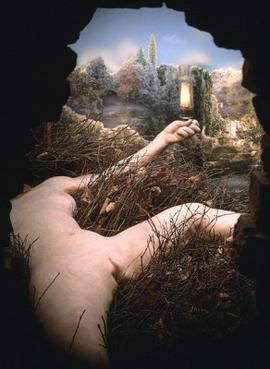
The last piece Duchamp does is Étant donnés. It’s a great big installation piece now at the Philadelphia Museum of Art. You could be forgiven for missing the most important part. It’s only visible through two peepholes in a door. And what you see looks like this. A nude, reclined against a landscape backdrop, what you might call a “real painting”, a real life piece, not readymade crap.

Duchamp kept this a secret between two girlfriends and his wife, only revealing the work after his death, and 25 years after he had apparently retired from art to play competitive chess.

Is this what Duchamp believed about art all along?

Duckies, relax, keep yourself in check, and stay cool. Let people enjoy themselves. There’s no real need to get snobby about other people’s tastes.

But also know your own. Do your thing. Let the progressives get on with theirs. They have all sorts of rules and ideas and it’s all built on sand. #Walkway? Disengage, do your own thing. They can do their thing. You’re going to do something cool that doesn’t care about their rules. In turn, your thing will show up theirs, passively. Show, don’t tell. Let them be ridiculous by comparison. Let it come naturally and not because you’ve driven them there.

Or maybe it’s all a load of rubbish? Duchamp used elements of luck as his materials in creating Bride. Jackson Pollock still came along as if he was doing something new with his drip period 20 years after. Andy Warhol still came along 40 years later with his prints as if the readymades hadn’t basically done the same thing before. And contemporary art keeps going.

Duchamp didn’t make anyone realise how ridiculous they were.

Did you just read this entire piece for nothing?

Photo Credit.

Government Versus The Family

Over the past few decades, it has become the norm that when a person is in trouble they rely on the state and not their family. When a man is in financial trouble he is infantilised by the state as he turns to universal credit. When a man has personal troubles, he feels more confident in turning to a stranger qualified as a ‘therapist’ than to find comfort in the arms of his loved ones. When a man needs education, he turns to the state-approved curriculum in a run-down, crowded comprehensive school rather than carrying on his father’s trade or learning for himself. The state has effectively become the parent.

Now, this is not to say that there aren’t situations in which individuals may need support outside their family; there are times when getting help from the community is important. The average person is stuck between two ideas: that families shouldn’t be dependent on the state and that we shouldn’t let children suffer because of their family situation. However, the default in modern society is to turn to the state first and the family second. Regardless of how altruistic the intent is, the state has incentivised such behaviours by creating a system where children are more dependent on the government than their parents. This, in turn, incentivises single-parent households and mothers to enter the workforce; needing to spend less time at home thanks to state-provided childcare. Whether that be providing free childcare or encouraging women to pursue careers through promoting university, the government has encouraged mothers to leave their children to go to work. This was especially seen under Blair’s government which provided free part-time nursery places for all three and four-year-olds or targeting 50% of the population to go to university. 

As stated by Peter Hitchens: 

“The whole idea of public policy towards childhood now is that children should spend as much time as they possibly can away from their mothers. I am taxed so that children can be put in nurseries so their mothers can go out and work in call centres.”

Of course, this is not to say that women should not go to work. However, through these policies, the government has incentivised women to put work in front of their family. This has led to major negative effects for children such as a significant rise in mental health problems over the past few decades. 

The family, and by extension the community, should offer a support system. When a person is in need, relying on family is much more reliable and rewarding than government benefits. Family tends to be much more reliable than the impersonal government that changes every few years. And when there are times where the family fails, private charity is there as a safety net for the most vulnerable of society. 

In addition, the government deprives families of the responsibility to give to charity as society trusts the government to show their altruism by providing welfare for those in need. By removing individual responsibility through government enforced philanthropy, community connections are withered. 

However, our current system means that the support many children receive is from faceless civil service workers rather than seeing the generosity of their neighbours. During the last decades of life, our elderly receive their support from state pensions instead of their family. Their earnings in their working life have been taxed, with the government using their money on projects that don’t benefit them or their loved ones. Due to this, they’ve not been able to build up wealth to pass on to their children. In addition, the state creates a division between generations, as the young are forced to pay for an increase in social care through the national insurance increases which creates disdain between the young and old. The state deprives the family of its role – it incentivises disconnect between generations and a reliance on the state rather than those closest to you.

A strong family creates happiness, security and prosperity. It helps each generation learn from the last and grow. It allows children to grow up as individuals with diverse perspectives and ideas, not just the taught lessons from state education. It allows children to have an identity within the family while retaining their individuality. This isn’t something that can be replaced by faceless bureaucrats. The family should come first, not the state.


Photo Credit.

Considerations on Revolution

The 28th of December of this year will mark the 100th anniversary of the creation of the Union of Soviet Socialist Republics.

The Soviet Union was a product of the so-called `Russian October Revolution` which sought to “liberate” workers and establish a communist utopia but in truth resulted in the murdering of the Romanov royal family, government-engineered famines which killed millions in Ukraine, persecution of Christians, a secret police force, and slave labour camps. Inevitably, like most violent political revolutions, the Russian one ended in failure after 75 years.

The Russian Revolution is, however, a product of the nature of revolution itself. According to the Brazilian traditionalist thinker Plinio Correa de Oliveira, revolution is made up of three distinct stages. The first stage consists of a crisis in the tendencies which he describes as “disorderly tendencies [which] by their very nature struggle for realization. No longer conforming to a whole order of things contrary to them, they begin by modifying mentalities, ways of being, artistic expressions, and customs without immediately touching directly – at least habitually – ideas.” The second stage is the revolution of ideas, which means that, from the aforementioned deep tendencies, arise new dogmas. On the revolution of ideas, Plinio states, “they at times seek a modus vivendi with the old doctrines, expressing themselves in such a way as to maintain a semblance of harmony with them. Generally, however, this soon breaks out into open warfare.” Lasty, Plinio mentions the revolution of facts, whereby revolutionary beliefs and ideas are made into physical practice through both violent and non-violent means. It is presented by Plinio as when “the institutions, laws, and customs are transformed both in the religious realm and in temporal society.”   

Violent revolutions survive to the extent that they can hold on to the momentum which put them in power in the first place. This attempt at maintaining momentum while in power most of the time means the removal of enemies of the revolution at all costs which, in some cases, also includes the very same people who initiated it in the first place, for the revolution always eats its own children like Saturn devouring his own offspring, and as the Savoyard counter-revolutionary thinker, Joseph de Maistre says, “it is usually the revolution which leads men, not men lead it.”

Even more dangerous, however, than bloody and violent revolutions are those which are cultural and metaphysical, and concerned with popular thought. This is because the consequences of such revolutions are felt more often than not in the long-term and usually start out as mere harmless reforms.

Two such metaphysical values emerge from metaphysical revolutions: absolute equality and absolute liberty. These two values are typically also accompanied by two parallel vices: pride and sensuality.

The proud man yearns for egalitarianism because he hates all authority but that over himself. Because of this, he hates superiority of any kind, and thus contains within his mind-set and heart, hatred for God. It is this pride which creates what Pope Emeritus Benedict XVI calls the “dictatorship of relativism” meaning that man has dethroned God and made himself his own god. This is why we have the issues of, for instance, multiculturalism or gay marriage, which proclaim that we cannot discriminate between different cultures and religions, and that we cannot say that a heterosexual family is the only true family respectively, because in doing so we would be affirming superiority.

Sensuality and absolute liberty, on the other hand, are but mere synonyms for modern liberalism. Man`s intelligence guides his will, and his will ought to guide his sensual appetites. The core dogma of liberalism is to revolutionise this inherent nature and reverse it so that sensual appetites dominate man. As St. Augustine rightfully says, “a man has as many masters as he has vices.” Hence the revolution seeks to justify the worst of passions in the name of individual liberty as a metaphysical value. Because liberalism stands against Christian principles upon which the West was built, such as the maximisation of freedom to do good, and modesty, naturally it becomes the antithesis to Western civilisation itself, for liberalism seeks to maximise freedom for evil and promotes sensuality. Therefore, because of the opposing natures of Christianity and liberalism, they can never coexist.

Both egalitarianism and liberalism produce disordered tendencies or vices. The more these vices are satisfied, the more extreme they become. This is why today we find ourselves in a time of erroneous doctrines and moral crises. These errors tend to lead to new errors and new crises until they succumb to an abysmal disorder. One can say that the West today finds itself at this latter stage of the revolutionary process, id est, in its final death rows.

To sum up, the revolution always has its peak period, the one during which it establishes, on paper, all humans as equal brothers of the world and gives them rights of all kinds. However, once this peak period of the revolution subsides, it spends the rest of its days destroying itself. Therefore the truest enemy of the revolution is not some outside opposing force, but rather the very decadent nature of itself.


Photo Credit.

The Whitewash – A Review of ‘War on the West’ by Douglas Murray

To begin, it’s worth saying I owe something of a debt to Douglas Murray. He brought me to many of the positions I hold today, and while my overall impression of ‘War on the West’ was disinterest, it is only upon looking back at my own political journey I’m beginning to understand why I felt that way.

‘War on the West’ follows ‘The Madness of Crowds’ and the ‘Strange Death of Europe’ as Murray’s third book discussing the state of political affairs in the Western world. Murray’s thesis is best laid out by Murray himself:

“People began to talk of “equality”, but they did not seem to care about equal rights. They talked of “anti-racism”, but they appeared deeply racist. They spoke of “justice” but they seemed to mean revenge.”

Herein lies the problem with ‘War on the West’, and why I moved away from Murray in my own life: there is no examination of what equality is to mean, what anti-racism is to look like, or what kind of justice is to be enacted, if any. The primary objection Murray has to the armies waging a war on the West is that their vision is not a classically liberal one. Explicitly antagonising white people with terms like ‘white fragility’, ‘white tears’, or ‘white privilege’ is bad because it racialises things Murray believes to have been deracialised by the Civil Rights Movement and other changes that occurred between the 1950’s to early 2000s. In his previous work, Murray uses an analogy of a train of equality pulling into the station, only to careen off down the tracks at a greater speed than ever before without allowing its passengers to get off. Throughout Murray’s work is an unexamined liberalism, that at best, is only ever criticised for being too pure. Liberalism, by its nature, criticises social orders for creating barriers for individuals. The many freedoms the West has provided have always come at the expense of the social orders liberalism eroded. Freedom for women came with the erosion of a patriarchal social order, and took with it the benefits such a system provided – such as the ability to raise a family on one income, a high degree of social trust, and a defined relationship between the sexes. It was inevitable that liberalism would eventually critique itself, and many of the authors Murray cites, from Kendi to DiAngelo, often build on those drawing on Herbert Marcuse and Theodore Adorno. The former was given money by the Rockefeller Foundation, and even worked for what would become the CIA. In many ways, it was Western liberalism with its free flow of capital and revolving door between the academy and influential roles of state that enabled these theories to promulgate.

In his interview with the Telegraph promoting the book, Murray states:

“As long as people are armed with the right facts and the right arguments, I just don’t see how the cultural revolutionaries can win. I don’t know about you, but I’m not spending the rest of my life cringing and being told I’m guilty of things I never did. Not doing it, not guilty.”

This really begs the question of how exactly we got to this position to begin with. What’s most striking about ‘War on the West’ is that it does read almost like a recap of a war. Battlefields are specified, different players and their decisions are named, and Lord knows there are a huge number of casualties in the culture wars Murray describes. But, were the people who permitted things to reach this stage simply incapable of posing arguments against it? In one chapter, Murray notes that claims that America is founded upon stolen land are self-refuting because the many tribes of America stole the land from one another. Are we to believe Americans are so ignorant of their own history that this argument has never been made? Murray himself notes in the conclusion that outlets such as MSNBC and the New York Times will deny that Critical Race Theory is taught in schools, but acknowledge that it exists when forced. There are no arguments that can be used against such a thing.

Left out of ‘War on the West’ is any truly systemic analysis of the problem. The aforementioned New York Times moved to a paywall model in 2011, and from that point forward, the focus on things like ‘racism’, ‘sexism’, ‘homophobia’, and ‘transphobia’ increased many times over. Around this time, legacy media was dying slowly. So newspapers moved from selling papers to many people to selling stories to a niche audience. The niche audience of the New York Times is the kind of cosmopolitan liberal who is very interested in niche identitarian trends, and in pitching themselves as radical while at the heart of the very system they claim to dislike. Despite this being a veritable War on the West, according to Murray, the emergency powers of war are never called upon. There are no calls to take decisive action to halt or prevent these systemic changes that led to this point. And in the conclusion, he defends the same economic system of capitalism that gave the New York Times its power, and forced it to change its business model to appeal to a niche audience of people hostile to Western people.

This attachment to a liberal historiography, in which individuals are given The Arguments and Make The Case, with spontaneous and emergent bottom-up change coming about as a consequence blinds Murray to the economic and legal realities that influence and shape this War on the West. Multiple universities are stated as battlegrounds for this war, but there is not a single mention of the fact universities are public authorities under the Equality Act (2010). That they have an ‘equalities duty’ to publish routine equalities reports, and must legally keep permanent members of staff dedicated to pushing this anti-Western message.

The only law Murray appears to mention in this vein is the Civil Right Act, which he defends as an example of the kind of good equality that he desires. Yet it was the Civil Rights Act which created the Civil Rights Commission, which in 1973 wrote to the Civil Service Commission and had them drop the standards for algebra in order to allow them to hire more non-white civil servants. Similar acts can be found in the UK. The Race Relations Act of 1973 (which performed the same anti-discrimination function as the Civil Rights Act he praises) created the Commission for Racial Equality. Today, the Race Relations Act has been assimilated into the aforementioned Equalities Act, and the Commission for Racial Equality has become the Equality and Human Rights Commission, which forces compliance with the Equalities Duty. There is a clear through-line from the civil rights legislation both in the USA and the UK, to the situation we are in now. The back of ‘War on the West’ reads as follows:

“The anti-Western revisionists have been out in force in recent years. It is high time we revise them in turn…”

Fundamentally however, there isn’t much of a revision of dominant left-wing narratives within ‘War on the West’ at all. Instead, it seeks to remind leftists that their own heroes, from Marx, to Foucault are also not spotless figures. This can only go one of two ways: either they ignore this, and nothing changes, or they recognise this, and move away from those figures, and as a consequence have doubled down on their principles of removing any and all unsavoury figures from public life. Regardless, none of this is at all revisionary, nor does it fundamentally challenge the values and beliefs of the cultural revolutionaries. A truly revisionist view of things would challenge the dominant understanding of things like the Civil Rights Movement, which was not (as Murray describes) people ‘making the case’ for rights, that the American public was so blown away by that they accepted and endorsed. Academic studies like that done on Rosedale show the side of desegregation that was forced upon people, and came at the cost of schools, neighbourhoods, communities and lives. Rosedale was a segregated community, but desegregation and the tensions that came with it made it difficult for authorities to maintain peace. The result was that many of the former residents who didn’t move out of their homes, found themselves the victims of racial violence by those who moved into the area, and had no regard for the police, who stopped policing the area out of fear of creating tensions. When Brown v. The Board of Education ended the desegregation of schools in America, and people protested, the national guard was sent in to disperse the crowd at gunpoint.

All of these changes were not the natural unfolding of human progress. They came today as they did in the civil rights movement, through force. Eisenhower and the national guard did not make the case for desegregation in light of Brown, they imposed it down the barrel of a gun. Whether that was right or wrong is irrelevant, that fact alone disproves the notion Murray insists upon in his recent public life – that the train of equality was chugging along gently, and only recently got out of hand. Equality is not a train chugging along set tracks, it is an amorphous blob that seeks to desacralise everything and dissolve all boundaries between all things. It does not progress in one direction alone, like a train, but expands in all directions and infects all things, including our supposedly right wing public figures.

In light of this, I still see some utility in Douglas Murray. Challenging double standards and hypocrisy is a cheap tactic which ultimately will not defeat those Murray opposes. Yet it is often the first chink in the armour for many people. I know I first came to move away from liberal beliefs because I found them to be contradictory, it was only in time I rooted out my own inherently liberal views, and ultimately moved to the political views and positions I hold now. In this respect, Murray is useful – he can confirm people’s suspicions about the modern left, and give them comfort that there is a public figure who opposes these things. It’s incumbent upon people with more bravery and introspection to take that one step further, and marry it with a systemic analysis of the situation, and propose and action a plan to undo these things and institute something new in its place.


Photo Credit.

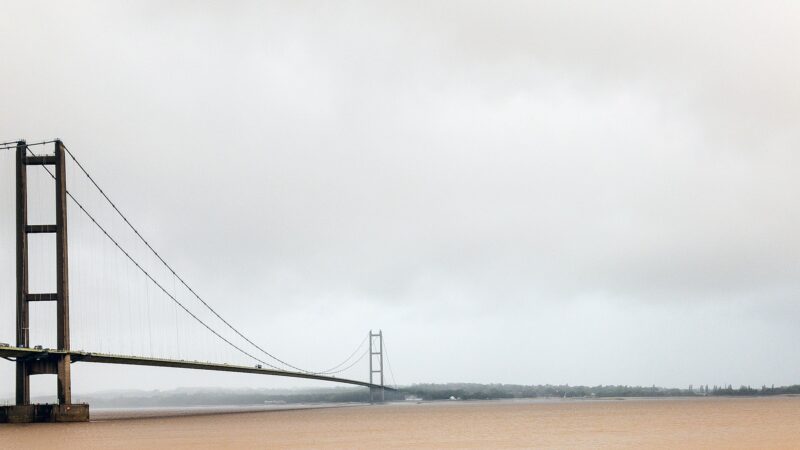
Humber Bridge 2

When the Humber Bridge was completed in 1981, it was the longest single span suspension bridge in the world. 41 years later, it has been reduced to a mere 11th place. The current longest single span suspension bridge in the world, the Akashi Kaikyo bridge in Japan, stands a mere 500 metres longer. This is an unfathomable disgrace for the people of Great Britain and is, quite frankly, a national tragedy and embarrassment. To add to this disgrace, another bridge, the ‘Çanakkale 1915 Bridge’ will soon be completed in Turkey. It will kick the Akashi Kaikyo bridge from its number one spot, and move the Humber Bridge to a measly 12th place.

Therefore, for my submission to The Mallard’s project 22, I would like to make a simple but resoundingly important proposal: build a second Humber Bridge (Humber Bridge 2 some would say) and make it precisely one metre longer than the Çanakkale 1915 Bridge, therefore reclaiming Britain’s rightful place in the world as the country with the world’s longest single span suspension bridge.

This proposal is likely to ruffle some feathers internationally, and I imagine our friends in the East would be quick to try and build another, even longer single span suspension bridge somewhere else. The solution to this possible outrage is, of course, simple: Build a third Humber Bridge.

These proposed projects have a myriad of benefits that I am sure are obvious. I will however go over them in an attempt to convert the non-believers. Not only will these projects drastically increase the infrastructure of the East Riding of Yorkshire and Northern L*ncolnshire, they will also bring desperately needed construction work and employment to an otherwise overlooked region. The construction of perhaps five or six Humber Bridges over the next 50 years would create literally thousands of jobs for engineers, technicians, builders, and labourers.

Coming in with an estimated price tag at just over £2 billion each, I am sure you can see that these bridges would be an absolute steal for the price!

I know what you’re thinking ‘He can’t be serious! This is a joke right?’. No, I am being very serious. As the nation which invented the bridge, I think it is perfectly reasonable that Great Britain goes to great lengths to have the longest one in the world, the lack of one is wounding to our pride. If you do not support the construction of perhaps eight or nine more Humber Bridges in our lifetime, not only are you a coward, but I can only assume that you are also working in favour of foreign governments, which makes you a traitor, and I’ll be damned if I’m going to sit here and be lectured by some fifth columnist.


Photo Credit.

The Tragedy of the Praying Indians

A generation after the first Thanksgiving, colonial Massachusetts experienced the single deadliest per capita war in North American recorded history. Though the famed declaration of friendship between White settlers and Native tribes was within living memory for many of the fighters in this war, it did not in any way soften the animosity nor stay the violent hands of either side. This was King Philip’s War, a turning point for American history, the war that set the precedent for Anglo/Native relations for centuries to come, and yet one that is woefully unknown and underdiscussed even West of the Atlantic. It left all parties involved scarred, traumatised, and for one group even less understood than this forgotten war, a betrayal never to be overcome.

It is 1675, and the titular King Philip, Christian name of the Sachem (chief) of the Wampanoag, Metacomet, has lead a raid on the New England colony town of Swansea in retaliation for the English executing three of his countrymen for the murder of one John Sassamon. Despite his European name, Sassamon was a Harvard-educated Praying Indian, the name given by the Puritan colonists to the groups of Native Americans that had adopted the faith and customs of their new neighbours. He was a respected member of Metacomet’s court and a cultural mediator who had recently informed the Plymouth governor of the Sachem’s intention to gather tribes for war. His murder was seen as revenge for this betrayal by the English, but this perceived overreach of the colonial authorities, in killing his kinfolk without consultation, was the pretext Metacomet was waiting for to being this war he had been so wanting.

The raid on Swansea was a horrible affair. The Wampanoag laid siege to the town before overcoming the militiamen defenders and laid a terrible waist upon the hapless civilians. Many women and children were butchered neath the tomahawk that day, and the other colonies were quick to respond to the massacre. The Praying Indian warriors were keen to come to the assistance of their European allies to meet this aggression, and expected naturally to be accepted as a welcome aid by their dear friends. They were in this, and in much else, utterly and tragically mistaken. Though the Praying folk saw the English as firm allies, this was a decidedly one-sided relationship. That these natives had taken as their own European clothes and custom, and English tongue and English Bibles, mattered little, for to the Europeans the Praying Indian inescapably remained, above all, an Indian. An outsider worthy always of suspicion over trust.

The early stages of King Philip’s war were not good for the English. Despite the common contemporary view of the various North American colonial conflicts as being between technologically advanced musket-wielding Europeans versus bow and hatchet-armed Natives, there were a lot of shared weaponry and tactics between them. This makes sense when considering that by the late 17th Century Natives and colonials had known of and been trading with one other for decades, and many groups had enthusiastically adopted firearms to fight their tribal rivals in wars over fur-trapping land. These years using European technology served the Wampanoag well in the first engagements of the war, and using them they beat the English militias in a number of battles up and down Massachusetts Bay. An opportunity of spiritual warfare was also presented; when a near total eclipse of the moon one night allowed the tribal warband to slip out of the colonial noose tightening on their swampland capital and make for the wilds. Such a freak lunar event at such a crucial time was seen as a divine blessing by the Wampanoag, and an ominous sign of heretical magic by the English, who were thoroughly demoralised by the affair.

Native successes in the war made the situation for the Praying Indians deteriorate rapidly. The English feared uprisings amongst the settled natives, and in a grim turn, dissolved the praying towns that had until then served as a shield for the colonies, and moved thousands of Indian civilians into  internment camps, with over 1,000 being crammed into just one at Deer Island. Conditions in the camp were dreadful, and the families kept there doubled as hostages to ensure the loyalty of the Indian scouts fighting with the English. Many hundreds would die over the cruel winter of 1675-6. Puritan minister John Elliot would fight hard against this policy, but by this time it was dangerous to say anything to the defence of Native Americans, no matter the tribe or custom, and he was powerless to stop it.

As for the success of the Wampanoag and their allies, it would not be the English that finally overcame them, but their own kin. Upon hearing that the Mohawk tribe to the West were moving in force towards Massachusetts Bay, Metacomet and his men eagerly turned to await these new allies in their fight against the White man. He was, however, gravely mistaken. In a single action the Mohawk warriors fell upon the Wampanoag, upon the Narragansett, upon all the troublesome Algonquin Confederation and massacred them almost to a man. Metacomet’s power was in a single night broken, and broken by his own kind. He fled to the wilderness, shattered and alone, and would be later slain by the musket shot of one of those who had been, despite everything, loyal to the end; a Praying Indian called John Alderman. The war continued for a further two years in scattered skirmishes, but hope for victory died with Metacomet, King Philip himself, in the Massachusetts swamplands.

King Philip’s War devastated all involved. It resulted in the deaths of 2,000 Natives and 2,800 colonists, the near total annihilation of the Wampanoag and their allies, and of the English settlements nearly half were attacked with hundreds of civilian deaths. The Praying Indians suffered perhaps more than any; hundreds of their already small population had died, and the discrimination and suspicion they had suffered from the English before the war had metamorphosed into open hostility and hatred. They had considered the Europeans their brothers, in culture and Christ. They had adopted their ways and their God, severing themselves from their Algonquin brothers of Old in favour of the civilised and energetic New.

It did not save them.

The newcomers did not see brothers, they saw Indians.                                                                            They did not see Christians, they saw Indians.                                                                                                      They did not see allies, they saw Indians.

When it came down to it, ingratiating themselves to their new neighbours did not save the Praying Indians. For their efforts and their loyalty, they received only tragedy and betrayal, they died like the rest.

Perhaps there is a lesson to be learned here.


Photo Credit.

So What?

At the end of last month, the first results of the 2021 UK Census were published. As many will recall, the results were simultaneously, although not quite paradoxically, shocking and expected. The information published showed that 1 in 6 UK citizens are born in another country – ten million of the UK’s 69 million; a 33% increase from the 7.5 million a mere decade ago.

The details were shocking insofar that few expected a demographic shift of such extreme proportions, even when compared to the last census in 2011. Nevertheless, they were expected. As anyone with an elementary understanding of British politics knows, the political system has pursued, less-so out of empirical consideration and moreso out of humanitarian (“it’s our moral obligation!”), diveristiarian (“diversity is our strength!”), and utilitarian (“immigration grows the economy!”) dogma(s), a policy of mass immigration since the late 1990s.

Just last week, data from the ONS showed that migration into Britain had reached a new record of 504,000 – a net increase of over 331,000 from the year prior. Keep in mind, all of this has happened despite the public’s clear and consistent opposition to immigration, nevermind the magnitudinous demographic change it has caused.

As soon as the data went public, one could piece together the overarching division of attitudes. Some welcomed the rapid erosion of Britain’s native-born citizenry. By contrast, the murmurs of the moderate-minded indicated a sense of foreboding. If the data on citizenship is this demographically untenable, what on Earth is the data regarding national identity going to look like?

Well, now we know. Reported by the ONS, the UK 2021 Census showed:

“81.7% of residents in England and Wales identified their ethnic group as within the high-level “White” category in 2021. A decrease from 86.0% in 2011.

As part of the “White” ethnic group, 74.4% of the population in England and Wales identified their ethnic group as “English, Welsh, Scottish, Northern Irish or British.  This is a continued decrease from: 80.5% in 2011 and 87.5% in 2001.”

As with the initial citizenship data, many celebrated this seismic change, suggesting that fewer white British Christians in Britain amounted to a moral improvement.

On the other hand, some deemed the largest demographic shift since late antiquity to be completely ineffectual. Directed at Nigel Farage’s reaction to the census, which underscored the shrinking ethnic British population in London, Conservative MP Sajid Javid tweeted a forthright and mask-off response: “So what?”.

“It’s not happening and that’s why it’s a good thing” as the saying goes.

Nevertheless… So what? Well, for a start, it shows that the 2011 Census wasn’t a one off, but signified the start of an unprecedented trajectory: the continuous decline of the ethnically British population. On its own, this should be alarming, but the fact this demographic shift has occurred within a single generation makes it even moreso.  Needless to say, but worth saying nonetheless, to do so without consultation from or consideration of those implicated is, to put it moderately, extremely irresponsible.

Moreover, what good is talk of “integration”, the oft-proposed silver-bullet to the consequences of immigration, if the historical ethnocultural in-group, the one which immigrants are supposed to integrate, cannot sustain its hegemony? At most, they’ll “integrate into” (perpetuate) a godless ratrace; a demoralising sluggish existence against the world’s richest on the housing market and the world’s poorest on the labour market. As Morrissey says: shelve your Western plans… Life is hard enough when you belong here.

As it stands, numerous communities across England and Wales are majority-minority – where the national majority group constitutes a local minority – a fact which makes panicked rhetoric about rhetorical divisiveness all the more out-of-touch. Mutually-segregating, and often mutually-loathing, communities have been around for decades, the census just reaffirms this reality.

More to the point, who could expect integration? Flimsy abstractions of Britishness aren’t holding British society together. Having a cuppa, forming an orderly queue, and appealing to vague, arbitrary, and contradictory notions of “tolerance” and “inclusion” and so on just doesn’t cut it. What is a nation, especially a democratic one, if it cannot inspire loyalty?

The rate of immigration and concentration of immigrant and immigrant-descended populations diminishes any incentive or expectation of integration, no matter how willing the native population is to water down the criteria of national belonging. If people can choose to associate and live amongst their kind, they shall do so – as has been the case since the dawn of time. Blood is thicker than water, even if the water is boiled, milked, and caffeinated.

But beyond a debate of causation, whether it’s a case of “can’t integrate” or “won’t integrate”, both instances point to the same overarching problem: Britain is fragmenting.

In order to accommodate the contradictory complexities of the world, primarily a consequence of the similarly unwanted reimagination of Britain as a “global” entity, “Britishness” has been reconfigured from a distinct identity – something that people indivisibly are, that their parents are, that their parents’ parents are – into a bureaucratic technicality – something that people can have, should and whenever they be so inclined; from a complex and unique ethnocultural particularity to a two-dimensional universality.

This fact, combined with evidently unmanageable and unpopular immigration numbers, is not a good omen. Rather, it risks gradually wiping Britain from the face of the Earth; from its unique and beautiful place in relation to a global diversity of similarly unique and beautiful ethnocultural organisms to a crude amalgamation of all-else, pathetically bound though an appeal to inoffensive all-inclusive emptiness.

All the more fitting then that the census should also reveal a collapse in religiosity. In a nation where church and state are bound, less than 50% (46.2%) of the population identifies as Christian – down from 59.3% in 2011. Simultaneously, those self-identifying as having “no religion” surged from 25.2% to 37.2%. This is the first time in 1000 years that Christainity is not the majority faith.

Of all the census details, this is perhaps the least surprising. For decades, we’ve barely considered ourselves “Cultural Christians” – those that tick the box, but don’t attend the service. In this regard, the 2021 Census is merely a formal confirmation of long-waning Christainity.

Who could have seen any of this coming? Actually, quite a few people. Back in 2011, then-UKIP leader Nigel Farage, citing statistics published by Migration Watch, said that the UK could expect 50,000 Romanians every year over the course of ten years. 

At the time, these numbers – as well as millions of ordinary people – were lampooned and ridiculed by the media, politicians, comedians, and (most damning of all) the Experts (the Serious People that Know Things), as delusional racists, fruitcakes, loonies, and so on.

Nevertheless, a decade later, that is exactly what has transpired. The census revealed that the number of Romania-born people living in the UK amounted to 539,000 – a 576% increase from 2011.

It’s no secret that Farage’s acknowledgement of immigration-led displacement of white Britons was one of his early selling points. Indeed, it was arguably as important (if not more important) than his euroscepticism. As has been established time and again, the latter is very much a product of the former. As such, it’s rather uncharitable to interpret his aforementioned comments with regard to London as anything but a reiteration.

Additionally, there’s David Coleman, former Professor of Demography at Oxford University, who predicted back in 2013 that, if demographic trends continued, “white Britons could be a minority by 2066” – a prediction which not only remains valid after the 2021 census but, evidently, did not assist him in retaining his then-already under-pressure position.

Granted, these are only notable examples. I cannot begin to imagine the number of normal people that have lost their livelihoods for concurring with such predictions, nevermind articulating the sentiment that they spelt trouble. Not even then does this account for those who have been scared into silence by active legislation and the fear of a vitriolic social death. You can be targeted for far less.

The inability to talk about matters in a frank, open, and civilised manner compounds problems which arise from matters which provoke the desire to discuss them in the first place.

On the religious front, Peter Hitchens has written and spoken about Britain’s post-Christainity on multiple occasions. Ever since WW1, Britain’s religiosity ceased to be sincere, instead being a series of motions undertaken without spiritual, theological, or moral investment. Now that there’s no room for doubt, one can expect the iconoclasts of Diversity and Inclusion to erase whatever hollow secularised traces of Britain’s Christian identity still exist in public life.

Put diplomatically, none of this is sensible. Quite the contrary, all these convergences spell catastrophe. Over the past few years alone, we’ve seen the fledglings of a nihilistic balkanised Britain.

Back in September, the now white British minority city of Leicester – a so-called “model” for a ‘diverse but cohesive’ Britain – fell victim to ethnoreligious rioting between Indian-descent Hindus and Pakistani-descent Muslims. Far from ‘diverse’, the riots were a replication of pre-existing global troubles.

To bare witness to the impotent, ahistorical, buzzword-laden gush of no-name ‘community leaders’, drowned out by an eruption of third-world carnage in Britain’s oldest settlements, as the mainstream press obfuscate the essence of the problem, is to bare witness to the self-deluding and short-sighted nature of Britain’s post-war political establishment.

Throughout various towns and cities across England, South-Asian grooming gangs have targeted white children since the 1980s. The police, more concerned about causing offence than networks of child prostitution, ignored the plight of the victims for several decades. Not even MPs could discuss the matter without facing repercussions.

Along the south-east, the perpetual tide of migrants (legal and illegal) has caused social unrest, so much so that coastal residents have taken to barricading their homes. The rate of immigration has skyrocketed housing costs, led to panicked hotel cramming by the Home Office, as well as an explosion of council-sanctioned homelessness.

Immediately following the release of the ethnicity data, tweets taunting white Britons to “come get your capital back” go viral, along with recorded procolations that Britain “is our country now”. Erstwhile, those of immigrant backgrounds descend on the capital, declaring their undying allegiance to a country that isn’t the one that houses them.

As for the sainted discourse, the goalposts of debate are shifted from “relax, you’re a local majority” to “relax, you’re the largest minority group” and pieces bemoaning “gentrification” are replaced by pieces celebrating “diversification”.

In the case of London, now 36.8% (down from 42.7% in 2011), some have tried to deflect any and all discussion of this matter by appealing to insinuations of white nationalism, forgetting that this entire question is, in essence, an ethnocultural one.

The idea that an unprecedented, unasked for, and potentially irreversible shift in the composition of a major city, nevermind an entire country, would not matter to the people insofar the shift was driven by those identifying “White Other” is obtuse and arrogant. Indeed, even when such a racial commonality exists between ethnically native and foreign-descended populace, there are still longstanding consequences.

As mentioned at the start, all of this boils down to mass immigration. The old and moneyed, addicted like junkies to the coursing streams of cheap foreign labour, are prepared to carve Britain’s youth out of the social contract in order to get their fill. Big business, professional activists, bureaucratic functionaries, and main-party politicians have locked arms and tirelessly marched in lock-step against my generation, their national belonging, and their prospect of a better future.

Both Labour and the Conservatives have demonstrated their indifference towards the problem of large-scale immigration-led demographic change. If anything, they have encouraged it, despite the pleas of their core voters.

Under Blair, Labour pursued a policy of mass-immigration to “rub the right’s nose in diversity”, simultaneously creating a pool of votes on which the party could rely in future elections, and accelerated Britain’s descent into ‘humanitarian’ quangocracy.

By not-so-much contrast, the Conservatives, having promised for decades to reduce immigration, won a landslide majority with the aid of traditional Labour voters (distinctly opposed to immigration) with a pledge to fulfil the spirit of Brexit – retainment of the sovereign control of borders to reduce the mass influx of people – only to do the exact opposite once in power. Don’t attribute to “failure” what is, in every respect, a design choice.

In the media, the Sensible umpires of political discourse, with clear-minded sobriety and transparent neutrality, insist that mass immigration is completely unstoppable and that we should shut up and make-do.

Likewise, in the equally Sensible world of think-tanks, mass immigration is supposedly the magical solution to all of Britain’s economic woes; everything from unprecedented high-tax levels to Britain’s economic  stagnation. Even a general overview of Britain’s economic performance these past few decades is enough to clock that such “expertise” is merely an officialised delusion.

More than mere snark, “So What?” perfectly encapsulates the underlying problem of our entire political system. Everything, from the political media to think-tanks to sitting MPs, pushes depoliticisation. The art of the possible is replaced with the art of the impossible. A decision of indecision, democratic deliberation, and the alternatives it affords, is supplanted by the arbitrary apolitical confines of authoritarian managerialism.

By opening up a multitude of historically unprecedented political fronts (tension between ethnocultural groups) whilst depoliticising the policy areas pertaining to their creation (post-war immigration policy) the British political system has manufactured an increasingly unsustainable ethnocultural divide.

In a scrambled effort to feign unity, schools across the country are mandated to teach the British state’s reinvention of its foundational identity, utilising empty appeals, laden with contradiction and irony, to “democracy, the rule of law, individual liberty, and mutual respect and tolerance of those with different faiths and beliefs“.

It does not occur to our leaders that democracy is the conduit by which identity groups will compete against others, that high social trust is prerequisite to liberty, or that mutual respect and tolerance can be hard enough within predominantly monoethnic/monocultural societies, nevermind increasingly multiethnic/cultural ones. In the end, all that is left is the brute force of authority.

Being the only politician with sizable political support that is prepared to deliberate this fundamental matter, Farage’s hour of decision is upon us. If he does re-enter politics, he must do so on the back of these census results. The stalwart indifference of the political class, and all that has transpired as a consequence of their dogmatic recklessness, must not be allowed to continue.

If he does create a new party, there’s every reason to believe he’ll be rewarded handsomely at the ballot box. The Conservatives face electoral annihilation. Javid, fully aware of this fact, is not standing at the next election; presumably why he felt comfortable telling his constituents (96% white British) that their survival, in their own native land, never meant anything to him.

That said, few expect things to improve under a Labour government. Having never promised a precise number on immigration, one could safely bet, if they ever did, that a) it wouldn’t be sufficient or, if it was, b) they’d u-turn on their promise once in power – just like the Tories.

However, should Farage decide against a new party (or leadership of an already existing party), he must stand aside for an alternative to manifest. Whether we like it or not, as Britain’s demographics continue to change, especially at the current rate, ethnicity, identity, and all things in-between will become a far more prevalent part of our politics. We must be prepared to address these matters – for our own good and for the good of others. The only thing worse than an insufficient answer to the demographic question is to never answer it at all.


Photo Credit.

What the reaction to the Ukraine conflict reveals about national identity


A country is first and foremost its people.

Despite my best efforts I cannot remember where I came across that phrase, nor will I be so brazen to claim it as my own. Nonetheless, it has always struck me as being axiomatic, and current events in Eastern Europe have given me reason to reflect on it further.

The West, including our own country, has since the end of World War II (and in some circles even before then) eschewed notions of national identity and even the concept of the nation itself. Borders are seen by many as a physical expression of violent exclusion and “othering” of fellow human beings, who should be given immediate and untrammelled access to any society they wish; free at any point to up and leave for another.

Politicians, organisations and members of the public alike, particularly those on the Left, are quick to espouse the idea that migration and asylum are human rights, which sit above the rights and privileges that attach to existing citizens.

A cursory glance through the Guardian’s migration articles tells you everything you need to know about how the Left views borders and the right to self-determination in 99% of cases involving the West. They unceasingly extol the supposed virtues of multiculturalism and appear to truly believe in the idea of open borders, with scant regard to the existing people of a nation.

Yet on one matter, the notions of inviolable borders, the nation, its people and the right to self-determination have come flooding back into consciousness and are being defended vociferously by those who otherwise have spent the last 80 years denigrating them and holding in contempt those who seek to re-establish them as common sense norms.

What is it about the ensuing conflict between Russia and Ukraine that has stoked the fires of righteous indignation in defence of a nation presently undergoing a hostile invasion by another?

Surely the mounting death toll plays its part in this reaction. But I am not convinced that is all.

What we are witnessing, it seems to me, is on some level a tacit realisation and acknowledgement that there is after all such a thing as a nation state, a specified people attached to and belonging in that nation state, and the right of that people to remain distinct, separate, independent and free to maintain their own homeland. It is tacit, not because those who express dismay at the current situation do so silently, but because they do not openly admit the source of their opposition to Putin’s aggression.

Back in July 2021, President of the Russian Federation Vladimir Putin wrote an article, published on the Kremlin’s official website – On the Historical Unity of Russians and Ukrainians – in which he outlines the common bonds that ultimately make Russians, Ukrainians and indeed Belarusians one and the same people.

“Russians, Ukrainians, and Belarusians are all descendants of Ancient Rus” he writes, “bound together by one language (which we now refer to as Old Russian), economic ties, the rule of the princes of the Rurik dynasty, and – after the baptism of Rus – the Orthodox faith…[which] still largely determines our affinity today.”

Of the constituent republics of the now defunct USSR, he says “Of course, inside the USSR, borders between republics were never seen as state borders; they were nominal within a single country.”

Mr Putin argues that “some part of a people in the process of its development…can become aware of itself as a separate nation” who should be treated “with respect.” He even goes as far as to suggest that those people should be welcome to establish a state of their own, but only after a satisfactory answer has been proffered to the question “But on what terms?”

It is clear that he does not truly believe the Ukrainians (or Belarusians for that matter) are as distinct from Russians as they like to believe. This he confirms later, essentially repealing his earlier platitudes, when he writes “But the fact is that the situation in Ukraine today is completely different because it involves a forced change of identity.” In other words, whilst some people undergo a change in identity and should be allowed to go their own way, this is not the case in Ukraine who have had such a change imposed upon them; a change it appears Mr Putin feels is incumbent upon him to help them resist.

Leaving aside the moral questions surrounding Mr Putin’s decision to invade Ukraine and whether he is justified in his view of the Ukrainians being fundamentally Russian, let us explore the principles he is applying.

What Putin is suggesting here is that the Russians and Ukrainians, though occupying separate, autonomous territories, comprise the same people, united by a common ancestry, language and heritage. In other words, the lineage of Ancient Rus endures, despite some fragmentation here and there along with the establishment of states independent from one another.

Such a set-up has historical precedent. The Ancient Greek City States were seen as being inhabited by fundamentally the same people – Greeks – yet each with their own independent territories, the citizens of which took on an identity derived therefrom whilst simultaneously maintaining their overarching Greek identity. One could be a Spartan and a Greek, or an Athenian and a Greek. Either way, one was still a Greek.

This shines light on something quite interesting in terms of the conception of a people. For, and I have long been aware of this, one’s citizenship merely denotes one’s rights and status within a state, not one’s membership of a people.

In other words, membership of a people, whilst it could be enshrined in law (and I think there are good arguments it should be – this appears to have been the impetus behind the idea of the nation state to being with, now weakened by lax immigration policy and the doctrine of multiculturalism), ultimately pre-exists that law and the citizenship that might formalise it. As Sir Roger Scruton wrote: “Nations emerged as forms of pre-political order that contain within themselves the principles that would legitimise sovereign government.”

This idea of pre-existence is quite clear in Putin’s understanding of the underlying indivisibility of Russians and Ukrainians. Yes, they occupy different states and maintain distinct citizenship. But, crucially, just like the Greeks, they share an overarching identity and membership otherwise not indicated by co-habitation of the same land.

No doubt millions of Ukrainians would reject this view point. Yet, in doing so, they too would be applying the same principle – namely that their being Ukrainian pre-exists the Ukrainian state. In fact they could reasonably argue, in contradistinction to Putin’s claims, that it is this very pre-existence which endows the Ukrainian state with its right to exist separately from Russia. Their very sense of themselves as a nation acts as the motivation behind their dogged defence of their national territory.

When it is said that a people have the right to self-determination, as many are now saying of the Ukrainians, which “people” do they mean? I think they can only reasonably point to a people who would in the absence of a state to call their own continue to be extant and identifiable.

If, for example, the state of Ukraine underwent a sea-change in its population such that the members of Ukrainian society, Ukrainian citizens, were largely Germans or Somalis or indeed a farrago of peoples of widely varying languages, cultures, customs, religions and historical descent/heritage, they would be Ukrainian in name only, solely by virtue of their citizenship. Assuming those who we presently know and recognise to be Ukrainian people occupy another region of the world, would they not continue to be Ukrainian notwithstanding that the territory of Ukraine would have been abandoned?

In fact it is quite obvious that Ukrainians are considered a people in their own right by the intention of the International Court of Justice to investigate claims of genocide as a result of the conflict.

According to Article II of the United Nations’ Convention on the Prevention and Punishment of the Crime of Genocide, genocide is defined as specified acts “committed with intent to destroy, in whole or in part, a national, ethnical, racial or religious group, as such.”

I would submit that an awareness of a pre-existing membership of a particular and identifiable people has long been found in those of us who believe in nation states and borders. But I would also argue that that same awareness can be found in those on the Left who are denouncing the Russian invasion. For if Ukrainians are not a people in their own right, why should they have self-determination? If, as Putin holds, they are Russians, does it make sense to say that they are entitled to that determination? It would be tantamount to asserting that Russians are entitled to self-determination from Russians. Applying that logic, there should be no opposition to Surrey declaring a bona fide independence from the rest of England.

If those crying out in defence of Ukraine do not see a people that pre-exists its nation state, but rather a people identified only by the continued existence of that state, they nonetheless do acknowledge that Ukrainians are a distinct and separate people albeit merely by virtue of citizenship, irrespective of background.

Let us assume for a moment that is the correct view. This does not change the fact that Ukrainians, even by admission of the Left, have the right to decide for themselves their own future. Such a freedom must surely be unfettered, meaning that any and all decisions that could affect them within their borders should be within their exercise of control.

I think the notion of a people based on pre-existence to a state, though manifested and formalised by the creation of a state – a homeland – is the better one, without which the nation state is less well-grounded and defensible. Another reason is that if a people are identified by the existence of the state they occupy, what happens if that state ceases to exist?

None of this is to diminish the role that territory plays in the identity of a people. On the contrary, and as alluded to above, that role is of paramount importance.

The occupation of territory, together with the establishment of institutions endowed with a sense of identity and which reflect the culture of its people, is a direct manifestation of that pre-existing status that subsists in the absence of a law that enshrines and protects it.

Scruton put it thus: “National loyalty marginalises loyalties of family, tribe and faith… [placing] before the citizen’s eyes…a country…defined by a territory, and by the history, culture and law that have made that territory ours.” He goes on to say that “Nationality is composed of land, together with the narrative of its possession.”

As such, the nation state of a people – their homeland – becomes as much a part of their identity as their cultural practices. The loss of that homeland does not to my mind destroy them as a people but it is certainly a gross offence against their identity which serves to alienate them from themselves, even if not completely.

In this way, and as now brought to our attention in the most alarming of ways, borders matter. But more than that: the reaction to the invasion of Ukraine proves to us we already knew that, including those who ceaselessly advocate for the right of all and sundry to enter a Western country as if it were more their right to do so than our right to preserve our sense of who we are by exercising full control over our borders.

Russia might be invading Ukraine with tanks; the United Kingdom has been invaded by other means – unwanted mass immigration which has encouraged millions to arrive with their own cultures and sense of who they are in distinction to us who were already here and whose sense of ourselves is intimately bound up in our own homeland, its institutions and its history – now all under assault for being less than perfect and not reflective (rightly so) of peoples whose cultures and identities evolved thousands of miles from our shores.

It is time we recognised that if, as I would agree, Ukraine has a right to exist for the benefit of Ukrainians, detached from Russia and free to determine its own future, we in the West and in particular Great Britain, have that right also. We, too, are a people. Our state, our kingdom, might be the result of a unification of the English, Welsh, Scottish and Irish peoples, but each of us retains our own unique character and, importantly, homeland. Although there is some agitation to dissolve the union in Scotland (and in some parts of England), the preservation thereof derives from continuing mutual agreement without impinging on that uniqueness.

The same cannot be said for the results of mass immigration and multiculturalism which, whilst allowing newcomers to preserve their identities, serves to undermine ours whose is expressed in the country we have for a thousand years called home, but is now threatened with having to accommodate increasingly vast differences while losing the benefit of a retreat to somewhere recognisably ours such as was available to Englishmen and Scotsmen alike prior to 1945.

Any student of history can point to numerous examples of the inherent difficulties in establishing territorial dominion over multitudinous peoples who differ so widely in matters of culture and identity that open conflict eventually bursts out and engulfs the region. The situation as we face it in Great Britain, brought about by absurd notions of cultural relativity, is unsustainable.

The circumstances in which Ukraine now finds itself are objectively much more urgent and dire and, admittedly, have come about in a different manner: but the intended outcome is the same. Putin is, after all, making an attempt to reabsorb the Ukrainian people into a Greater Russian family, thereby extinguishing their identity. He will fail to do this absolutely, but if he succeeds in establishing dominion over the territory that otherwise acts as a significant expression of who they are, their identity will be materially reduced.

Such a loss would not necessarily mean a displacement of the Ukrainians to other lands, but the incursion of other peoples’ customs and laws, however similar Putin might hold Ukrainians and Russians to be. In this way, the expression of the Ukrainian people via a country and institutions that becomes less recognisable to them will serve to alienate them and prevent them from self-realisation and determination.

The Left knows this. They know that borders provide a delineation between “us” and “them” – this is of course why they hate borders. Yet in the case of Ukraine that same knowledge prompts them to defend, at least in word if not deed, the rights of the Ukrainian people to maintain a homeland for themselves.

If Putin does manage to subdue Ukraine in the immediate term, the longer term will be much more difficult. The Ukrainian people’s conception of themselves – a conception that pre-exists their own nation state – will likely prompt them to persevere in re-establishing it.

A country is first and foremost its people. But we in the West would do well to remember that if a people lose entitlement and independent jurisdiction over their homeland, whilst they might continue to endure in some form or other, their destiny will no longer be in their hands.


Photo Credit.

Scroll to top