This dictatorship of the present has been enabled by around thirty years of material abundance and relative peace following the conclusion to the Cold War. As John Keegan, the military historian put it, Britain and American can afford our universalist idealism and our fantasies of a benevolent world united and ameliorated through commerce, given our good geographical fortune of being separated from continents by bodies of water. We can forget that the tides of history have pulled whole cultures under in violence and war, instead indulging in an imagined progressive history, moving ever upwards towards ever greater enlightenment and prosperity.
Our leaders, if they deserve the name, have forgotten the lessons of history, because they do not know history. They do not know the fate of nations and peoples. They are ignorant of the importance of the landscape of the world and the moral landscape of the heart, and how the interplay between the two shapes the destinies of civilisation. It is not to engage in nostalgia for a vanished age that never existed to reckon with the fact that those who governed us in the past were well aware of life’s tragic nature, of the reality of necessity and the ultimate goal of the avoidance of anarchy, its own form of tyranny. Our leaders in the 19th and up to the mid-20th centuries had been baptised in the fires of historical experience and therefore knew that the maintenance of right order, in accordance with the good, true, and beautiful, was the precondition for any liberty. Utopian, romantic ideas of universal rights, spreading democracy and natural freedom were dangerous in their unbounded idealism, leading nations and government astray in the quest for moral perfection.
History never ended, in the sense Francis Fukuyama meant it. Hegel, and his disciple Alexander Kojeve, were both wrong in discerning a direction to human History that would see the creation of the perfect liberal democratic regime and state of being in our world. History is the story of the deeds men and women do and accomplishments achieved together as clans, tribes, cities, empires, and nations. It is a story that will only end at the end of all things. Awareness of the living past reminds us that our lives are part of the weave of time, stretching back across the years, our own lives and the actions we take adding the threads that continue into the future.
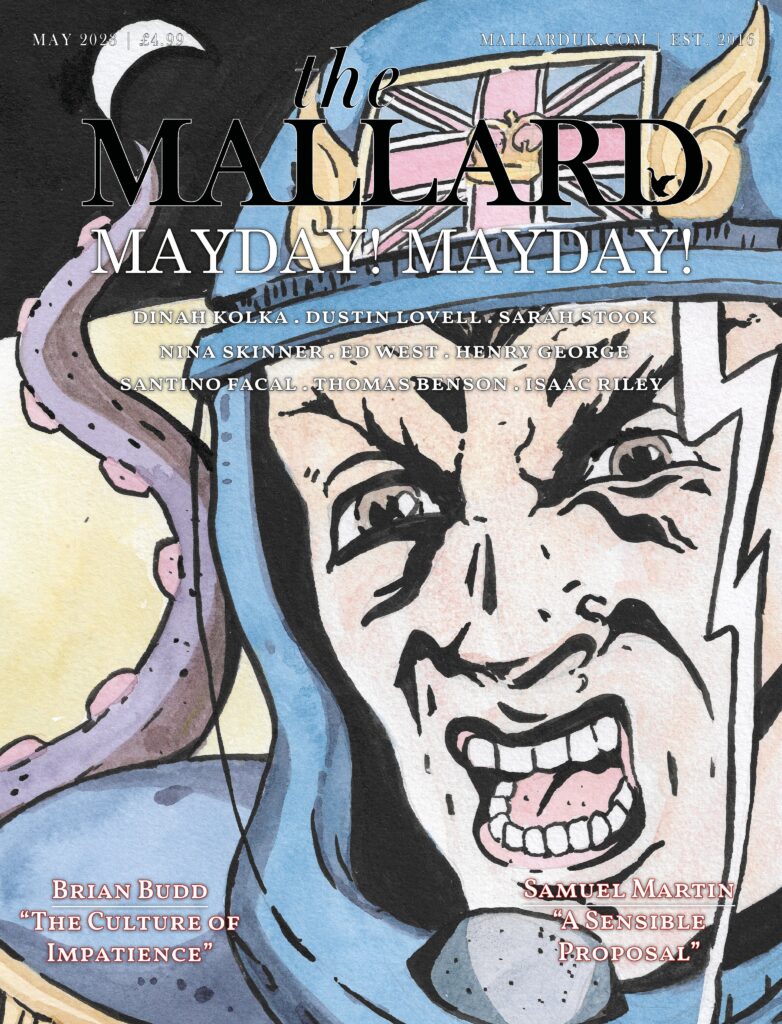
This is an excerpt from “Mayday! Mayday!”. To continue reading, visit The Mallard’s Shopify.
-
Putin’s War: A Tale of Soviet Romanticism and Western Ignorance | Daniel Hawker
With Russian troops having begun a full-scale invasion of neighbouring Ukraine, President Joe Biden was recently asked by a journalist “Do you think you may have underestimated Putin?” In response to the question, the supposed ‘most powerful man in the world’ offered merely a smirk and proceeded to sit in silence whilst his team rushed to stop the video recording. This was inevitably due to the honest answer being yes – the warning signs have been evident for decades. Let us first consider the historical basis for the invasion.
Vladimir Putin’s position as a Soviet romantic has come to be a defining aspect of his political image. In his 2005 state of the nation address, he notably referred to the 1991 collapse of the USSR as “the greatest geopolitical catastrophe of the century”, an event which left “tens of millions of our fellow citizens and countrymen … beyond the fringes of Russian territory”. It is this Slavophilic perspective that is paramount in understanding the motives and aims of Russian foreign policy in Eastern Europe. With the fall of the USSR came, according to Russian nationalists, the mass displacement of Soviet citizens outside of the Motherland. Millions of Slavic people, all of whom shared a rich cultural history, now living within the borders of independent states, stripped of their collective identity. At this time, young Vladimir Putin was working for the Mayor of Leningrad, and this moment came to shape his ideology and vision for Russia’s future (and the future of former-Soviet satellite states).
Ukraine however, has always occupied a special place within Russian romantic nationalism. The Russian Federation actually has its origins in modern-day Ukraine – specifically the Kievan Rus’ federation (consisting of East Slavic, Baltic and Finnic peoples), which existed from the 9th to the 13th century. Linguistic and cultural roots remain strong, with most Ukrainians also speaking Russian, especially in the eastern and southern parts of the country. Whilst a region of the Russian Empire (and later the USSR), Ukraine was a crucial region for agriculture due to its soil, which is exceptionally well-suited to the farming of crops.
Given this intertwined history, a key tenant of Putin’s romantic mindset is the idea that Russians and Ukrainians are one people, and must therefore exist within the same state. This view was most recently revealed in a 2021 article written by the president, titled ‘On the Historical Unity of Russians and Ukrainians’, in which he affirmed that “true sovereignty of Ukraine is possible only in partnership with Russia”. Stella Ghervas, a professor of Russian history at Newcastle University, has explained that “the borders of the Russian Empire in 1914 remain a point of reference from the Kremlin up to this day”.
However, it seems that the West has chosen not only to ignore how ideologically desperate Putin is to reclaim Ukraine, but also how brutally willing he has been to utilise hard power to achieve his expansionist aims. 2008 saw artillery attacks by pro-Russian separatists (backed by Putin) in the South Ossetia region of Georgia; 2014 brought us the infamous annexation of the Crimean Peninsula, and 2021 saw a mass-movement of Russian troops and military equipment to the Ukrainian border, raising concerns over a potential invasion. These examples should have clearly demonstrated to Western powers the lack of respect Vladimir Putin has for national sovereignty, and that once his mind becomes fixated on regaining lost Soviet territory, he can’t be easily dissuaded. With this in mind, the invasion of Ukraine should be viewed as the inevitable and long-awaited finale to Putin’s expansionist concerto.
The response to the latest developments is hardly surprising: economic sanctions appear to be a firm favourite amongst Western leaders; Boris Johnson has sanctioned five Kremlin-friendly oligarchs and aims to target “all the major manufacturers that support Putin’s war machine”, whilst Joe Biden has levied penalties against major Russian industries and frozen the bank assets of the regime’s major figures. An international effort has also been undertaken, with the UK, US, EU and Canada agreeing to cut off a number of Russian banks from SWIFT, the international payment system. However, such sanctions, especially those against individuals, have received pushback. Following Crimea in 2014, the late and greatly-missed philosopher Sir Roger Scruton published a piece in which laid out how believing that sanctions against oligarchs “will make the faintest difference to Russia’s expansionist foreign policy is an illusion of staggering naivety” – having faced the threat of increased sanctions since then, Russia has built up foreign currency reserves of $630bn (akin to ⅓ of their economy).
In terms of military responses, the general consensus is that Western troops won’t be deployed, and there is a simple logic to it – Western populations have no real hankering for a war: two recent YouGov polls revealed 55% of Britons and 55% of Americans oppose sending their own troops to fight in Ukraine (for the United States, last year’s disastrous withdrawal from Afghanistan undoubtedly turned the public off of war for a while). However, NATO troops have been deployed to Eastern Europe, and we’ve also sent 1,000 soldiers to Hungary, Slovakia, Romania and Poland, in preparation for the inevitable outpouring of innocent and scared Ukrainian families.
Whilst the objectives of the Putin regime and the long-term naivety of the Western order are the two primary factors, the West’s role in bringing this situation about must also be acknowledged, for the sake of honest discussion. In the early 1990s, Boris Yeltsin expressed his desire for Russia to one day join NATO; Putin echoed this in 2000 when Bill Clinton visited Moscow. Despite Russia at these times being a fledgling democracy, they were turned down by the alliance – provided the opportunity to start anew and help the Russian people, the West refused to bring Russia into the international fold.
Further evidence of the West’s culpability is the expansion of NATO’s borders. Although an arrangement with murky origins, the generally-understood version is that the US Secretary of State James Baker, told Mikhail Gorbachev that NATO expansion was ‘not on the agenda’. Regardless, the welcoming of former Eastern Bloc states into the alliance (Romania, Bulgaria, Latvia, Lithuania, Estonia, Slovakia and Slovenia in 2004, and Albania and Croatia in 2009) has only served to worsen relations between Putin and the West – despite the availability of open dialogue for decades, we’ve consistently chosen mistrust when dealing with Russia.
Whilst the West may be shocked that Putin actually went ahead with a military invasion, it can’t seriously claim to have been surprised; the president’s intentions regarding Eastern Europe and Ukraine especially have been nefariously evident for at least a decade, in which time we’ve fooled ourselves, downplaying the risk Russia posed. We must endeavour to remember however, the most tragic consequences of this entire situation: the many thousands of innocent Ukrainian civilians who’ve lost their lives, their homes and their feeling of safety within their own borders. For Russia, sanctions will hurt their citizens, all whilst their understanding of the situation is distorted through propagandistic state media. This really is a horrific situation, and one that has occurred because of Putin’s worldview and Western leaders’ inability to take Russia seriously as a threat.
-
What we must take from Marx
Britain is a nation that enjoys making light of its peculiarities and eccentricities. We enjoy having a laugh over a slightly self deprecating and scathing analysis of the fine-points of our society. We are keenly aware of the little things that set us apart – most famously the class system.
Unblemished by the tumults of the continent, we never saw fit to put whole socio-economic stratas to death, and such, on this isle has evolved a range of economic classes; that at times can seem whole cultures within themselves. The topic of a good Harry Enfield sketch, the plethora of verbal inflections in dialect, or what one tends to do on a Sunday, to general mannerism and pattern of speech – there is much that can set one into working, middle, or upper class. We view class not through a reasoned analysis, nor through a simple review of how much money is in one’s wallet – in fact, these tend to be quite secondary thoughts when judging someone’s place in the hierarchy.
Class is understood through a range of social signifiers, all of which have their root in one’s upbringing, which have their root in the upbringing of one’s father, and his father, and his father, and so on.
No matter how much money you win for your coffers, no matter how noble and high your method of work is, no matter how much you may put on a rendition of received pronunciation – you cannot really change your class. You may own a country estate, go shooting pheasants with the lads on Sunday, you may call your son Tarquin, but if your Dad came from a pit village, and passed down the speech, mannerism, and sentiments of said pit village to you – you’ll never leave the place. You may be able to win your son a jaunt up the social ladder, Joseph Chamberlain’s little known son called Neville transcended his father’s position in the middle class by growing up far away from his Dad at Eton, managing something of a different upbringing thereby.
The ultimate result of this strange institution is an utterly cartoonish understanding of class. It is entirely possible in this view of things, that a well-born feckless son from a manor in the home counties could spend his days shepherding pit-ponies around mineshafts in South Wales, and still outrank Gwyn Jones who was born in the pit village just adjacent, and made enough money to buy that very country estate mentioned.
Do not suppose that I write against such cartoons, they are quite wonderful, and I wish not for some Jacobin iconoclasm to mandate state-approved classes based upon occupation. These things make brilliant Harry Enfield sketches, however, when we seek to understand British society, and thereby create a successful right-wing movement, we have no time for the twee cartoons of such a sketch. We can not begin to engage in a successful right-wing, or nationalist political program without a firm understanding of how social classes interact in this country, every political movement must find itself between a class antagonism, lest it fail. Hence, we must begin to integrate Marx’s view of class into our thinking. Marx, despite standing in near complete contradiction to us, is the only thinker from which we can concretely define and analyse the real and tangible class divisions within the British people, beyond the thesis of a sketch.
Marxist class analysis centres around how one relates to the means of production. Totally ignoring someone’s salary or mannerisms – Marx defines class purely through the manner in which one works. We all know of the two main classes of industrial capitalism he expounds upon – the proletarian, and the bourgeois. The bourgeois class owns means of production (in Marx’s time this could be a cotton mill or a steelworks) he holds this capital, and purchases wage labour in order to produce goods with it. The Proletarian class are the folk from whom wage labour is purchased, not owning any means of production themselves, the working class sell their labour-power in order to make a living.
Furthermore, Marx introduces the petit-bourgeois class. Marxists (who cannot for the life of them agree on anything) disagree on what exactly this class is, and whom makes up its ranks. Simply, it could be said, the petit-bourgeois class may own alternative forms of capital (such as a small shop) but are unlikely to purchase labour power in the working of this capital, and wherein he does, he likely works side by side with the proletarians he pays.
Now, Marx does not ramble on like this all day, and he eventually gets to the point: antagonism. The ultimate purpose of delving into these social relations is getting to grips with the separate desires and interests each class works toward. To put it simply, the proletarian seeks to labour as little as possible for the greatest wage. The bourgeois, inversely, wishes for the proletarian to labour as much for the smallest possible wage.
In this, we find Marx’s most valuable lesson. In taking up his understanding of class, we need not blanketly throw his particular analysis of the Victorian urban sprawl onto our day, we need not even use the word bourgeois and such – in fact, the economic relations of our day can be said to have deviated so much from Marx’s day that such terms are useless. We must centre in on the antagonism between the classes, while also putting key caveats on our understanding of it.
If one is to ignore this doctrine of antagonism, then one is to ignore nearly all of British political history. Is not the rift that has dominated our nation since even before the Civil War that of Whig and Tory? One cannot separate these two groups from their diametric class antagonism. The Tory of the country, who profits from agriculture, who finds himself well off in the ancient landed hierarchies. The Whig who profits from the city, who thrives in more modern and capitalistic relations of the mill and steelwork. There are few debates of British political history that can be fully understood without getting to grips with this specific sociological battle. We cannot look to Peel’s full thrust support for the abolition of the corn laws, and championing of free trade thereby, without understanding that the Whig sought out this reform in order to ensure the flow of cheap grain into urban centres, and the mouths of their proletarians, at the expense of the Tory landowner and his tenant. Without this economic antagonism, there is no movement to abolish the corn laws.
Now, this is not to say that all hitherto history is that of class struggle, we should not assume that Peel was consciously plotting to pull the rug under the Tory landowner – no one thinks this way, in fact, class antagonism while informing these political disputes can sometimes enter the sub-conscious. We can understand this doctrine without becoming totally affixed to it.
Principally, we must maintain that class is not the prime fraternity of man. There is no international working class or the like, and such is a fanciful idea. Ultimately, one’s nation and ethnicity trump their class identity. Leftists like to imagine that they have more in common with a working class Chinaman than a billionaire of their ethnic kin, but while Richard Branson may have vastly different economic interests; you can share a conversation in your mutually native language, you celebrate the same festivities every year, you probably share the same cultural references and tidbits. Man is much more than his economic interests, and his identity goes much beyond what he’d like to be paid at work – such a totalising view of class ignores the depth that makes up men’s lives.
Nonetheless, we can simultaneously hold that ethnos is the prime fraternity of man, while recognising the inherent divisions within such a thing. Without a comprehension of these differences, we will remain ignorant as to how to effectively mobilise our people in a political movement. Blindly assuming that if we put forward a political program that broadly seeks to better the condition of the native Briton, that such will rally all sections of our people will lead us to ruin.
While it is true that in ‘diverse’ societies, democracy simply becomes an ethnic headcount (see South Africa) such diversity is concentrated in certain areas of our country. Areas such as Bradford fit this model much more, wherein the diametric antagonism between the native and immigrant groups naturally trumps the bounds of class, however in other areas of the nation this is not such. (Ironically, it is class antagonism that brought this into being. Former industrial areas are highly saturated with immigrant groups due to the importation of cheap labour into mills and cotton works, for example.) Thereby, we must understand the class antagonisms we can ride, and the classes with whom we have appeal.
To illustrate this, let us think to the average voter in the 1983 general election, the man who voted for Thatcher, and the man who voted for Foot. The man who voted for Thatcher, 38 years on, has likely benefited from the deindustrialisation of the country, much more attuned to a neoliberal regime of international finance and services. He is likely insulated from the demographic issues of the nation, perhaps he will scoff at some anti-social behaviour on the tube, but he is not bound by public transport. Let us think now to the man who voted for Foot, he has seen the industries his family worked in for generations crumble before his eyes, and the economic impetus of his town dry up. Equally, he has seen an unprecedented swamping of its demographic character in mere decades. He has lost his home, and his work at the behest of short sighted, shock doctrinaire neoliberalism.
Who is more likely, do you think, to support a nationalist cause? We all know that the working class tend to be more right-wing in our day, but if we do not understand the antagonism (being in this case, deindustrialisation) that this tendency has its roots in, then we shall fail to harness this support. Once we comprehend this, we will understand that nationalism has no future among the jungles of the free market, it must entail economic nationalism, and an active role of the state in economic affairs in order to steer the economy toward the national interest.
Without being at the parapet of class antagonism, that fuels all successful political movements, we march aimlessly into bogs and marshes. We must understand that nationalism has to be a movement in the interests of the disenfranchised native working class, that acts in the interests of that class. Without this, we are but ideologues barking into the wind.
-
Zero Seats isn’t Over
Keep going. The target isn’t eliminated yet. There is more to do. There is more you must do.
You have felt mush. You must keep pushing. The target must not be allowed time to recover. It is not enough that they’re tired, meandering, and feel like they’re under a slow but inevitable gravitational pull toward irrelevancy. Where they are making mistakes, they must be helped along, not just left uninterrupted.
Waiting for the next general election for the double tap isn’t enough. You must be more ambitious and more aggressive. The work must be put in now. The fight isn’t won in the ring, it’s won long before you dance under the lights.
Certainly, the opportunity for zero seats is still open. Is it possible before the next general election?
The target’s prospects are dim. There are two things a party needs to keep going and they have neither: an offer which enough of the right people want, or an ability to inspire any confidence.
If you have one, preferably both, of these, everything else (people, enthusiasm, money, effect) comes easier.
Sundries
Let’s get two small things out of the way first. Money and supporters.
Money. They’re broke.
Donors ran while their rivals raised 15 times more in large donations. They had to cut spending on cut spending on social media advertising because they ran out of money. They’ve been in trouble for a long time, even firing cleaning and security staff ahead of the campaign to make savings. Now the target is squeezing its leadership candidates. What a convenient way of weeding out the biggest of the timewasters.
Conference this year is looking ropey. Businesses don’t see any reason to go and spend lots of money for a stall or to sponsor an event or two, apparently. Previous years have earned up to £2m profit. Pretty meagre to begin with, but better than an imminent zero. Nobody to influence. That’s long before you consider what the content of Conference will be about. Nothing motivating. This will mean less money.
Money is a real problem. They never had a lot of people dedicated to the political work, or to the grind of knocking on doors, delivering leaflets, etc. and settled for a good chunk of their supporters quietly paying membership fees and other donations, which allowed them to make up for the small number of activists compared to their competitors.
Supporters. What supporters?
One estimate puts the target’s membership numbers at 172,000 as of July 2022. Do you think it has gone up or down since then? You can assume some boost ahead of the leadership election. The results of that vote will produce a number for totals and turnout. Now is a good time to buy low, perhaps, but are the signs particularly good?
Signs from the General Election and associated polling. Certainly, the winners didn’t receive very many votes in absolute – the lowest of any winning party since the 1880s, apparently. Goodness. Well, what does that mean for everyone else? They received even fewer votes. (For a particular newer party this may not mean the same thing – perhaps it’s best judged against other new entries/debuts over the years like the Brexit Party or UKIP more recently, or even going back in further psephological history to the birth of the Labour Party, perhaps).
And of this much reduced voter support, how long will that last? In the +70-age bracket, 46%. For the 60-69 range, 33%. For 50-59, 24%, much lower than the winner’s 34%.
Assuming things stay approximately the same, with the, er, normal circle of life, one projection has the target’s vote share in total declining at a rate of 2% per year. From 2025 to 2029 that would be a reduction of 24% to 16%.
Things never stay approximately the same, though, and why take the chance?
There’s no need to be nasty. Instead, be persistently, relentlessly, merely matter of fact. The target must be made to feel like it is neither hot or cold, just straightforward inevitability that it is empty and pointless. It has no energy and looks a lot like UKIP did after Nigel Farage left it all those years ago.
What is the point of you? What are you even doing? Just give it up and try again aligned with people who might actually take you somewhere.
Leadership election
Their leadership election is certainly reminiscent of those early post-Farage death throes.
This whole thing is set to be one big example of why zero seats is not over yet.
They haven’t even technically gotten rid of the “old” disgraced leader yet. And he’s going to hang around all the way until November? Past the reopening of parliament, the budget, conference season, and whatever unforeseen opportunities and scandals and events of importance might happen in the meantime?
Losing the election and the vast reduction of their MPs was bad enough. In the winner-takes-all system the UK has they might as well have had zero seats. Now they won’t have any coordinated response to anything until November? Isn’t that going to look an awful lot more like zero seats in functionality and practice?
And who have they got? The same old ding-dongs who got them there in the first place.
Many are flexing what little they have for the pony show, it seems. The pattern from the 2019 leadership race is so far re-emerging. Never mind the “front runners”, a series of true nobodies are also taking the chance to float their names. How pointless. There are so few of you that you’ll all almost certainly get a job as a shadow this or that anyway, without having to raise your profile.
And indeed, there are very, very few of you. With only 121 MPs the biggest contenders may well only just scrape together the 10 or so nominations (including themselves) needed to proceed. This is weenie. Why is nobody treating them as weenie? Treat them as weenie. They’re weenie.
Who have they got who can take on the Prime Minister (even if he is Keir Starmer) or Nigel Farage?
They’re not just weenie, they’re totally without any creativity. These people are so empty I reckon I could write every single one of their leadership pitches without having actually seen a single one of them. I’d much rather inflict that slovenly indignity on you, duckies. Does the following sound at all familiar?
“Hi, my name is Blah Blahson, and I’m standing to lead the target.
We need to be honest about where we went wrong. We didn’t listen. We broke all of our promises. We did in fact do too much of [insert random thing that was never the real issue, but something on the side or a symptom like divisiveness and infighting]. I will put an end to all that and start the difficult task of earning back your trust in time for the next election.
Here’s a bit about me and how I grew up to make me seem more relatable or sympathetic or something. Economy. Aspiration. Your dreams.
I want to be a tough ole grind-stoning cliché, cliché, cliché. I am proud of my record as [insert not totally unimpressive but generally not uncommon non-political working background here] + of my record as [insert whatever non-detailed and highly questionable ministerial gubbins they want to puff themselves up with]. I am a true conservative blah blah blah, and that is why I believe I am the right person to deserve your trust and lead us back to glory.
Next time, we’re going to be totally honest. I’m a no-BS kind of politician. It’s time for us all to unite. That’s what real leadership means to me.
That is why I am but humbly putting myself forward for leadership of the target, and I ask for your support.”
What do you reckon? That’s about right, isn’t it? Good grief.
November’s a good while away. You can expect a few relaunches of the same leadership campaign. As in, from the same politician. They’ll either fail to hit the mark or they’ll just be doing it again and again on some excuse to try to get more media attention.
And you know what? They’ll probably go through at least two leaders before the next election. And it’ll be from the same pool of MPs. People are going to get really sick of seeing the same unimpressive bunch over and over again. This is only going to be worse if, because there are so few MPs, shadow ministers are going to have to hold multiple briefs and work multiple appearances. It’ll get worse. Do you think these people have enough capacity for the mental arsenal on multiple briefs? What will this mean for their ability to cut through, to work detail, and nuance, and out-fox civil servant-resourced ministers?
All of this will perpetuate the idea that they’re disorganised and pointless. Weak.
Keep pushing on all of this. Keep pushing zero seats. It’s not over.
The target won’t reorganise
The target’s MPs don’t have it in them. There are a few reasons.
First, they’re scrabbling and struggling to keep their heads above zero seats as it is. What does this mean for reorganisation? At the best of times, MPs are looking to pick party leaders who will win them their seat, secure their seat, increate their majority, etc. First and foremost. The strongest incentive is for them personally, above anything else first, to be in office. (This is not the same as them being in power, but they think it is). It’s just that this means their own job, money, perceived prestige, pomp, etc., it’s at least somewhere in the correct 180° arc that you need to be in officer (power) to actually do anything, and that once you get some office (power) the correct thing to do politically is to keep getting more and more and more of it. The problem for the target is that they are desperate, which has its own ick, but this will also make them short-termist and wrong about what they need to do.
Second, the target has the same problem that the dying days of the Gordon Brown Labour Party had, and the first few post-2010 years. Same old people. The ideal best thing they could have done would have been to fire probably almost all of their sitting MPs and brought in a much fresher (not necessarily younger, though that might not have hurt) and energetic bunch. Even if it was naivety they’d at least sound enthusiastic and eager about whatever ideas they’d cooked up while they were dreaming of being MPs. And they wouldn’t be coming with the same dismal tainted track records. Instead, you’ve just got a bunch of blockers hanging around.
Third, the target doesn’t have anyone willing, let alone capable, of reorganising themselves. They might be making some of the right noises (see the accurate leadership pitch above) but they’ll almost certainly all be missing the point. They’ll be doing it on purpose. What’s the pitch otherwise? Here’s all these truthful reasons about why the target is awful but this time the same people will sort it out despite not understanding what was wrong before? If they understood, why didn’t they do something about it? If they didn’t understand, why humour them now? They should resign, but they won’t. Where else have they got to go? There is nothing so “ex” as an “ex-MP”. Maybe they genuinely, deludedly think that they can turn things around? Does it matter? They’re not going to go. It’s why the target is going to stay in a terrible spot.
Zero Seats is right there. Keep pushing it.
They won’t learn the right lessons
A related, but distinct-enough separate point. They won’t reorganise because they won’t learn the right lessons.
The incentives aren’t set up that way. It would mean admitting they were wrong. If they were wrong, why keep them around? Why not just start fresh with some people who were right?
They’re locked into failing to learn the lessons of the 2019 voter realignment. Reform will probably keep at it. This also incentivises them not to change. You can’t really mimic another party. At a certain point your remaining supporters leave, the ones who left will stick with the real deal, and those tempted will also just go to the real deal.
The same applies to the wets. Why not just go with the absolutely soaking in the form of the Lib Dems? Holiday-fun Ed Davey is already promising to come and kill you, at your house, in real life, and wear your dresses and makeup like the ancient Irish did, from the left.
The target is almost entirely ersatz, at best. Will that inspire at Conference?
You’ve known how empty they are for a while. It seems just as likely that they didn’t win because they were totally without plans (except for banning people from buying cigarettes or something? Who knows?) – not because they weren’t left or right enough or didn’t do anything or deliver on promises.
Beyond substance, do they even have the form for a good pitch? More on that next.
They sit out of the Pareto distribution
A lot of you were hoping for a genuine zero seats. Some of you thought sub-hundred would create the same effect.
You’re all too soft. I wanted to see one seat. Just one. Just one only lonely solely wholly put upon target MP in the whole of the country. Rishi Sunak. Could you imagine that humiliation? And then the humiliation of all the other decisions he would have had to make after that?
Anyway, a lot of you were disappointed that the target retained over one hundred seats. You suspect that this might be enough to keep them alive. Maybe, but also maybe not.
It’s still not a strong position to be in. They’re not clearly in one side of the niche of the pareto distribution or the other, are they? Genuine question.
For the uninitiated, the Pareto distribution is also known as the 80/20 rule. This is approximately that 80% of any phenomenon, market, etc. is due to 20% of the factors/actors involved. It’s never an exact 80/20 ratio, but one example might be that 80% of groceries are sold by 20% of all the grocery providers around. In other words, a small number of individual actors do most, but not all, of the business, and that remaining portion is likely done by many much smaller competitors.
In business in particular, this is important, because you either have the size and scale to do a large amount of generic mass market business, or you go smaller and niche and specialise. Think the difference between a mass market M&S suit versus Savile Row. Each has their place doing a particular sort of thing.
In the political case, does the target neatly sit in the big party or small party category? Too small to have a crack at the 80% market share, but too big to really be niche like the Green Party or Plaid Cymru or whoever?
Reform might have the opposite problem – are they genuinely going to try to break into and have a crack at being on the big boy side of that Pareto distribution? Or is it enough to function as a glorified pressure group like UKIP did (hey, not knocking it, it worked) without the full “mainstream” breakthrough?
The target is sitting very awkwardly right now.
What’s next?
Well, really, continue the Zero Seats campaign.
It’s not over. Slog it out. You didn’t think politics was going to be all excitement and meme wars, did you? Politics is a strong and slow boring of hard boards.
The way forward: take their oldies.
The target is pretty much only supported by old people now. As mentioned above, all other things remaining the same, this would see their vote share dwindling at a rate of about 2% per year. But all other things will not remain the same. There will be more oldies along in a minute. The target might start doing good politics and start making a meagre recovery.
No!
I don’t care if it’s Reform UK or the Lib Dems or the Greens or whoever or all of them. Start coming out with plausible policies, announcements, attacks, aimed at splitting off the oldies from the target.
Come on. Zero Seats!