politics

The Wire and Singapore

The small island nation of Singapore is like the American TV program, The Wire. I understand that is probably one of the weirdest opening sentences to an article about philosophy and global politics, but hear me out.

Co-creator of The Wire, David Simon, once stated the reason for the show’s success was its ability to mirror every conceivable political bias of the viewership. This was enabled by the many different themes and issues exhibited throughout the show. If you are against the War on Drugs, you will see evidence of its failings. If you support it, you will see evidence it should continue. If you believe that police failings are because of cultural or economic reasons, you will see those perspectives reflected too.

In short, within the entire series, you will see nearly every modern political issue at play as understood by every ‘side’ of said issue. What remains interesting is that, as noted by Simon, the show maintains an ability to “validate” and consequently reinforce the beliefs of the viewers.

As such, the city of Baltimore continues to hold a light to America-at-large and its ongoing issues, even if it aired 21 years ago, finishing just before the election of Barack Obama in 2008. Whether it’s urban decay, corruption, or the failure of the American Dream, what we see in the show are things that existed in the 1960’s and still exist today in this post-industrial broken city.

You can follow this train of thought into the world of global politics, which is not as far away from modern media as I would like to admit. Specifically, we have seen a similar situation emerge out of the success story that is Singapore.

Singapore is like a mirror to any political persuasion that one might have, from which also can “validate” one’s own personal politics. The only real difference is that The Wire (and by extension the city of Baltimore, I say this because the city itself is largely the main character for the entire show) are used negatively, while Singapore is used positively.

If you want to see a thriving multi-ethnic, multicultural, post-colonial state, then you can look to Singapore. If you want to see somewhere that champions free-market capitalism, then you can see it there. If you want to see somewhere with a right-wing government that places a strong emphasis on law and order, not to mention the death penalty, it’s right there between Johor and the Riau Islands.

It remains fascinating to me that a tiny island, one which most people could never find on a map, has sparked such a massive debate on what they ‘see’ when they think of Singapore.

A nation with a population comparable to Lebanon or Palestine, yet more than a hundred leagues above such countries. A right-wing free-market paradise with the best public housing in the world. Those who see its publicly-funded universal healthcare system, one of the most efficient in the world, argue to the contrary. A super politically conservative nation that’s current president is an ethnic minority Muslim woman, racial success story, model minority, etc, etc.

Is Singapore perfect? Of course not. Is Singapore used to reflect general political beliefs about the world? Well, yes. Are a lot of these views correct? Yes and no.

Politically, socially, economically, a lot of different political views and philosophies are validated by the existence of Singapore. Fundamentally, Singapore and Baltimore have a comparable effect on the politically-minded.

Do people get murdered and addicted to drugs in both places? Yes. Are both places being led by an ethnic minority leader? Yes. How we view subjects often depends on the viewer itself, as much as the subject matter in play.

Despite this, Singapore has become a symbol of success whilst Baltimore has become a symbol of failure. Singapore is a model whilst Baltimore is a failure, and nobody wants to see their political beliefs reflected or “invalidated” by the latter.

What is revealing is how two completely different places are so similar, while being so completely poles apart. Everyone can infer whatever they want from either place or still be generally, albeit not exactly, correct.

In conclusion, I think that David Simon is largely correct about this idea of how we as viewers of a thing can be so vastly different, yet so widely validated by its existence. Maybe, it’s more revealing for us, as viewers, to look at places or thematic issues within the greater context of The Discourse, whether political or pop culture, and realize we can all be somewhat right, while also being largely wrong.

Enjoying The Mallard? Consider subscribing to our monthly magazine.


Photo Credit.

British Conservatism is Ignorant of History and has Forgotten its Past (Magazine Excerpt)

This dictatorship of the present has been enabled by around thirty years of material abundance and relative peace following the conclusion to the Cold War. As John Keegan, the military historian put it, Britain and American can afford our universalist idealism and our fantasies of a benevolent world united and ameliorated through commerce, given our good geographical fortune of being separated from continents by bodies of water. We can forget that the tides of history have pulled whole cultures under in violence and war, instead indulging in an imagined progressive history, moving ever upwards towards ever greater enlightenment and prosperity.

Our leaders, if they deserve the name, have forgotten the lessons of history, because they do not know history. They do not know the fate of nations and peoples. They are ignorant of the importance of the landscape of the world and the moral landscape of the heart, and how the interplay between the two shapes the destinies of civilisation. It is not to engage in nostalgia for a vanished age that never existed to reckon with the fact that those who governed us in the past were well aware of life’s tragic nature, of the reality of necessity and the ultimate goal of the avoidance of anarchy, its own form of tyranny. Our leaders in the 19th and up to the mid-20th centuries had been baptised in the fires of historical experience and therefore knew that the maintenance of right order, in accordance with the good, true, and beautiful, was the precondition for any liberty. Utopian, romantic ideas of universal rights, spreading democracy and natural freedom were dangerous in their unbounded idealism, leading nations and government astray in the quest for moral perfection.

History never ended, in the sense Francis Fukuyama meant it. Hegel, and his disciple Alexander Kojeve, were both wrong in discerning a direction to human History that would see the creation of the perfect liberal democratic regime and state of being in our world. History is the story of the deeds men and women do and accomplishments achieved together as clans, tribes, cities, empires, and nations. It is a story that will only end at the end of all things. Awareness of the living past reminds us that our lives are part of the weave of time, stretching back across the years, our own lives and the actions we take adding the threads that continue into the future.
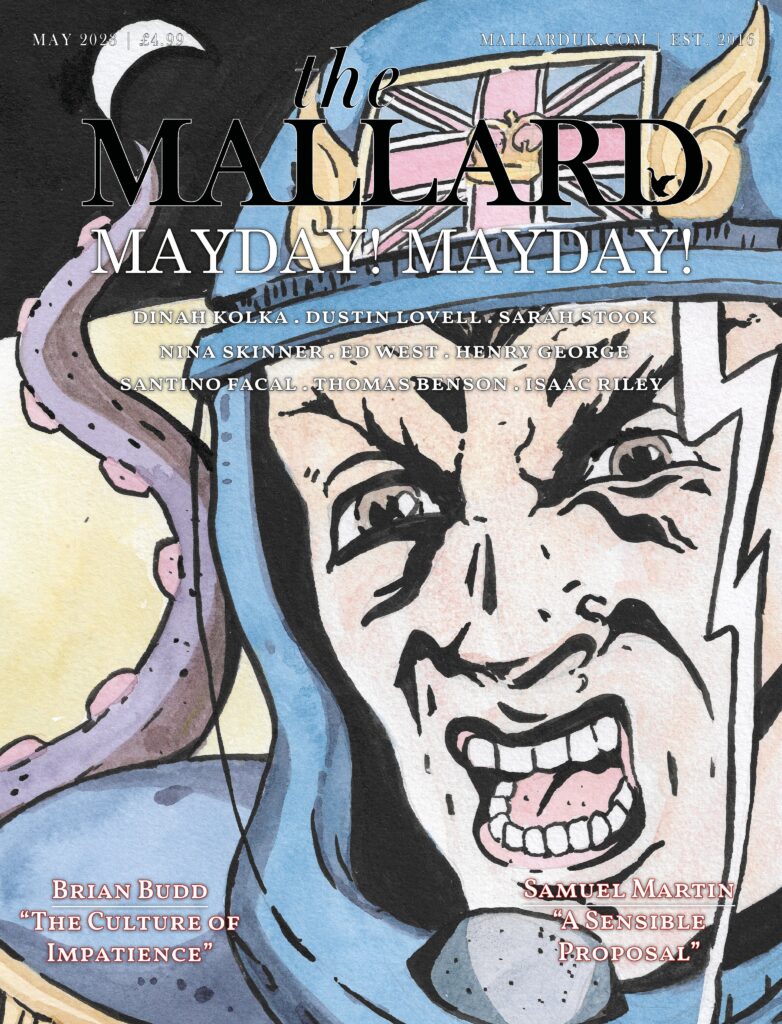
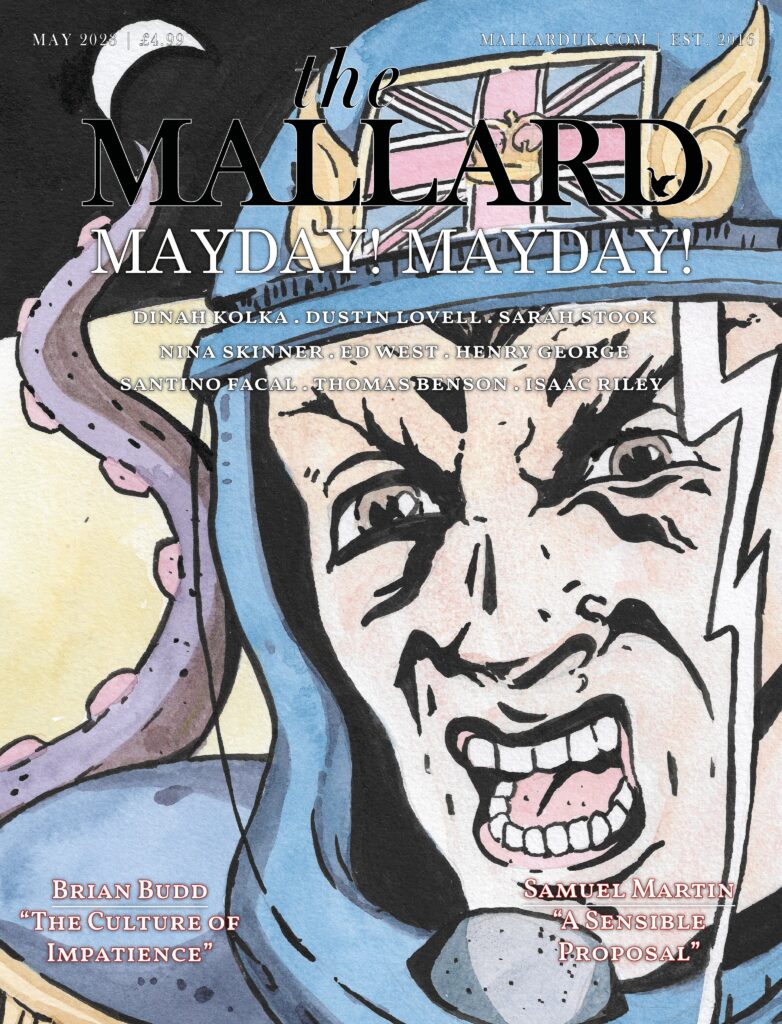
This is an excerpt from “Mayday! Mayday!”. To continue reading, visit The Mallard’s Shopify.

Photo Credit

An Opportunity from Nothing – View from the National Conservatism Conference

Strolling down Marsham street, past the Itsu and Pret a Manger, a funny looking man in a top hat flanked by grey haired beret wearing old women scream at the top of their lungs whilst recording a group of depressed looking individuals clad in ill-fitting suits who walk past them and into the Emmanuel Centre. Loud renditions of ‘Ode to Joy’ blare from the portable speakers powered from a generator in a white van plastered in EU flags.

You might think, for at least a moment, that I am describing a snapshot from 2017. That these individuals are making plans for Britain’s ‘strategy moving forward as we leave the EU’, and that Mister Bray would at least have a reason to be shouting ‘bollocks to Brexit’ at the passers-by. Instead, the year is 2023, Brexit is barely being mentioned at all inside the walls of the conference room, and no one is quite sure what he – or they – are there for.

That seems to be an outstanding theme of the conference: uncertainty. No one at all seemed to be able to pin down exactly what it was that they stood for. A plethora of rambling speeches about Edmund Burke, multiple references to ‘Le contrat sociale’, continuous struggle sessions against the rotting corpse of Margret Thatcher (who seemingly still operates behind the shadows in every corner of government), and yet nothing new or interesting was being said, just vague topics which they knew everyone would sort of agree with anyway.

Worse still, a lot of the high-profile attendees (especially the MP’s who bothered to turn up) didn’t really seem to know what the event was for. A favourite moment of mine was when, at the very opening of the event, Yoram Hazony and Jacob Rees-Mogg accidentally went ‘head-to-head’ in debating the finer points of the corn laws and the benefits of wheat tariffs in their separate speeches… absolutely thrilling stuff which really tackled… THE ISSUES.

Another devastating moment was when Suella Braverman took the stage to talk about her vision for Britain. In actuality, it was a 25-minute party political broadcast about why you should just ignore the last decade of Tory government and still trust her to ‘stop the boats’. It’s always so upsetting when you listen to actual real politicians – high ranking ministers, no less – who act like opinion piece columnists. The looks on the faces of the attendees during her talk said it all: “YOU ARE A MINISTER OF STATE, YOU HAVE CONTROL OVER THE HOME OFFICE, DO SOMETHING!”

No leadership, no courage, no unified vision. This is what the supposedly ‘Real Right Wing’ looks like for Britain at the moment. No figure appeared to give any sense of direction or policy; they would much rather ‘hash out the arguments’ and ‘make their case’ instead. This is not how you win elections or drive the mechanisms of state, this is how you gain followers on twitter or get a graduate columnist job at [MAGAZINE_NAME.COM].

Despite my negativity, I actually think that this presents a wonderful opportunity for those with more dissenting ideas on what the future of ‘national conservatism’ means in Great Britain. “NatCon” doesn’t really know what it seeks to be and has no defined leadership, so why not show it the way? Instead of feeling like a ‘captured institution’, it felt like a proto-organisation which can’t quite put its finger on what it is yet. Instead of allowing it to lean on the boring and decaying figures of the present, a fascinating vacuum is opening up to swallow anyone with the boldness to make clear cut statements on what they wish to see as the future of National Conservatism. Doing *that* would be a lot easier than any sort of ‘Tory Entryism’ which the generation before us sought to complete.

At the very least, the conference was an excellent opportunity for networking. It was nice to see a format more similar to CPAC than Tory Party Conference, with many MPs, intellectuals, and journalists more than happy to sit and chat with you outside of the main hall instead of listening to the lectures. This was genuinely enjoyable and made the experience a lot more worthwhile. I sincerely hope that more events like that can take place in future. 

Enjoying The Mallard? Consider subscribing to our monthly magazine.


Photo Credit.

A Sensible Proposal (Magazine Excerpt)

Britain is in decline. This much is true. Nobody would dare suggest otherwise – unless, of course, they wish to attest to pure ignorance or twisted glee.

Given this, we are very much in need of sweeping reform. Yet reform is not the product of drawn-out pontification. Ultimately, it is the sum of action: action moulded by proposition.

As such, dear reader, allow me to do just that. May I present to you: A Sensible Proposal.

Shrink the cabinet to its 5 or 6 most capable members, empower ministers to fire civil servants at will, and slash the civil service by at least 75% – it’s not technically Moldbuggian RAGE (Retire All Government Employees), but it’s of the same spirit.

Take the Civil Service Code and throw it on the regulatory bonfire, along with every obstructive procurement rule preventing us from becoming the AI capital of Europe.

Implement mandatory IQ tests for all new civil service hires and scrap the counter-intuitive stakeholder model of policy-making; ensuring government bureaucrats literally, not figuratively, live in The Real World.

Double the length of every sentence, especially for crimes which make civilised society impossible (murder, rape, theft, schmonking weed, etc.). Freedom, if nothing else, should mean the ability to go from A to B without being mugged, molested, or murdered.

Repeat offenders should receive at least one of the following: an extended sentence, a life sentence, chemical castration, or the death penalty. Tough on Crime, Tough on The Causes of Crime.

Abolish the Communication Act and its statutory predecessors to make speech free again. The less time the plod can spend harassing you for tweeting facts and logic, the more time they’ll dedicate to brutalising groomers of our nation’s children, vandals of our nation’s heritage, and abusers of animals.

Furthermore, abolish the Supreme Court and bring back the Law Lords – Tony Blair and Gordon Brown, eat your precious ‘modernising’ hearts out! 

Speaking of which, if we can hand out titles to cronies, half-wits, and dodgy sorts, I’m sure we can take them away – put some actual aristocrats in Parliament; of spirit in the Commons and of blood in the Lords.

Abolish the TV licence fee and replace it with nothing. That or broadcast stuff worth watching – like reruns of Kenneth Clark’s Civilisation series or Spy x Family.

This is an excerpt from “Mayday! Mayday!”. To continue reading, visit The Mallard’s Shopify.


Photo Credit.

They’ll Hate You Regardless

Well, that’s that then. It definitely could’ve been better, but I was expecting much worse; I was expecting slam poetry about the Windrush Scandal from an NHS nurse, followed by a breakdance exhibition from Diversity, a ‘witty’ monologue about gay sex from Stephen Fry, topped off with a ‘modernised’ version of God Save the King.

The concert was thoroughly mediocre though – I’d be surprised if anyone under the age of 25 could name more than half of the line-up. When will the palace learn that glitzy American pop stars are not fit for royal celebrations?

In retrospect, it’s clear that the worst aspect of the coronation wasn’t the subversion of pomp and circumstance, but the commentary which overlaid it.

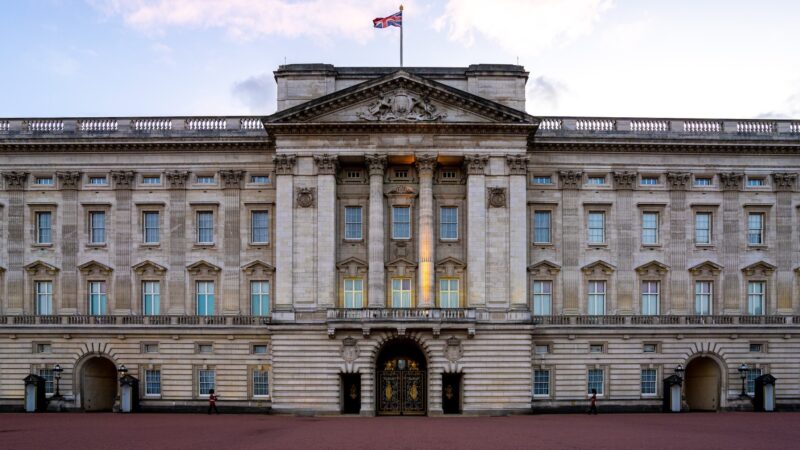
Once the more lavish aspects of the procession had subsided, along with the smattered allusions to Modern Britain, and the royals assembled on the balcony of Buckingham Palace, Bridgerton actress Adjoa Andoh, who had been graciously invited to commentate on the King’s coronation, said:

“We’ve gone from the rich diversity of the Abbey to a terribly white balcony. I was very struck by that.”

Anyone brushing this off as a stray comment from the WOKE (!!!) Liberal Metropolitan Elite clearly hasn’t been paying attention. As we saw with the death of Elizabeth, a vast chunk of the ‘criticism’ directed at the British monarchy is pure racial resentment. Don’t pretend you don’t remember.

The anti-white rhetoric of the monarchy’s critics isn’t some exceptional tendency or blip, it’s the logical conclusion of an inherently republican understandings of representation and legitimacy.

As Britain undergoes historic demographic change, primarily due to mass immigration (in other words, the result of government policy) an increasingly large subsection of the population, conscious of their distinctness to the heads of state, will likely pursue the dismantlement of what they perceive to be an arbitrarily (that is, oppressively) white Christian political structure, in order to better reflect (at the very least, better accommodate) Britain’s newly ‘diverse’ population.

If you’re scratching your head as to why the monarchy is unpopular with younger voters, I suggest you take a gander at the demographic composition of younger voters – and younger people generally.

Of course, institutions by their very nature cannot be diverse; people identify with them because they reflect a fundamental homogeneity which underpins the group from which they emerge, and by extension, seek to sustain.

Differences may very will exist within them, but none of these differences will constitute diversity in the contemporary sense, as they don’t aim to breach the underlying unity required to make them recognisable.

This is definitively true of monarchy – a role defined by a sole person, restricting any metric of difference from being, nevermind represented.

In any case, it would be simply unjustifiable, within the parameters of republicanism, for a state to have an unelected white Christian as its head, especially when the citizenry is both minority-white and minority-Christian.

Given this, the monarchy risks following the course of Parliament; a battle ground for fragmented groups with increasingly little sense of essential or collective being – antithetical to the monarchy’s imagined role as a constitutional lynchpin to counter-balance the enmity of domestic politics.

Even if the institution is defanged to the point of mere ceremonialism, as has been the case over recent decades, much to the delight of so-called “progressive patriots”, it has been maintained that even if Britain’s monarchy ceases to be politically problematic in a functional sense, it remains politically problematic in a representational sense.

The overarching point is that, as Britain’s monarch, it doesn’t matter if you permit politically motivated investigations into obvious questions or if you commit to protecting all faiths as Supreme Governor of the Church of England. It doesn’t matter if you declare your support for Our NHS or opt to include Black Gospel in your coronation ceremony.

Diversity, Equity, and Inclusion matter for zilch: your enemies will hate you regardless.

Just as Scottish and Welsh separatists are prepared to devolve the union out of existence, modernisers and republicans are prepared to reform the monarchy out of existence. No amount of capital-C Compromise is going to fundamentally change their defining position.

Moreover, just as Scottish and Welsh separatists evoke a sense of ethnocultural distinctness whilst pursuing policies to undermine Celtic culture, modernisers and republicans evoke Cromwell, Roundheads, and the English Civil War, even though Cromwell would’ve absolutely despised them, they possess the prudence and restraint of Cavaliers, and have nothing but contempt for Englishness – often proudly declaring they’re not English whatsoever.

“You will never be a real Roundhead. You have no God, you have no purity, you have no zeal. You are a narcissistic degenerate twisted by leftism and secularism into a crude mockery of English revolution.”

When the British republic comes, assuming it does, I doubt we’re going to get Cromwell 2 or Lord Protector Nigel. Indeed, Farage himself has suggested we’ll end up with some moth-bitten mandarin: “some duffer… Neil Kinnock, or somebody.” – a failed politician with the shameless desire to be remembered as a Bismarck-esque elder statesman.

Although, as circumstances present themselves, it’s completely plausible that we get a ‘respectable’ long-standing representative of the so-called anti-racist coalition… His Excellency, President David Lammy.

As far as we know, British republicanism is a team effort; a team disproportionally comprised of (exceptions accounted for) post-colonial grifters from BAME and non-Christian backgrounds, White leftists and liberals, many of whom lay claim to permanent victim credentials, with others are eager to affirm their ‘Otherness’, whether to worm their way out of discussions about colonialism or revitalise some feud the Anglo has long forgotten.

In which case, who supports the monarchy? Exactly who you’d expect. Again, accounting for notable exceptions, it’s White English conservatives, especially those living in rural areas and with Anglican heritage. In simpler terms: the sort of people that gave us Brexit, but I digress – the pivot away from memes about royal ethnic make-up to an unabashed proxy war for ethnic grievance won’t end well.

Given this, if Charles knows what’s good for him, he’ll reject any and all further attempts at ‘modernising’ the monarchy and reverse any that have been undertaken since the end of WW2, rather than counter-signalling policy that slightly, if barely, edges towards defending the interests of his realm, his post, and especially of his dwindling (in part, rather old) number of core supporters.

After all, given the transcendental nature of kingship, should a monarch violate the spirit of their post, no monarchist would feel conflicted about withdrawing their support, if not for the benefit of a hypothetical republic, but for the benefit of the institution itself.

Enjoying The Mallard? Consider subscribing to our monthly magazine.


Photo Credit.

The Internet as Mob Rule

The ancient Greeks believed political constitutions repeated in a pattern called kyklos (“cycle). The idea first occurs in Plato’s Republic, gets elaborated by Aristotle in his Politics, then reaches its apogee in Polybius’ Histories.  

Unlike modern theorists of cyclical rise and fall of civilisations, such as Oswald Spengler, the kyklos doesn’t have a zenith or golden age. It’s rather a waxing and waning of stable society types, followed by unstable society types. What characterises a stable society is that the ruling class and citizens both strive towards the common good, conceived as the objective purpose of human beings, which results in their happiness and flourishing. Society becomes unstable when its members stop having the common good in mind, and instead strive after their selfish private interests to the detriment of other citizens. 

Kyklos then presupposes several things. First, it isn’t culture specific. Its objectivist outlook means it applies equally to all political human groups, always and everywhere. Second, the engine that drives history is human virtue and vice, and not economics, class struggle, or war. These are secondary factors resulting from the characters of human beings. Healthy economies, contented class structures, well-won peace and just wars all result from virtuous people. Third, the stable government types are various. Kyklos defends neither monarchy, nor aristocracy nor a republic exclusively. It isn’t a Whiggish or utopian theory of history, that says if and only if a certain group are in power all will be well. Rather it claims that whatever group are in power, they must be virtuous to rule well. Vice immediately leads to disorder.

Simplifying in the extreme, the kyklos model runs as follows. Rule can be by one person, several, or many. When these rule for the common good, they are just, and are called monarchy, aristocracy and republican respectively. When they rule for their private interest to the detriment of society, they are tyranny, oligarchy and democratic respectively.    

It’s important to note that by “democracy” I don’t mean here a system of popular representation or voting. The virtuous form of this is called a polity or republic in classical thinking. In the latter, bonds of authority and specialised expertise remain. In the former, absolutely everything is sacrificed for the sake of equality of the masses (see below).

A good monarch rules with benevolence. His successors are unjust and become tyrants. The nobility removes them, creating an aristocratic state. These in turn degenerate into oligarchs as they grow decadent and self-interested and begin to oppress the poor. The people rise up and remove them, creating a republic where all citizens have a say. But the mass of citizens loses the bonds of political friendship, grows selfish, and the republic becomes a democracy. Democracy eventually deteriorates to a point where all bonds between people are gone, and we have a mob rule. The mob annihilates itself through infighting. One virtuous man seizes power, and we return to monarchy. The cycle begins anew.

With these preliminaries out of the way, I come to my point. I believe the present age we are forced to live through is highly ochlocratic. Of course, it’s not a pure mob rule since we have non-mob elites and a rule of law. I also think our age is oligarchic (dominated by elites swollen with pleasure). But it’s more ochlocratic, I contend, than it was a few centuries ago, and enough that mob behaviour characterises it.

The defining trait of unstable regimes, as I’ve just said, is vice. However, vice doesn’t just happen spontaneously as though people awake one morning deciding to be selfish, spoilt, and cruel. Evil people, as Aristotle notes, often believe they are good. Their fault is that they’ve mistaken something which is bad for what is good. For example, the man who hates the poor falsely believes money is the same as goodness. The man who mocks monks and sages for their abstinence believes all and only pleasure is good. Even when we know what is good for us, ingrained habit or upbringing might make the illusion of goodness overpowering. A lifetime of cake-gorging can condition one to the point it overrides the knowledge that sugar is bad for health.

            I think the Spanish thinker Jose Ortega y Gasset in The Revolt of the Masses (1930) unwittingly echoes Plato when he points to the faults of the democratic “mass-man” of the twentieth century. All human societies need specialised minorities to function. The more demanding and specialised a field, the more those who do it will be a minority of the population. Further, all societies, to function, need sources of authority which aren’t decided by a majority vote. Modern democracy has created the illusion that the unspecialised mass is sovereign and has no reliance on anybody. It has achieved this mirage through artificial liberation: creating unnatural freedoms through constant government intervention and technocratic engineering.

This in turn has supported vices out of unthinking habit. The mass-man accepts his lack of qualifications and is proud of this absence. He isn’t one deluded about his knowledge. Quite the opposite. The mass-man is someone who openly declares he knows nothing but demands to be listened to anyway because he’s a member of the sacred demos. In short, according to Ortega y Gasset, the ideology of the mass-man is: “I’m ordinary and ignorant, and so I have more of a say than those who are specialised and learned.”

The internet is a democratic medium par excellence. This isn’t to say that its members are all egalitarian and individualist, rather, its very construction assumes egalitarian and individualist ideas, and these force themselves onto its users whether they be willing or not.

Here we can extend the criticisms that Neil Postman makes at television in Amusing Ourselves to Death (1985) to the web. On the internet, all information is available to everyone. Anyone can create it, and anyone can opine on it. The medium doesn’t distinguish for quality, so the greatest products of human civilisation sit alongside the basest, on the same shelf. There are no filters online for expertise or experience, indeed, any attempts to create such filters are decried as “gatekeeping”. As a result, the internet has no difficulty settings (to use a metaphor). Getting through the easier levels isn’t mandatory to reach the harder ones. You can skip ahead, so to speak, and mingle with the pros as their peer.

Someone might object here that I’m exaggerating, since online communities monitor themselves all the time. I can indeed post my amateur opinions onto an internet space for astrophysicists, but these will mock and exclude me once I become a nuisance. However, this isn’t an answer. The internet is built on the assumption of mass wisdom, and the only way to enforce hierarchies of value on it is by banding a mob together. The space around remains anarchic. Yes, there are communities of wise people online, but these exist in an ocean of communities of fools. The medium presents them all as equally valuable. Which communities grow powerful still depends on the wishes of the mass. 

When the internet produces a rare fruit of quality, this is because by sheer accident, the wishes of the mass have corresponded to reality. It isn’t an in-built feature.

The result is that the internet functions like a classic mob regimen or ochlocracy. The medium has no sensitivity to quality, but rather responds to will, provided enough people are behind it. Those who wield influence online do so because the mob will has selected them. They are our modern versions of Plato’s Athenian demagogues, or rabble-rousers of the French Revolution. A mass of ignorant and desperate people swirls around equally ignorant and desperate demagogues who promise them whatever they want. Demagogues rise and fall as the mob is first enamoured then bored of them. As the internet has grown to encompass our whole lives, this ochlocracy has spilt out into the real world.

In this space, truth entirely drops out. It’s a common fault of the ignorant to confuse desire with truth since desires are often hotly felt and what is very vivid seems real. Our egalitarian internet machine therefore is wont to magnify desires rather than realities. And because it magnifies desires, these ever more get confused with reality, until mob wishes would replace the common good of society. I believe a good example of this is how the online demagogue-mob relationship works. When internet personalities, especially political and social influencers, fall from grace, it’s usually because their followers realise they can no longer get what they want out of them (seldom do demagogue and mob cordially separate because each has become wiser). The power lies with the followers and not with their purported leader.

Which brings me back to kyklos. A classic Greek political cycle resets when a virtuous individual takes the reigns from the mob and establishes a monarchy. He recreates justice through his personal goodness. This was more likely, I think, in ancient societies where religion, community and family were stronger, and so the pool of virtuous people never entirely depleted. If our ochlocratic internet is indeed a stage in a kyklos (or a component of an ochlocratic stage), and it ends, I think it will end with one demagogic idiocy imposing itself on the others by force.

A population conditioned by the internet to think mass-appeal as equivalent to truth will readily accept a technocratic whip provided it claims to issue from the general will. Which idiocy gains supremacy is a matter of which can capture the greater part of the mass in the least time, to form a generation in its own image. This is why I don’t think the current trend of the internet becoming more regulated and censored is good. The regulators and censors come from the same debased crop as those they regulate and censor.

Enjoying The Mallard? Consider subscribing to our monthly magazine.


Photo Credit.

A Factory for Mediocre Leadership

“Hero-worship exists, has existed, and will forever exist, universally, among mankind.” – Thomas Carlyle, ‘On Heroes, Hero-Worship, and the Heroic in History’, 1841.

I often read history through the lens of ‘Great Men’*. The term ‘Great Men’ refers to ‘Great Man Theory’. Originating from Thomas Carlyle’s lectures on heroism in 1840, later being published as ‘On Heroes, Hero-Worship, and the Heroic in History’ in 1841, the theory alleges that history is dictated by those men who possess a remarkable ability to inspire, lead, operate, and execute. These men often find themselves climbing the ladders of power with haste, winning decisive battles or reinvigorating policy and therefore dictating the future of their people for generations to come. Furthermore, these men are rare to come by.

Most notably, Great Men most often rise to power after periods of struggle and disdain. This is no coincidence, of course, as it is during these times when those seeking power find the cracks to reach it. Napoleon Bonaparte, Julius Caesar, and Caesar Augustus all rose to power sometime after periods of national crisis, and afterwards pursued a relentless set of reforms. It makes one wonder, as the United Kingdom struggles and toddles along with little direction, how long it will be before another Great Man makes our nation his own. I am not going to write yet another list of everything that is wrong in the United Kingdom in 2023, as this has become rather cliché, but it is worth saying that in such bleak and despairing times, people will seek a Great Man to worship.

Yet, if history is so full of Great Men, then where are the Great Men of today? Some present the argument that history is written and read through the lens of nostalgia, and that perhaps these Great Men of the past were not vastly different to the leaders we have today. While nostalgia will always tilt perceptions of history to some degree, it would be unfair to discredit the Great Men of history due to it. Or perhaps, the leaders of today simply do not have as much opportunity to prove their ‘greatness’. While Bonaparte, Caesar, and Augustus could ride into battle on horseback, wielding swords and witnessing stunning victories before their own eyes, the leaders of today can only really prove their greatness via oratory and data. However, this isn’t to say that a leader cannot be ‘great’ post 19th century. Winston Churchill may not have rode into battle on horseback, but he can be considered a Great Man nonetheless.

However, the greater point here is that modern democracy simply isn’t built to elect Great Men. It is impossible for the electorate to understand the character of candidates to any considerable degree if information is only presented to them via snappy slogans, 60-minute debates on Channel 4, and vague five-point policy plans. Not only do we rarely understand what it is the candidate wants to do, but we know nearly nothing about the candidates themselves. A 30-minute interview with Andrew Neil, however great of an interviewer he may be, will not accurately inform us of the deeper character of the interviewee. If one wishes to elect Great Men, you must know them personally, or at least be aware of their faults and goods to some deeper level. The modern electorate simply cannot elect Great Men, and not for a fault of their own. You could call it a factory for mediocrity.

Compare this to older processes of election, and the story is different. Richard D Brown talks of the system of election soon after the United States was birthed in his article titled ‘Where Have All the Great Men Gone?’, and says:

“The key process of nominating candidates was dominated by layers of local, state, and national elites. Candidates were selected by their peers, people who had witnessed them in action for years and who knew first-hand their strengths and weaknesses. Whatever the office in question, relatively homogeneous groups of incumbents and their associates selected candidates from among their own number. While the system was open to new men, and choices required approval at the polls, it had a distinctly oligarchic flavor. High esteem among the peer group was a prerequisite for major elective offices.”

The likes of George Washington and Thomas Jefferson were elected because the electorate knew them. The electorate trusted them. They assumed the presidency because those voting for them could trust that they had the guts, the character, and the bottle to lead this newly born nation. Furthermore, as Brown later says, these men were elected on the basis of “private, personal virtue as a prerequisite to public virtue”, and on the basis of possessing “superior wisdom, energy, initiative, and moral stature”. One could say that this system intended to elect Great Men. Moreover, this certainly is not an advocacy for the implementation of the electoral system of the early years of the United States. Instead, it tells us that our current electoral system is flawed, and that we should seek to implement electoral systems with the potential to fight off mediocrity. Electoral systems featuring some form of meritocracy and aristocracy appear to do this best.

Moreover, it was said earlier that a modern leader cannot ride into battle on horseback. Therefore, how do we identify Great Men in the modern world? Such a man should not be judged by the endless quest for progress, nor should they be wholly judged by however much of a percent our GDP rises by each quarter. If we are to identify Great Men, we need to search for the correct metrics to find them. This requires hefty research, and it wouldn’t be proper of me to claim to know how to identify Great Men in the modern world in this short article. Yet, having the capability to identify Great Men is central to moving past mediocrity.

However, as a final point, it is worth noting that the Great Men of history often have common personality traits. We have already talked of energy and charisma, but initiative, principle, and confidence are personality traits often found, and these traits should be a starting point when attempting to identify a Great Man in the modern world. Moreover, these personality traits remain massively important. While a Great Man of today may not have access to swords, bayonets, and rifles, reform and reinvigoration remains as important as it ever has. Only a master statesman is capable of successfully reforming and reinvigorating a nation. The likes of Bonaparte, Caesar and Augustus all had the vigour to do just that, and all three understood that politics is about winning.

*Today, ‘Great Men’ are sometimes referred to as ‘Big Beasts’, and the purpose behind this is to include great female leaders under the term. While I rarely like to modernise language (and haven’t done so in the article above), I do believe it is worth writing this note here, for there have been many great female leaders of whom possessed many of the same traits as Great Men.


Photo Credit.

The Original “Original Right-Wing Gramscians”

Last year, The Mallard’s Chairman, Jake Scott, wrote two essays titled “The Original Right-Wing Gramscians”, detailing the history, ideology, and influence of free-market think-tanks in post-war Britain.

However, unlike the post-war free marketeers, whose “right-wing Gramscian” descriptor has been added retroactively, the French ‘New Right’ (Nouvelle Droite) openly characterised themselves, as did others, as “Gramscians of the Right” – both during their intellectual ascendancy in the 1970s, and during revived interest in their movement around the turn of the millennium.

Whilst technically established in 1968 with the foundation of the ‘Groupement de Recherche et d’Etudes pour la Civilisation Européenne’ (GRECE; Research and Study Group for European Civilization), the most recent attempt at a unified doctrine for the French (and, by extension, European) New Right is found in an essay titled “The French New Right in The Year 2000” (FNR2K).

A relatively short work, the FNR2K reads less as a political manifesto and more as an intellectual one. Granted, the content is political, but it doesn’t confine itself to the trappings of electoral politics. After all, the French New Right (FNR) grew out of electoral alienation, instigated by consecutive right-wing electoral defeats throughout the 1960s.

This prioritisation of intellectualism over electoralism is made clear off-the-bat when Alain De Benoist, often dubbed the FNR’s leading figure, dispels the idea that the FNR constitutes a “political strategy”. Instead, the FNR is defined as a “school of thought” attempting to “formulate a metapolitical perspective”.

Metapolitics, Benoist continues, is “not politics by other means”. Rather, it is the idea that “ideas play a fundamental role in collective consciousness”. All human actions, trivial or revolutionary, take place within a framework of “convictions, beliefs, and representations which provide meaning and direction”. These “convictions, beliefs, and representations” are the focus of the FNR’s work. In simpler terms, metapolitics is that which is outside, but shapes, the development of politics.

FNR2K is divided into three sections: Predicaments, Foundations, and Positions. ‘Predicaments’ is divided into three sub-divisions: What is Modernity?, The Crisis of Modernity, and Liberalism: The Main Enemy, all of which provide context to the FNR’s intellectual work. 

‘Foundations’ establishes the FNR’s theoretical first principles in relation to a variety of topics: man, society, politics, economics, ethics, technology, the world, and cosmos. Throughout, these first principles are juxtaposed with the theoretical first principles found in liberal modernity.

Finally, ‘Positions’ summarises that which the FNR is for and against, as well as an additional 13th stand-alone commitment to promoting “independence of thought and a return to discussion of ideas”.

The FNR interprets Modernity as a convergence of five processes: Individualization (the destruction of traditional communal life), Massification (the adoption of standardised lifestyles), Desacralization (the replacement of religious understanding with scientific understanding), Rationalization (the hegemony of “instrumental reason” via capital and technology), and Universalization (the globalisation of assumed-to-be superior models of social organisation).

The Crisis of Modernity refers to the failure of these processes to produce their initial promises of Freedom and Equality. Freedom has been reduced to a procedural formality; it means to operate “within the marketplace, technoscience or communications without ever being able to influence their course”. Erstwhile, Equality has failed two-fold. It has both “betrayed” the people it allegedly sought to benefit (e.g. the murderous nature of communist regimes) and has been “trivialized” (e.g. growing economic inequality under capitalism). Specifically, this has happened despite Equality being the foundational principle of both communism (equal access to means of production) and capitalism (equal opportunity to prosper within a market economy). 

As such, the end result of Modernity is “the most empty civilization mankind has ever known”. Contrary to a free and equal paradise, “the language of advertising serves as the paradigm for public discourse, the primacy of money has made commodities an omnipresent feature of society. Man has turned from a social animal to a hedonistic object; he occupies an unreal world of drugs, virtual reality, media-hyped sports” – he operates as a “solitary individual” amid an “anonymous and hostile crowd”.

Considered to be “the dominant ideology of modernity”, it follows that Liberalism is the FNR’s primary intellectual target. Attacked for reducing life to individualistic economic competition, erstwhile imposing a hypocritical notion of value-neutrality, the FNR considers Liberalism responsible for creating a barren existence: survival for the sake of survival, an existence devoid of higher purpose or aspiration.

However, Liberalism is not the only target. Whilst charitably described as a “legitimate reaction”, the FNR dismisses Marxism as a counter-productive and misdirected response to the problems arising from Liberalism, being rooted in common modern presuppositions.

As an example, Benoist points to the modern welfare state. Emerging as a reaction to the autonomous market, the welfare state does not restore historic communal ties undone by Liberalism. Rather, it assisted in re-engineering society to adhere to the matrix of mere production and consumption. Whilst Liberalism is nothing more than a “global system of production and reproduction”, Marxism has created conformity around “an opaque redistributive structure”, one which has “generalised irresponsibility” and has transformed members of society into “nothing more than recipients of the public system”. 

In summary, Modernity has reduced humanity to the lowest-common denominator; to the barebones of production and consumption, supplementing its constituents with a hypermodern array of metastasized rights and a dehumanising system of welfare. Compounded, the end result is a frightful and depersonalised lumpen.

In response to this hellish existence, the FNR begins to lay the ‘Foundations’ of its counter-ideology. At bottom-level, this means recognising a distinction between Pluriversuum and Continuum; a distinction between what is diverse and particular (‘plural’) and what is constant and universal (‘continuous’).

Contrary to Modern depictions of man, either as an “infinitely malleable” atomised individual or the sum of a single specialised factor (i.e., economy; homo economicus) – man is neither wholly determinable or determined.

For example, one can’t change his ethnicity or family, but can, in a moral sense, choose to “go beyond himself or debase himself”. In this instance, the Pluriversuum of man is exemplified by the natural diversity of communities which exist in the world, whilst the Continuum of man is exemplified by his ability to engage in decisions, irrespective of his particular community and its customs. Neither is more key to man’s nature than the other; they are distinct but equally important aspects of what he truly is.

Against the backdrop of the first section, the FNR sees Modernity as reducing Earthly existence to Continuum (technical decision-making within a globalised system of production and consumption) at the expense of Pluriversum; liberal modernity means global homogenization (or, as it has become known in some circles: globohomo).

Given this, it follows that the origins of man, a social animal, as well as the affairs of his society, are also beholden to this logic. Society cannot be reduced to a homogenised collective or aggregated individuals, but a “body of communities” – families, neighbourhoods, localities, national ethnicities and supranational groups; they are distinct and defined by their respective, precise, and unique relation to each other.

Politics is an art, offering a vibrant plurality of forms, renditions, improvements and cultivations, unlike the Modern understanding which situates politics as a system of management; decisions are made to be purely technical and “neutral”, denying any fundamental alternatives to the machine, reducing politics to a matter of stability, rather than the deliberation and actualisation of ideas.

Economics (oikos-nomos; family law) must be recontextualised, from the narrow realm of immediate and quantifiable transaction to a broader understanding which incorporates distinctly qualitative values, such as beauty, ecology, family, and ethics.

Ethical values, whilst universally contingent on the distinction between good and bad, and other such related categories, must be allowed to organically develop into specific customs appropriate for particular societies. The universal reduction of morality to “practical materialism” must be resisted. This principle of striving towards excellence, provided specific meaning by context, is also true of different modes of life within a community; a good plumber is better than a bad philosopher.

Technology, whilst celebrated for its “Promethean” capabilities, must be harmoniously balanced with environmental custodianship. Concern for the natural world should stem not from government regulation or technophobia, but from a shared moral conscience; one which earnestly wishes for future generations to inherit a world “no less beautiful, no less rich, and no less diverse than the world we know today”.

Having established their given context and theoretical response to said context, the FNR2K concludes with its ‘Positions’ – what it is against and for:

Against Uprooting, For Strong Community Identities; Against Racism, For Difference; Against Immigration, For Cooperation; Against Sexism, For Gender; Against The New Class, For Bottom-Up Autonomy; Against Jacobinism, For a Federal Europe; Against Depoliticization, For Democracy; Against Productivism, For New Forms of Labour; Against Ruthless Economic Policies, For Economy at the Service of the People; Against Gigantism, For Local Communities; Against Megalopolis, For Cities on a Human Scale; Against Unbridled Technology, For Integral Ecology; For Independence of Thought and a Return to Discussion of Ideas.

Many of these points will be intuitively, if not immediately, understood, such as the first, third, ninth, tenth, eleventh, twelfth and thirteenth. After all, these are matters regularly discussed and supported by more traditional conservatives: social cohesion, national identity, strong borders, developing social and economic capital, aesthetical refinement of all kinds, and environmental custodianship.

Although there has been strong pushback against ‘gender ideology’ and corresponding issues (i.e. transgenderism), one shouldn’t be misinterpret De Benoist’s use of ‘gender’ – he’s saying very much the same thing: men and women are ontologically different and one cannot, and should not, become the other.

Even unfamiliar terms like “The New Class” immediately become familiar once De Benoist pins down a summary:

“…the manpower for the media, large national and multinational firms, and international organisations. This New Class produces and reproduces… the same type of person: cold-blooded specialists, rationality detached from day to day realities… engenders abstract individualism, utilitarian beliefs, a superficial humanitarianism, indifference to history, an obvious lack of culture, isolation from the real world, the sacrifice of the real to the virtual, an inclination to corruption, nepotism and to buying votes… The New Class depersonalises the leadership of Western societies and… lessens their sense of responsibility.”

All this said, some points are likely less understood from the get-go. Despite being listed second, the commitment to ‘difference’ is perhaps the central defining tenet of the FNR. Dubbed “the right to difference” De Benoist suggests, as a matter of principle, that diversity is good – diversity of people, cultures, systems, products, religions, and ideas.

Placing primary emphasis on ethnocultural diversity, the “right to difference” is meant to counteract what De Benoist sees and refers to as “the ideology of sameness” – an all-encompassing term for global homogenization and all its various forms: mass immigration, economic and cultural globalisation, philosophical universalism, egalitarianism, and so on.

However, whilst the “right to difference” forms the basis for the FNR’s support for group-based, individual, and ideological differences, it also provides a basis for conserving differences in a whole host of other domains.

Democracy is, first and foremost, understood as a rejection of universal equality; it recognises “a people” – defined by a common, but distinct, sense of membership – as the basis for legitimate deliberation and decision-making, both in the name of the common good and as an expression of individual agency. This is situated in contrast to depoliticization, which does not recognise the existence of a people, and by extension the sovereignty of the people, allowing bureaucrats, technocrats, and lobbyists to forego pluralism and disqualify certain political programs at will.

Similarly, instead of a “Europe of Nations” or a “European Nation”, the FNR2K poses organic regional secession from existing European nation-states, and the ‘bottom-up’ federalized along Eurocultural lines (including Russia), affording distinct identities and devolved powers to all principalities, with the exception of “those matters which escape the competence of the lower level” and apply to “all the federal communities” of Europe, such as major military, diplomatic, legal, environmental, and infrastructural matters.

The FNR believes: “the nation-state is now too big to manage little problems and too small to address big ones” – civilizational superorganisms, organised in a polycentric patchwork, albeit with integrated research, industry, communications, and currency, are necessary for securing autonomy, tranquillity, and difference.

Labour must be reinterpreted beyond a ‘productivist’ understanding – it must incorporate work that is conducted and valued for qualitative, rather than merely quantitative, reasons; this ranges from labours of love and duty to ensuring the fruits of labour strive for timelessness, rather than obsolescence.

Additionally, modernity has created a society “where payment by salary is the principal means of integration into social life”. As such, the mission of reimagining labour is two-fold: “to work less in order to work better and in order to have some time for oneself to live and enjoy life”.

Tell me: doesn’t it feel as though you’ve heard all of this before? That you have felt, read, or even articulated such sentiments yourself? To be clear: I am not remarking on the originality or unoriginality of the FNR2K. After all, what good would such a point prove? ‘Originality’ – the moralist insistence to reinvent, the insistence of newness as a virtue – is a cornerstone of modernity.

Rather, I am remarking on how a document published over 20 years ago still bears an uncanny resemblance to matters the British right has, seemingly, only begun to publicly engage with, even if only peripherally, over the past few years: disaffection with liberalism, deracination in a society struggling to be cosmopolitan, the ‘bloatedness’ of institutions, the sense of ennui amid barely managed decline, the ‘re-emersion’ of tribal and class antagonism, the vicious discourse surrounding hereditarian innateness and social malleability, the homogenisation of everything from brand logos to community identities, from the sound of music to values and customs, from architecture to our options at election time.

Despite this, Francophobia has become something of an informal cornerstone of the British right’s identity; THB Britain Should Invade France, etc. Such parochialism, whether sincere principle or hollow performance, does not aid our political or intellectual development.

If the British right is prepared to concede, as it has done so before, that despite historic animosity and cultural differences, Britain and France share common civilisational challenges (multi-faceted demographic change, the future of freedom, sclerotic and hostile institutions, etc.) then it should also be prepared to engage with and learn from French – and more broadly, European – interpretations of affairs.

It’s no debate. The French right talks about positive visions for the future, the British right talks about the Plank of the Week. Whilst the British right mobilised to find footage of Keir Starmer not wearing a seatbelt, the French right almost made Eric Zemmour president of the republic. In Britain, we’ve only just got around to discussing illegal immigration. By contrast, France is way ahead of us.

It’s clear that many of our problems are here at home, not with the “Cheese-Eating Surrender Monkeys”. Given how intellectually barren the political landscape is generally, particularly on the right, perhaps it wouldn’t hurt to look beyond the English Channel, and see what our continental adjacents can offer as inspiration.


Photo Credit.

Britain’s Brown Scare

A spectre is haunting Britain – the spectre of fascism. At least, that’s what we’re told.

In Technology, Communism, and The Brown Scare, Curtis Yarvin defines The Brown Scare as: “America’s ginormous, never-ending, profoundly insane witch-hunt for fascists under the bed.”

However, it is blatantly apparent that this witch-hunt is not inherently American in character. Indeed, such paranoia greatly afflicts the wider Western world, and certainly the United Kingdom.

This month, Sadiq Khan, Mayor of London said: “Those that have legitimate objections [to ULEZ expansion] are joining hands with a far-right group.”

“Let’s call a spade a spade, some of those outside are part of the far-right, some are Covid-deniers, some are vaccine deniers, some are Tories.”

Currently, ULEZ (Ultra-Low Emission Zone) covers all areas within the North and South Circular Roads, but is set to expand across all London boroughs from 29th August 2023.

Vehicles that are not ULEZ-compliant will receive a daily charge of £12.50. This means that cars, motorcycles, vans, and specialist vehicles up to and including 3.5 tonnes, and minibuses up to and including 5 tonnes, will be charged.

Exemptions will be given to lorries, vans, or specialist heavy vehicles over 3.5 tonnes, and buses, minibuses, and coaches over 5 tonnes, which will continue to pay the Low Emissions Charge (LEZ) charge.

Unsurprisingly, there have been a range of objections to ULEZ expansion.

Many commuters cannot afford the charge and fear it will be detrimental to small businesses. Others are angered that no such proposal was included in Khan’s manifesto, and that the results of the ensuing consultation on ULEZ expansion have been ignored.

Some object to the planned expansion of surveillance that is required to make the policy workable, whilst others argue ULEZ is unworkable altogether and will not help lower carbon emissions.

On the whole, none of these positions are conspiratorial. If anything, they’re all pretty straightforward expressions of democratic and economic concern.

Nevertheless, all these objections are irrelevant because, at least according to Khan, opposition to an arbitrary proposal that will destroy livelihoods, expand mass-surveillance, and do little to help the environment is, allegedly, tainted by vague “FAR RIGHT” (!!!) tendencies.

As many have surmised, this is nothing more than a political tactic. Khan hopes that by condemning objections as “FAR RIGHT” (!!!), the Anti-ULEZ campaign will divert time, energy, and resources away from protesting his insane and popular policy, and towards expunging their association with the unnamed, unsubstantiated, likely fictitious and/or irrelevant “far-right group”.

Whilst this is true, it misses a more straightforward point, albeit one that is harder to bring up: just because something is “FAR RIGHT” (!!!) doesn’t mean it’s wrong.

Why would it matter if ULEZ is opposed by the “FAR-RIGHT” (!!!)? As a policy, ULEZ is either good or bad depending on its intent, feasibility, and results and should be deliberated and implemented accordingly.

Unfortunately, the Sensible People, despite their obsession with Forensics, care very little for detail. Totally PR-brained, the ‘connotations’ of one’s words carry infinitely more weight than what one actually says.

As such, they are not only inclined to pedantic language-policing, they assess politics by every metric other than policy.

Take the Wakefield controversy as another example. A group of four children, and their families, received death threats after word got out that one had smudged a copy of the Quran, the Islamic holy text, as well as a suspension from their school, despite the headmaster’s declaration that there was: “no malicious intent by those involved.”

Consequently, the boy’s mother was dragged into the local mosque – by the police, no less – in what can only be described as Modern Britain’s equivalent of a Struggle Session.

Teary, veiled, and evidently shaken, she profusely apologised for the behaviour of her son, who is autistic, stating: “[he] doesn’t always realise what is appropriate and what is not appropriate.”

As we all know by now, in Modern Britain, the role of the police isn’t to prevent the type of crime that led to its founding. Recent data, published in The Times, shows that serious crimes, including but not limited to: harassment, assault, stalking, and criminal damage are virtually legal, and that charge rates have plummeted to an all-time low since 2015.

Rather, the purpose of the British police is to calm the ungrounded fears of society’s most unhinged members, those who believe that Britain’s traditional identity, and the preservation of it, inherently predisposes people to THE FAR-RIGHT (!!!), and that there is an omnipresent conspiracy to turn Britain into the least ethnically homogenous ethnostate in history.

As such, the permanent policy of the contemporary British state is not protection, but social engineering; it is one of never-ending, domestic, ‘de-Nazification’.

In fact, this establishment-sanctioned whataboutism, perpetually pointing the finger at the FAR-RIGHT (!!!), is so pervasive that not even national travesties can escape its grasp. 

Charlie Peters’ recent documentary, aired by GBNews in February, outlined the scandalous racially charged abduction, trafficking, and rape of thousands of young white girls by south Asian men; a practice which took place across the UK over multiple decades.

Despite the eye-watering amount of completely preventable suffering caused by the scandal, it was clear that such evil was continuously swept under-the-rug by British police; specifically, for the sake of “political correctness” and “community cohesion.”

Like the police, whose complicity in suppressing public knowledge of the scandal has not resulted in a single firing, left-leaning and liberal-leaning individuals, led by a pseudo-academic, are calling for the censorship of Peters’ documentary, believing it emboldens the far-right, stokes racial stereotypes, and promotes “hate” and “division”.

Needless to say, but worth saying nonetheless, when 1 in 73 Muslim males in Rotherham are involved with paedophilic rape gangs, there is no community cohesion to fuss over – it simply doesn’t exist.

This is perhaps the defining feature of Britain’s Brown Scare: it prevents people from understanding what is right in front of them, whether it’s the condition of one’s community or one’s own material interests.

The Manchester Arena bombing, the deadliest terrorist attack and the first suicide bombing in the UK since the 7/7 bombings, conducted by a foreign-trained Islamist that came to Britain as a refugee, has been retroactively rewired to make the bombing about the threat of FAR-RIGHT (!!!), as opposed to Islamist, radicalisation.

No doubt about it, if a civilisation-ending meteor were to crash into Earth, Britain’s pseudo-intelligentsia, the Waterstones Intellectuals that they are, would use their last moments to make pseudo-profound remarks about how such a travesty would ‘embolden’ THE FAR-RIGHT (!!!).

All this said, it’s clear that this delusional preoccupation with an impending fascist threat isn’t a recently-concocted political tactic. Rather, it is at the centre of the West’s post-war secular theocracy. As such, we can expect The Brown Scare to afflict wider culture, more so than mainstream politics, and indeed it does.

Whether it’s Coronation Street’s goofy storyline about a white working-class kid joining the “FAR-RIGHT” (!!!) after he’s replaced by a refugee at his old school, or the upcoming 60th anniversary special of Doctor Who, which is set to feature an antagonistic “FAR-RIGHT” (!!!) party, aestheticized as a mishmash of every “FAR-RIGHT” (!!!) development as of recent: GBNews, Patriotic Alternative, MAGA, Brexit Party, Vote Leave, The Conservative Party, you name it.

Drag Queen Story Time, which involves an adult-entertainer talking to infants about sexual exploration, gender identity, and… other things – Y’know, good family-friendly stuff – was hosted at Tate Britain, inciting sizeable protests and counter-protests. How did the media portray this debacle? As a far-right attack on human rights, but ultimately a triumph for liberal society.

Erstwhile, Prevent, the government’s own anti-terror programme, has flagged various films and TV series as FAR-RIGHT (!!!) material, including but certainly not limited to: Zulu, The Dam Busters, Yes Minister, Civilisation, The Thick of It, and (perhaps most ridiculously of all) Great British Railway Journeys.

In addition, the list features authors ranging from Thomas Hobbes and John Locke to Thomas Carlyle and Edmund Burke. Tolkien, Lewis, Conrad, Huxley, even Orwell, make a debut on an official red-flag list used and taken seriously by the British state.

Even the works of our national poet, Shakespeare, were listed as potentially dangerous material. Considering this, it’s no wonder they are being adapted to conform to our post-war neurosis, with a recent showing of The Merchant of Venice being about fighting Oswald Mosley’s Blackshirts.

At this point, one cannot pretend that the scare is just a fringe, confined conspiracy – it’s a widespread, mainstream conspiracy theory that masses of people, “low-status” or “high-status”, have bought into wholesale.

Things have gotten so bad that the BBC, not exactly in good books of “THE FAR RIGHT” (!!!), or the right in general for that matter, had to release a press statement telling people stating that, despite rumours of a “sixth episode” being pulled to avoid “right-wing backlash”, no such episode of Sir David Attenborough’s new series, Wild Isles, exists or has ever existed.

Given this daily bombardment of delusion, there is a tendency to push back; to demonstrate a more measured approach to the topic of fascism, usually echoing, or making direct reference to, Orwell’s words in What is Fascism?: 

“The word is almost entirely meaningless. In conversation, of course, it is used even more wildly than in print. I have heard it applied to farmers, shopkeepers, Social Credit, corporal punishment, fox-hunting, bull-fighting, the 1922 Committee, the 1941 Committee, Kipling, Gandhi, Chiang Kai-Shek, homosexuality, Priestley’s broadcasts, Youth Hostels, astrology, women, dogs and I do not know what else.”

This tendency is completely understandable. When Reform UK and left-wing individuals with mildly gender-critical views are listed alongside fringe and powerless Neo-Nazi weirdos as threats to society, one gets the impression that those seeking to affirm the veracity of UK-wide fascist collusion are, to say the least, scraping the barrel.

However, this misses the overarching point: according to those afflicted by Britain’s Brown Scare, nothing is in possession of any inherent quality.

From raiding wallets to raping, bombing, and harassing children, from blacklisting timeless literature to human trafficking, things most people would consider egregious, only become worthy of condemnation depending on their imagined relative proximity to Adolf Hitler, or their hypothesised potential to ‘embolden’ the “FAR RIGHT” (!!!).

Most recently, of course, Gary Lineker has been suspended from the BBC after he compared the government’s recent attempts to crack down on illegal channel crossings to 1930s Germany.

Whether one thinks Lineker deserves to be suspended or not is beside the point: Britain’s Brown Scare is believed by those in positions of considerable influence, not just nutty FBPE parochialists.

With a general election set to take place next year, and a Labour victory all but officialised, we can expect Britain’s Brown Scare to get worse, especially when Modern Britain’s founder, Tony Blair, is effectively shadow-leading the party.

Besides, how are Labour meant to remain in power if they don’t satiate the delusions of those that support them to save the NHS and immigrants from Tory Brexit Fascist UKIP Stalinism?

However, none of this means Labour is popular. The British people would like nothing more than a new party, with one-quarter of Brits saying they would support a party led by Farage, which is prepared to lower immigration, bring economic stability and growth, and tackle crimes that people actually care about.

It goes without saying that such a party, unlike the current Conservative Party, should be willing to protect right-minded citizens from the detached and paranoid fury which afflicts much of the populus, and threatens what remains of our livelihoods and liberties.

Many things can happen in politics, but one thing is certain: as long as the Brown Scare continues to spread, speaking the truth will remain a revolutionary act, and those with an outlook barely distinct from David Icke will be considered Sensible Centrists by everyone in a position of power.


Photo Credit.

Squandering a Revolution

Ignore the snarky joylessness of self-important losers and the performative perplexing of Very Serious Political Commentators, the past few days have been hilarious. Brought down by inadvertent kamikaze molester “Pincher by name, Pincher by nature” Chris Pincher, appointed to be (you couldn’t write this) a party whip, amounts to more than another Gay Tory Predator scandal. Instead, we are finally witnessing the end of Johnson’s inert and wasteful premiership.

Here I was thinking we’d be dealt an anti-climactic resignation over a piddly piss-up. All those times half-wit pundits, with their mundane alcoholism, lapsed anuses and hyperlinked relatives on Wikipedia, insisted that “it’s over” for Boris, only for such prospects to be dashed when a big fat *nothing happens*, effectively wore down the belief that Johnson could be removed at all.

However, just as a monkey could write Shakespeare if given enough attempts, journalists occasionally conjure the ability to publish something with a kernel of veracity, in this case – the government is imploding because Johnson feigned ignorance of Pincher’s pinching.

As funny as it is to see Boris’ top guys do a 180 in less than 24 hours, contrasted to the inexhaustible ride-or-die energy of Nadine Dorries, you came here for Insightful Political Commentary; a lucid outline of What is To Be Done, you came here for The Ideas. Very well, ladies and gentlemen. After all, chaos is a ladder.

Like most conservatives, I am torn between my hatred of Johnson and my hatred of full-time Johnson-haters. The former was handed an unconstrained sledgehammer to smash the Blairite machine. Criminally underutilised, it was primarily used for tasks completely incongruent with the telos of a sledgehammer – Building Back Better, Levelling Up, etc.

Adding insult to injury, the constructivist rhetoric was entirely devoid of actual construction. Housing prices continue to climb, the borders are wide open, the tax burden continues to punish the most productive, supply-side solutions to energy problems are practically non-existent, and all ‘attempts’ at resolving [REDACTED] have mounted to nothing more than superficial lip service to whip up momentary support from disaffected voters. For a man versed in the classics, Boris should know Heraclitus’ First Cause – Construction and Destruction were born joined at the hip, the fire which festers within a blacksmith’s forge and the fire which springs from a Molotov cocktail are the same force.

In the case of the latter, the full-timers sincerely believe that Boris has made extensive use of his loaned hardware, obliterating Those Ancient British Traditions: the NHS (1946), the HRA (1998), Supreme Court (2005), Britain’s membership of the EU (1992), etc. Ironically, had Johnson aspired (never mind achieved) more than a measly fraction of the aforementioned, he would be leading by double-digits.

The derangement of these full-timers makes one wish Johnson had made like Caesar and crossed the Rubicon. If not to pursue a revolutionary agenda, then to amplify the deserved misery of Britain’s worst inhabitants; the type of people that Tumblr-format tweets about having integrity in politics – “The Parties, The Lies, The Cheese and Wine, it’s DISGUSTING” – as they listen intently to the most recent episode of Alastair Campbell’s podcast.

It’s old news, but it’s worth remembering that Boris is not a conservative. He’s a liberal whose self-obsession disrupted what would have been his natural Brexit alignment. He’s managed to court support from people who would otherwise not have supported him, knowing full well they have little realistic alternative. A socially liberal chieftain of a socially conservative tribe, a Globalist commander of a nationalist army, Boris’ betrayal of both sides of Britain’s politico-cultural schism are finally converging, depriving him of what he values the most: popularity. Like Louis XVI awkwardly donning the revolutionary bonnet, Johnson found himself divided between his political inclinations, those of his new compatriots, and his desire to remain popular irrespective of circumstance.

A high-tax, high-immigration, high time-preference, low-wage, low-cohesion, low-growth Britain with a political life routinely interspersed by the misdeeds of a Prime Minister that backstabs his own supporters and elevates pillow-talk policy over national priorities. Brexit was always more than technical independence from the EU. Sovereignty was never the ultimate end. The Leave coalition was underpinned by the pursuit of sovereignty, but it was the prospect of exercising this sovereignty that brought about the electoral realignment. It was why the Nationalist-Brexiteer majority and the Globalist-Brexiteer minority could co-operate. Not a means to an end, but a means to greater means, and from these greater means a true ultimate end. A half-baked means (see: ECHR), but a necessary means, nonetheless. Even without Brexit, to waste such a supermajority, as a Conservative, should be grounds for life imprisonment.

In case you haven’t noticed, I am not outraged at “THE LIES”. Expecting politics to be free of lies, noble or otherwise, is like expecting the sea to be free of fish. It’s that a national revolution, literally decades in the making, has been squandered by a fat, self-absorbed, Etonian mutt that cares more about getting cummies from mid women and supporting The Current Thing like the insufferable libtard he is, rather than using a historic opportunity to liberate his country from institutionally inflicted self-harm; a stranglehold that will certainly be reinforced under a Labour government.

Speaking of Labour, how is the mortician doing? Has he recovered from his divorce yet? If the polls are to be believed, he’s doing better than a country with half-serious political system would allow. I do not believe mass reconversions to Labour will occur. The next election will be decided by the magnitude of [c]onservative disaffection.

And what of future Conservative leadership? Oh joy, a choice between Loony Liz and Total War Tom; an accidental hot war with Russia vs an intentional hot war with Russia. Decisions, decisions. Then again, what do you expect when given the option between an ex-Liberal Democrat and a dual-citizen neocon? It all screams “Look at me, I’m a rat that will jump wherever!”.

Rishi? The ‘Diversity Built Britain’ guy? Okay sure, he didn’t run cover for Pincher but he’s still a dull gremlin with a non-dom wife – not a good look! Besides, he’s still “implicated” by “Partygate” – an even worse look! Hunt deserves more contempt than can be articulated by the human tongue. Javid is an NHS fundamentalist. Not only does he worship the NHS, but he also unnecessarily attacks people on Twitter that dare to criticise it. Braverman is a Judas Goat – either she puts up or shuts up. Does anybody have an opinion of either Gove or Zahawi that isn’t associated with unnecessary underhandedness?

Mordaunt will be Theresa May 2.0 – the untainted candidate that slides in from the side-lines, garnering popularity from the prospect of some maternal reconciliation. Indeed, thoroughly disgusting prospect. This country can’t endure five seconds of political excitement without wailing like an infant. Speaking of Theresa May, she’s rumoured to be a potential “caretaker Prime Minister”. Does nobody remember her premiership? She embodies this country’s infuriating sentimentalism towards mediocre politicians. Furthermore, the timeline will be unbearable. Every sycophantic bint with a “Bloody Difficult Woman” tote bag from 2017 will re-emerge, squawking about the totally-not-astroturfed-and-definitely-politically-attractive notion of Compassionate Conservatism.

For all his faults, at least Boris had some charisma. One suspects people were banking on 2019 to make Parliament a little less boring, replenish it with at least a few interesting people. But no, we got potato sacks.

It is easy to imagine that Johnson will become a Girardian scapegoat for the coming Parliament – an environment defined by his ostracization and anything that can be construed to be representative of his presence (very easy for a man with the track record of an erratic ape). Onto him, all the ‘sins’ of the past 3 years will be unanimously piled; his resignation will represent an exorcism that alleviates whatever is political convenient for his ex-compatriots and the neurotic full-timers. An insulated circlejerk which will barely disguise an aggressive repositioning against the progressively minded – “if Johnson’s premiership was the result of Brexit, then nothing like Brexit can happen again”, and so on.

In the end, whatever maximises political randomness may best serve the betrayed. January 6th kino isn’t coming to Britain (we’re far too boring for something like that), but there’s certainly no reason to support the Conservatives at the next election. At this point, democratising the Conservative Party should be on the table. We cannot carry on with a system which consistently produces such terrible representatives – ones which can so easily abuse (literally and figuratively) the party’s support base and continuously get away with it.

Brace for the self-righteous gush that will begin to flow courtesy of Johnson’s neuron-cranking retardation. The BBC will find another reason to put Ian Hislop on the television and use “Should I Stay or Should I Go” in whatever slapdash documentary comes out of this. Unfunny comedians will tune into radio shows to compare Johnson to their ex-boyfriends. “The 2022 UK Government Crisis Shows the Enduring Problem of White Male Fragility. Discuss.” (40 marks).

Enoch Powell said that “all political careers end in failure”. On a technical level this is true, but few political careers end with the squandering of a revolution. The boy who wanted to be king was gifted the crown on a velvet cushion and, when placing the crown onto his head, dropped it into the gutter. Here’s hoping the crown can be retrieved by someone of kingly calibre and salvage the future that could have been.


Photo Credit.

Scroll to top